this week in lectures, signings, panel discussions, workshops, and Q&As

GALERIE LELONG — DIALOGUES: ETEL ADNAN’S DISCOVERY OF IMMEDIACY

Etel Adnan, Découverte de l’immédiat 16, oil on canvas, 2021 (photo courtesy Galerie Lelong)

Who: Carla Chammas, Dawn Chan, Jina Khayyer, Mary Sabbatino
What: Live, virtual discussion about artist Etel Adnan
Where: Galerie Lelong & Co. online
When: Saturday, February 12, free with advance RSVP, noon
Why: In the summer of 2021, curator Hans Ulrich Obrist interviewed artists and longtime partners Etel Adnan and Simone Fattal at their summer home in Erquy, France, prior to their upcoming shows at Art Basel. At one point Adnan, who was born in 1925 in Beirut, said, “My last book [Shifting the Silence] is about realizing that I am going to die. It’s different to know and to feel it, and it’s as if life happens in silence. There is behind the noise of daily life a silence that we hear, another noise, a shifting silence. This silence has changed the focus of consciousness. That’s my last book.” Adnan, who had continued working through the pandemic and was a celebrated poet as well as a visual artist, passed away that November at the age of ninety-six. Her extraordinary career will be the focus of the latest free “Galerie Lelong: Dialogues” virtual discussion, taking place February 12 at 12:30; the talk features gallerist and curator Carla Chammas, art critic and writer Dawn Chan, and writer, poet, and journalist Jina Khayyer; Galerie Lelong vice president/partner Mary Sabbatino will moderate the conversation.
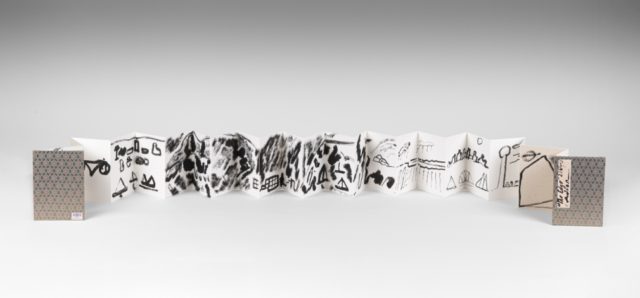
Etel Adnan, Erquy the Edge, India ink on booklet, 2021 (photo courtesy Galerie Lelong)

The gallery’s New York City and Paris locations are currently showing “Discovery of Immediacy,” on view in Chelsea through February 19. The exhibition consists of new black-and-white oil paintings and leporello, folded paper works. “The leporello is a journey,” Adnan told Obrist. “When you start a leporello, it’s like getting on a boat — you have a journey in front of you and that’s what’s beautiful. In the middle of a leporello you are afraid of making a mistake because you would have to throw everything away. You have to invest in the work and you have to keep a tension. It’s like composing music, [maintaining] a rhythm — that’s the work of the leporello, not to fall into a hole, to continue like when you are surfing, to hold the wave.” The colorful Guggenheim retrospective “Etel Adnan: Light’s New Measure,” which included color paintings and a bonus of several films, recently closed, but it is sure to come up as well as we all try to hold the wave.

THE HARE WITH AMBER EYES — EDMUND de WAAL AND E. RANDOL SCHOENBERG IN CONVERSATION

Edmund de Waal will talk about his book and accompanying exhibition in free, virtual Jewish Museum program (photo by Iwan Baan)

Who: Edmund de Waal, E. Randol Schoenberg
What: Live virtual discussion about book and exhibit
Where: JewishGen Talks online
When: Wednesday, February 9, free with advance RSVP (donations accepted), 2:00
Why: “It is not just things that carry stories with them. Stories are a kind of thing, too. Stories and objects share something, a patina,” Edmund de Waal writes in his 2010 memoir, The Hare with Amber Eyes: A Hidden Inheritance. When ceramicist de Waal inherited his family’s netsuke collection, consisting of hundreds of miniature objects, he did a deep dive into the history of the Ephrussi clan, turning it into a bestselling book. Now the story behind his family and the netsuke is on view at the Jewish Museum through May 15. The fabulous show features paintings, letters, photographs, personal documents, keepsakes, and several vitrines containing hundreds of tiny items made of wood, ivory, or bronze, ranging from mice, monkeys, fish, rats, and nuts to spirits, demon catchers, gods, masks, and bottles. A woman takes a bath. A boy exposes himself. A snake wraps around a lotus leaf. A sea woman suckles an octopus. An eji stretches.

“The Hare with Amber Eyes” is on view at the Jewish Museum through May 15 (photo by Iwan Baan)

On the audio guide, de Waal quotes from the prologue, “I want to know what the relationship has been between this wooden object that I am rolling between my fingers — hard and tricky and Japanese — and where it has been. I want to be able to reach to the handle of the door and turn it and feel it open. I want to walk into each room where this object has lived, to feel the volume of the space, to know what pictures were on the walls, how the light fell from the windows. And I want to know whose hands it has been in, and what they felt about it and thought about it — if they thought about it at all. I want to know what it has witnessed.”

On February 9 at 2:00, de Waal will discuss the book, his family history, and the exhibit with attorney, philanthropist, and genealogist E. Randol Schoenberg; the free, virtual event is sponsored by the Museum of Jewish Heritage — A Living Memorial to the Holocaust, the Jewish Museum, and the Leo Baeck Institute. You can check out an earlier Jewish Museum conversation between de Waal and Adam Gopnik, about de Waal’s 2021 book, Letters to Camondo, here.

COMPANY: KATRINA LENK, PATTI LuPONE & CHRIS HARPER

Who: Katrina Lenk, Patti LuPone, Chris Harper, Jessica Shaw
What: Virtual discussion about current Broadway revival of Company
Where: The Temple Emanu-El Streicker Center online
When: Thursday, February 10, free with advance RSVP, 12:30
Why: In my review of the current, controversial revival of Stephen Sondheim and George Furth’s beloved Company, I wrote, “Two-time Tony winner Marianne Elliott has reconceptualized Company in ways that go beyond mere gender switching and diverse casting; this Company emphasizes individuality, confinement, isolation, and fear through magnificent staging.” You can hear what some of the key participants have to say about the show when the Temple Emanu-El Streicker Center hosts a live, virtual discussion with Tony and Grammy winner Katrina Lenk (The Band’s Visit, Indecent), who plays Bobby, previously always portrayed as a man; two-time Tony and two-time Grammy winner Patti LuPone (Evita, Gypsy), who delivers the classic “Ladies Who Lunch”; and Olivier-winning producer Chris Harper (Elliott’s War Horse and The Curious Incident of the Dog in the Night-Time). SiriusXM’s Jessica Shaw will moderate the free talk.

DAVID BYRNE AND JOHN WILSON — HOW WE LEARNED ABOUT NON-RATIONAL LOGIC: A CONVERSATION ON HUMOR AND BOOKMAKING

John Wilson talks with David Byrne about his latest Pace show and new book on February 7

Who: David Byrne, John Wilson
What: Live virtual discussion
Where: Pace Gallery, 540 West Twenty-Fifth St., Pace Gallery YouTube
When: Monday, February 7, free (online), 7:00
Why: In his endlessly creative and fun HBO docuseries How To with John Wilson, Astoria native John Wilson uses footage shot all around New York City to delve into such issues as small talk, scaffolding, memory improvement, finding a parking spot, and making the perfect risotto. In his endlessly creative and fun career, British-born musician, singer, playwright, and visual artist David Byrne has made albums (solo and with Talking Heads), given concerts, directed films, and had gallery shows; currently, his brilliant American Utopia continues on Broadway at the St. James Theatre through April 3, and his latest exhibition, “How I Learned About Non-Rational Logic,” is running at Pace’s Twenty-Fifth St. space through March 19. The show consists of several series of drawings Byrne has done over the last twenty years, including his unusual depictions of dingbats sketched during the pandemic. (He describes his fascination with dingbats here.)

Byrne and Wilson have previously collaborated on the 2015 true crime concert documentary Temporary Color; they now will sit down together for a discussion at Pace in conjunction with the publication of Byrne’s new book, A History of the World (in Dingbats) (Phaidon, March 9, $39.95). “How We Learned About Non-Rational Logic: A Conversation on Humor and Bookmaking” takes place in person at Pace, where attendees will receive a signed copy of the book; the event will also be streamed for free over YouTube. “This idea of non-rational logic was not something I made up, but I realized that it kind of resonated with both the fact that I make music and the fact that these drawings follow a kind of logic that isn’t kind of based on logical or rational thinking,” Byrne notes in the above behind-the-scenes video. There should be plenty of such non-rational logic in what promises to be a very funny and illuminating talk.

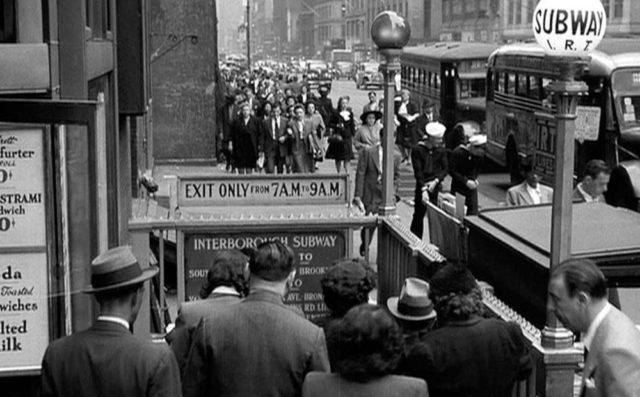
NYC’S MOVIE RENAISSANCE 1945 – 1955

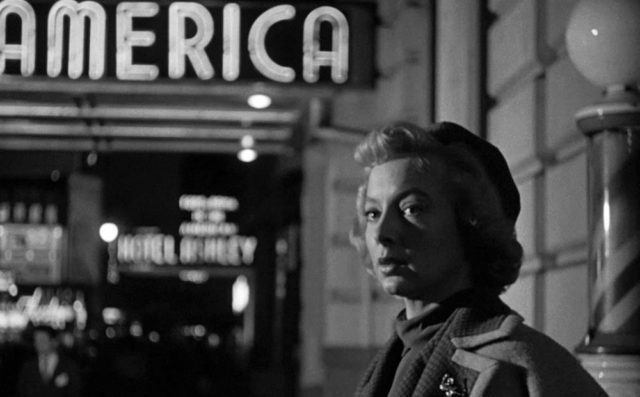
New Yorkers should be flocking to see The Naked City and other Big Apple flicks at Film Forum

NYC’S MOVIE RENAISSANCE 1945 – 1955
Film Forum
209 West Houston St.
Through February 10
212-727-8110
filmforum.org

In his July 2021 book “Keep ’Em in the East”: Kazan, Kubrick, and the Postwar New York Renaissance (Columbia University Press, $40), film historian Richard Koszarski details how New York City came to be a haven for making movies. “Fiorello La Guardia was the first New York mayor to realize the full significance of the motion picture industry to the city’s economic well-being. The few hundred jobs directly at stake in the late 1930s were not unimportant, but ever since the turn of the century, the movies — along with broadcasting and publishing — had also been doing something else for New Yorkers. Where the twentieth century had begun with a range of great American cities competing for world and national attention, it was now clear that modern America was no longer so flat a landscape. Now there was New York — and all those other places. Pittsburgh, Chicago, and San Francisco were all great cities, but New York was the city.”

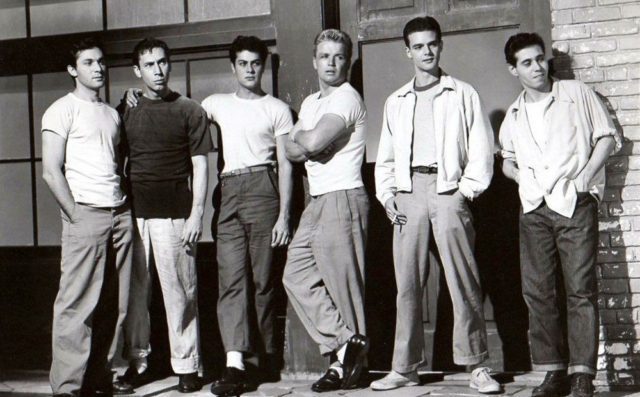
Tony Curtis and Richard Jaeckel are two of the toughies in Maxwell Shane’s City Across the River

New York City native Koszarski will be at Film Forum to talk about a few of the films in “NYC’s Movie Renaissance 1945 – 1955,” a two-week series consisting of two dozen flicks that take place in and around Gotham, released in the ten years beginning around the end of WWII. The diverse selection ranges from noir and romcoms to musicals and courtroom dramas, psychological studies and cop stories with car chases. Among the many stars you’ll encounter are Joseph Cotten, Jennifer Jones, Marlon Brando, Eva Marie Sainte, Richard Conte, Judy Holliday, Ray Milland, Jane Wyman, Jack Lemmon, Tony Curtis, Coleen Gray, Richard Widmark, Thelma Ritter, Dana Andrews, Jane Wyatt, Frank Sinatra, Ann Miller, Vittorio Gassman, Gloria Grahame, John Garfield, Moms Mabely, and Victor Mature.

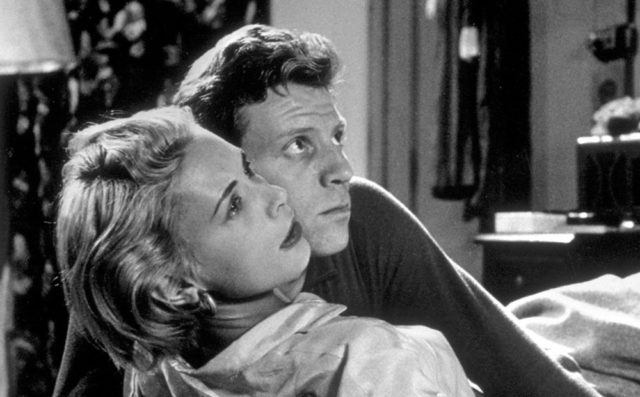
Earl McEvoy’s The Killer That Stalked New York is among the many surprises in Film Forum series

Familiar classics such as Abraham Polonsky’s Force of Evil, Henry Hathaway’s The House on 92nd St. and Kiss of Death, Billy Wilder’s The Lost Weekend, Gene Kelly and Stanley Donen’s On the Town, and William Dieterle’s Portrait of Jennie are joined by such lesser-known works as George Cukor’s The Marrying Kind, Maxwell Shane’s City Across the River, Earl McEvoy’s The Killer That Stalked New York, Maxwell Shane’s City Across the River, Josh Binney’s Boardinghouse Blues, cinematographer extraordinaire Ted Tetzlaff’s The Window, and Bernard Vorhaus’s incarcerated women tale So Young, So Bad with Rita Moreno and Anne Francis.

Stanley Kubrick’s Killer’s Kiss is part of Film Forum series about the renaissance of NYC-set flicks

Koszarski writes about Fletcher Markle’s Jigsaw, “Interesting suggestions of widespread corruption involving the mafia, right wing vigilantes, and political power brokers who operate out of Manhattan penthouses. . . . Most of the cast consisted of unfamiliar New York faces, but Markle and [Franchot] Tone did convince quite a few of their friends to pop up in oddball cameos.” And he explains about Morris Engel, Ruth Orkin, and Ray Ashley’s absolute gem Little Fugitive, in which a young boy goes on a Coney Island adventure, its “simplicity was itself a great part of its appeal: no pointed moral, no dramatic character arc, no allegorical references to corruption, intolerance, World War II, or nuclear disarmament. Instead the audience is led on by the film’s uncanny sense of observation — not just in terms of photographic imagery but in the way ordinary New Yorkers relate to one another, solve their little problems, and go about the mundane details of their everyday lives.”

Moms Mabely stars in Josh Binney’s Boardinghouse Blues

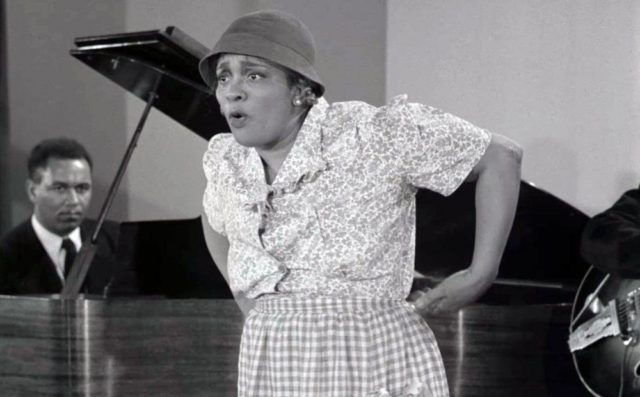
Koszarski will introduce Joseph Lerner’s awesomely titled Guilty Bystander, featuring Zachary Scott as an ex-cop house detective, on February 2 at 6:40. Master Film Forum programmer Bruce Goldstein will introduce Jules Dassin’s genre-defining The Naked City on February 5 at 7:50, accompanied by his short personal documentary, Uncovering The Naked City, and Susan Delson, author of Soundies and the Changing Image of Black Americans on Screen: One Dime at a Time (Indiana University Press, December 2021, $35-$85), will present “Soundies: America for a Dime” on February 10 at 6:50, focusing on “movie jukebox” clips from Duke Ellington, Nat “King” Cole, Dorothy Dandridge, Fats Waller, Sister Rosetta Tharpe, and others.

HENRIK LUNDQVIST’S RETIREMENT NIGHT

Hulu Theater at Madison Square Garden
31st – 33rd Sts. between Seventh & Eighth Aves.
Friday, January 28, $30-$60, 6:30
www.nhl.com

Ed Giacomin (1), Brian Leetch (2), Harry Howell (3), Rod Gilbert (7), Adam Graves (9), Andy Bathgate (9), Mark Messier (11), Vic Hadfield (11), Jean Ratelle (19), Mike Richter (35). Since their inception in 1926, the New York Rangers, founded by Tex Rickard, have retired the jerseys of ten star players. They turn it up to eleven on Friday night when the number 30 worn by goaltender extraordinaire Henrik Lundqvist from 2005 to 2020 gets raised to the rafters.

Over the course of fifteen seasons, King Henrik amassed a regular season record of 459-310-96, with a 2.43 GA average and a save percentage of .918. The five-time all-star and five-time Vezina finalist — he won the coveted trophy in 2012 — took home a gold medal manning the pipes for Sweden at the 2006 Turin Olympics and led the Broadway Blueshirts to the Stanley Cup finals in 2014. The Rangers let Lundqvist go after the 2019-20 season, but before he could play a game with the Washington Capitals, who signed him to a one-year deal, he had to hang up the skates because of pericarditis that required open-heart surgery, forcing him to retire at the age of thirty-nine.

Henrik Lundqvist will be cheered yet again when his jersey is raised to the Garden rafters on January 28

Tickets are still available for the Rangers’ battle against the Minnesota Wild on January 28, but they currently start at a mere $350. So a better option might be spending thirty bucks and joining in the fun at a retirement watch party with Rangers alums at the Hulu Theater at Madison Square Garden. Tex’s Rangers are on a roll this year, with 60 points in 43 games, while the Wild is enjoying a hot first half as well, with 53 points in 38 games, so it should be quite a game. It all gets going around 6:30, when a parade of Rangers greats will pay homage to the King, a fashion plate who is likely to look hotter than ever on the Garden ice. In conjunction with the special event, you can post your own Lundqvist story here and check out a month of Henrik highlights here. Net proceeds from the watch party will be split between the Garden of Dreams Foundation and the Henrik Lundqvist Foundation.

CAMERA MAN: DANA STEVENS ON BUSTER KEATON

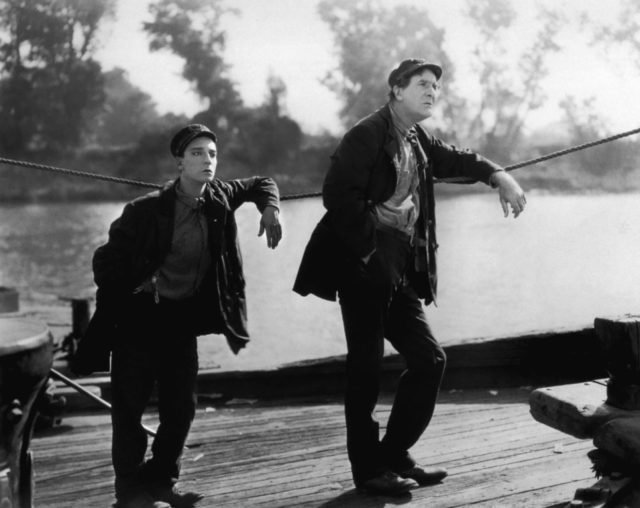
Bill Jr. (Buster Keaton) mimics his father, Bill Campbell (Ernest Torrence), in silent film classic

Who: Dana Stevens, Imogen Sara Smith
What: Screening and discussion about Buster Keaton
Where: Film at Lincoln Center, Elinor Bunin Munroe Film Center, Francesca Beale Theater, 144 West Sixty-Fifth St.
When: Thursday, January 27, $15, 7:00
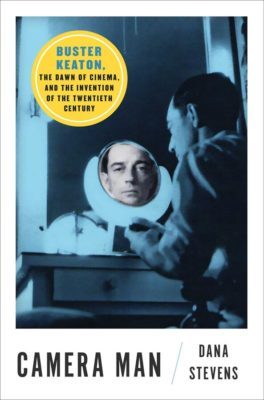
Why:Steamboat Bill, Jr. may be [Buster] Keaton’s most mature film, a fitting if too-early farewell to his period of peak creative independence,” Slate film critic Dana Stevens writes. “Its relationship to the rest of its creator’s work has been compared to that of Shakespeare’s last play, The Tempest.” Stevens gets serious about the Great Stone Face, one of silent film’s best comics, in her brand-new book, Camera Man: Buster Keaton, the Dawn of Cinema, and the Invention of the Twentieth Century (Atria, $29.99).

In celebration of the launch of the tome, Stevens will be at Lincoln Center’s Francesca Beale Theater on January 27 at 7:00 to screen a 4K restoration of the 1928 classic, directed by Charles Reisner, about a riverboat battle and true love, preceded by a 2K restoration of Keaton and Edward F. Cline’s twenty-five-minute masterpiece, One Week, about a pair of newlyweds (Keaton and Sybil Seely) and their unusual new home. (Both films feature orchestral scores by American composer Carl Davis.) Stevens will put Keaton’s life and work in sociocultural context with Criterion contributor Imogen Sara Smith, author of Buster Keaton: The Persistence of Comedy. If you’ve never seen Keaton on the big screen, now is the time, as no one could turn tragedy into comedy quite like Keaton.