this week in lectures, signings, panel discussions, workshops, and Q&As

JOHN EARLY SELECTS: MAPS TO THE STARS

MAPS TO THE STARS

Jerome Fontana (Robert Pattinson) and Agatha Weiss (Mia Wasikowska) look to the Hollywood hills in Maps to the Stars

MAPS TO THE STARS (David Cronenberg, 2014)
Metrograph
7 Ludlow St. between Canal & Hester Sts.
Wednesday, March 9, 4:45 and 7:15
Metrograph at Home, March 12-14
www.focusfeatures.com
nyc.metrograph.com

Actor and comedian John Early’s latest selection for Metrograph is an underrated gem. Canadian filmmaker David Cronenberg and American novelist and screenwriter Bruce Wagner, a match made in Hollywood Babylon, paint a savage portrait of celebrity culture in the absolutely incendiary and off-the-charts satire Maps to the Stars. The darkly funny comic drama centers on Agatha Weiss (Mia Wasikowska), a young woman who returns to Hollywood after having been put away for a long time for a dangerous deed, her face and body marked by burns. Befriending limo driver Jerome Fontana (Robert Pattinson), who is an aspiring actor and writer, Agatha gets a job working for disgruntled actress Havana Segrand (Julianne Moore), who is desperate to star in the remake of Stolen Moments, playing the role that made her mother, Clarice Taggart (Sarah Gadon), famous, but Havana fears that according to Hollywood she is much too old. Havana undergoes regular intense physical and psychological therapy to deal with her mommy issues with television healer Stafford Weiss (John Cusack), Agatha’s father, who has banished his daughter from ever contacting the family again. Meanwhile, Agatha’s younger brother, thirteen-year-old child star Benjie Weiss (Evan Bird), is a Bieberesque character fresh out of rehab who is negotiating the sequel to his massive hit, Bad Babysitter, with his very serious stage mom, Cristina (Olivia Williams). Slowly but surely, everyone’s lives intersect in a riot of fame and misfortune, drugs and guns, ghosts and incest.

Julianne Moore

Havana Segrand (Julianne Moore) screams for success in dazzling collaboration between David Cronenberg and Bruce Wagner

Cronenberg, who has made such cult favorites as Scanners, The Fly, Naked Lunch, and A History of Violence, and the L.A.-based Wagner, author of such stinging novels as I’ll Let You Go, Still Holding, The Empty Chair, and I’m Losing You, which he also turned into a film, leave nothing and no one unscathed in this thoroughly brutal depiction of Hollywood as a haunted La La Land of dreams and nightmares, both literally and figuratively. Rising star Wasikowska (Alice in Wonderland, In Treatment, Jane Eyre) is superb as Agatha, her inner and outer scars revealing more and more of themselves as she reinserts herself into the life of her crazy family, with Cusack channeling a bit of Nicolas Cage as the overprotective patriarch, a self-help guru who could use a little help himself. Moore was named Best Actress at Cannes for her harrowing portrayal of an actress teetering on the edge of reality.

Shooting for the first time ever in the United States, Cronenberg captures the sights and smells of Los Angeles and its environs; most of the film was shot in Canada, however, but Cronenberg kept Wagner, a former Hollywood limo driver himself, close by, trying to attain as much authenticity as possible. Twilight hunk Pattinson, who spent all of Cronenberg’s previous movie, Cosmopolis, in the back of a limo, gets in the driver’s seat here, playing an alternate, reimagined version of Wagner. The severely screwed-up Weiss family serves as a microcosm for Hollywood’s own severely screwed-up dysfunction, as Cronenberg melds the ridiculous with the sublime, the tragic with the comic, the bizarre with the, well, more bizarre, creating a modern-day fairy-tale mashup of Shakespeare and Williams, Sunset Boulevard and Less than Zero, a caustic, cautionary tale of the price you pay for getting what you wish for. Maps to the Stars, with an introduction by Early (Search Party, The Afterparty), is screening March 9 at 4:45 and 7:15 at Metrograph, then will be streaming March 12-14 as part of Metrograph at Home.

CELEBRATING MOLIÈRE’S 400th BIRTHDAY

Who: Lisa Gorlitsky, Margaret Ivey, Postell Pringle, Adam Gopnik, Erica Schmidt, Comédie-Française
What: Celebration of Molière’s quadricentennial
Where: FIAF, Florence Gould Hall and Skyroom, 55 East 59th St. between Madison & Park Aves.
When: March 10-12, 24, 30, $20-$45 (three-event package $75)
Why: Jean-Baptiste Poquelin was born into a bourgeois family in early 1622 in Paris. Nicknamed “le Nez” because of his relatively large proboscis, he eventually became better known as poet, playwright, and actor Molière. In celebration of the four hundredth anniversary of his birth, the French Institute Alliance Française is hosting a trio of special events. Taking place March 10-12 at 7:30 ($45) at FIAF’s Florence Gould Hall, “Molière Turns 400: 17th Century Paris Meets 21st Century New York” consists of staged excerpts, complete with sets, costumes, and live music, from The Misanthrope, The School for Wives, and Tartuffe, with Lisa Gorlitsky, Margaret Ivey, and Postell Pringle and directed by Lucie Tiberghien, the founding artistic director of Molière in the Park, which performed livestreamed adaptations of all three works during the pandemic lockdown. The March 10 presentation will be followed by a reception.

Ivo van Hove’s adaptation of Molière’s uncensored Tartuffe screens at FIAF March 24

On March 24 at 7:00 ($25), New Yorker staff writer Adam Gopnik and director Erica Schmidt will be at the FIAF Skyroom for the talk “Modernizing Molière,” available in person and via livestream. Gopnik contributed the foreword to Molière: The Complete Richard Wilbur Translations, while Schmidt directed Molière’s The Imaginary Invalid at Bard SummerScape in 2012, starring her husband, Peter Dinklage. The fête concludes March 30 at 7:00 ($35) in Florence Gould Hall with a screening of Molière’s uncensored Tartuffe or the Hypocrite by Comédie-Française, directed by Ivo van Hove from the original script, which was censored by Louis XIV in 1664; the filmed version stars Christophe Montenez and features a score by Oscar-winning composer Alexandre Desplat.

SARA MEARNS: PIECE OF WORK

SARA MEARNS: PIECE OF WORK
Joyce Theater
175 Eighth Ave. at 19th St.
March 8-13, $10-$71
212-645-2904
www.joyce.org
saramearns.com

During the pandemic lockdown, I covered more than a thousand online events created since March 2020. I had many favorite performers over those nearly two years, from actress Kathleen Chalfant and musician Richard Thompson to Arlekin Players Theatre and White Snake Projects to dancer-choreographer Jamar Roberts and Stars in the House hosts Seth Rudetsky and James Wesley. You can check out them and other stalwarts in twi-ny’s three-part Pandemic Awards.

But for me no one stood out like Sara Mearns. The extraordinary New York City Ballet principal dancer expanded her horizons in a series of breathtaking performances, including her Le Cygne (The Swan) variation for Swans for Relief, the Works & Process commission Storm, Lee Mingwei and Bill T. Jones’s durational Our Labyrinth at the Metropolitan Museum of Art, Justin Peck’s Thank You, New York for the New York City Ballet New Works Festival, Christopher Wheeldon’s The Two of Us for Fall for Dance, L.A. Dance Project’s Sonata for Saras (Mearns as her own trio!), Henry Joost and Ariel Schulman’s Another Dance Film shot at the East River Park Amphitheater, and Molissa Fenley’s State of Darkness solo onstage at the Joyce.

Austin Goodwin’s carefully is part of Sara Mearns program at the Joyce (photo by Drew Dawson)

But in October 2021, Mearns had to take a break to deal with a personal issue she eventually discussed on social media several months later: She was diagnosed with depression and extreme burnout and was getting help from a sports psychologist. “This is never something I saw happening to me,” she wrote on Instagram. “I thought I was invincible, that maybe I was just tired, that maybe it’s just a phase, and to get over it. I’m here to tell you it’s a very real thing,”

From March 8 to 13, Mearns will return to performing, and to the Joyce, with her own program, “Piece of Work,” a kind of coming-out, coming-back party in which she will perform with eight dancers in works by six choreographers, including five world or NYC premieres created specifically for Mearns. “I have been lucky enough to perform in the biggest houses in the world, doing grand productions, pouring my heart out. It’s what comes naturally to me. It doesn’t feel like a risk,” she explains in a program note. “Three years ago, I decided it was time to go a different route, a route that was vulnerable for me artistically and that would be the biggest challenge for me thus far in my career. . . . I would like to say that I curated this evening, but the truth is, New York did. It will be raw, honest, and at times messy.”

The evening begins with Jodi Melnick’s Opulence, a duet with Melnick commissioned for the 2019 Jacob’s Pillow Dance Festival, with music by drummer Kid Millions and guitarist Zach Lehrhoff. Choreographer and director Austin Goodwin’s film carefully pairs Mearns with Paul Zivkovich inside an empty house. Mearns teams with Vinson Fraley Jr. in Fraley’s On the Margins, set to an original score by Rahm Silverglade for violin, electronics, guitar, and sax.

Following intermission, Mearns will perform with Melnick, Taylor Stanley, Jaquelin Harris, Chalvar Monteiro, and Burr Johnson in a special JoycEvent, excerpts from “Night of 100 Solos: A Centennial Event” and other works by Merce Cunningham, arranged and staged here by Rashaun Mitchell and Silas Riener, featuring live music by John King. Beth Gill’s SSSara is a solo for Mearns with music by Ryan Seaton. The night concludes with Guillaume Côté’s Spir, a duet with the Canadian dancer and choreographer set to German pianist, producer, and composer Nils Frahm’s “Corn” and Woodkid and Frahm’s “Winter Morning I.” In between each piece will be audio interludes directed and edited by Ezra Hurwitz.

Mearns also wrote on Instagram, “This show has been thru so many lives, revisions, faces, versions, and I wouldn’t take any of it back. A big influence was the pandemic; it gave me a clear path of what I wanted this show to be about. I’m not the same person or artist I was before the pandemic, and I wanted the evening to reflect that & acknowledge it. How art, specifically dance, is created in New York; what artists go thru in New York is unlike anywhere else in the world.” Mearns will talk about that and more in a curtain chat at the March 9 show.

SACRED SCREENS AND SCROLLS: DECODING BUDDHIST SYMBOLS IN SHIKŌ MUNAKATA’S PRINTS

D. Max Moerman will lead a virtual walkthrough of Japan Society exhibition on March 8

Who: D. Max Moerman, Ramona Handel-Bajema, PhD
What: Virtual discussion and walkthrough of “Shikō Munakata: A Way of Seeing,” on view at Japan Society through March 20
Where: Japan Society YouTube
When: Tuesday, March 8, free with RSVP (suggested donation $5-$20), 6:00
Why: On March 8 at 6:00, Barnard College professor and Columbia University Seminar in Buddhist Studies cochair D. Max Moerman will give the online lecture “Sacred Screens and Scrolls: Decoding Buddhist Symbols in Shikō Munakata’s Prints,” a deep dive into the current Japan Society exhibition “Shikō Munakata: A Way of Seeing.” Joined in conversation by Japan Society chief program officer Ramona Handel-Bajema, PhD, Moerman will walk through the show, which features nearly one hundred works by Munakata (1903-75), comprising woodblock prints, calligraphy, sumi ink paintings, watercolors, lithography, and ceramics.

“How does the artist breathe life into his work? By summoning the spirit of the art that lives inside him. . . . Power comes from the artist’s spirit, warmth from his tenderness, and serenity from his prayers,” Munakata explained in Hanga no Hanashi in 1954. Five years later, he came to New York City as a fellow in Japan Society’s Print Artists Program; several of the pieces he created for the institution are also part of the show. Moerman will focus on religious aspects of Munakata’s work, including the six-panel screen Eulogy to Shōkei and the twelve-set hanging scrolls The Ten Great Disciples of Buddha. The exhibit, which will have extended days and hours because of its popularity, also is highlighted by the newly rediscovered Tōkaidō Series from 1964, arranged at Japan Society to evoke the coastal road between Kyoto and Tokyo.

RED BULL THEATER CELEBRATES MARGARET CAVENDISH

Who: Red Bull Theater company
What: Livestreamed Zoom conversation, benefit reading, and Bull Session surrounding Margaret Cavendish’s The Convent of Pleasure
Where: Red Bull Theater website, Facebook Live, and YouTube
When: Conversation Monday, March 7, suggested donation $25, 7:30; benefit reading Monday, March 14, suggested donation $25, 7:30; Bull Session Thursday, March 17, free on YouTube with live chat, 7:30
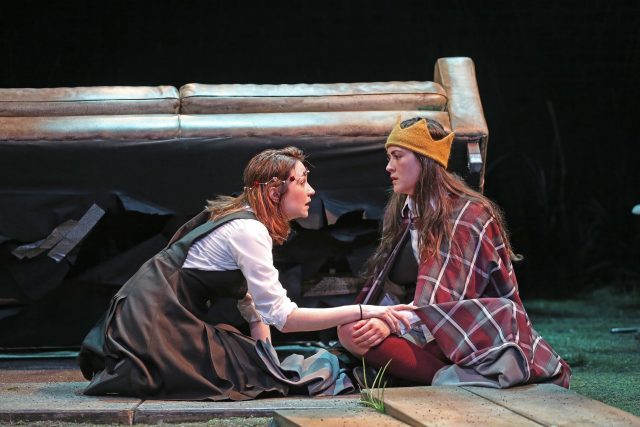
Why: “Nature is material, or corporeal, and so are all her Creatures, and whatsoever is not material is no part of Nature, neither doth it belong any ways to Nature,” wrote duchess of Newcastle-upon-Tyne and polymath Lady Margaret Lucas Cavendish. Red Bull Theater is turning to the seventeenth-century poet, philosopher, aristocrat, scientist, fiction author, and playwright for Women’s History Month, presenting an online reading and discussions about her 1668 comedy, The Convent of Pleasure. The play, a closet drama not intended to be performed onstage and dealing with women who believe they can live a fulfilling life without men, features wealthy noblewoman Lady Happy, her friend the widow Madam Mediator, the anti-convent Monsieur Take-Pleasure, the married Lady Amorous and Lady Vertue, Mimick the fool, and a cross-dressing prince/princess suitor.

Lady Margaret Cavendish’s The Convent of Pleasure will be explored extensively by Red Bull

“Let me tell you, that Riches ought to be bestowed on such as are poor, and want means to maintain themselves; and Youth, on those that are old; Beauty, on those that are ill-favoured; and Virtue, on those that are vicious: So that if I should place my gifts rightly, I must Marry one that’s poor, old, ill-favoured, and debauch’d,” Lady Happy says early in the play. “Put the case I should Marry the best of Men, if any best there be; yet would a Marry’d life have more crosses and sorrows then pleasure, freedom, or hapiness: nay Marriage to those that are virtuous is a greater restraint then a Monastery. Or, should I take delight in Admirers? they might gaze on my Beauty, and praise my Wit, and I receive nothing from their eyes, nor lips; for Words vanish as soon as spoken, and Sights are not substantial. Besides, I should lose more of my Reputation by their Visits, then gain by their Praises. Or, should I quit Reputation and turn Courtizan, there would be more lost in my Health, then gained by my Lovers, I should find more pain then Pleasure; besides, the troubles and frights I should be put to, with the Quarrels and Brouilleries that Jealous Rivals make, would be a torment to me; and ’tis only for the sake of Men, when Women retire not: And since there is so much folly, vanity and falshood in Men, why should Women trouble and vex themselves for their sake; for retiredness bars the life from nothing else but Men.”

On March 7, Red Bull will host the Zoom discussion “The Closet or the Stage? A Conversation about Margaret Cavendish’s The Convent of Pleasure,” with University of Tennessee professor and author Misty G. Anderson; University of Toronto associate professor Liza Blake, editor of Margaret Cavendish’s Poems and Fancies: A Digital Critical Edition; Columbia University professor Julie Crawford, author of the upcoming Margaret Cavendish’s Political Career; and Carnegie Mellon professor emeritus, curator, and author Kristina Straub.

The reading, directed by Kim Weild (American Moor, Paradise Now), will be held the following Monday at 7:30, in association with the R/18 Collective, which “believes the theatrical repertoire from the 1660s to the 1830s provides insights into the deep histories of race, gender, sexuality, ability, nation, and capital that continue to shape anglophone culture and the world.” The cast includes Heidi Armbruster, Becca Ayers, Talley Gale, Cloteal Horne, Rami Margron, Anthony Michael Martinez, Maria-Christina Oliveras, and Josh Tyson. And then, on March 17, a free Bull Session with Weild, cast members, and scholars will take place on YouTube, with a live chat.

THE 35th ANNUAL TIBET HOUSE US BENEFIT CONCERT

Who: Philip Glass, Keanu Reeves, Trey Anastasio, Patti Smith, Laurie Anderson, Cyndi Lauper, Gogol Bordello, Nathaniel Rateliff, Jason Isbell and the 400 Unit, Angélique Kidjo, Margo Price, Punch Brothers, the Fiery Furnaces, Jesse Paris Smith, Tenzin Choegyal, Rubin Kodheli, Camerata — Queensland’s Chamber Orchestra, the Scorchio Quartet, Paul Simon, Stephen Colbert, Iggy Pop, Bernard Sumner
What: Annual benefit concert for Tibet House US
Where: Mandolin streaming platform
When: Thursday, March 3, $25-$250, 8:00
Why: The annual Tibet House US benefit fundraiser always features a wide-ranging group of special guests, gathering under the leadership of artistic director Philip Glass. The thirty-fifth annual event is no exception, with the added celebration of Glass’s eighty-fifth birthday. This year’s performers will once again be streaming in live and prerecorded from around the world instead of joining together at Carnegie Hall. The roster includes Glass, Trey Anastasio, Patti Smith, Laurie Anderson, Cyndi Lauper, Gogol Bordello, Jason Isbell and the 400 Unit, Angélique Kidjo, Punch Brothers, the Fiery Furnaces, and others as well as greetings from the Scorchio Quartet, Paul Simon, Stephen Colbert, Iggy Pop, and Bernard Sumner.

All proceeds benefit Tibet House US, “a nonprofit educational institution and cultural embassy that was founded at the request of His Holiness the Dalai Lama, who at the inauguration in 1987 stated his wish for a long-term cultural institution to ensure the survival of Tibetan civilization and culture, whatever the political destiny of the six million people of Tibet itself.” Tickets start at $25, with additions of a Katak blessing scarf, limited edition benefit poster, event T-shirt, mala beads, and more at higher levels.

BODYTRAFFIC

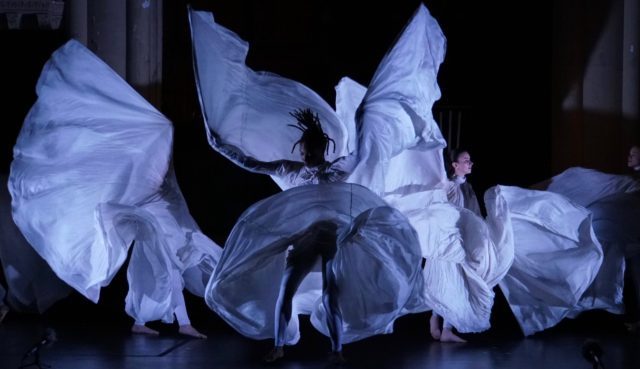
Micaela Taylor’s SNAP is part of BODYTRAFFIC program at the Joyce

BODYTRAFFIC
Joyce Theater
175 Eighth Ave. at 19th St.
March 1-6, $41-$61
212-645-2904
www.joyce.org
bodytraffic.com

“There’s nothing quite like coming home,” BODYTRAFFIC artistic director Tina Finkelman Berkett writes in a program note about the LA company’s upcoming presentation at the Joyce. “Growing up in NYC, I dreamt of performing on the Joyce stage, and each time our company returns is incredibly meaningful.”

Finkelman Berkett used the pandemic lockdown to reimagine the troupe, which she founded in 2007 with Lillian Barbeito, and the results can be seen March 1-6. The show begins with the world premiere of Baya & Asa’s The One to Stay With, which takes on corporate greed; the cast consists of associate artistic director Guzmán Rosado, Joan Rodriguez, Katie Garcia, Pedro Garcia, Whitney Schmanski, Jordyn Santago, Tiare Keeno, and dance captain Ty Morrison, with music by Tchaikovsky, Russian Brass Brand, and Béla Bartók.

Following a set change, Finkelman Berkett truly returns to the Joyce stage with the New York premiere of Fernando Hernando Magadan’s (d)elusive minds, a duet she will perform with Rosado, set to Schubert’s Trio Pour Piano, Violon Et Violoncelle En Mi Bemol, Op. 100. It was inspired by Dora Garcia’s “All the Stories” and the true story of a man with Capgras syndrome who killed his wife, thinking she was a duplicate, and spent fifteen years in an institution believing his real wife was still alive, writing to her every day. Magadan’s scenic design includes a near-semicircle of paper along with a chair and a typewriter.

After intermission, TL Collective artistic director and former BODYTRAFFIC dancer Micaela Taylor’s SNAP will make its New York premiere, with Alana Jones, Joseph Davis, Katie Garcia, Santiago, Keeno, Rodriguez, and Morrison moving and grooving to James Brown, with original music by Shockey and costumes by Kristina Marie Garnett. The piece is meant to snap people out of their complacency while celebrating the diversity of Los Angeles.

The evening concludes with Alejandro Cerrudo’s PACOPEPEPLUTO, a work for three male soloists originally choreographed for Hubbard Street Chicago in 2011, with Rodriguez, Pedro Garcia, and Rosado or Davis hoofing it to Dean Martin’s “In the Chapel in the Moonlight,” “Memories Are Made of This,” and “That’s Amoré.” In addition, there will be a curtain chat on March 2.