Who: Harambee Dance Company, Jason Reynolds, Roxane Gay, Roger Reeves, Jennifer Mack Watkins, Akwaeke Emezi, A. J. Verdelle, Linda Villarosa, Jacqueline Woodson, more What:Schomburg Literary Festival Where:Schomburg Center for Research in Black Culture, 515 Malcolm X Blvd. at 135th St. When: Saturday, June 18, 10:30 am – 5:00 pm, free Why: The fourth annual Schomburg Literary Festival takes place on Saturday, June 18, with poetry readings, live music, workshops, discussions, book signings, and more on Malcolm X Blvd. Among the highlights are appearances by Jason Reynolds, Roxane Gay, Jennifer Mack Watkins, and Jacqueline Woodson. Below is the full schedule; all events are free. In addition, the Marketplace features booths from the Center for Fiction, the Reading Team, Subsume, Harlem Writers Guild, Total Equity Now, Countee Cullen Library, New York Urban League, and others.
Woke Baby! Festival, with Theo Gangi, Cathy Linh Che, Max Michael Jacob, Soré Agbaje, Stephanie Pachecho, Miah Prescod, Oluwatoyin Kupoluyi, Ayonnah Sullivan, and Jasmine Dabney, curated and hosted by Mahogany L. Browne, Adam Clayton Powell Jr. Stage, 10:30
Reading, an Act of Rebellion and Joy, procession and discussion with Harambee Dance Company, Jason Reynolds, and Roxane Gay, Langston Hughes Auditorium, Schomburg Center for Research in Black Culture, 11:00
Workshop: The Art of Creating Historical Fiction, facilitated by Minnette Coleman, American Negro Theatre, 12:00
Poetry for Our Time, with Kemi Alabi, Zora Neale Hurston Stage, 12:15
Mateo Askaripour, with moderator Rahshib Thomas, Aaron Douglas Reading Room, 12:30
Health and Racism in America, with Linda Villarosa, moderated by Rebecca Carroll, Langston Hughes Auditorium, 12:45
Poetry for Our Time, with Akwaeke Emezi, Zora Neale Hurston Stage, 12:45
Literary Monuments, Friendship, and Toni Morrison, with A. J. Verdelle, moderated by Tiphanie Yanique, Adam Clayton Powell Jr. Stage, 1:00
Elevator Repair Service will celebrate the hundredth anniversary of Ulysses at Symphony Space on June 16
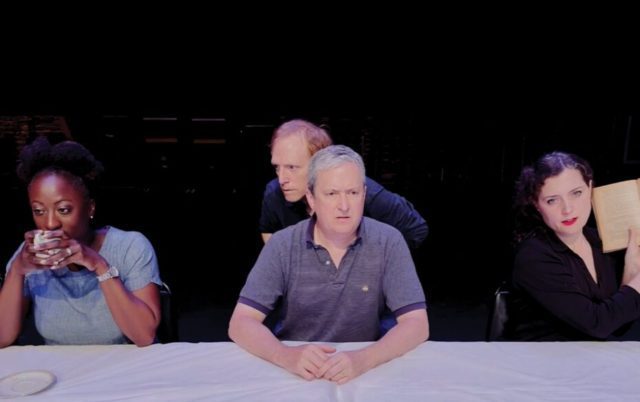
Who:Elevator Repair Service What:Bloomsday on Broadway Where:Symphony Space, Peter Jay Sharp Theatre, 2537 Broadway at Ninety-Fifth St. When: Thursday, June 16, $17-$28, 8:00 Why: Last year, walking on the Lower East Side, I bumped into Scott Shepherd, longtime member of Elevator Repair Service (ERS), which has been presenting unique, experimental theatrical works since 1991. I asked him what he was up to and he said, “Just wait to see what we’re doing for Bloomsday at Symphony Space.” That day has arrived. On June 16, in honor of the centennial of the publication of James Joyce’s masterpiece, Ulysses, ERS will be doing something different at Symphony Space, which has been celebrating the novel for decades by having all-star marathon lineups reading the book on June 16, the day in 1904 in which the story takes place.
Helmed by ERS artistic director John Collins, the two-hour presentation features ERS ensemble members Shepherd, Dee Beasnael, Kate Benson, Maggie Hoffman, Vin Knight, Christopher-Rashee Stevenson, and Stephanie Weeks performing excerpts from each of the book’s eighteen episodes, bringing the tale to life as only ERS can. ERS has previously brought its unpredictable style to F. Scott Fitzgerald’s The Great Gatsby (the eight-hour Gatz), William Faulkner’s The Sound and the Fury, and Ernest Hemingway’s The Sun Also Rises (The Select). The set design is by dots, with costumes by Enver Chakartash, lighting by Mark Barton, sound by Ben Williams, and props by Patricia Marjorie. It all begins with “Stately, plump Buck Mulligan came from the stairhead, bearing a bowl of lather on which a mirror and a razor lay crossed.” For more on the centenary of the novel, be sure to head over to the Morgan Library to see the new exhibit “One Hundred Years of James Joyce’s Ulysses.”
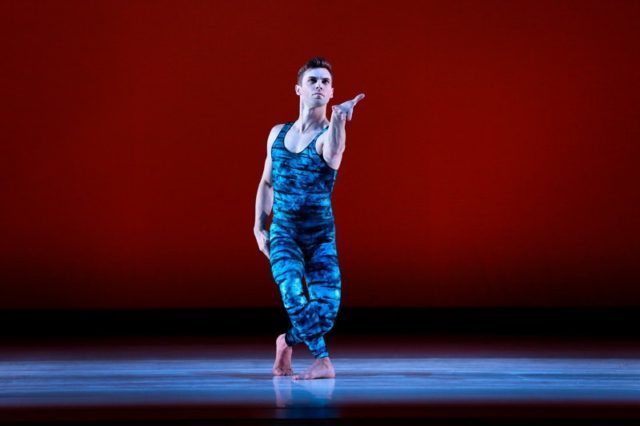
PTDC artistic director Michael Novak is deep in thought during rehearsal for Joyce season (photo by Whitney Browne)
PAUL TAYLOR DANCE COMPANY
Joyce Theater
175 Eighth Ave. at 19th St.
June 14-19, $71-$91 (Curtain Chat follows June 15 show)
212-645-2904 www.joyce.org paultaylordance.org
Growing up in a Chicago suburb, Michael Novak initially tried his hand at sports, but when that didn’t go very well he soon found his muse in musical theater and dance, as both a performer and a disciplined student. Dance became a form of expression that helped him through a severe speech impediment when he was twelve.
He was an artistic associate at the Columbia Ballet Collaborative at Columbia University, where he performed Paul Taylor’s solo from Aureole and graduated magna cum laude and Phi Beta Kappa in 2008. He made his debut with Paul Taylor Dance Company in 2010-11 — Taylor created thirteen roles on him — and, on July 1, 2018, was named the artistic director designate.
At the time, Taylor announced, “I know that Michael is the right person to lead my company in the future. I look forward to working with him to continue my vision.” However, Taylor died that August at the age of eighty-eight, leaving Novak to take on his mentor’s legacy.
Having guided PTDC through a two-year pandemic lockdown, Novak is now ready to present three special programs at the Joyce, running June 14-19, offering something different from the company’s usual seasons at City Center. The schedule consists of Taylor’s Events II (1957), Images and Reflections (excerpt; 1958), Fibers (1960), Aureole (1962), Tracer (1962), and Profiles (1979), along with a pair of PTDC commissions: the world premiere of Michelle Manzanales’s Hope Is the Thing with Feathers and the New York premiere of Peter Chu’s A Call for Softer Landings.
On the eve of opening night, Novak, who is married to award-winning Broadway choreographer Josh Prince, shared his thoughts on transitioning from dancer to artistic director, navigating through the coronavirus crisis, and planning the future of a beloved, legendary troupe.
twi-ny: You performed with Paul Taylor Dance Company for nine years and were named artistic director designate only a few months before Mr. Taylor’s passing. What were the initial challenges of maintaining his legacy, especially with him no longer there?
michael novak: One of my goals as artistic director is to both preserve Mr. Taylor’s art, legacy, and values while also innovating to push the art form forward driven by my own beliefs and vision. Initially, many of the challenges were centered on how to hold space for the death of a founder and simultaneously move forward, bringing tens upon tens of thousands of people along with us.
But we did it, launching the Celebration Tour in 2019 — a multiyear international retrospective of the most celebrated and captivating dances by Paul Taylor — and creating PTDF Digital, a platform that created a host of unique digital engagements during the pandemic.
twi-ny: How was your transition from dancer to artistic director?
mn: The transition from dancer to artistic director was, overall, smooth. I have always had a passion for arts administration, dance history, and graphic design, so those passions have served me well, as has my education from the Columbia University School of General Studies.
twi-ny: Just as you’re establishing yourself as artistic director, the pandemic hits. What was lockdown like for you, both personally and professionally?
mn: The initial phase of lockdown was extraordinarily unsettling because I was very concerned about our dancers’ safety and company’s sustainability. Simply, we worked nonstop . . . on revamping our educational platforms, rethinking social media strategy, building new ways to engage with patrons and audiences, and, most importantly, getting our dancers back in the studio as soon as possible. We knew that if we wanted to thrive in such a volatile environment, adaptability and sustained momentum were essential.
Michael Novak performs in Paul Taylor’s Concertiana (photo by Paul B. Goode)
twi-ny: In some ways, dance thrived during the coronavirus crisis, unlike other art forms, leading to innovation in online productions. PTDF Digital included the 2021 gala benefit “Modern Is Now: Illumination.” Can you describe that title and what it has been like creating digital works?
mn: I believe modern is a movement, not just a moment. So, “Modern Is Now” is another way of creating an awareness of our present moment to create and experience something new. Being modern has been the foundation of our past and it is what propels us into the future. It has been a very thrilling opportunity to step into the digital world and reach audiences in new ways. At the same time, it has made me realize the poignancy and preciousness of live performances where audiences and artists are in the same space experiencing art together.
twi-ny: In March, PTDC returned to the stage and live audiences at the City Center Dance Festival. What was that experience like?
mn: It was wonderful to be back on the New York stage for our audiences, and at City Center, where so much of our history was made. It was emotional on both sides of the curtain.
twi-ny: The City Center shows saw Michael Apuzzo’s final bow as a dancer, and Jessica Ferretti and Austin Kelly have joined the troupe. What does it take to be a Paul Taylor dancer?
mn: Taylor dancers are known for their athleticism, power, transcendence, and, most importantly, their individuality. They are also known for their emotional range — from the comedic to the horrific, and everything in between.
twi-ny: In preparing for the Joyce season, what Covid-19 protocols were in place, and how did that impact rehearsals?
mn: Covid protocols have changed constantly over the past two years. Our board of directors has been relentless in supporting the company at every stage of this recovery, from daily testing, mask wearing, building upgrades, rehearsal schedule adjustments, etc.
twi-ny: The Joyce season includes the sixtieth anniversary of Aureole, which was a major turning point in Taylor’s career as he reexamined dance as an art form. How do you approach such a piece in 2022? You yourself danced the solo when you were studying at Columbia.
mn: This lyrical, joyful work was a controversial departure from the norm of modern dance in 1962, and it catapulted the then-thirty-two-year-old choreographer to the forefront of the dance world — a position he never relinquished. This is a seminal work that is as impactful now as it was on its premiere. We work diligently with alumni to ensure that its poignancy remains steadfast while also encouraging each artist to find their own voice within the work. It’s balancing both preservation and interpretation.
twi-ny: The three Joyce programs include major works from more than fifty years ago, a New York premiere by Peter Chu, and a world premiere by Michelle Manzanales. What was the impetus behind these specific selections, and how do they differ from the company’s usual Lincoln Center shows?
mn: As artistic director my goal is to curate theatrical experiences that celebrate both our ever-expanding dance repertory and the unique venues we perform in. I have been interested in presenting a series of performances that link early, foundational works from the Taylor canon with new works for a very long time. I am thrilled to present premieres by two of today’s most captivating choreographers, Peter Chu and Michelle Manzanales, at the Joyce.
My vision is to juxtapose the past and future of our company in one of the most intimate dance theaters in our city so audiences will understand — more than ever — how our company sits at a fascinating intersection of radicalism and beauty. These early dances by Paul Taylor were made on small ensembles, and audiences will benefit greatly from their proximity to the stage. It will be up close, visceral, and vibrant.
twi-ny: Four years after taking over as artistic director, what do you see as the next chapters for the company?
mn: The Paul Taylor Dance Company is one of the most innovative, athletic, and expressive dance companies in the world. Our next chapter takes us into celebrating seventy years of bringing the best of modern dance to the broadest possible audience.
We will continue to bring Paul Taylor’s great dances to stages around the world; curate great modern dance from the twentieth and twenty-first centuries; invest heavily in the creation of new work by our resident choreographer, Lauren Lovette, and other compelling choreographers and designers; and expand our educational programming and outreach initiatives.
Modern dance is born out of a desire to innovate, rebel against convention, liberate the human body, and to express the freedom of the emotions of the soul. The need for this never subsides, and our company will never stop innovating and responding to our experiences in the world.
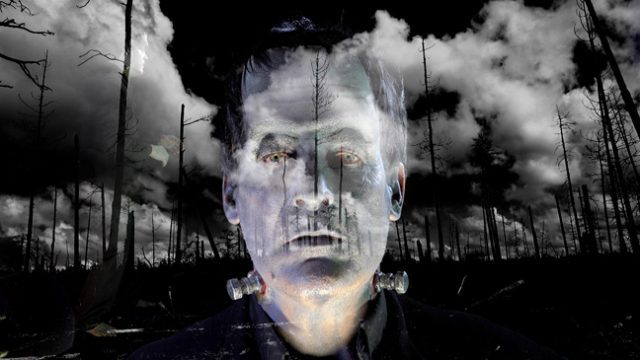
Jim Fletcher plays Frankenstein’s monster in Tony Oursler’s Imponderable (photo courtesy Museum of Modern Art)
Who: Jim Fletcher What:Film series Where:Anthology Film Archives, 32 Second Ave. at Second St. When: June 11-16 Why: In a January 2020 twi-ny talk, actor, writer, and editor Jim Fletcher, who is beloved in the experimental theater scene, said of his working with such companies as the New York City Players (NYCP), the Wooster Group, and Elevator Repair Service, “I’m working with people I love. It seems I never asked myself what kind of work I wanted to do, and also never the follow-up question, who best to do it with. In that sense I’m not a productive person. I think when you get close to people, you spontaneously start working in some way . . . out of sheer energy or whatever it is. Surplus.” Fans of Fletcher’s stage work (Pollock,Isolde,Why Why Always) might not realize just how productive the deep-voiced actor is, but they can find out in the Anthology Film Archives series “Jim Fletcher On Screen,” running June 11-16.
The mini-festival consists of eight programs comprising sixteen shorts, documentaries, and features starring the tall, bold Fletcher, from Roland Ellis’s ten-minute Break Down, Nicholas Elliott’s Icarus, and Laura Parnes’s Blood and Guts in High School (an adaptation of the book by Kathy Acker) to Shaun Irons’s Standing By: Gatz Backstage (a behind-the-scenes look at the eight-hour Gatz), Zoe Beloff’s Glass House (based on an unrealized science fiction project by Sergei Eisenstein), and Ellen Cantor’s Pinochet Porn (an episodic narrative that was completed after her death). NYCP founder Richard Maxwell is represented with The Feud Other,The Darkness of This Reading, and Showcase, the latter promising, “Gradually getting dressed, [Fletcher’s character] discusses life on the road, memories, moron jokes, the conference he is attending, business strategies, and a pivotal deal that went down recently under intimate circumstances. He sings.” Yes, Fletcher sings!
The celebration of all things Fletcher concludes June 16 with visual artist Tony Oursler’s 3D Imponderable, which was the centerpiece of a MoMA exhibition in 2016-17 and in which Fletcher portrays his dream role, Frankenstein’s monster. Fletcher will be at Anthology to talk about his work at several screenings, bringing along some of his friends and colleagues. Be prepared to join the ever-growing Fletcher faithful; we are legion.
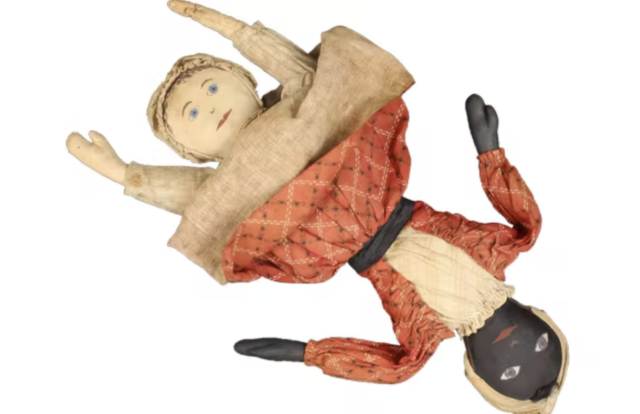
Topsy-turvy doll, mixed fabrics, paint, 1890-1905 (photo by Glenn Castellano)
BLACK DOLLS
New-York Historical Society
170 Central Park West at Seventy-Seventh St.
Wednesday – Sunday through June 5, $6-$22 www.nyhistory.org
The New-York Historical Society explores the sociocultural history of black dolls, particularly in regard to slavery and racism, in the revelatory exhibit “Black Dolls,” on view through June 5. The show features more than two hundred items, including more than a hundred handmade dolls dating back to the 1840s. Cynthia Walker Hill’s “Doll representing an enslaved man” depicts a fugitive slave with a slave collar still around his neck. There are several dolls crafted by Harriet Jacobs, author of Incidents in the Life of a Slave Girl: Written by Herself, for the children of white author Nathaniel Parker Willis. There are several topsy-turvy dolls, a Black figure on one side, a white figure on the other; an old advertisement makes a clear distinction between the two.
A row of Black dolls forming a family are lined up in front of photographs of girls with dolls of a different color. Disturbed at seeing two Black girls playing with a white doll, Sara Lee Creech worked with Eleanor Roosevelt and Zora Neale Hurston on a line of Black dolls with positive images, not stereotypes, but they didn’t sell well. In 1908, Richard Henry Boyd and his National Negro Doll Company began manufacturing “Negro Dolls for Negro Children.” In the 1990s, American Girl introduced Addy Walker, a Black doll with her own, smaller Black doll.
“While the names of the women who created these dolls are largely unknown, every stitch that they sewed into place is invaluable evidence of their lived experience, as well as a reflection of the larger historical forces of slavery and its legacy,” New-York Historical Society president and CEO Dr. Louise Mirrer said in a statement. There’s a folk-art quality to the dolls, reminiscent of story quilts, each one forming its own narrative.
In its landmark 1954 decision Brown v. Board of Education of Topeka, the Supreme Court cited Dr. Kenneth Clark’s doll tests, in which he asked questions of Black and white children between the ages of three and seven to find out which doll they felt represented them and which were the good ones. The results were a window into how kids viewed racial stereotypes and their own self-esteem; most of the children preferred the white dolls. “To separate [Black children] from others of similar age and qualifications solely because of their race generates a feeling of inferiority as to their status in the community that may affect their hearts and minds in a way unlikely ever to be undone,” Chief Justice Earl Warren wrote in the opinion. The exhibit demonstrates more than a century and a half of quiet efforts to resist that damage and the resilience of the Black community and a few allies in the ongoing fight to represent themselves.
There will be guided gallery tours on May 29 and June 1 at 1:00. While at the museum, be sure to check out such other exhibits as “Title IX: Activism On and Off the Field,” “Picture the Dream: The Story of the Civil Rights Movement Through Children’s Books,” and “Scenes of New York City: The Elie and Sarah Hirschfeld Collection.”
The career of Mike Leigh is celebrated in Lincoln Center retrospective
HUMAN CONDITIONS: THE FILMS OF MIKE LEIGH
Film at Lincoln Center, Walter Reade Theater
165 West 65th St. at Amsterdam Ave.
May 27 – June 8 www.filmlinc.org
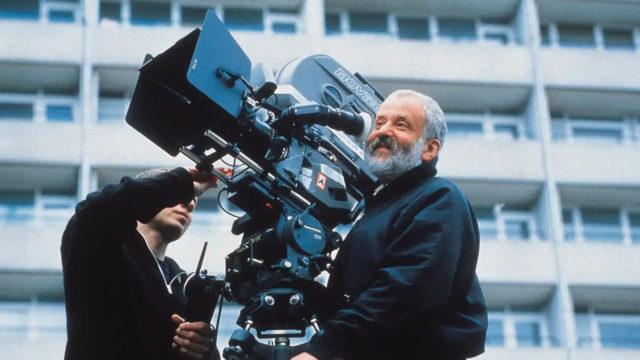
For more than fifty years, British auteur Mike Leigh has been making character-driven films set in working-class worlds, anchored by memorable performances: Katrin Cartlidge in Career Girls, David Thewlis in Naked, Sally Hawkins in Happy-Go-Lucky, Jim Broadbent and Timothy Spall in Life Is Sweet, Marianne Jean-Baptiste in Secrets & Lies, Imelda Staunton in Vera Drake. His famed style involves the actors immersing themselves in their roles months and months ahead of shooting, resulting in stories steeped in reality, and humanity.
Film at Lincoln Center is honoring the seventy-nine-year-old director with the two-week retrospective “Human Conditions: The Films of Mike Leigh,” consisting of all fourteen of his features and two of his shorts (A Sense of History and The Short and Curlies), ranging from 1973’s Bleak Moments to 2018’s Peterloo. Leigh will be at the Walter Reade Theater for Q&As following the May 27 screening of the 4K restoration of Naked, the May 28 screening of a new restoration of Secrets & Lies, and the May 29 screening of a new restoration of his Gilbert & Sullivan biopic, Topsy-Turvy. Below are select reviews.
A pair of sisters contemplate their miserable lives in Mike Leigh’s first film, Bleak Moments
BLEAK MOMENTS (LOVING MOMENTS) (Mike Leigh, 1971)
Friday, May 27, 4:00
Saturday, May 28, 9:00
Friday, June 3, 1:00 www.filmlinc.org
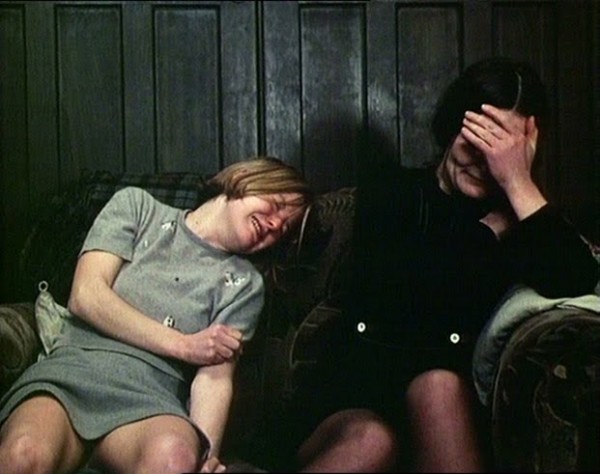
British master filmmaker Mike Leigh’s feature debut, 1971’s Bleak Moments, is just that, a series of grim scenes involving five main characters who are not exactly the most scintillating of conversationalists. But slowly, the dark, dreary opening evolves into a wickedly funny black comedy about different sorts of relationships (familial, sexual, professional), comprising episodes that help define the film’s alternate title, Loving Moments. It would be hard for Sylvia (Anne Raitt) to live a more boring life. A typist at an accounting firm, she spends most of her free time at home taking care of her sister, Hilda (Sarah Stephenson), who suffers from a kind of autism. Hilda works with Pat (Joolia Cappleman), a strange bird obsessed with movies, Maltesers, and Hilda. Meanwhile, teacher Peter (Eric Allan), who seems terrified of people, shows interest, if you can call it that, in all three women. And Norman (Mike Bradwell), a wannabe singer-songwriter, has moved into Sylvia’s garage, where he plays music that intrigues Hilda. Over a short period of time, the three women and two men sit around, go for walks, eat, drink, and, mostly, say very little to one another, their tentativeness palpable, each one terribly frightened in his or her own way of what life has to offer, of connecting. But Leigh isn’t making fun of them; instead, Bleak Moments is a lovingly drawn story of real life, where people don’t always know exactly what to say or do or how to react in various situations.
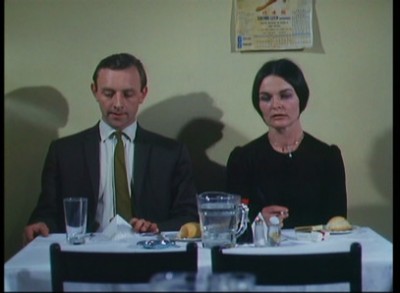
Peter (Eric Allan) and Sylvia (Anne Raitt) go on a date to remember in Bleak Moments
Originally mounted as a stage production, Bleak Moments transitioned to the big screen with the financial help of Albert Finney. As became his trademark, Leigh had the actors first embody the roles in rehearsals and preparation, giving the film a believability despite the absurdity of it all. The overwhelming despair and hesitation demonstrated by the characters becomes painfully funny, especially when Peter takes Sylvia to a Chinese restaurant and, afterward, she tries to ply him with sherry.
In January 2013, Leigh discussed Bleak Moments with the Guardian, at first comparing it to watching paint dry and acknowledging that some people thought it was “the most boring film in the world” while also explaining, “From this distance, I cautiously feel I’m allowed to feel a touch of paternal pride in my young self. With such brief life experience, did I really invent this painful, tragic-comic tale of a beautiful but suppressed young woman, tied to her elder, mentally challenged sister? I guess I’m astonished at the maturity and sophistication of my achievement, not to mention its pathos and irony. . . . I’ve tried to vary my films considerably, but I would have to admit that Bleak Moments remains, in some ways, the mother of all Mike Leigh films. And I’m very proud of it.” As well he should be.
Sally Hawkins is unforgettable in Mike Leigh’s Happy-Go-Lucky
HAPPY-GO-LUCKY (Mike Leigh, 2008)
Sunday, May 29, 9:00
Friday, June 3, 3:30 www.filmlinc.org
Mike Leigh’s Happy-Go-Lucky is the most charming of all his films. Sally Hawkins gives a career-making performance as Poppy, the most delightful film character since Audrey Tatou’s Amélie (in Jean-Pierre Jeunet’s 2001 French comedy Le Fabuleux Destin D’amélie Poulain). Poppy is a primary school teacher who has an endearing, seemingly limitless love of life; she talks playfully with strangers in bookstores, teases her sister (Kate O’Flynn) and best friend (Alexis Zegerman) with the sweetest of smirks, takes a flamenco lesson on a whim with a colleague, and, when her bicycle is stolen, simply starts taking driving lessons.
However, her driving instructor, Scott (Eddie Marsan), is a tense, angry man with endless chips on his shoulder, trying to sour Poppy at every turn. But Poppy is no mere coquettish ingenue; when she senses a problem with one of her students, she is quick to get to the bottom of the situation, with the appropriate serious demeanor. As with most Leigh films, much of the dialogue is improvised (following long rehearsal periods), adding to its freshness. But also as with most Leigh films, there are dramatic turning points, but even those can’t wipe away Poppy’s — or the audience’s — endless smile.
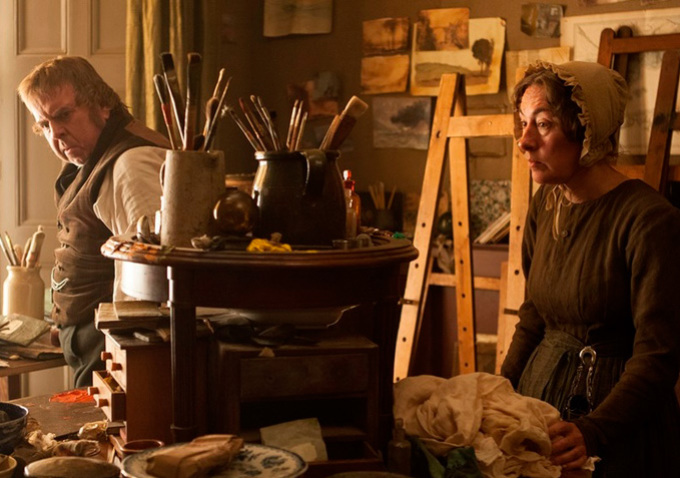
British painter J. M. W. Turner (Timothy Spall) and his devoted housekeeper, Hanna Danby (Dorothy Atkinson), pause for a moment in biopic
MR. TURNER (Mike Leigh, 2014)
Sunday, June 5, 2:00
Wednesday, June 8, 3:30 www.filmlinc.org
Timothy Spall was named Best Actor at the Cannes Film Festival for his compelling portrayal of British artist Joseph Mallord William Turner in Mike Leigh’s lovely biopic, Mr. Turner. Spall, who played Peter Pettigrew in the Harry Potter series and has appeared in such other Leigh films as Topsy-Turvy, All or Nothing, Life Is Sweet, and Secrets & Lies, portrays Turner as a gruff, self-involved painter who grunts and growls his way through life. At his home studio he is assisted by his aging father, William (Paul Jesson), and his devoted housekeeper, Hanna Danby (Dorothy Atkinson), who he occasionally shags when in the mood. Turner carries his sketchbook wherever he goes, always on the look-out for a beautiful landscape or winter storm that could become the subject of his next painting. With that in mind, he rents a room in a small seaside inn run by Sophia Booth (Marion Bailey), who eventually becomes more than just his landlady. An artist well ahead of his time, Turner becomes frustrated with the men at the Royal Academy of Arts and lisping art critic John Ruskin (Joshua McGuire), who don’t appreciate his work properly, especially when he starts heading toward abstraction.
J. M. W. Turner (Timothy Spall) is always on the look-out for a subject to paint in Mr. Turner
Leigh does not paint the kindest portrait of J. M. W. Turner, who turned his back on his former mistress, the shrill Sarah Danby (Ruth Sheen), and their two daughters (Sandy Foster and Amy Dawson); doesn’t have the nicest things to say about such contemporaries as John Constable (James Fleet) and Benjamin Haydon (Martin Savage); and won’t listen to the stern warnings of his doctor (David Horovitch). Turner is an artist first and foremost; everything else takes a backseat in his life. Despite being based on actual events, the film was made in Leigh’s usual style, with the actors improvising within set scenes; Spall, who studied painting for two years in preparing for the role, takes full advantage of the opportunity, often refusing to articulate, grunting and growling as he deals with other people who dare share their thoughts and opinions with him. It’s a very funny conceit that helps define a rather unusual character.
As befits a story about a masterful painter, cinematographer Dick Pope, who has shot most of Leigh’s films, beautifully photographs the sun rising and setting over vast landscapes, capturing its glowing light cast over the sea. Leigh keeps the narrative subtle, as when Turner and Sophia sit for a daguerreotype; almost nothing extraordinary happens in the scene, but from a few groaned questions and Spall’s expression, viewers can sense Turner realizing the changes that photography will bring to realist painting, spurring his controversial switch to more abstract canvases. It is not shown as a eureka moment but just another part of Turner’s development in becoming one of the most important and influential artists of the nineteenth century. And then there are the paintings themselves, glorious works that are always a joy to see, especially in a film that is a work of art itself.
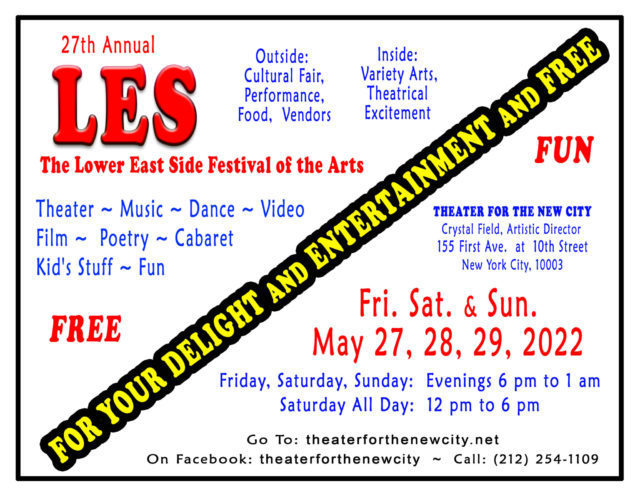
Who: Nearly two hundred performers What: Lower East Side Festival of the Arts Where:Theater for the New City, 155 First Ave. at Tenth St. When: May 27-29, free (donations accepted) Why: The twenty-seventh annual Lower East Side Festival of the Arts, a wide-ranging, indoor and outdoor celebration of the vast creativity of the neighborhood over the decades, will feature nearly two hundred performers, at Theater for the New City and on Tenth St. Taking place May 27-29, the festival, with the theme “Artists Embrace Liberty and Justice for All,” includes dance, spoken word, theater, music, visual art, and more from such familiar faves as David Amram, the Thunderbird American Indian Dancers, Shakespeare in the Parking Lot, James Rado, La MaMa, Akiko, Folksbiene National Yiddish Theater, Malachy McCourt, KT Sullivan, Eduardo Machado, Austin Pendleton, the Rod Rodgers Dance Company, Melanie Maria Goodreaux, Chinese Theater Works, New Yiddish Rep, Eve Packer, 13th Street Rep, and Metropolitan Playhouse.
The event will be emceed at the various locations by Crystal Field, Robert Gonzales Jr., Danielle Aziza, Sabura Rashid, David F. Slone Esq., and Joe John Battista. There will also be vendors and food booths and special programs for children curated by Donna Mejia and hosted by John Grimaldi, film screenings curated by Eva Dorrepaal, a “poetry jam with prose on the side” curated by Lissa Moira, and an art show curated by Carolyn Ratcliffe. Select performances will be livestreamed here.