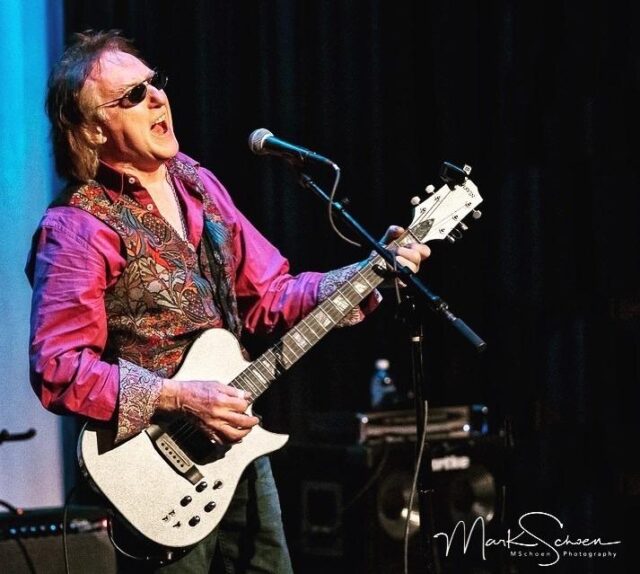
Denny Laine returns to numerous City Winery venues with “Acoustic Songs & Stories” in February
DENNY LAINE: ACOUSTIC SONGS & STORIES
City Winery New York
25 Eleventh Ave. at Fifteenth St.
Tuesday, February 7, $25-$45, 8:00
City Winery Hudson Valley
Wednesday, February 8, $25-$35, 8:00
citywinery.com
facebook.com/DBFLaine
Anybody who’s listened to British rock in the past six decades has heard Denny Laine’s songs and his guitar playing, but they may not recognize his name. That’s about to change as he begins a solo tour of City Wineries across the USA this month, including a stop February 7 at the City Winery next to Little Island. (He’ll also be at the Hudson Valley City Winery on February 8 and My Father’s Place at the Metropolitan in Glen Cove on February 23.)
Born Brian Frederick Hines in Birmingham, England, Laine is an acclaimed musician and songwriter who has been performing solo and in bands since the late 1950s. He is a founding member of the Moody Blues (1964–66), singing lead vocals on their number one hit “Go Now,” and Wings (1971–81), which he formed with Paul and Linda McCartney. Among the other groups he played in and/or started were Balls, the Electric String Band, and Ginger Baker’s Air Force, and he’s released a dozen solo records.
Prior to the pandemic, he began putting together “Acoustic Songs & Stories,” an evening of music and anecdotes from throughout his life and career, during which he has played and toured with an inordinate amount of remarkable colleagues. He recently spoke with me over the phone from his home in Florida, where he was preparing to hit the road.
Laine, who is seventy-eight, has an easygoing, casual way about him, sharing jaw-dropping tales that he recounts as if it were just another day, which for him it was. He talks about being inducted into the Rock and Roll Hall of Fame and hanging out with the Beatles, the Moodies, Jeff Beck and Rod Stewart, Ginger Baker and Jack Bruce, and Jimi Hendrix like it’s no big deal. He’s a musician’s musician, quintessentially British, equally comfortable in the background or center stage. What follows is a kind of prelude to Laine’s upcoming one-man concerts as he discusses getting his first guitar, playing football in the hallway with Jeff and Rod before a gig, writing with Paul McCartney, the unusual genesis of a Beatles classic, and his philosophy of life.
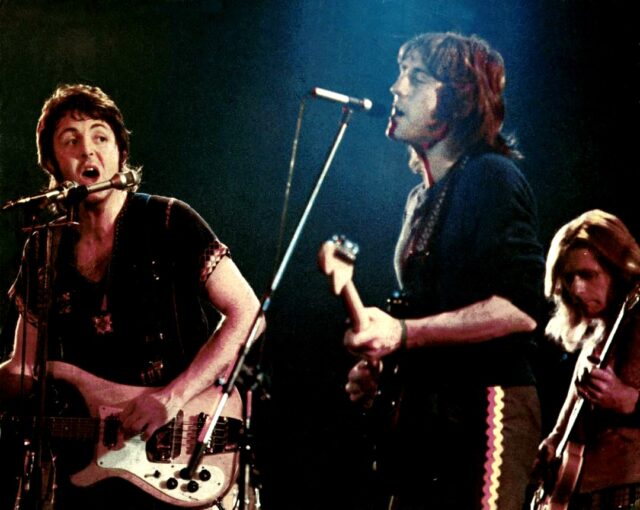
Denny Laine cofounded Wings with good friends Paul and Linda McCartney (photo courtesy Denny Laine)
twi-ny: My very first concert was Wings at Madison Square Garden in 1976.
denny laine: That sounds good.
twi-ny: My father took me for my thirteenth birthday. I’d never seen anything like it.
dl: Well, that was a good day, man, I’ll tell you.
twi-ny: I read that your first concert was Ella Fitzgerald and the Oscar Peterson Trio. That’s not a bad beginning either.
dl: That’s absolutely true. First time I went to see anybody in a theater. It was at Birmingham Hippodrome, I believe.
twi-ny: You must have been a kid, right?
dl: Well, I was working as a trainee buyer for musical instruments, can you believe? That was the only job I ever had, a real job where you had to get up in the morning. So a friend of mine who worked in the record department was a big fan of Ella Fitzgerald, and I was sort of a Django Reinhardt fan at the time.
twi-ny: And Stéphane Grappelli, I understand.
dl: Right. All of that gypsy jazz stuff. He got some tickets, and I went with him. I loved that music. That trio was unbelievable. And Ella was just great. That’s where I started really listening to music, because I’ve now been to see it, you know, it’s like, you listen to bits here and bits there, but it was the first time I ever got to see it and appreciate the professionalism and the talent. So that was it, really.
twi-ny: When did you get your first guitar?
dl: Around that time, I would think. No, probably a year before that or so, when I was in school. And skiffle was around. Actually, when I was twelve, I played my first live show. It was a cheap old guitar, really a cheap guitar. And I played at the Birmingham Institute. I don’t know how I got on it, but I did. I did some Lonnie Donegan song and really didn’t get it properly until later on. But I started being in bands at school and stuff like that. So, I’d say I got the guitar when I was twelve, but I didn’t take it seriously. I went in for competitions; once I got to the finals and then chickened out. But I was starting to plonk around on it. I didn’t know how to tune it in those days. And then a friend at school — his brother was a jazz guitarist — taught me to tune it. It was just a four-dollar job, a cheap old job. But it worked.
twi-ny: So I remember very well at the Garden that night that it was a big deal because McCartney hadn’t played a lot of his Beatles songs since they had broken up. But one of the songs that stood out for me was “Time to Hide.” It was a thrill for me to see that, because here’s this superstar — I knew who the band was because I was listening to all the records and studying the covers. But here’s the sideman jumping to the front of the stage.
dl: [laughs] Well, I was encouraged to do that by Paul all the time. He was trying to drag that out of me, to get me to write more. He didn’t want the full profile all the time. Of course, it was impossible for him because of how famous he was. I know that he got me into that band because I had already been in the Moody Blues, and I’d got to know him years before, in the Birmingham days. I got to know the Beatles a little bit. So then when we moved to London, we really got friendly with him. So I think he got me into that band because he wanted me to be more of a band member, because he used to be in a band, like me. So he didn’t want to be the front man all the time. But of course, he couldn’t help it, you know? But anyway, I started with that song, it was one I wrote, and he dragged it out of me. He wanted me to play “Go Now” onstage as well.
twi-ny: I remember that from the live album and the concert film.
dl: Yes. Because the idea was that we weren’t gonna go on there and have him do Beatles songs and me do Moody Blue songs. We didn’t put Wings together for that reason. We wanted to do something new.
twi-ny: You also were cowriting a lot of songs with Paul. You wrote about half of London Town, and cowrote “Mull of Kintyre.” I still have the 45 for that. Obviously, Paul was famous for collaborating with John. What were your collaborations with Paul like?
dl: Well, again, I knew him and we all grew up on the same music, in a sense, American music. But before that it was all British folk. And skiffle; skiffle was a sort of a mixture of American stuff and English folk. That’s really what it was.
twi-ny: Did you write both the lyrics and the music together?
dl: In the case of “Mull of Kintyre,” he had the chorus. So I went over to his house up in Scotland. I was living over the hill on the same land. I went over for breakfast one morning. He had the chorus, and that to me was the song. So I encouraged him to go and finish it off. He wasn’t too sure about it because he thought, well, you know, I might be assassinated doing a Scottish song; it might not go down too well.
twi-ny: They might call that cultural appropriation today.
dl: [laughs] I ended up doing quite a lot of the lyrics on that song. We recorded it up there and it was a huge hit. It was easy. I never had a hard time writing with him at all. We had the same ideas. We were trying to do something new and it was all something current, based on what we were going through or who, where we were, and who we were hanging out with and whatever. So we all did everything together a lot. We even lived together on the same farm. We would go up there every year to rehearse and get away from everything. For the privacy and stuff. Sometimes we’d go to another country just to take a week to go and write, get influenced by wherever we were.
twi-ny: You mentioned “Go Now” before. People forget that you were a founding member of the Moody Blues, and you are in the Rock and Roll Hall of Fame as a Moody Blues founder.
dl: That’s because of “Go Now.” The thing is that Paul used to stand at the side of the stage and watch me do that every night because we toured with the Beatles, the second British tour. So he encouraged me and wanted me to do that live again because, again, he’s trying to tell the public who I was. And even to this day, believe it or not, [Moody Blues cofounder] Ray Thomas’s wife, who we are still in touch with, she was trying to convince all the Moody Blues fans who didn’t even know I was in the band. But there was another Moody Blues before them. And some of them don’t even accept it. A lot of people didn’t know Paul was in the Beatles, how ’bout that?
twi-ny: Right! When Paul plays at awards shows, the Twitterites don’t know who he is or say, Paul McCartney was in a band before Wings? If they even know who Wings are.
dl: You gotta laugh.
twi-ny: It’s very funny.
dl: That’s the way it goes; young people coming along, what’re you gonna do.
twi-ny: Another early group of yours was the Electric String Band, which opened for Procol Harum and Jimi Hendrix in ’67. I believe that there was a show in ’67 where Jimi played a Beatles song from Sgt. Pepper and Paul was in the audience, not expecting it because the record had only just been released. Was that the show?
dl: Yeah. He used to always do that. Anytime there was a Beatle in the audience, he’d play, “It was twenty years ago today.” Jimi was just as excited about the Beatles and that era as anybody else. And the fact that he got to come to England, and as Eric Burdon puts it, he became one of us. A lot of the American bands used to come over to London, and me and Paul would go and see them all, me and George [Harrison] or all of us would go and see some of the bands that came over. The Byrds. Talk about David Crosby and all. I met all these people in those days through the Beatles, going out with the Beatles, and the Moodies had parties and all stuff like that.
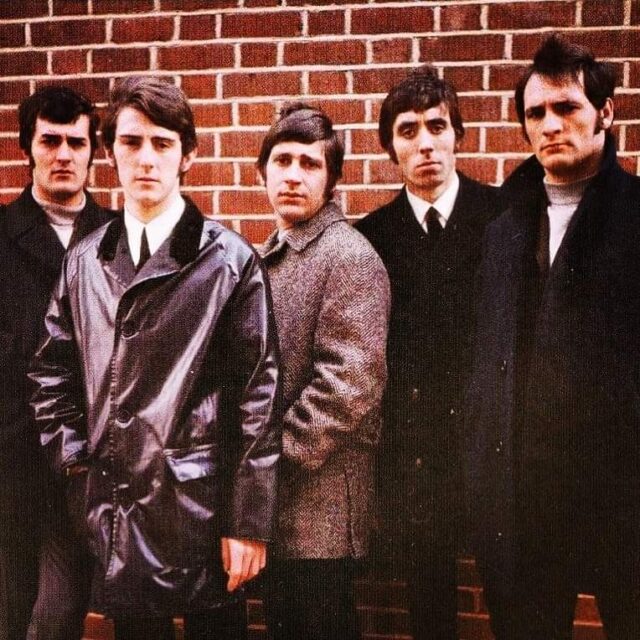
Denny Laine (2nd from l.) cofounded the Moody Blues with Mike Pinder, Ray Thomas, Graeme Edge, and Clint Warwick in 1964
twi-ny: I mean, that’s quite a historic night. Procol Harum, your band, Pete Townshend, Eric Clapton, and McCartney in the house, Jimi Hendrix playing a Beatles song. Was that just another night for you guys?
dl: Well, no, it was pretty big for me. It was big for me for two reasons. The first reason being is I was supposed to do it two weekends. And the first one I was supposed to be on, my bass player got sick and there’s no way I was gonna go up there. I practiced with the drummer from the Pretty Things, and he got the bass player from that band to come down and rehearse and he couldn’t cut it. So I canceled that particular night. And I heard later on that John [Lennon] had said, “Where’s Denny? We only came to see him.”
Anyway, the next weekend I did it, and it went down really well. And Jimi even paid me a compliment that night at the club. He said, “Oh, I liked your guitar player, man.” I said, “The guitar player, that was me.” He went, “Oh yeah. Sorry, man.” But that was a nice little backhanded compliment. I knew Jimi through Noel Redding and Mitch Mitchell; I knew them from way before. So I was part of that crowd, and especially with the String Band being a folk rock type of thing. That was obviously influenced by the Beatles and George Martin.
But having said that, I always loved classical music too. I was brought up on classical music through my parents and sisters. I was into amalgamating music and joining different styles. The drummer in my first band started ELO with Jeff Lynne, Bev Bevan. So the connection was always there. And so this folk thing was my thing. I ended up hanging around with all the folkies and in fact, on my solo record Say You Don’t Mind, I had a couple of folk players on that. I had Danny Thompson from Pentangle, and I had a couple of other people; we were folk people. Donovan was a big friend of ours as well.
So anyway, getting back to the Jimi Hendrix thing, it went down really well. It was the first time, I think, anybody used pickups on the violins and cellos. We’d already done about a year in Europe, so we were pretty good by then. Peter Asher was in the audience, who is still a friend of mine to this day. So it came back that everybody was really pleased with it. In fact, we got a standing ovation, so it was really cool.
twi-ny: You mentioned Ray Thomas, who passed away a few years ago, and then more recently some other people who you played with or opened for have left us. You brought up David Crosby, and now Jeff Beck, whose death I think was even more surprising because he was just playing on tour with Johnny Depp.
dl: I knew David in the very early days, from the Byrds days, and then I met him a couple of times in America; he was always hanging around doing different things in the same crowd, Laurel Canyon and all that crap. Jeff Beck, when he was in the Jeff Beck Group with Rod Stewart, we used to do doubles with them. I remember doing a double with them where we all got into a fight because the guy wouldn’t let us play football in the hall before the gig started. So we were all part of that London scene. And we had the same agency, Marquee Artists, who brought all the blues players over from America and Europe. And so again, we would play a lot of the same venues, and that’s how I knew them.
twi-ny: You also played in Ginger Baker’s Air Force, so your connections are extraordinary.
dl: Same thing. Ginger and Jack [Bruce] I met in the early days because we were doing the very first Moodies theater tour, it was the Chuck Berry tour. Ginger and Jack were in the opening band, actually, the Graham Bond Organisation. So that’s how I met them. It’s a long story, but it was Steve Winwood’s birthday, and I was down there with Trevor [Burton] from the Move, and Ginger and Eric were down there that same day. We all sat around and had a little bit of a jam. And next party I went to, Ginger was there, and he asked me if I wanted to join a band. So I did that with him. That’s the way it goes, you know?
twi-ny: It’s fascinating. I can listen to these stories all day.
dl: Well, that’s what I’m doing. Telling stories.
twi-ny: Oh, yes, exactly. We’re gonna get to that in just a minute. I want to first ask you about something that is going to lead into that. So you’ve got all these other bands, you’ve got Balls, the Diplomats, and the Moodies, and you’ve put out some solo records, like Japanese Tears Reborn and The Blue Musician. So all those years ago, Paul McCartney is telling you, I’m putting you front and center. You’re gonna sing a couple songs a night. Is it easy to go back and forth between leader and sideman?
dl: Well, I was used to that in the Moody Blues, don’t forget.
twi-ny: Oh, that’s true. Right.
dl: I was the front man in the Moody Blues, so I’d already had that experience. In fact, Wings was like a day off for me because I didn’t have to do it all. But no, I’d already done that. One of the reasons that I walked away from — well, not walked away from — the Wings thing . . . I mean, I was still in touch with everyone, but I just wanted to do my own thing again. That’s all. I’d already put out an album, which was called Ahh . . . Laine, and that came out during the early Wings phase. But it was actually recorded before I joined Wings. It just hadn’t come out. So I’d already done that. It was partly to do with the fact that Paul had that thing with Japan, so we couldn’t really tour for a while after that. Eventually I just said, well, I want to go out and I want to start doing some live work. And so that was it. I started making albums then in the early eighties and played a lot of the instruments myself actually. But I had friends, Rick Wakeman, Chris Slade from AC/DC, on those albums. I basically just did my own thing, thanks to Paul for encouraging me to be more of a songwriter.
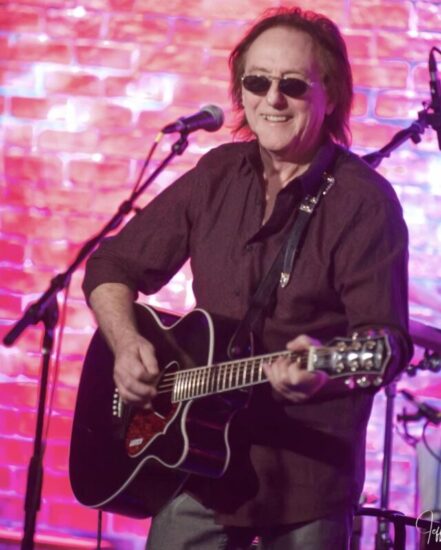
Denny Laine will perform songs and tell stories from throughout his career on City Winery tour (photo courtesy Denny Laine)
twi-ny: And so now you’re coming to City Winery with “Acoustic Songs & Stories.” You’ll be playing songs from throughout your career, along with some choice cover material. How did this come about?
dl: Well, it was inevitable because of the pandemic in a way. We all went off the road, but prior to the pandemic, I had been doing some of these things. Because although I’d done the band thing, I was going out and doing a set; the first half was just a selection of songs, and then the second half was the Band on the Run album. I had my band doing all the vocals on all of that. So I changed myself with that for a while, and then I did a couple of solo things I was invited to do and it just kind of caught on. I thought, well, this is easy. This goes down. I have a lot more freedom. I was getting to play songs that I felt like playing off the top of my head or if somebody shouted out something, whatever.
So it was just a more free thing and I enjoyed it so much. And then the pandemic hit, so that’s the way it goes. And I thought, well, I’ve gotta get back out there and do it again. I hadn’t had any injections at that time; it was Paul who talked me into getting them. And so it just was that easy to decide, I’m gonna go out and do the solo thing again. Why not, you know? And that’s what I did. So we booked this especially for that. But I’m doing mainly my own stuff, I’m doing obviously my career.
twi-ny: The songs you wrote and were involved in.
dl: I actually did it not too long ago, where I got to play a lot of songs of my own. It’s sort of a rehearsal. If I do a lot of these things, I can move it around a little bit, add a few extra songs here and there that I didn’t do on the show before.
twi-ny: I noticed that one night you played “Nights in White Satin.”
dl: That was just for a laugh. I don’t know how that came about, but I think we were talking about it and I just threw in a verse of it. I didn’t even know the words.
twi-ny: During the pandemic, I followed numerous British musicians, guitarists and songwriters, who played solo concerts online from home. I’m thinking specifically of Robyn Hitchcock, Richard Thompson, and they play whatever comes to mind. Is that a thing with you guys, with you?
dl: Well, I don’t know, maybe I started it.
twi-ny: Maybe you started it.
dl: I don’t think I’m famous enough to start a trend. But yeah, I was doing it way before a lot of people were, and now everybody’s doing it. We used to do that, don’t forget, in the Wings [acoustic] set, in the middle of the show. So I suppose in some ways we did influence a lot of people in that way. It was a way that Paul could do a couple of Beatles songs without it trying to sound like the Beatles. This is the way the songs were written. You hear them just with a guitar and the voice. And that’s really what I mean. I’m not taking a piano out with me. I’ve got piano songs I could do, but I’m not going to, and it’s just gonna be me and the way the songs originated. The audience likes that kind of thing.
twi-ny: It gets to the essence of the song. You had Springsteen on Broadway. You have Bono doing a tour right now where he’s doing solo songs and talking about his life.
dl: Really? I didn’t know that.
twi-ny: He’s got a book out. He’s doing it at the Beacon Theatre here in New York.
dl: Oh, cool. I think it’s great that people are doing that. You’ve got stories to tell, and you’ve got that connection with the audience more. You can’t have that in a big stadium. It’s like the old days when we used to do all the clubs and all the pubs, you were much more close up to the audience. Going back to roots is always good. That’s how we all started.
twi-ny: City Winery is a really good venue for this. I’ve seen Richard Thompson, Graham Parker, Ian Hunter, Eric Burdon, a lot of your contemporaries there.
dl: Oh, yeah. I’m doing all of them.
twi-ny: Right. You’re playing Nashville, Boston, Hudson Valley, Chicago, Philly.
dl: Yeah, I’m doing all of them. And that’s the point. I’d already booked to do them before the pandemic and couldn’t do them, so that’s why I’m doing them now. It’s a mixed audience, all out for a good time and something to eat, and they appreciate the music. They’re there to listen, they’re there to enjoy that instead of sitting in a crowd of thousands of people.
twi-ny: During the pandemic, I imagine you had a lot of time to think about the songs you would play and the stories you would tell.
dl: The stories, sometimes they come off the top of your head, sometimes you keep repeating yourself.
twi-ny: Are there any stories that you might have wanted to tell but might be a little naughty?
dl: Ah, that’s a bit of a leading question.
twi-ny: Yes it is.
dl: I don’t think anybody wants to hang all the dirty washing out in public. I mean, come on. But no, not really, because Wings and the Moodies, we were having fun. Nothing I’m ashamed of, you know what I mean?
twi-ny: But the Moodies were well known for their parties.
dl: They bloody were, because everybody used to come to our house out in Row Hampton and drink and chat and play music and just hang out. All the music business used to be there. If a bomb went off, there wouldn’t be any music business. I’m telling you. That’s what those parties were like. John Lennon used to be on the door.
twi-ny: Checking IDs?
dl: You know what’s a good story? He said to [Moodies founding member] Mike Pinder, we’re all standing in the doorway there. We had one of those little things you open up through the door to see, you know . . .
twi-ny: A peephole?
dl: Yeah. And John’s standing there, and he says, “Who’s this?” There’s a woman there he hadn’t let in. And Mike Pinder said, “Oh, she came in through the bathroom window.” No kidding. So that’s where that title came from. Even though Paul, I think, wrote that, but somebody climbed up the drainpipe into the bathroom window to get into the party.
twi-ny: That’s hysterical.
dl: I’m not kidding.
twi-ny: On New Year’s Day, you posted on social media the following quote: “The past is what we were; now is what we are.” How do you stay so positive in these crazy times?
dl: It’s not so much positive; it’s just being balanced. Like in the past, we did all that. Now we’re doing this. And that’s what life is. You can’t live in the past, and you certainly can’t live in the future. You live for the moment, and that way you are naturally just positive because you just gotta deal with whatever’s going on now. You talked about cell phones [before the interview officially started], whatever’s the new technology, you’ve gotta get to know, and you’ve got to deal with everybody else in the world. You’ve gotta keep up to date. That’s all I meant. A lot of people have come up with that conclusion because of the pandemic. It’s made people get up and rethink their lives. A lot of people don’t want to go back to the same old job they hated, and they’re starting their own businesses. There’s a silver lining in everything bad that happened.
twi-ny: A lot of creativity came out of the pandemic.
dl: That’s exactly what I’m saying.
twi-ny: The same thing happened in theater. And in many ways, your show is really a form of theater. It’s more than a concert.
dl: That’s the way I see it. I’m starting with the wineries, and I’m going to do the theaters after, just small theaters. It’s nice to have that sit-down thing, where everybody in the audience can hear and see and be part of it.
twi-ny: Terrific. I am so thrilled to have had the chance to speak to you. It was really a lot of fun. Good luck with the tour, with the shows. I look forward to seeing you at City Winery. You’ve entertained me endlessly over the years. I even still have my Wings T-shirt from the 1976 concert. I can’t fit into it anymore, but my wife can.
dl: You’re handing it down.
twi-ny: I’ve handed it down. She also looks a lot better in it than I ever did.
dl: [laughs] I love it.
[You can find more of the interview here.]