BEFORE THE DEVIL KNOWS YOU’RE DEAD concludes weeklong tribute to Sidney Lumet at the Film Society of Lincoln Center
BEFORE THE DEVIL KNOWS YOU’RE DEAD (Sidney Lumet, 2007)
Film Society of Lincoln Center, Walter Reade Theater
165 West 65th St. at Amsterdam Ave.
Monday, July 25, 8:30
Series runs July 19-25
212-875-5601
www.filmlinc.com
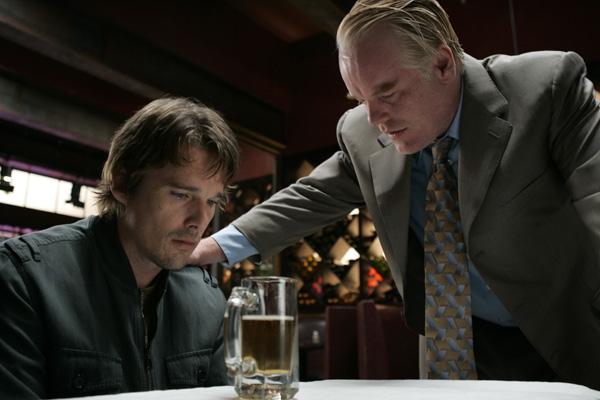
 Sidney Lumet spins an intriguing web of mystery and severe family dysfunction in Before the Devil Knows You’re Dead. Andy (Philip Seymour Hoffman) and Hank (Ethan Hawke) are very different brothers who are both in desperate financial straits. Andy, a real estate exec, has a serious drug problem and a fading marriage to his sexy but bored young wife (Marisa Tomei), while ne’er-do-well Hank can’t afford the monthly child-support payments to his ex-wife (Aleksa Palladino) and daughter (Amy Ryan). Andy convinces Hank to knock off their parents’ (Albert Finney and Rosemary Harris) jewelry store, but when things go horribly wrong, everyone involved is forced to face some very difficult situations, leading to a harrowing climax. Seymour and Hawke are both excellent, the former cool, calm, and collected, the latter scattershot and impulsive. Tomei gives one of her finest performances as the woman sleeping with both brothers. Lumet tells the story through a series of flashbacks from various characters’ point of view, with fascinating overlaps — although a bit overused — that offer different perspectives on critical scenes. Adapted from a script by playwright Kelly Masterson — whom Lumet had never met or even spoken with — Before the Devil Knows You’re Dead (the title comes from an Irish toast that begins, “May you be in heaven half and hour…”) is a thrilling modern noir from one of the masters of melodrama.

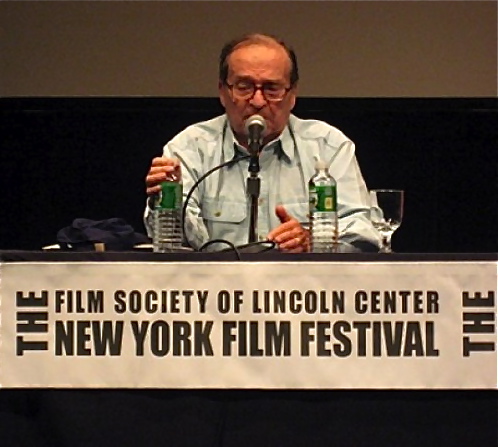
Sidney Lumet discusses BEFORE THE DEVIL KNOWS YOU’RE DEAD and more at the New York Film Festival in 2007 (photo by twi-ny/mdr)
Before the Devil Knows You’re Dead is screening July 25 at 8:30 as part of “Prince of the City: Remembering Sidney Lumet,” the Film Society of Lincoln Center’s tribute to one of New York’s greatest directors, who passed away in April at the age of eighty-six. Trained in the Yiddish theater and married to such celebrities as Rita Gam and Gloria Vanderbilt (and Gail Jones, daughter of Lena Horne), Lumet made more than forty films during his fifty-year career, which began in 1957 with the powerful, claustrophobic 12 Angry Men (screening July 19 and 22) and continued with such gritty New York City dramas as The Pawnbroker (July 19 & 22), Serpico (July 20 & 23), and Dog Day Afternoon (July 23 & 25), virtually redefining the world’s view of the Big Apple. He also adapted Eugene O’Neill’s Long Day’s Journey into Night with Katharine Hepburn and Jason Robards (July 24), Anton Chekhov’s The Sea Gull with James Mason and Simone Signoret (July 23), and, yes, The Wizard of Oz with The Wiz, starring Diana Ross and Michael Jackson (July 23). The series, which runs July 19-25, includes Q&As with screenwriter Walter Bernstein following the July 20 screening of 1964’s cold war thriller Fail-Safe and with Luis Guzman, Paul Calderon, and Judge Edwin Torres after the July 24 screening of 1990’s Q&A; Treat Williams will be on hand, along with the man he portrayed, former narcotics detective Robert Leuci, for the July 24 showing of 1981’s Prince of the City. Despite such an impressive track record — the series also includes Network (1976), The Verdict (1982), and Running on Empty (1988), as well as the little-known The Offence, in which Sean Connery plays a British detective on a very sensitive case — Lumet received only one Academy Award, an honorary Oscar in 2005.