this week in lectures, signings, panel discussions, workshops, and Q&As

SUMMER NIGHT AT THE FRICK COLLECTION

Giovanni Bellini, “St. Francis in the Desert,” oil on poplar panel, ca. 1475-78

The Frick Collection
1 East 70th St. at Fifth Ave.
Friday, July 22, free, 6:00 – 9:00 (children over ten welcome)
212-288-0700
www.frick.org

Every Sunday morning from 11:00 to 1:00, admission to the Frick Collection is pay-what-you-wish instead of the normal $18 to experience one of the city’s genuine treasures. But this Friday, the Frick is extending its hours, as the “Summer Night” program will open its doors for free from 6:00 to 9:00 for a special after-hours viewing of “In a New Light: Bellini’s ‘St. Francis in the Desert,’” which has recently undergone infrared reflectography, leading to new insight into the meaning behind the masterpiece, as well as “Turkish Taste at the Court of Marie-Antoinette.” The evening will also include the class “Summer Sketch: Bellini and Botany,” taught by Liz Insogna in the Garden Court; the gallery talks “Introduction to the Frick” at 6:15, 7:15, and 8:15 in the West Gallery and “Rooms of the Frick” at 6:45, 7:45, and 8:45 in the Dining Room; the curatorial presentations “Marie-Antoinette’s Turkish Dreams” by Charlotte Vignon at 6:30 and 7:00 and “Bellini Multimedia: Screening” by Denise Allen at 7:30; and five-minute live performances of “Danse Arabe” by Andreas Heise and Kristen Stevens in the Music Room at 8:15, 8:25, 8:35, and 8:45. Although there are no reservations or tickets needed, there are likely to be long lines for everything, so get there early.

GET WEIRD: GRAY

Gray will be getting weird again at the New Museum on July 21 (photo by Linda Covello)

New Museum of Contemporary Art
235 Bowery at Prince St.
Thursday, July 21, $15, 7:00 & 9:00
212-219-1222
www.newmuseum.org

In 1979, Jean-Michel Basquiat teamed up with performance artist Michael Holman to form the jazzy, funky experimental No Wave ambient industrial band Gray, named after Gray’s Anatomy, an influential book on Basquiat’s career. “New York is my town / Lower East Side I get down,” they declared on “Life on the Streets.” On July 21, Holman and original Gray member Nicholas Taylor, who have re-formed and released the album Shades of . . . last year, consisting of new and old songs, will play two special shows at the New Museum on the Lower East Side as part of the monthly Get Weird series, which focuses on “experimental and freaky jams.” In the past twenty-three years, the band — which has also included such members as Justin Thyme (Wayne Clifford), Shannon Dawson, and Vincent Gallo — has played live only twice, including at Basquiat’s memorial service, so this is a rare occasion indeed. There will be two performances, one at 7:00 and another at 9:00. The New Museum is very busy this weekend as well. On Friday night, Shaina Anand and Ashok Sukumaran will give the talk “CAMP, or the Love of Technology,” and on Saturday the New Museum Block Party in Sara D. Roosevelt Park will include such acts as Lumberob, Geo Wyeth, BowWow, and Isle of Klezbos, art activities and workshops, and free admission to the museum, where you can check out the new exhibits “Ostalgia” and “Charles Atlas: Joints Array.”

THE FINE ART OF COMICS, WITH GARY PANTER, ART SPIEGELMAN, AND CHRIS WARE

Lyonel Feininger, “Wee Willie Winkie’s World,” from the Chicago Sunday Tribune, November 25, 1906, commercial lithograph, © 2011 Lyonel Feininger Family, LLC/Artists Rights Society (ARS), New York (photograph © the Museum of Modern Art/Licensed by SCALA/Art Resource, NY)

Whitney Museum of American Art
945 Madison Ave. at 75th St.
Wednesday, July 20, $8, 7:00
212-570-3600
www.whitney.org

In conjunction with the splendid exhibit “Lyonel Feininger: At the Edge of the World,” the Whitney is presenting the special program “The Fine Art of Comics” on July 20. The wide-ranging retrospective traces New York native Feininger’s career path, which began with such comic strips as “The Kin-der-Kids” and “Wee Willie Winkie’s World” for the Chicago Tribune. Discussing the work of Feininger and the state of the comics industry will be three living legends: Art Spiegelman, who started the highly influential RAW with his wife, Françoise Mouly, back in 1980 and won the Pulitzer Prize for his two-part graphic novel Maus; painter, designer, and commercial artist Gary Panter, creator of the Jimbo books and a two-time Emmy winner for his set designs for Pee-Wee’s Playhouse; and Chris Ware, who has released such complex comics as Acme Novelty Library and Jimmy Corrigan, the Smartest Kid on Earth. The panel will be moderated by journalist John Carlin.

PRINCE OF THE CITY: REMEMBERING SIDNEY LUMET

BEFORE THE DEVIL KNOWS YOU’RE DEAD concludes weeklong tribute to Sidney Lumet at the Film Society of Lincoln Center

BEFORE THE DEVIL KNOWS YOU’RE DEAD (Sidney Lumet, 2007)
Film Society of Lincoln Center, Walter Reade Theater
165 West 65th St. at Amsterdam Ave.
Monday, July 25, 8:30
Series runs July 19-25
212-875-5601
www.filmlinc.com

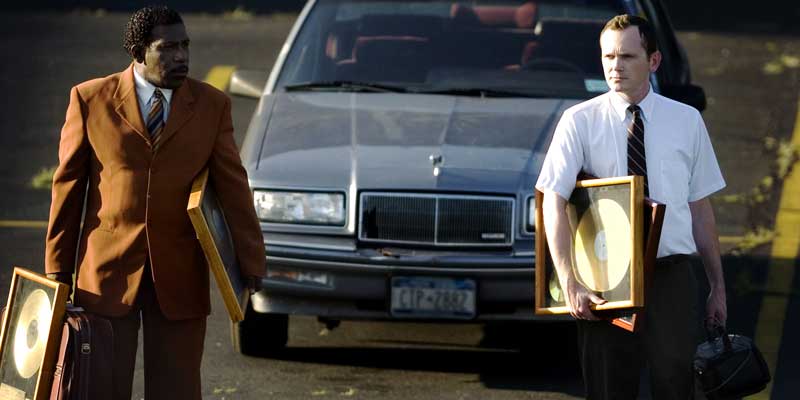
Sidney Lumet spins an intriguing web of mystery and severe family dysfunction in Before the Devil Knows You’re Dead. Andy (Philip Seymour Hoffman) and Hank (Ethan Hawke) are very different brothers who are both in desperate financial straits. Andy, a real estate exec, has a serious drug problem and a fading marriage to his sexy but bored young wife (Marisa Tomei), while ne’er-do-well Hank can’t afford the monthly child-support payments to his ex-wife (Aleksa Palladino) and daughter (Amy Ryan). Andy convinces Hank to knock off their parents’ (Albert Finney and Rosemary Harris) jewelry store, but when things go horribly wrong, everyone involved is forced to face some very difficult situations, leading to a harrowing climax. Seymour and Hawke are both excellent, the former cool, calm, and collected, the latter scattershot and impulsive. Tomei gives one of her finest performances as the woman sleeping with both brothers. Lumet tells the story through a series of flashbacks from various characters’ point of view, with fascinating overlaps — although a bit overused — that offer different perspectives on critical scenes. Adapted from a script by playwright Kelly Masterson — whom Lumet had never met or even spoken with — Before the Devil Knows You’re Dead (the title comes from an Irish toast that begins, “May you be in heaven half and hour…”) is a thrilling modern noir from one of the masters of melodrama.

Sidney Lumet discusses BEFORE THE DEVIL KNOWS YOU’RE DEAD and more at the New York Film Festival in 2007 (photo by twi-ny/mdr)

Before the Devil Knows You’re Dead is screening July 25 at 8:30 as part of “Prince of the City: Remembering Sidney Lumet,” the Film Society of Lincoln Center’s tribute to one of New York’s greatest directors, who passed away in April at the age of eighty-six. Trained in the Yiddish theater and married to such celebrities as Rita Gam and Gloria Vanderbilt (and Gail Jones, daughter of Lena Horne), Lumet made more than forty films during his fifty-year career, which began in 1957 with the powerful, claustrophobic 12 Angry Men (screening July 19 and 22) and continued with such gritty New York City dramas as The Pawnbroker (July 19 & 22), Serpico (July 20 & 23), and Dog Day Afternoon (July 23 & 25), virtually redefining the world’s view of the Big Apple. He also adapted Eugene O’Neill’s Long Day’s Journey into Night with Katharine Hepburn and Jason Robards (July 24), Anton Chekhov’s The Sea Gull with James Mason and Simone Signoret (July 23), and, yes, The Wizard of Oz with The Wiz, starring Diana Ross and Michael Jackson (July 23). The series, which runs July 19-25, includes Q&As with screenwriter Walter Bernstein following the July 20 screening of 1964’s cold war thriller Fail-Safe and with Luis Guzman, Paul Calderon, and Judge Edwin Torres after the July 24 screening of 1990’s Q&A; Treat Williams will be on hand, along with the man he portrayed, former narcotics detective Robert Leuci, for the July 24 showing of 1981’s Prince of the City. Despite such an impressive track record — the series also includes Network (1976), The Verdict (1982), and Running on Empty (1988), as well as the little-known The Offence, in which Sean Connery plays a British detective on a very sensitive case — Lumet received only one Academy Award, an honorary Oscar in 2005.

NYAFF 2011: DETECTIVE DEE AND THE MYSTERY OF THE PHANTOM FLAME

Andy Lau stars as Di Renjie in Tsui Hark's impressive DETECTIVE DEE AND THE MYSTERY OF THE PHANTOM FLAME

DETECTIVE DEE AND THE MYSTERY OF THE PHANTOM FLAME (DI RENJIE) (Tsui Hark, 2010)
Film Society of Lincoln Center, Walter Reade Theater
165 West 65th St. at Amsterdam Ave.
Monday, July 11, $13, 9:00
Series runs through July 14
212-875-5601
www.filmlinc.com
www.subwaycinemanews.com

During the early Tang Dynasty in the late seventh century, Wu Zetian (Carina Lau sporting some great hairdos) is about to become the first empress of China. In preparation for her ascendance to the throne, architect Shatuo (Tony Leung Ka Fai) is leading the construction of a two-hundred-foot Buddha statue with her face, a massive structure that is like its own city inside. But when people start spontaneously combusting after a pair of amulets in the statue are moved, Wu calls in Detective Dee (Andy Lau sporting some great facial hair), who has been in prison for eight years for previously opposing her, to find out who is behind the horrific deaths. Dee is teamed up with Wu’s right-hand woman, Shangguan Jing’er (Li Bingbing), and albino warrior Donglai Pei (Deng Chao) to get to the bottom of the killings, which many believe is a curse not being perpetrated by humans. As the unlikely threesome gets closer to the answers, they become enmeshed in a series of battles featuring unusual weapons and unexpected twists and turns, not knowing whom they can trust, their lives in constant danger. Nominated for the Golden Lion at the 2010 Venice Film Festival and winner of six Hong Kong Film Awards (including Tsui Hark for Best Director, Carina Lau for Best Actress, and Phil Jones for Best Visual Effects), Detective Dee and the Mystery of the Phantom Flame is a fun and exciting old-fashioned wuxia tale, with exciting if repetitive action scenes directed by Sammo Hung and sumptuous production design by James Chiu. The inner workings of the enormous statue is a thing of beauty that has to be seen to be believed. A mix of actual and invented characters — there really was a Judge Dee (Di Renjie), who was turned into a detective hero in a series of novels by Dutch author Robert van Gulik — the film is a thrilling historical mystery epic that could have used a little more back story but is still a return to form for Hark. Detective Dee and the Mystery of the Phantom Flame will be screening July 11 at 9:00 as part of the Wu Xia Focus at the New York Asian Film Festival at Lincoln Center, and as a special bonus director Tsui Hark will be on hand to talk about the film and receive the Star Asia Lifetime Achievement Award (at 8:30, with all ticket holders welcome).

MICHAEL TULLY PRESENTS BAD RONALD

Scott Jacoby is up to no good in cult classic BAD RONALD, screening July 5 at 92YTribeca

BAD RONALD (Buzz Kulik, 1974)
92YTribeca
200 Hudson St. at Canal St.
Tuesday, July 5, $12, 8:00
212-415-5500
www.92y.org

There are certain movies that are impossible to get out of your head, lingering there for years, rooting through your brain, imbedding itself in your subconscious, affecting every step you take. Buzz Kulik’s 1974 cult classic, Bad Ronald, is just such a film. For those who have seen it, Bad Ronald leaves an indelible memory imprinted on their very being. We know, because we have never been the same since first seeing it oh those many years ago. Made during the tail end of the Nixon era as a new kind of mass paranoia ran rampant across the country, Bad Ronald captured the zeitgeist of the post-Woodstock generation, with Ronald Wilby (the beautifully fro’d Scott Jacoby) the ultimate awkward latch-key kid, living behind a wall after committing a terrible act. In many ways Ronald, a childlike Rupert Pupkin, can be considered a guru to those minions currently residing in their parents’ basement, creating art and music on their laptops. In that room, Ronald immerses himself in the fantasy world of Atranta, a land of princesses and demons, with danger lurking around every corner, especially when the Woods (father Dabney Coleman, mother Pippa Scott, and three daughters) move into Ronald’s house after the death of his mother (Kim Hunter).

One of the strangest television movies ever made, Bad Ronald is getting a rare public screening tonight at 92YTribeca, where it is being presented by indie filmmaker Michael Tully. Tully cites the crazy tale as a major influence on his most recent feature, Septien, which opens at the IFC Center tomorrow. “Bad Ronald isn’t a ‘horror’ film, per se. Unless you’re a five-year-old watching television in the mid-1970s, that is,” Tully writes on the 92Y Tribeca event page. “That’s how I first encountered it, and I’m still haunted by the experience. Buzz Kulik’s ABC Movie of the Week tells the bizarre tale of high school outcast Ronald Wilby (Scott Jacoby, not just looking but sounding like Matthew Modine), who accidentally kills a girl. His overprotective mother proceeds to build a secret room in their house in order to hide him from the world. That setup works just fine, until Mom dies unexpectedly and a new family moves in. . . . Though they are very different, one of our primary goals in making Septien was to capture that same ‘five-year-old-discovering-a-movie-that-he-probably-shouldn’t-be-watching’ spirit that I felt when I stumbled upon this strangely alluring gem.” Bad Ronald is more than just a movie, more than just a 1970s oddity; it is nothing less than a life-changing experience.

(For our twi-ny talk with Tully, click here.)

TIME AGAIN

“Novel” examines different modes of storytelling as part of “Time Again” at SculptureCenter (photo by twi-ny/mdr)

SculptureCenter
4419 Purves St.
Thursday – Monday through July 25, suggested donation $5, 11:00 am – 6:00 pm
718-361-1750
www.sculpture-center.org

Playing off of Walter Benjamin’s theory of the vanishing point in the here and now, curator Fionn Meade has put together an intriguing collection of paintings, drawings, sculpture, installation, and video for the two-floor show “Time Again.” On view at Long Island City’s SculptureCenter through July 25, the show consists of works that self-consciously examine and manipulate imagery, representation, gesture, narrative, and the past through repetition and sequencing. In “Image of Absolon to Be Projected Until It Vanishes,” Matthew Buckingham continuously projects a single slide of Christian Gottlieb Vilhelm Bissen’s 1901 statue of Copenhagen founder Bishop Absalon atop a horse; over the course of the exhibition, the heat from the projector will cause the image to fade into nothingness, taking the history it embodies with it. Uli Hohn’s six cast plaster and wood reliefs are each slightly different, creating their own time line that feels like it is still in process. Evoking Andy Warhol’s 1960s Screen Tests, Rosalind Nashashibi’s “This Quality” cuts from a series of shots of a woman staring into the camera to cars covered by fabric on the streets of Cairo; rather than protecting the automobiles from the elements, it appears that the sheets are hiding their past, especially as people walk by. In a separate area, pieces by Sergej Jensen, R. H. Quaytman, Paul Thek, and others make up “Novel,” which provides a unique look at storytelling.

SculptureCenter examines memory and repetition in “Time Again” (photo by twi-ny/mdr)

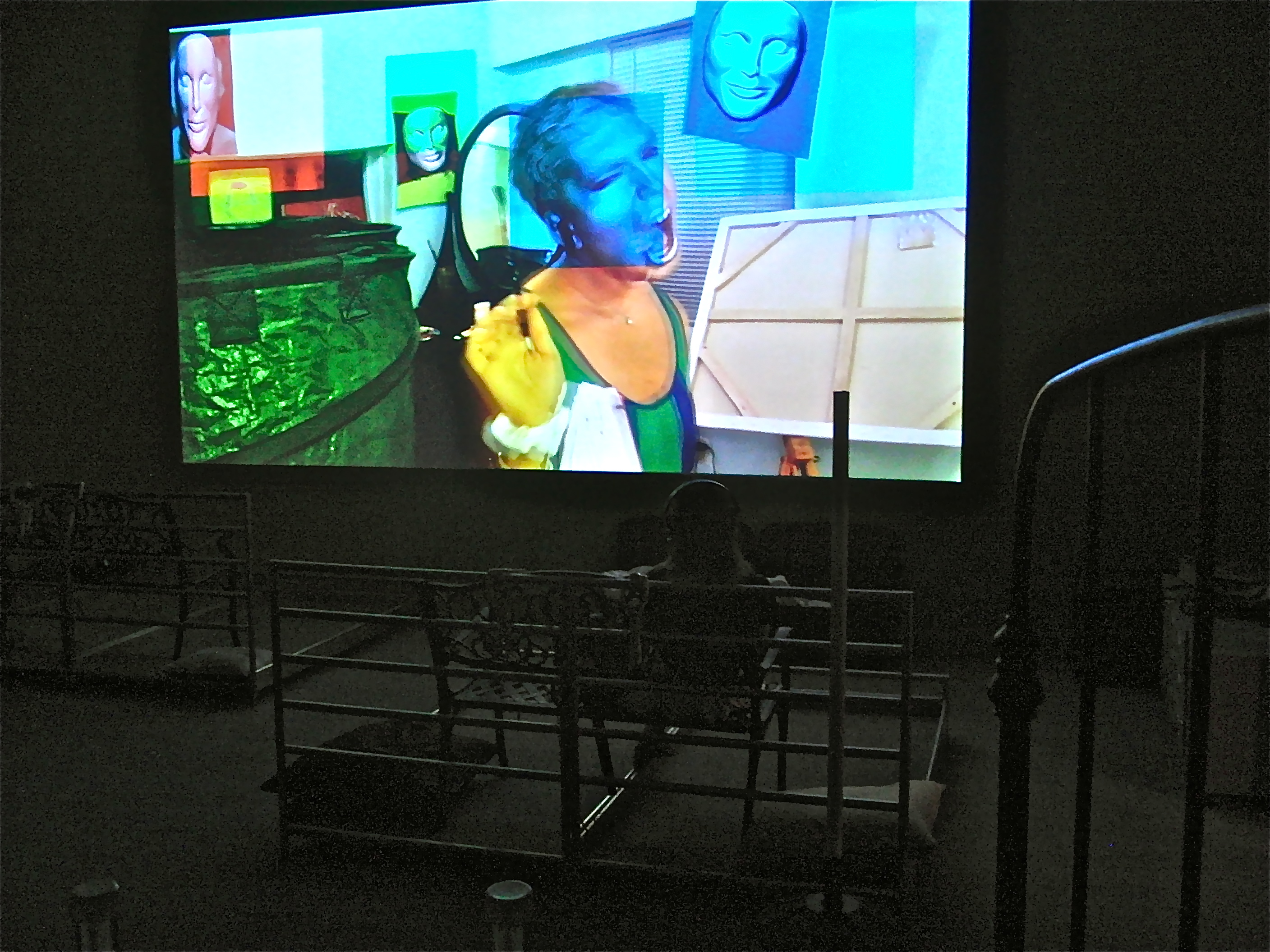
The exhibit kicks into high gear in the basement, where the works are set up amid narrow concrete hallways and passages and in dark rooms. Laure Prouvost’s “It, Heat, Hit” video confronts viewers directly, demanding their attention and that they remember what they see, flash cuts of text and image that fly by in a fury as they tempt and attack all five senses. Rosemarie Trockel’s “Goodbye, Mrs. Mönipaer” consists of longer, calmer shots of a glassed-in bungalow on a beach, water lapping onto the sand as two women, one in a bikini, the other in a bathrobe, each one wearing a mask, are involved in a potential art deal. In “Untitled (David Wojnarowicz Project),” Emily Roysdon re-creates David Wojnarowicz’s “Arthur Rimbaud in New York” series, which comprised photographs of a man, most likely the artist himself, walking the streets of New York wearing a mask that replicated the only known photo of the influential French poet; Roysdon has revisited that idea by taking photos of friends wearing a mask that depicts Wojnarowicz’s visage. In “Berlin Flash Frames,” William E. Jones repurposes a 1961 propaganda film produced by the U.S. Information Agency to question history and memory as the Berlin Wall is constructed and individuals are prepared for relocation. And in “Rabbits,” Aurélien Froment details how to make various knots by using the “rabbit hole” storytelling technique about a rabbit and a snake, neatly tying everything together before taking them apart. The films, most of which are shown using old-fashioned projectors, are the star of the show at the cavernous SculptureCenter, which evokes the past itself, having taken over a former trolley factory, with various mechanical contraptions still visible, creating a kind of palimpsest. SculptureCenter is open on July 4; if you check in on foursquare, you get two-for-one admission and free lemonade. In addition, SculptureCenter will host a pair of “Time Again”-related screenings July 5-6 at 7:00 at Anthology Film Archives, including short works by Joan Jonas, Shahryar Nashat, Ursula Mayer, and exhibition artists Prouvost, Nashabishi, Buckingham, and Jones; Leslie Thornton and Lisa Oppenheim will participate in a special conversation following the July 5 show, with Jones taking part in a Q&A following the July 6 screening.