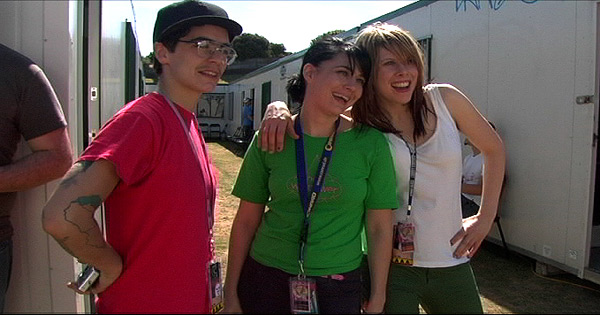
Le Tigre concert documentary will screen January 25 at the Nitehawk Cinema, with members of the band on hand to discuss the film and more
WHO TOOK THE BOMP? LE TIGRE ON TOUR (Kerthy Fix, 2010)
Nitehawk Cinema
136 Metropolitan Ave.
Wednesday, January 25, 9:00
718-384-3980
www.nitehawkcinema.com
www.letigreworld.com
 In 1961, Barry Mann and Gerry Goffin wrote, “I’d like to thank the guy / who wrote the song / that made my baby / fall in love with me.” The title of that be-bop song, “Who Put the Bomp,” inspired one of music’s first fanzines and later the punk record label Bomp! Records. In their 1999 song “Deceptacon,” the riot grrrl group Le Tigre flipped that question around, asking, “Who took the bomp from the bompalompalomp? / Who took the ram from the ramalamadingdong?” In the song they also dare, “Let me hear you depoliticise my rhyme.” Formed in 1998 by former Bikini Kill leader Kathleen Hanna, zine writer Johanna Fateman, and visual artist Sadie Benning, who was replaced in 2000 by DJ and projectionist JD Samson, Le Tigre challenged the male-dominated world of rock and punk, championing individuality and sexual freedom while redefining gender roles. In 2004, Hanna, Fateman, and Samson set out on a world tour in support of their third and final album, This Island, and asked their lighting designer, Carmine Covelli, to capture it all on film. The result is the engaging Who Took the Bomp? Le Tigre on Tour, in which Covelli and director Kerthy Fix go onstage, backstage, and behind the scenes as the influential trio heads across four continents and ten countries, playing exciting live shows, meeting the media, taking pictures with Slipknot, revealing what they pack in their luggage, exercising in the gym, and talking about facial hair. They also discuss more serious issues such as gender identity, lesbianism, and their DIY mentality, which flew in the face of the music industry. The seventy-two-minute film, which features live multimedia performances of such songs as “Hot Topic,” “Keep on Livin’,” “Viz,” and “Deceptacon,” is screening on January 25 at 9:00 at the Nitehawk Cinema in Brooklyn and will be followed by a Q&A with members of the band.
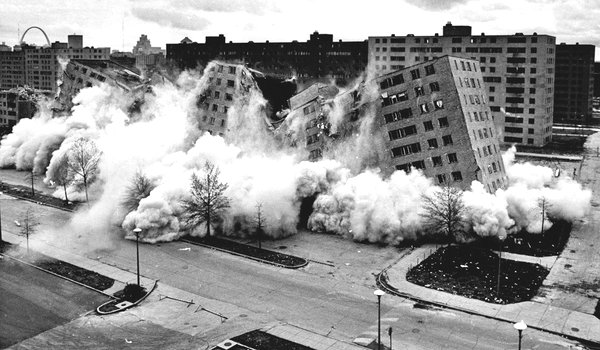
 In 1954, the St. Louis Housing Authority completed a massive urban renewal project, Pruitt-Igoe, a thirty-three-building complex for low-income families that was like a city unto itself. Eighteen years later, mired in crime, violence, poverty, and horrifically unsanitary and unsafe conditions, Pruitt-Igoe was torn down, the implosion famously being shown on news channels around the country as an example of the failure of public policy planning. The short, contentious history of Pruitt-Igoe is explored in the revealing documentary The Pruitt-Igoe Myth. Director Chad Freidrichs (Jandek on Corwood, First Impersonator) revisits Pruitt-Igoe through archival footage, new interviews, and a drive past the site where the iconic housing development, designed by architect Minoru Yamasaki, once stood, revealing the fascinating story of what was first a symbol of the post-WWII boom and then a prime example of the nation’s financial and racial problems of the 1970s. “It was like an oasis in the desert,” Ruby Russell remembers. “I never thought I would live in that kind of a surrounding.” But Brian King, who spent his childhood there, sees it a little differently. “It was hell on earth,” he says. Freidrichs speaks with urban historians Robert Fishman and Joseph Heathcott, sociologist Joyce Ladner, and former residents as they chronologically follow the rise and fall of “the poor man’s penthouse.” Narrated by actor Jason Henry, The Pruitt-Igoe Myth tells a shameful chapter in American history, one that should still be used today as a blueprint on what not to do. “It seemed to me that we were being penalized for being poor,” says former resident Jacqueline Williams. “That caused so much anger.” Named Best Documentary at several festivals and winner of the American Historical Association’s John E. O’Connor Film Award, The Pruitt-Igoe Myth opens January 20 at the IFC Center, with Freidrichs on hand to talk about the film at the 8:20 showings on Friday and Saturday night.

 For The Interrupters, director, producer, and editor Steve James (Hoop Dreams, At the Death House Door) teamed up with journalist Alex Kotlowitz (There Are No Children Here) to hit the dangerous inner-city streets of Chicago with the men and women of CeaseFire, a grass-roots organization of former gang members who are now trying to stop the violence. Inspired by Kotlowitz’s New York Times Magazine article, the two men concentrate on three primary stories. Ameena Matthews, the Muslim daughter of notorious gang leader Jeff Fort, is working with a deeply troubled young woman who’d rather fight than flee, even if it means being sent back to prison. Cobe Williams has his hands full with the angry, recently released Flamo, who thinks the whole world is against him. And Eddie Bocanegra is attempting to come to grips with a cold-blooded revenge murder he committed when he was a teenager by visiting schools and talking about turning his life around. One of the most poignant moments of the film occurs when Williams brings Lil Mikey back to the barbershop he and several of his cohorts robbed at gunpoint as he again faces some of his victims. Matthews, Williams, and Bocanegra are paid employees of CeaseFire, which was founded by Dr. Gary Slutkin, an epidemiologist who believes that violence is a disease that can be treated in similar ways, and is run by Tio Hardman, who handles his extremely tough task with intelligence and dignity as he deals with what he calls “the madness.” But in a society in which “words’ll get you killed,” as Matthews says early on, these tireless violence interrupters put their own lives on the line every day, battling a sickness that seems to have no end in sight. The award-winning film, a hit at numerous film festivals, felt a bit long at its original 144 minutes, but James edited it down to a more streamlined 124 minutes for its recent theatrical release. The Interrupters is screening January 12 at 8:00 at the IFC Center as part of the Stranger than Fiction series and will be followed by a Q&A with the director.