this week in lectures, signings, panel discussions, workshops, and Q&As

CRAZY WISDOM: THE LIFE AND TIMES OF CHÖGYAM TRUNGPA RINPOCHE

Buddhist bad boy Chögyam Trungpa is focus of colorful new documentary playing at the Rubin Museum (photo by Bob Morehouse)

CRAZY WISDOM: THE LIFE AND TIMES OF CHÖGYAM TRUNGPA RINPOCHE (Johanna Demetrakas, 2011)
Rubin Museum of Art
150 West 17th St. at Seventh Ave.
November 25 – December 3, $12
212-620-5000
www.rmanyc.org
www.crazywisdomthemovie.com

Born in February 1939 and recognized as an enlightened reincarnation of the Trungpa tülkus when he was just thirteen months old, Chögyam Trungpa escaped his native Tibet during the 1959 Chinese invasion, eventually becoming a central figure in the spread of Tibetan Buddhism throughout the West. Filmmaker Johanna Demetrakas (Right Out of History: The Making of Judy Chicago’s Dinner Party), a former student and friend of Chögyam Trungpa’s, recounts his unusual story in the adulatory Crazy Wisdom: The Life and Times of Chögyam Trungpa Rinpoche. “From the first seminar, called ‘The Battle of Ego” in Los Angeles, to filming his cremation on a cloudless but rainbow-filled day in Vermont, Chögyam Trungpa literally blew my mind,” Demetrakas explains on the film’s official website. His fascinating tale is liable to blow your mind too. Chögyam Trungpa invited Demetrakas into his inner circle from 1983 to 1987, allowing her intimate access to his wild life, which included exchanging his monk’s robes for a business suit and later a pseudo-military uniform, confusing his followers and angering his critics. A proponent of what he called “crazy wisdom,” Chögyam Trungpa studied at Oxford, suffered partial paralysis in a car accident, married a sixteen-year-old westerner, smoked cigarettes, was a heavy drinker, and carried on dalliances with many of his female students while teaching about fear, self-deception, the ego, spiritual materialism, and the importance of meditation. “You can survive by doing nothing,” he preached, but he alienated some with his nontraditional actions, leading him to be known as the “Bad Boy of Buddhism.” Trying to get to the bottom of the complicated man who founded such learning centers as the Naropa Institute and Shambhala, Demetrakas speaks with Chögyam Trungpa’s wife, Diana Mukpo, his lover Agness Au, and his eldest son, Sakyong Mipham; such fellow teachers as Pema Chodron and Ram Dass; poets Allen Ginsberg and Anne Waldman; and various other scholars, journalists, and former students, supplemented by archival footage and clips from his teachings, which together paint a compelling portrait of a most colorful and singular individual. Crazy Wisdom is scheduled for a one-week limited engagement at the Rubin Museum beginning November 25, with all screenings (several of which are beginning to sell out) followed by Q&As with such special guests as Demetrakas, Waldman, Au, Meredith Monk, Tulku Jamyang Rinpoche, and others.

SEE YOU NEXT WEDNESDAY: 8 FILMS BY JOHN LANDIS

THE BLUES BROTHERS is part of eight-film BAMcinématek tribute to John Landis

BAMcinématek
30 Lafayette Ave. between Ashland Pl. & St. Felix St.
November 21-30
212-415-5500
www.bam.org

Film enthusiast, historian, theorist, actor, and writer-director John Landis made some of the seminal comedies of the 1970s and ’80s, particularly a five-film streak that began in 1977 with The Kentucky Fried Movie and continued with National Lampoon’s Animal House (1978), The Blues Brothers (1980), An American Werewolf in London (1981), and Trading Places (1983), followed by the underrated Into the Night (1985). He’s also made such guilty pleasures as 1986’s ¡Three Amigos! (you know you don’t change the channel when you find it on cable) and the 1992 vampire flick Innocent Blood, but he’s directed only one feature film since 1998, the 2010 comedy Burke and Hare. BAMcinématek is honoring the Chicago-born, L.A.-raised auteur with an eight-film tribute in conjunction with the release of his latest book, Monsters in the Movies (DK Adult, September 2011, $40), that begins today with two screenings of Animal House sandwiching a 6:50 showing of Into the Night that will be followed by a Q&A and book signing with Landis, who will be back tomorrow for a Q&A and signing after the 7:00 screening of The Blues Brothers, which is still a riot after all these years. The tribute continues on Wednesday with the very funny — and currently extremely relevant yet again — Trading Places, with one-percenter-wannabe Dan Aykroyd changing positions with ninety-nine-percenter Eddie Murphy. The series concludes next week with a pair of double features, ¡Three Amigos! and Coming to America (1988) on November 29 and the always welcome An American Werewolf in London and the 1982 documentary Coming Soon on November 30. Oh, and keep an eye out for a reference to “See you next Wednesday,” which makes a Hitchockian appearance in nearly every one of Landis’s films.

THE CONTENDERS 2011: BRIDESMAIDS

Kristen Wiig will be at MoMA on November 21 discussing BRIDESMAIDS with costar Rose Byrne and director Paul Feig

BRIDESMAIDS (Paul Feig, 2011)
MoMA Film
Museum of Modern Art
11 West 53rd St. between Fifth & Sixth Aves.
Monday, November 21, 2011, 7:00 p.m
Series runs through January 26
Tickets: $10, in person only, may be applied to museum admission within thirty days, same-day screenings free with museum admission, available at Film and Media Desk beginning at 9:30 am
212-708-9400
www.bridesmaidsmovie.com
www.moma.org

First and foremost, don’t link Bridesmaids in with all those lousy Saturday Night Live one-note movies and the string of overrated and overhyped lowbrow trash streaming out of the Judd Apatow factory. And don’t assume it’s a silly chick flick either. As it turns out, Bridesmaids is one of the most consistently funny laugh-out-loud romps of this young century. Directed by Freaks and Geeks creator Paul Feig, Bridesmaids is an endlessly clever and insightful examination of love, loneliness, and friendship starring SNL’s Kristen Wiig, who cowrote the smart script with Groundlings member Annie Mumolo (who makes a cameo as a nervous flyer). Wiig shows surprising depth and range as Annie, a perennial screw-up whose closest childhood friend, Lillian (Maya Rudolph), is marrying into a very snooty upper-crust family. After agreeing to be Lillian’s maid of honor, Annie gets involved in a battle of wits with Lillian’s future sister-in-law, the elegant Helen (a radiant Rose Byrne), who is determined to outshine Annie in every way possible and steal Lillian away from her. Already a mess — she had to close her bakery, she shares an apartment with a bizarre pair of British siblings, she works in a jewelry store where she drives away potential customers with her sorry tales of woe, and she allows herself to be treated miserably as a late-night booty call for a self-centered businessman (Jon Lamm) — Annie experiences a series of hysterical, pathetic setbacks as she attempts to organize the bridal shower and bachelorette party, including a riotous potty-humor scene in a high-end boutique that is likely to go down in comedy history for its sheer relentlessness. The rest of the bridesmaids are quite a hoot — Becca (Ellie Kemper), the Disney-loving kewpie doll; Rita (Wendi McLendon-Covey), a foul-mouthed married mother who can’t wait to go crazy away from her family; and the groom’s burly sister, Megan (the hugely entertaining Melissa McCarthy), who lives life without a filter. Annie is so caught up in her own failures that she doesn’t recognize when something potentially good enters her life, in the form of state trooper Nathan Rhodes (Chris O’Dowd). Wiig gives the finest performance of her career as Annie, clearly a role that is very close to her heart. Despite the slapstick nature of many of the jokes, Bridesmaids is filled with heart and soul, making it one of the best comedies in years.

Bridesmaids is screening November 21 at the Museum of Modern Art as part of MoMA’s “The Contenders 2011,” with Wiig, Byrne, and Feig participating in a postscreening discussion. The series, which focuses on either underlooked films and/or those that MoMA believes will stand the test of time, continues through January 26 with such works as Terence Malick’s The Tree of Life, Nicholas Winding Refn’s Drive, David Cronenberg’s A Dangerous Method, and Karim Ainouz’s O Abismo Prateado (The Silver Cliff).

BEST FILM NOT PLAYING AT A THEATER NEAR YOU: THE REDEMPTION OF GENERAL BUTT NAKED

The bizarre story of the Liberian warlord known as General Butt Naked is told in stirring documentary

THE REDEMPTION OF GENERAL BUTT NAKED (Danielle Anastasion & Eric Strauss, 2011)
MoMA Film
Museum of Modern Art
11 West 53rd St. between Fifth & Sixth Aves.
Saturday, November 19, 3:30, and Sunday, November 20, 6:00
Tickets: $10, in person only, may be applied to museum admission within thirty days, same-day screenings free with museum admission, available at Film and Media Desk beginning at 9:30 am
212-708-9400
www.moma.org
www.generalbuttnakedmovie.com

Once again, the month of November is playing host to MoMA’s inventive “Best Film Not Playing at a Theater Near You” series. This program of American independent cinema, held in conjunction with the annual Gotham Independent Film Awards and the Independent Film Project, highlights five award-winning documentaries and features, with Q&A sessions with the filmmakers following selected shows. One of this year’s noteworthy selections is The Redemption of General Butt Naked, a documentary following the story and progression — as well as midlife crisis and career change — of brutal Liberian warlord Joshua Milton Blahyi. A figure infamous for an unimaginable resume of inhuman and genocidal atrocities, the eponymous general was known for leading an army of child soldiers into battle during his country’s long civil war, often wearing nothing more than boots and an AK-47 rifle, believing himself to be supernaturally immune to gunfire. The film examines his history and details his subsequent spiritual reawakening and self-reinvention as a charismatic Christian evangelist. Director-producers Danielle Anastasion and Eric Strauss will be on hand following the two screenings (November 19 at 3:30 and November 20 at 6:00) for a discussion of the film, which was cited for Excellence in Cinematography (Ryan Hill and Peter Hutchens) at this year’s Sundance Film Festival. The series continues through November 21 with four other 2011 discoveries, Madeleine Olnek’s Codependent Lesbian Space Alien Seeks Same, Sophia Takal’s Green, Blue Hadaegh and Grover Babcock’s Scenes of a Crime, and Mark Jackson’s Without. The Best Film Not Playing at a Theater Near You winner will be announced at the Gotham Independent Film Awards ceremony on November 28.

TWI-NY TALK: GUY MADDIN

Eclectic Canadian filmmaker Guy Maddin will be taking part in a pair of special Performa 11 presentations on Friday and Saturday

Tales from the Gimli Hospital: Reframed
November 18-19, Walter Reade Theater, 165 West 65th St., $25-$30, 7:00 & 9:00
www.11.performa-arts.org/event

“The Power of a Continuity-Free Cinema”
Saturday, November 19, Performa Hub, 233 Mott St., $10, 3:00
www.11.performa-arts.org/event

During a career that has now reached a quarter of a century, iconoclastic Canadian filmmaker Guy Maddin has made ten feature films and more than two dozen shorts, many of them harkening back to the early days of silent black-and-white cinema. His eclectic tales often blend fact with fiction, the past with the present (and the future), as evidenced in such critical successes as Careful (1992), The Heart of the World (2000), and My Winnipeg (2007). He has also expanded the notion of cinema with such works as Cowards Bend the Knee (2003), which was initially shown in ten segments screening at individual stations, and Brand upon the Brain! A Remembrance in 12 Chapters (2006), which debuted with live music and narration. For Performa 11, Maddin is going back to his first feature film, 1988’s Tales from the Gimli Hospital, adding a new score by Matthew Patton that will be performed live by an Icelandic supergroup, electronics engineer Paul Corley, and Seattle-based collective Aono Jikken Ensemble, along with new narration sung and spoken by Kristín Anna Valtýsdóttir. The exciting program takes place at the Walter Reade Theater on November 18-19, directed by Maddin, who will also be teaching the film class “The Power of a Continuity-Free Cinema” on Saturday afternoon. We corresponded with Maddin via e-mail as he prepared to participate in Performa 11.

twi-ny: What made you want to revisit your first film, Tales from the Gimli Hospital, for Performa 11?

Guy Maddin I thought, of all the films of mine that might actually thematically justify a revisiting from the director (something that truly ought not to be done under almost any circumstances!), then this was the title. The movie, if it’s about anything, seems to play with the Icelandic proclivity for making personal lives into timeless myths. I chose to use the project to help us timid Canadians take up the task of doing the same thing for our smaller-than-life selves. There’s a serious national myth debt in Canada. Back in 1988, when I completed the movie, I tried to right that wrong by myself, using the great vocabularies of early Hollywood dream factories and the sassitudes of the ancient Icelandic sagas. We have a wondrous and perverted history up here in Canada, but our temperament is too weak, our storytelling flare too pallid, to impart to these stories the bigger-than-life lineaments required to elevate a person or incident to mythic dimensions. Americans can do this stuff in their sleep, so you might be puzzled to hear of a country struggling with such things.

Anyway, myths are the product of a long process of telling and retelling, word-of-mouth burnishings into canonical permanence that can take decades, centuries, or even millennia to complete. I wanted to do it overnight, using artificial means aided by methods borrowed from Hollywood, and now, twenty-three years later, I get to artificially update this saga of Icelanders struggling as delirious pioneers in the Canadian north by speed-composting twenty-three years’ worth of word-of-mouth retellings all in one night at Lincoln Center. I feel a bit like a mad scientist, but with my Petri dishes brimming with narrative gelatins instead of the usual sneeze-cultures. It’s crazy. If I’d tackled any other movie of mine, I’d simply be trying to reduce the humiliations produced by a dated filmography, but here I can use this mad process of allowing the stories to evolve in ways beyond my control to actually increase my humiliation!

Guy Maddin will be reframing his feature-length debut at Lincoln Center as part of Performa 11 (photo courtesy Guy Maddin)

twi-ny: How did you go about selecting the diverse range of musicians for this event?

Guy Maddin: Some of these were people located by Matthew Patton, the composer originally commissioned to create the new score. He’s a fervid Icelandophile and collected the phone numbers of some of the most talented musicians in that country. Incredible, unearthly, and eerie music is their coin of the realm. One gets the feeling their music would play the same backward as forward, that they waft out melodic palindromes on warm breezes of helium, that the actual source of these strains is the elf king’s adamantine face fixed and hidden somewhere in the Icelandic lava canyons. The other musicians are my friends from the Seattle-based Aono Jikken Ensemble, who performed for my Brand upon the Brain show that I mounted here in New York a few years ago. I love these equally mysterious alchemists. I have no idea how they even make some of the sounds they send out into the theater, although the audience will be able to watch them and perhaps divine for themselves.

I love making the component parts of a film visible to the public. It’s boredom insurance. I’m not thrilled about the vivisection of animals, but of films — I’m all for it!

twi-ny: We have to say that we’re for it too. That’s part of the reason why we’ll be attending the class you’ll be leading on Saturday afternoon, “The Power of a Continuity-Free Cinema.” What can people expect from that class? And what exactly is “Continuity-Free Cinema”?

Guy Maddin: Good question. I’ll be bluffing my way through that class. I guess I plucked the title out of my past, the early days of my career when everyone on set was a continuity expert. It drove me nuts when everyone pointed out to me, or refused to perform because of, the continuity errors I was making. I grew to hate these literal-minded people and to love bad continuity. No one really utters this vilest of c-words anymore. Terrence Malick hasn’t had two consecutive shots cut to continuity in his entire career. It’s gone. Maybe I’ll just show Tree of Life on DVD and dismiss the class when the credits roll. Maybe I’ll show some early examples of flagrant discontinuity from film history and try to share with my students the gooseflesh these incidents produce.

twi-ny: Sounds like it should be fun. Much of your work is not only about cinema itself but the physical and psychological experience involved with watching and listening to a film. With more and more people watching movies on computers and tiny handheld devices, is cinema as we knew it, as Peter Greenaway has announced, dead?

Guy Maddin: Nah, there’s still no better first date than a movie in a theater with popcorn. And we’ll always need first dates, or something like them. On a second date couples can meet up in some motel and watch my stuff on some lurid handheld device. Until we eliminate the first date, cinema is alive.

JOHN JASPERSE: CANYON

John Jasperse’s CANYON should delight audiences at BAM this week

NEXT WAVE FESTIVAL
Brooklyn Academy of Music
BAM Harvey Theater
651 Fulton St. between Ashland & Rockwell Pl.
November 16-19, $16-$45, 7:30
718-636-4100
www.bam.org

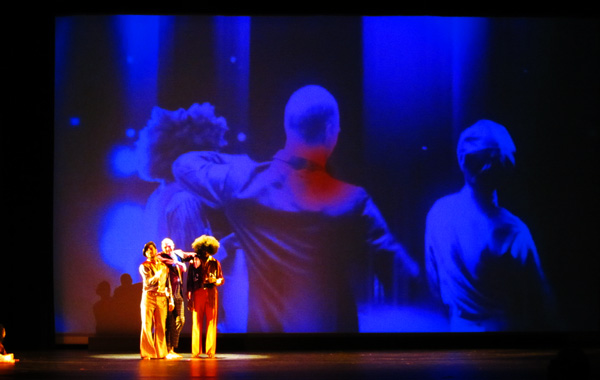
In works such as Becky, Jodi and John at Dance Theater Workshop, Truth, Revised Histories, Wishful Thinking, and Flat Out Lies at the Joyce, and Misuse Liable to Prosecution at BAM’s 2007 Next Wave Festival, New York City–based choreographer John Jasperse has shared intimate moments with the audience in creating unusual and often challenging evenings of dance theater. This week Jasperse and his Thin Man Dance company return to BAM to present the New York premiere of Canyon, which deals with “the transformative power of losing oneself in visceral experience.” Running November 16-19, the seventy-minute piece features dancers Lindsay Clark, Erin Cornell, Kennis Hawkins, Burr Johnson, and James McGinn, a live score by Hahn Rowe, visual design by Tony Orrico, and lighting by James Clotfelter. There will be an artist talk with Jasperse and his collaborators following Thursday night’s performance, moderated by Mary-Jane Rubenstein, whose book Strange Wonder: The Closure of Metaphysics and the Opening of Awe influenced the making of Canyon.

John Jasperse’s CANYON celebrates the thrill of the dance (photo by Tony Orrico)

Updated: Dance does not always have to be about something. In such previous works as Becky, Jodi and John, Truth, Revised Histories, Wishful Thinking, and Flat Out Lies, and Misuse Liable to Prosecution, John Jasperse dealt with a number of themes, from personal relationships and environmentalism to the fine line between fantasy and reality. In his latest evening-length piece, Jasperse eschews high concept in favor of, quite simply, the thrill of the dance. The seventy-minute Canyon puts Jasperse’s breathtaking choreography front and center, a celebration of the joy of movement, with Jasperse, Lindsay Clark, Erin Cornell, Kennis Hawkins, Burr Johnson, and James McGinn running, jumping, twisting, and rolling to an exciting score composed by Hahn Rowe and performed live by Olivia De Prato on violin, Ha-Yang Kim on cello, Doug Wieselman on bass clarinet, and Rowe on violin, guitar, and electronics. Because this is Jasperse, there are odd elements as well, courtesy of visual designer Tony Orrico, that include yellow tape that begins outside on the street and wends its way through the BAM Harvey lobby and bathrooms and into the theater, down the steps, across the stage, and onto the back wall, where they resemble an abstract map. Meanwhile, a large white box continually roams the space, adding to the fun. And what fun it is.

THE ART OF THE DATE: A GALLERY WALK ON THE LOWER EAST SIDE

Lower East Side Visitor Center
54 Orchard St. between Grand & Hester Sts.
Wednesday, November 16, free with RSVP, 6:00 – 9:00
www.newyorkdating.eventbrite.com
www.lowereastsideny.com

In the 1972 comedy Play It Again, Sam, Allan (Woody Allen) is in a museum trying to pick up a woman (Diana Davila). “What are you doing Saturday night?” he asks her. “Committing suicide,” she replies, to which Allan responds, “What about Friday night?” On Wednesday, November 16, it might not be so dire as a group of singles mingle for an evening of free art, conversation, music, and drinks and snacks. “The Art of the Date: A Gallery Walk on the Lower East Side” will take participants (free with advance RSVP) from the Lower East Side Visitors Center on Orchard St. to four nearby galleries: Lesley Heller Workspace, which currently has a solo show by Tom Kotik and a group show called “Headcase”; Lost Weekend NYC, which is displaying 1980s photographs by celebrity snapper Patrick McMullan; Dino Eli Gallery, which is showing “Artists on the Prowl: The Hunter, the Wanderer, the Trash Collector & the Street Master”: and Stephan Stoyanov Gallery, which is featuring “Transformation and Perception: Paintings by Jill Weber.” In addition to the art, there will be free food from Bruschetteria, PopChips, and Lucky Penny Bake Shop, free drinks courtesy of Beck’s, and music by DJ Michael Little.