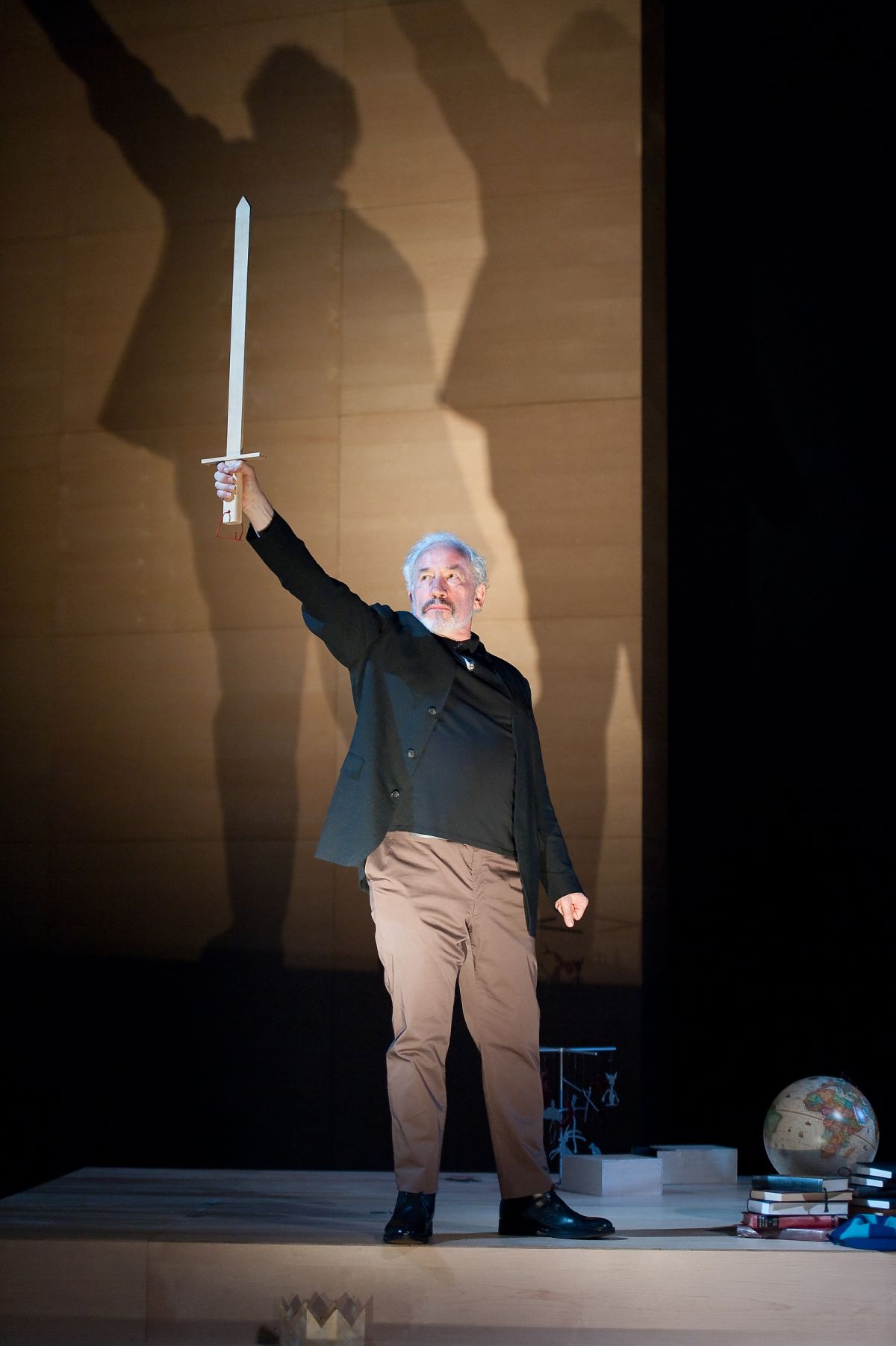
Simon Callow goes through the seven stages of Shakespeare in one-man show (photo by Stephanie Berger)
Brooklyn Academy of Music
BAM Harvey Theater
651 Fulton St. between Ashland & Rockwell Pl.
Through April 14, $25-$100
718-636-4100
www.bam.org
Obsessed with William Shakespeare since he was six years old, British actor Simon Callow, now sixty-two, is currently at BAM playing Hermione and Leontes from The Winter’s Tale, Mark Antony and Caesar from Julius Caesar, Jaques, Orlando, and Rosalind from As You Like It, Antipholus from The Comedy of Errors, Falstaff and Prince Henry from Henry IV, Prospero and Miranda from The Tempest, Quince, Flute, Bottom, and Puck from A Midsummer Night’s Dream, Kings Henry V, Richard II, and Lear (as well as Queen Margaret), both Romeo and Juliet, Macbeth, Old Hamlet, and even Shakespeare himself. And he does all that and more in a mere hour and a half in the one-man show Being Shakespeare, written by Bard scholar and Oxford English literature professor Jonathan Bate and directed and designed by Tom Cairns. Built around Jaques’s seven stages of man monologue from As You Like It — “All the world’s a stage / And all the men and women merely players / They have their exits and their entrances / And one man in his time plays many parts / His acts being seven ages” — Being Shakespeare follows the Bard from birth to death, with Callow (Shakespeare in Love, Four Weddings and a Funeral) discussing various aspects of Shakespeare’s personal life, about which precious little is known, and relating them to specific lines and characters from his plays and sonnets. Although there are a handful of Eureka! moments, there are also a lot of comparisons that are too much of a stretch, supposition instead of fact. Bate does include fascinating tidbits about Shakespeare’s sisters, working in his father’s glove-making shop, dealing with lawyers, and marrying the pregnant Anne Hathaway, but the show often feels more like a historical literary lecture than a dramatic play — and, of course, as Hamlet famously intoned, “The play’s the thing.” Callow does a magnificent job at some points, particularly his marvelously entertaining handling of an exchange between Falstaff and Prince Henry about preparing an army unit and the scene in which Peter Quince is casting Pyramus and Thisbe in Dream, but other snippets lack depth and power, perhaps better in idea than in execution. Being Shakespeare might be a treat for Shakespeare fanatics and completists, but it will leave others wanting more. Callow will participate in a postshow talk moderated by Jeff Dolven on April 12, and Bate will be in conversation with Barry Edelstein on April 15 in the BAM Hillman Attic Studio.
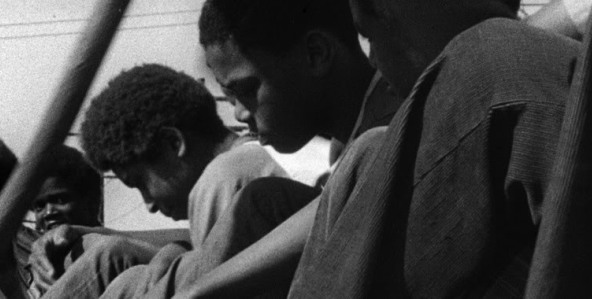
 In 2007, Milestone Films restored and released Charles Burnett’s low-budget feature-length debut, Killer of Sheep, with the original soundtrack intact; the film had not been available on VHS or DVD for decades because of music rights problems that were finally cleared. (The soundtrack includes such seminal black artists as Etta James, Dinah Washington, Little Walter, and Paul Robeson.) Shot on weekends for less than $10,000, Killer of Sheep took four years to put together and another four years to get noticed, when it won the FIPRESCI Prize at the 1981 Berlin Film Festival. Reminiscent of the work of Jean Renoir and the Italian neo-Realists, the film tells a simple story about a family just trying to get by, struggling to survive in their tough Watts neighborhood in the mid-1970s. The slice-of-life scenes are sometimes very funny, sometimes scary, but always poignant, as Stan (Henry Gayle Sanders) trudges to his dirty job in a slaughterhouse in order to provide for his wife (Kaycee Moore) and children (Jack Drummond and Angela Burnett). Every day he is faced with new choices, from participating in a murder to buying a used car engine, but he takes it all in stride. The motley cast of characters, including Charles Bracy and Eugene Cherry, is primarily made up of nonprofessional actors with a limited range of talent, but that is all part of what makes it all feel so real. Killer of Sheep was added to the National Film Registry of the Library of Congress in 1989, the second year of the program, making it among the first fifty to be selected, in the same group as Rebel Without a Cause, The Godfather, Duck Soup, All About Eve, and It’s a Wonderful Life, which certainly puts its place in history in context. Killer of Sheep will be screening on April 10 as part of the Ghett’Out Film Festival at BAM and will be followed by a Q&A with Charles Burnett. The series, which focuses on contemporary low-budget indie French cinema — Killer of Sheep was a major influence on this new French New Wave — continues through April 12 with such films as Jean-Charles Hue’s La BM du seigneur (The Lord’s Ride), Sylvain George’s May They Rest in Revolt (Figures of War) (Qu’ils reposent en révolte), Djinn Carrenard’s $200 Donoma, and Alain Gomis’s L’Afrance.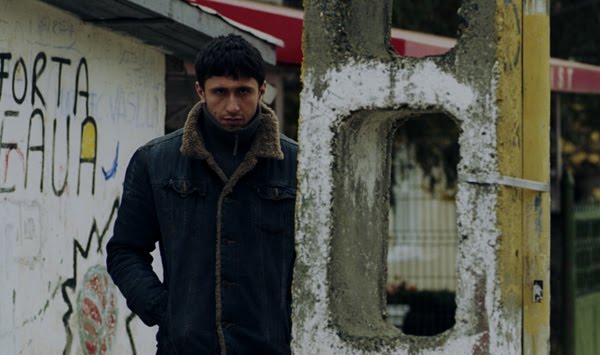
 The first half of Corneliu Porumboiu’s Police, Adjective is as dreadfully boring as Detective Cristi’s (Dragos Bucur) assignment, tailing a student, Victor (Radu Costin), who enjoys a joint with two of his friends every day after school. While Cristi wants to nail the kid’s supplier, the cop’s boss has him on a tight deadline, insisting he arrest Victor if the investigation continues to go nowhere, but Cristi strongly disagrees with putting the teenager away for up to seven years for a crime he believes will soon be abolished by the government. However, the film picks up considerably as Cristi seeks help from various contacts, getting caught up in red tape and public servants who would really rather not be bothered. And when he get called in by the chief (Vlad Ivanov from 4 Months, 3 Weeks, and 2 Days) and gets a long lecture in linguistics, well, you won’t be able to control yourself from laughing out loud. Porumboiu (12:08 East of Bucharest) keeps the pace very slow and very steady, but hang in there, because the end is a riot. Police, Adjective, which won the Un Certain Regard Jury Prize at the Cannes Film Festival, screened at the New York Film Festival and at MoMA as part of the “Contenders, 2009,” series, and was Romania’s official entry for the Foreign Language Film Academy Award, is being shown April 13 at the Bohemian National Hall as part of “Disappearing Act IV,” a festival of recent European films that also includes such works as Miguel Gomes’s Our Beloved Month of August (Aquele Querido Mes de Agosto) from Portugal and France, Vaclav Kadrnka’s Eighty Letters (Osmdesat dopisu) from the Czech Republic, Jaroslav Vojtek’s The Border (Hranice) from Slovakia, Argyris Papadimitropoulos and Jan Vogel’s Wasted Youth from Greece, and Marc Bauder’s The System (Das System ― alles verstehen heisst alles verzeihen) from Germany, with many screenings followed by a Q&A with members of the cast and/or crew. The series is curated and produced by Irena Kovarova and presented in association with the Czech Center, the Romanian Cultural Institute, and the Group of European Cultural Institutes and Diplomatic Representations in New York.
 Experimental filmmaker Bill Morrison’s production company is called Hypnotic Pictures, and for good reason; the Chicago-born, New York-based auteur makes mesmerizing, visually arresting works using archival found footage and eclectic soundtracks that are a treat for the eyes and ears. Several of his films were recently shown at a retrospective at the World Financial Center (including