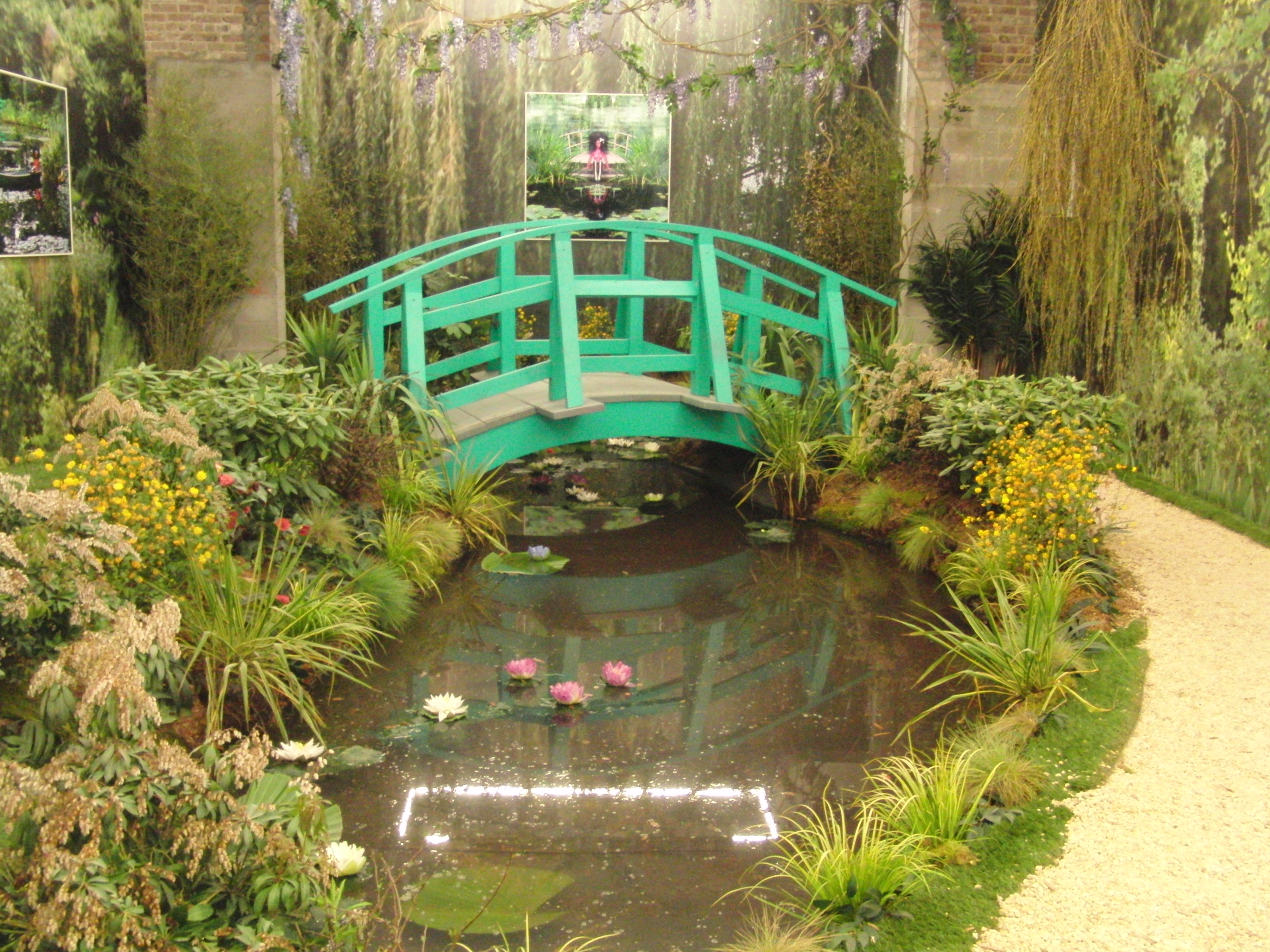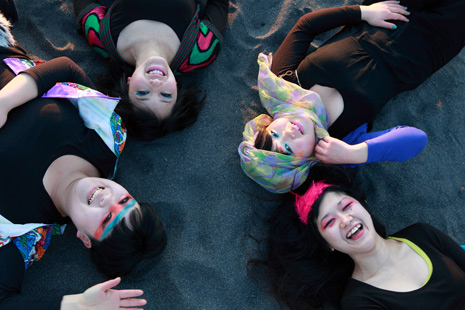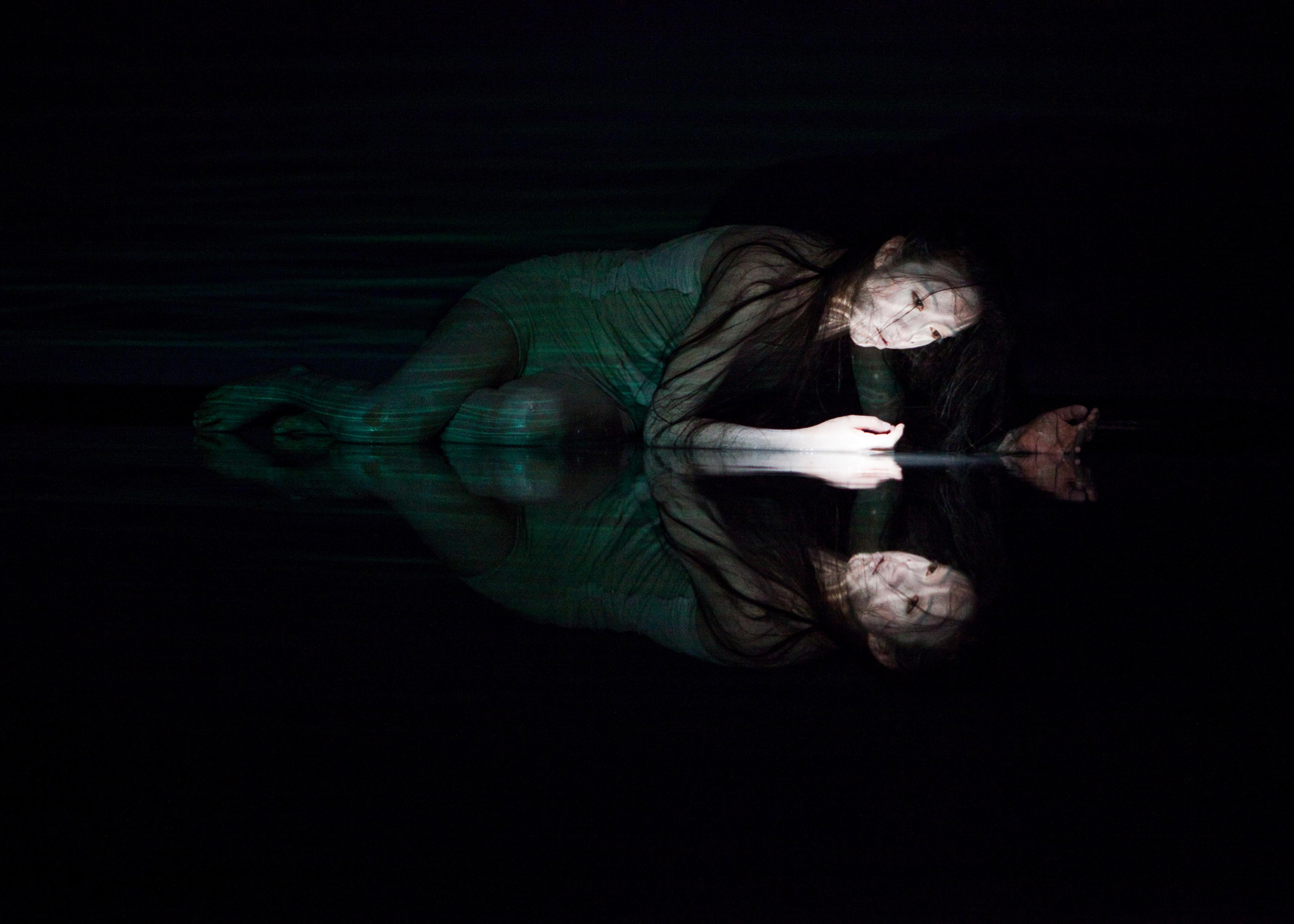
Ximena Garnica reflects on the return of FLOATING POINT WAVES to HERE (photo by Piotr Redliński)
FLOATING POINT WAVES
HERE
145 Sixth Ave. at Dominick St.
April 10-14, 8:30, $20
212-647-0202
www.here.org
Artistic directors of LEIMAY, CAVE, and the New York Butoh Festival, dancer-choreographer Ximena Garnica and video installation artist Shige Moriya collaborate on works that beautifully integrate sound, movement, and image. In such pieces as Furnace, Trace of Purple Sadness, and Becoming, they’ve created immersive, meditative environments that subtly dazzle the mind. They’re currently in the midst of a two-week run of Floating Point Waves, an evening-length show they first presented in January 2011 at HERE’s Culturemart festival as part of the downtown institution’s Artist Residency Program. In between working on Floating Point Waves and preparing for the inaugural SOAK Festival, which begins April 25, they answered some questions for our latest twi-ny talk.
twi-ny: We saw Floating Point Waves when it was presented as a work-in-progress at HERE’s Culturemart festival last year. How has it evolved since then?
LEIMAY: The Floating Point Waves process has been a bit like the formation of those things inside a limestone cave called stalagmites. That kind of formation rises from the floor of a limestone cave due to the dripping of mineralized solutions over long periods of time. Last year the piece itself needed more time for the dripping to carve new forms and uncover new colors. Last year we had found new elements, such as two new kinetic systems — the point sculpture and the tulle tubes — but had not fully integrated them to the level of the other two (pool & string sculpture). The pool and the string sculpture had been worked longer. In the creative process and especially in Floating Point Waves, time is very important. There is something about cooking on a small flame, no?
twi-ny: Indeed. The two of you have been collaborating now as LEIMAY for many years. What is the best thing about working together?
LEIMAY: We were born in very different places, Japan [Moriya] and Colombia [Garnica]. We speak very different languages and communicate in a third language. We were educated very differently, and growing up we studied different things, but somehow we share similar values. So the best thing is when through the work we make together, despite all our differences, somehow we can connect and find the essence of whatever it is we are creating. This might sound vague, but think about those so called “aha moments”; if you have them alone it is great, but when you have them together it is beyond words! However, sometimes those “aha moments” don’t come and one of us is stuck but the other can keep going — that is great too; there is some generosity involved and lots of love.
twi-ny: What is the worst thing about working together?
LEIMAY: When we are totally disagreeing about something and the more we talk the more we disagree but then suddenly we realize that we actually agree but our English is so off that it all seems like a disagreement . . . but in fact it was a lost-in-translation moment. It is awful.
twi-ny: Much of what you do is rooted in the butoh discipline. What is the most misunderstood aspect of butoh?
LEIMAY: Well, we like to say that our work ranges from photography to video art, art installations, interdisciplinary performances, and training projects. And although it is true that Ximena has been training with butoh artists and masters for the past twelve years, our performances and training projects are rooted in the body. What is really at stake is the body. Our contact with butoh has opened our mind to thinking about and questioning the meaning of the dancing body and its possible relationships with space and time.
For audiences, perhaps the most misunderstood aspect of butoh is the expectation of white body-painted people moving slow with grotesque faces and a bit of drooling. For performers, perhaps the most misunderstood aspects are 1.) the mystification of master teachers and of butoh itself and 2.) the view of butoh as a codified form.
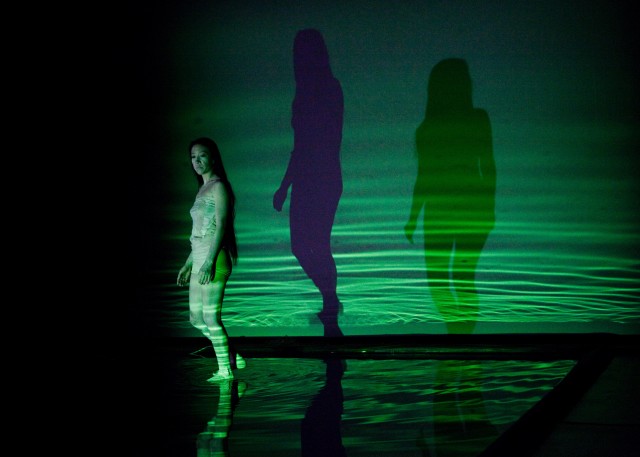
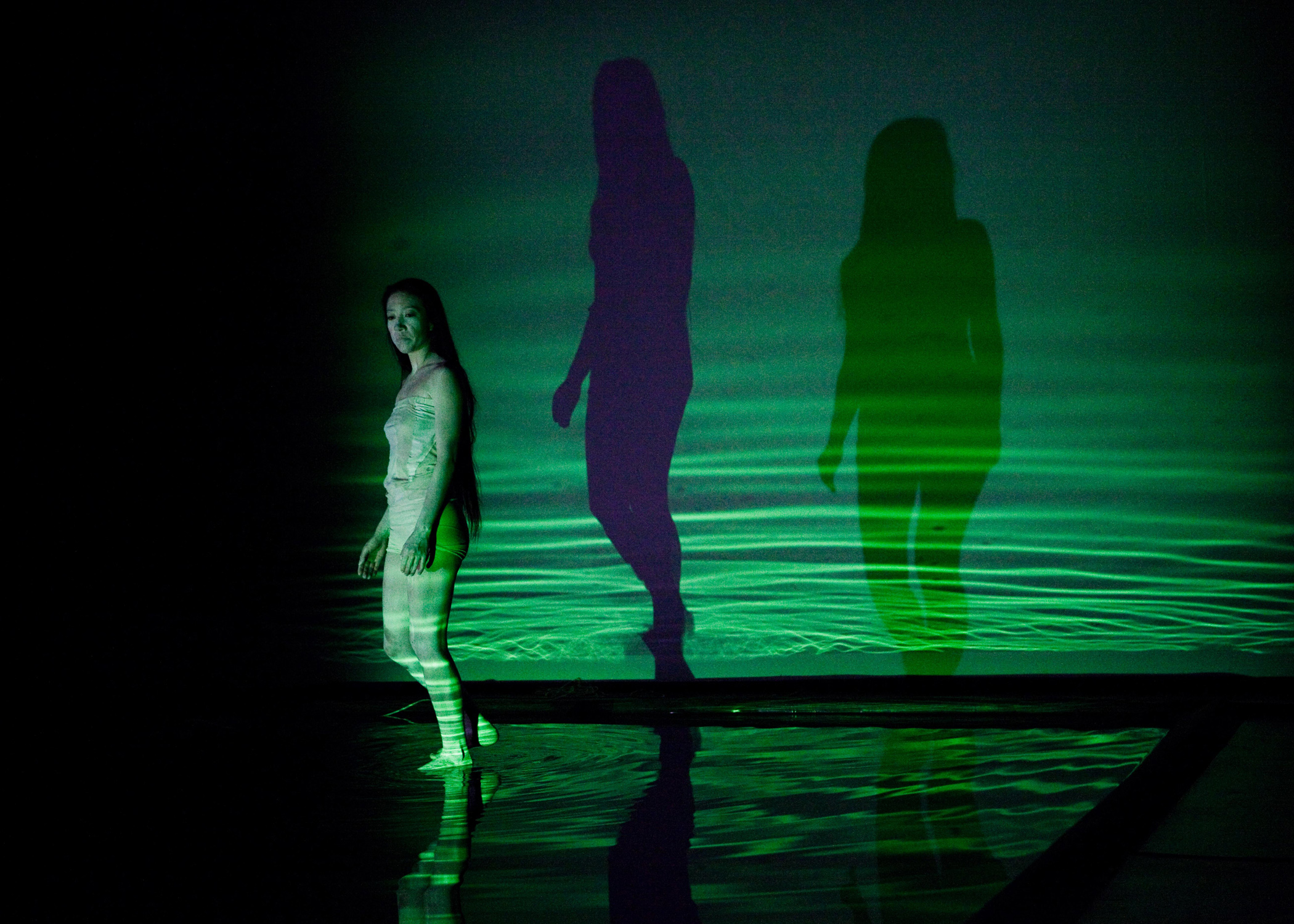
FLOATING POINT WAVES is another subtly dazzling collaboration between Ximena Garnica and Shige Moirya (photo by Piotr Redliński)
twi-ny: You’ve been organizing the New York Butoh Festival since 2003, and this year you’re staging the first SOAK Festival. What can people expect to see in this new festival?
LEIMAY: Actually, the SOAK Festival is taking over the New York Butoh Festival. In the spirit of the interdisciplinary nature of our creations and of the ecology from which our work sprouts, we are launching the first annual SOAK Festival. People can expect nothing. Yes, it is true: We want people to come without expectation. They are invited to our home to meet our friends. We have a good sense for assembling acts and we have an eclectic group of friends and colleagues and, most importantly, we want to share their work with those who make it out to Williamsburg.
This year we will have a deluge of acts and workshops from April 25 to May 13. Opening the festival are an experimental guitarist from Sicily, Ninni Morgia, and his partner, vocalist Silvia Kastel. Next is an unplugged version of a collaboration between butoh legend Ko Murobushi and San Francisco’s Shinichi Iova-Koga of inkBoat. The festival will continue with work from CAVE resident artists such as Russian theater innovator and international master teacher Polina Klimovitskaya and choreographer Rachel Cohen. Former Fulbright Fellow and Movement Research resident Ben Spatz and his theater partner Maximilian Balduzzi are also among those performing. The SOAK Festival workshops are equally eclectic, such as a drawing mural narrative workshop by Tijuana-born, Brooklyn-based draftsman artist Hugo Crosthwaite, an augmented reality lecture/demonstration by NYU teacher and activist Mark Skwarek, a sonoric voice workshop by Uruguayan vocal virtuoso Sabrina Lastman, as well as our own workshop led by Ximena on our training and performance technique called Ludus.
It seems to us like we all see life and performances and things with our own frame. Through our work and the production of the SOAK Festival we challenge ourselves and our audiences to make these frames as malleable as possible so we can expand our understanding of the body and our experience and understanding of daily life. Consequently, we enlarge the realms of perception and creation and discover the possibilities for interaction therein. We hope all of you reading this will make it out to CAVE for the first SOAK Festival.
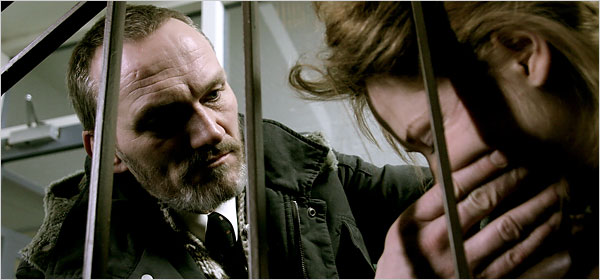
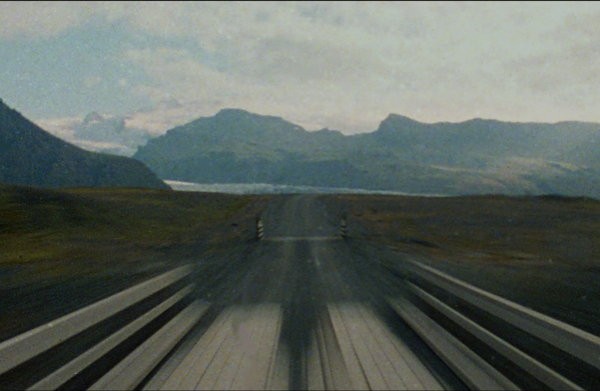
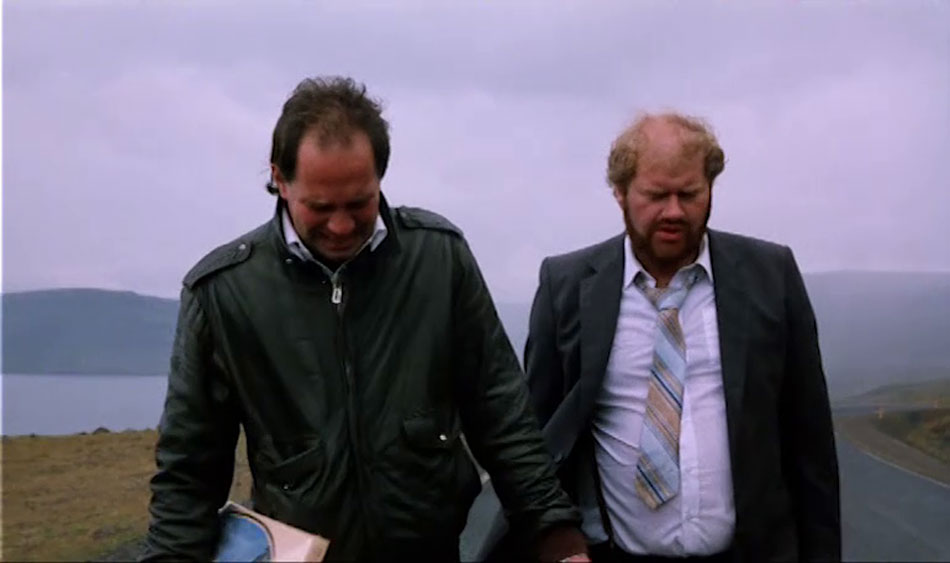
 Writer-director Baltasar Kormákur’s adaptation of Arnaldur Indriðason’s award-winning novel Jar City (Myrin) is a bleak but compelling police procedural that focuses on a fact-based controversial government initiative that is cataloging genetic research on all Icelandic families. When an aging man named Holberg (Thorsteinn Gunnarsson) is murdered in his home, brooding inspector Erlendur (Ingvar E. Sigurdsson) heads the investigation into the death, leading him to a thirty-year-old rape, a dirty cop, a trio of criminals (one of whom has been missing for a quarter century), a woman who killed herself shortly after her four-year-old daughter died, and a doctor who collects body parts. The divorced Erlendur also has to deal with his troubled daughter (Augusta Eva Erlendsdottir), a pregnant drug addict who hangs out with some very sketchy company. Meanwhile, a mysterious man (Atli Rafn Sigurdarson) is up to something following the traumatic death of his young daughter. Kormakur weaves together the story line of the two fathers side by side — in the book, the unidentified man appears only near the conclusion, although who he is still remains a mystery for most of the film — centering on the complex relationship between parents and children and what gets passed down from generation to generation, both on the outside and the inside. Sigurdsson plays Erlendur with a cautious seriousness, the only humor coming from the way he treats his goofy partner, Sigurdur Oli (Bjorn Hlynur Haraldsson). Iceland’s entry for the 2007 Foreign-Language Oscar and winner of the Crystal Globe at the Karlovy Vary International Film Festival, Jar City is a dark, tense intellectual thriller. Indriðason has turned Erlendur into a continuing character in such follow-ups as Silence of the Grave and Voices; here’s hoping Kormákur and Sigurdsson do the same. Jar City will be screening on April 20 and 24 at the Film Society of Lincoln Center’s “Images from the Edge: Classic & Contemporary Icelandic Cinema” series, comprising nineteen works from Iceland ranging from Loftur Guðmundsson’s 1949 Between Mountain and Shore and Ævar Kvaran’s 1950 The Last Farm in the Valley to Árni Ásgeirsson’s 2010 Undercurrent and Hafsteinn Gunnar Sigurðsson’s 2011 Either Way, with the directors present for many of the screenings, including Kormákur following the 6:15 showing of Jar City on April 20.