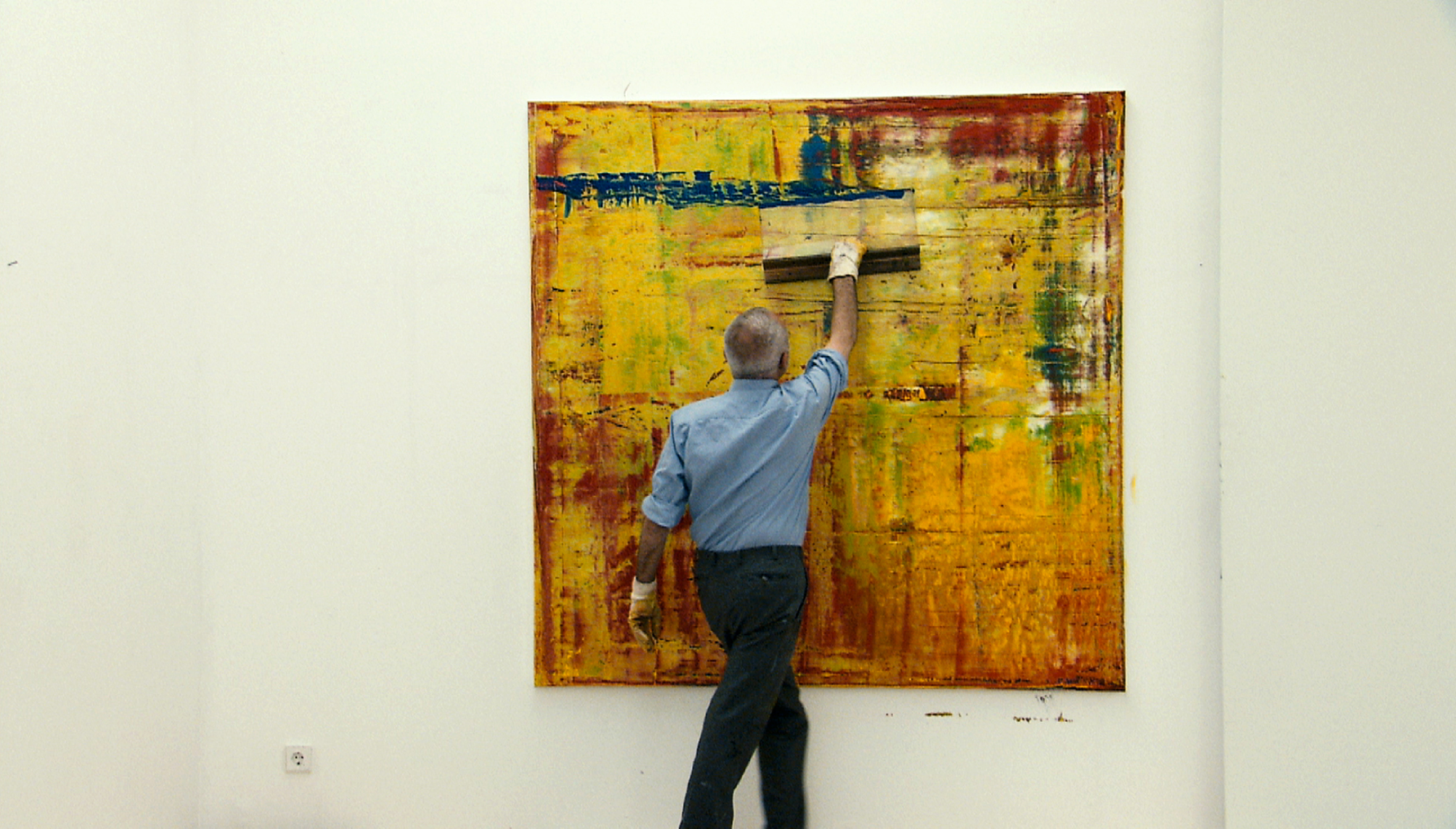
Gerhard Richter reveals his creative process in fascinating new documentary (photo courtesy of Kino Lorber)
GERHARD RICHTER PAINTING (Corinna Belz, 2011)
Film Forum
209 West Houston St.
March 14-27
212-727-8110
www.filmforum.org
www.gerhard-richter-painting.de
 There’s nothing abstract about the title of Corinna Belz’s documentary on German artist Gerhard Richter, no missing words or punctuation marks. Gerhard Richter Painting is primarily just that: Ninety-seven minutes of Gerhard Richter painting as he prepares for several exhibitions, including a 2009 show at the Marian Goodman Gallery in New York City. In 2007, Belz got a rare chance to capture Richter on camera, making a short film focusing on the stained-glass window he designed for the Cologne Cathedral. Two years later, the shy, reserved German artist, who prefers to have his art speak for itself, invited Belz into his studio, giving her remarkable access inside his creative process, which revealingly relies so much on chance and accident. Belz films Richter as he works on two large-scale canvases on which he first slathers yellow paint, adds other colors, then takes a large squeegee and drags it across the surface, changing everything. It’s fascinating to watch Richter study the pieces, never quite knowing when they are done, unsure of whether they are any good. It’s also painful to see him take what looks like an extraordinary painting and then run the squeegee over it yet again, destroying what he had in order to see if he can make it still better. “They do what they want,” he says of the paintings. “I planned something totally different.” About halfway through the film, a deeply concerned Richter starts regretting his decision to allow the camera into his studio. “It won’t work,” he says. “At the moment it seems hopeless. I don’t think I can do this, painting under observation. That’s the worst thing there is.” But continue he does, for Belz’s and our benefit. Belz (Life After Microsoft) even gets Richter to talk a little about his family while looking at some old photos, offering intriguing tidbits about his early life and his escape to Düsseldorf just before the Berlin Wall went up. Belz also includes clips from 1966 and 1976 interviews with Richter, and she attends a meeting he has with Goodman about his upcoming show, lending yet more insight into the rather eclectic artist. “To talk about painting is not only difficult but perhaps pointless, too,” Richter, who turned eighty last month, says in the 1966 clip. However, watching Gerhard Richter Painting is far from pointless; Belz has made a compelling documentary about one of the great, most elusive artists of our time. “Man, this is fun,” Richter says at one point, and indeed it is; watching the masterful artist at work is, well, a whole lot more fun than watching paint dry. Gerhard Richter Painting opens on March 14 at Film Forum, with Yale School of Art dean Robert Storr introducing the 8:00 screening.
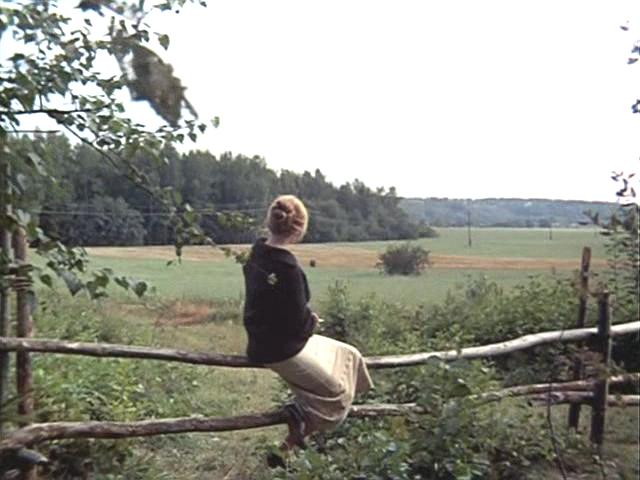
 “Words can’t really express a person’s emotions. They’re too inert.” So says Andrei Tarkovsky’s dream-filled, surreal masterpiece The Mirror, which features long scenes with little or no dialogue. Tarkovsky turns the mirror on himself and his childhood to tell the fragmented and disjointed story of WWII-era Russia through his own personal experiences with his family. Tarkovsky was obsessed with film as art, and this nonlinear film is his poetic masterpiece; he even includes his father’s poems read over shots that are crafted as if paintings. Many of the actors play several roles; have fun trying to figure out who is who and what exactly is going on at any one moment. The Mirror is screening on March 11 at 6:00 at the Museum of the Moving Image as part of the special program “Geoff Dyer on Tarkovsky, Cinema, and Life” and the ongoing “See It Big!” series and will be introduced by award-winning author Dyer, whose latest nonfiction tome is Zona: A Book About a Film About a Journey to a Room (Pantheon, February 21, $24), an obsessively detailed examination of Tarkovsky’s