this week in lectures, signings, panel discussions, workshops, and Q&As

LA VITA E CINEMA — THE FILMS OF NANNI MORETTI: THE SON’S ROOM

Nanni Moretti’s deeply personal THE SON’S ROOM, part of IFC Center retrospective, looks at family tragedy

LA VITA E CINEMA: THE FILMS OF NANNI MORETTI: THE SON’S ROOM (LA STANZA DEL FIGLIO) (Nanni Moretti, 2001)
IFC Center
323 Sixth Ave. at West Third St.
Sunday, April 1, and Monday, April 2
Series continues through April 5
212-924-7771
www.ifccenter.com

Winner of the Palme D’Or at the 2001 Cannes Film Festival, The Son’s Room is a moving look at life, love, and loss. Italian writer-director-actor Nanni Moretti stars as Giovanni, a psychiatrist who can’t control the dissolution of his family following a terrible tragedy. Moretti (Caro Diario, Ecce Bombo) has made a heart-wrenching work that will always be compared with Todd Field’s powerful In the Bedroom, which came out the same year. Both films examine family tragedy with honesty and believability, but whereas the family in In the Bedroom considers revenge, the father in The Son’s Room, achingly played by Moretti, can’t get over wrongly blaming himself, while his wife (Laura Morante, who won the Best Actress award at Cannes for the role) seeks solace in her son’s girlfriend (Sofia Vigliar), whom she had not known about. Moretti is a deeply personal filmmaker; at times you will feel like you are watching a documentary, and it will break your heart. The Son’s Room is screening Saturday and Sunday as part of the IFC Center series “La Vita e Cinema: The Films of Nanni Moretti,” being held in conjunction with the U.S. theatrical release of Moretti’s latest, We Have a Pope, which opens at the IFC Center on April 6. Moretti will discuss the film at the 7:30 screening on March 31. Other films in the retrospective include I Am Self-Sufficient, Bianca, Sweet Dreams, and The Mass Is Ended.

LA VITA E CINEMA — THE FILMS OF NANNI MORETTI: CARO DIARIO

Doctors can’t help Nanni Moretti find out what’s wrong with him in charming CARO DIARIO

CARO DIARIO (DEAR DIARY) (Nanni Moretti, 1994)
IFC Center
323 Sixth Ave. at West Third St.
March 31 – April 2
Series continues through April 5
212-924-7771
www.ifccenter.com

Nanni Moretti’s highly personal and very funny memoir, Caro Diario, is simply wonderful; Moretti plays himself, a filmmaker roaming around Rome on his Vespa and riding into charming little vignettes, including bumping into Jennifer Beals, with whom he’s obsessed. Moretti then travels to the Eolie Islands with his friend Gerardo (Renato Carpentieri), and more comic adventures ensue. The mood changes when Moretti comes down with a rash that doctor after doctor diagnoses differently. This international hit earned Moretti nominations and awards galore, including being named Best Director at the David di Donatello Awards and at Cannes. Caro Diario is screening Saturday, Sunday, and Monday as part of the IFC Center series “La Vita e Cinema: The Films of Nanni Moretti,” being held in conjunction with the U.S. theatrical release of Moretti’s latest, We Have a Pope, which opens at the IFC Center on April 6. Moretti will discuss the film at the 5:45 screening on April 1. Other films in the retrospective include I Am Self-Sufficient, Bianca, Sweet Dreams, The Son’s Room, and The Mass Is Ended.

THE REVIEW PANEL: WHITNEY BIENNIAL 2012

The National Academy will examine the Whitney Biennial on March 30

National Academy Museum
1083 Fifth Ave. at 89th St.
Friday, March 30, $12, 6:30
212-369-4880 ext201
www.nationalacademy.org
whitney.org

We know what we think of this year’s Whitney Biennial — and we’ll be letting you know soon — but in the meantime you can find out others’ thoughts on the 2012 exhibit at the next meeting of the Review Panel, being held March 30 at 6:00 at the National Academy. The National Academy regularly invites a small group of art critics and writers to discuss current exhibitions going on around the city, but this time they’ll focus only on the biennial, for which curators Elisabeth Sussman and Jay Sanders have added some different elements. David Cohen of artcritical.com will moderate the discussion, with participants Bill Berkson (artcritical.com, Art in America), Will Heinrich (The New York Observer), and Karen Wilkin (The New Yorker, The Wall Street Journal). The National Academy is in the midst of its own annual exhibition right now, which we’ll also be telling you more about shortly. The next Review Panel is scheduled for April 27 with Cohen, Lance Esplund, Maddie Phinney, and Barry Schwabsky examining several shows taking place around town.

YOU MUST REMEMBER THIS: CITIZEN KANE

Rubin Museum screening of Orson Welles masterpiece focuses on memory

CITIZEN KANE (Orson Welles, 1941
Cabaret Cinema, Rubin Museum of Art
150 West 17th St. at Seventh Ave.
Friday, March 30, free with $7 bar minimum, 9:30
212-620-5000
www.rmanyc.org/cabaretcinema
www2.warnerbros.com/citizenkane

Citizen Kane is the best-made film we have ever had the pleasure to watch — again and again and again — and it is even more brilliant on the big screen. A young, brash, determined Orson Welles created a masterpiece unlike anything seen before or since — a beautifully woven complex narrative with a stunning visual style (compliments of director of photography Gregg Toland) and a fabulous cast of veterans from his Mercury radio days, including Everett Sloane, Joseph Cotten, Ray Collins, Paul Stewart, and Agnes Moorehead. Each moment in the film is unforgettable, not a word or shot out of place as Welles details the rise and fall of a self-obsessed media mogul. The film is prophetic in many ways; at one point Kane utters, “The news goes on for twenty-four hours a day,” foreseeing today’s 24/7 news overload. And it doesn’t matter if you’ve never seen it and you know what Rosebud refers to; the film is about a whole lot more than just that minor mystery. Like every film Welles made, Citizen Kane was fraught with controversy, not the least of which was a very unhappy William Randolph Hearst seeking to destroy the negative of a film he thought ridiculed him. Kane won only one Oscar, for writing — which also resulted in controversy when Herman J. Mankiewicz claimed that he was the primary scribe, not Welles. The film lost the Oscar for Best Picture to John Ford’s How Green Was My Valley, but it has topped nearly every greatest-films-of-all-time list ever since. Citizen Kane will be screening March 30 at 9:30 as part of the Rubin Museum series “You Must Remember This,” focusing on memory in conjunction with its current Brainwave series and will be introduced by Israeli journalist Rula Jebreal. Admission to the Rubin is free on Friday nights, so you should also check out the exhibitions “Hero, Villain, Yeti,” “Modernist Art from India,” and the outstanding “Casting the Divine.”

THE AIPAD PHOTOGRAPHY SHOW

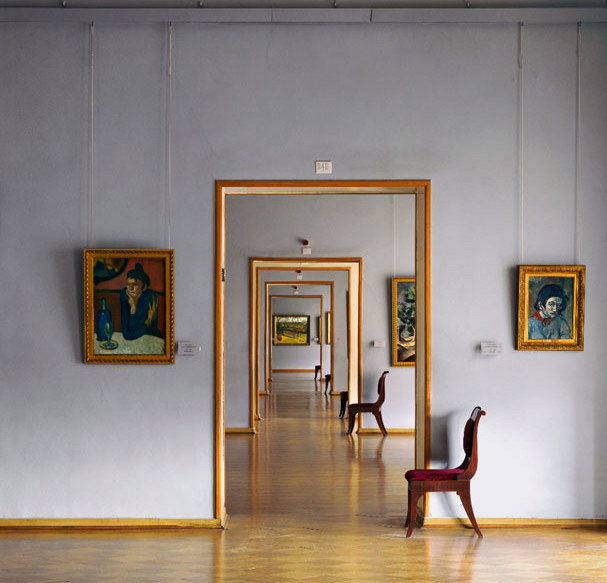
Andrew Moore, “Room 348, Hermitage Museum,” from the series “Russia,” 2003 (courtesy Yancey Richardson Gallery)

Park Avenue Armory
643 Park Ave. at 67th St.
March 29 – April 1, $25 for one day, $40 for all four days
202-367-1158
www.aipad.com
www.armoryonpark.org

These days everyone seems to think they’re a photographer, taking picture after picture after picture with their digital phones and other electronic devices, then posting the results all over social media and blogs. So we always like when the AIPAD Photography Show New York comes to town, reminding us that there’s actually a whole lotta skill that goes with capturing images of the world at large. The thirty-second gathering sponsored by the Association of International Photography Art Dealers takes place March 29 through April 1 at the Park Avenue Armory, featuring exhibits from seventy-five galleries as well as a series of special events, beginning March 28 with the gala kickoff benefiting inMotion, an organization that provides “justice for all women.” Exhibitors from Beijing, Munich, Toronto, Osaka, Paris, Buenos Aires, and London will join American galleries from across the country at the show, including such New York faves as Howard Greenberg, Nailya Alexander, Bonni Benrubi (which will be displaying photographs by Linda McCartney), Steven Kasher (Weegee, Vivian Meier), Danziger (Karen Knorr), Sasha Wolf (Elinor Carucci), Laurence Miller, Julie Saul (Jeff Chien-Hsing Liao), Bryce Wolkowitz, Yancey Richardson (Laura Letinsky, Rachel Perry Welty), Yossi Milo (Alejandro Chaskielberg), and David Zwirner (Philip-Lorca diCorcia). As you wind your way through the armory, you’ll also find works by Ansel Adams, Man Ray, André Kertész, Flip Schulke, and many others. The panel discussions ($10 in advance) will take place Saturday at Hunter College’s Hunter West Building, beginning at 10:00 am with “A Conversation with Rineke Dijkstra,” who will be interviewed by Guggenheim curator Jennifer Blessing, and will continue at 12 noon with “Curator’s Choice: Emerging Artists in Photography,” with Sarah Meister, Christopher Phillips, and Joshua Chuang, moderated by Lindsay Pollock; “How to Collect Photographs: What Collectors Need to Know Now” at 2:00, with Kenneth Montague and Joseph Baio, moderated by Steven Kasher; “A Celebration of Francesca Woodman” at 4:00 with Julia Bryan-Wilson, Sloan Keck, and Elisabeth Subrin, moderated by Robert Klein; and “Italian Contemporary Photography” at 6:00, with Maria Antonella Pelizzari, Yancey Richardson, Julie Saul, and Olivo Barbieri, moderated by Sandra Phillips.

SAKURA — SPRING RENEWS, BEAUTY BLOOMS: KABUKI DANCE

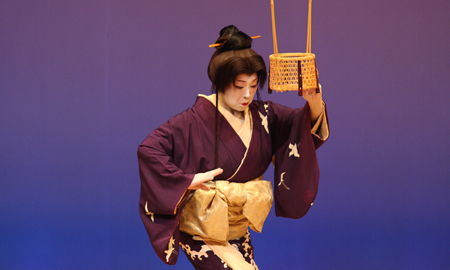
Japan Society celebrates the coming of spring with kabuki dance program this week (photo © Kiyofuji Studio)

Japan Society
333 East 47th St. at First Ave.
March 29-31,
212-715-1258
www.japansociety.org

For more than five hundred years, Japan has been telling stories using the art form known as kabuki, a highly stylized dance play that features ornate costumes, intricately choreographed movement, heavy makeup, and extreme facial gestures. As part of Japan Society’s “Sakura — Spring Renews, Beauty Blooms” festival, nihon buyo (Japanese classical dance) master Bando Kotoji will lead his troupe through four kabuki works March 29-31. Accompanied by live music, the program includes Sanbaso, Cho no Michiyuki (“The Last Journey of Two Butterflies”), Tamatori Ama (“The Pearl Diver”), and Yoshino-yama (“Yoshino Mountain”). All performances will be preceded by a lecture on shamisen music and kabuki dance by Dr. Sachiyo Ito. Japan Society will also be hosting a kabuki workshop on Saturday morning at 10:15 led by Bando; although participant tickets are sold out, you can still attend as an observer for eight dollars. Japan Society’s spring festival continues through April 14 with such films as Hirokazu Kore-eda’s Hana: The Tale of a Reluctant Samurai, a haiku workshop led by Sho Otaka and John Stevenson, and “J-Cation 2012,” an all-day event that includes live music, dance, art, film, food, storytelling, demonstrations, and more.

IT’S A HARD ACT TO FOLLOW

Blair Underwood (in undershirt) will discuss taking on the role of Stanley Kowalski in Drama Desk panel at Sardi’s

A DRAMA DESK PANEL ON PLAYING ICONIC ROLES
Sardi’s
234 West 44th St.
Friday, March 30, $55 with RSVP, 11:45 am
www.dramadesk.org
www.sardis.com

On March 30, you can have lunch with four Broadway stars at Sardi’s as they talk about taking on iconic roles in hit shows in the special Drama Desk event “It’s a Hard Act to Follow.” As you enjoy your choice of salmon, chicken, pasta, or a vegetable basket, USA Today’s Elysa Gardner will moderate a panel discussion featuring Blair Underwood, who will play Stanley Kowalski, a role originated on stage and film by Marlon Brando, in the upcoming revival of A Streetcar Named Desire, which begins previews at the Broadhurst on April 3; Cynthia Nixon, currently earning raves as Dr. Vivian Bearing, a role that previously earned Kathleen Chalfant a slew of awards, in the Broadway debut of Margaret Edson’s Wit, joined by director Lynne Meadow; Hunter Parrish, starring as Jesus in the Godspell revival at Circle in the Square; and Michael McKean, who is playing Dick Jensen in an all-star production of Gore Vidal’s The Best Man, now in previews preparing for an April 1 opening at the Gerald Schoenfeld Theatre.