Todd Haynes’s FAR FROM HEAVEN reveals the dark underside of suburbia
FAR FROM HEAVEN (Todd Haynes, 2002)
Museum of the Moving Image
35th Ave. at 36th St., Astoria
Thursday, June 14, $20, 7:00
718-777-6800
www.movingimage.us
www.farfromheavenmovie.com
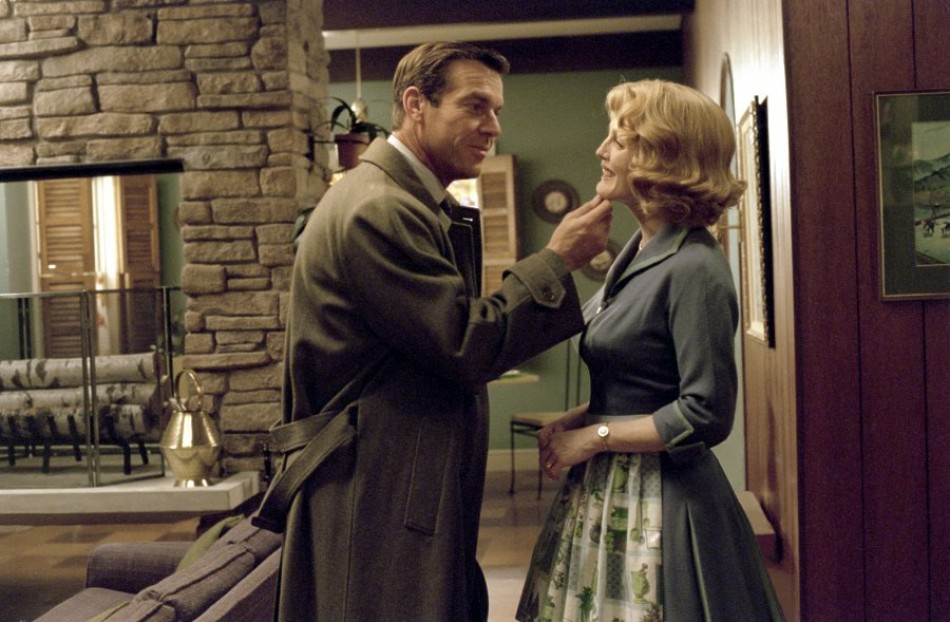
 Douglas Sirk and Thomas Mann would be proud. In Todd Haynes’s wonderfully retro Far from Heaven, Oscar-nominated Julianne Moore is amazing as 1950s housewife Cathy Whitaker, who thinks she has the perfect idyllic suburban life — until she discovers that her husband (Dennis Quaid) has a secret that dare not speak its name. Mr. & Mrs. Magnatech they are not after all. When she starts getting all chummy with the black gardener (Dennis Haysbert), people start talking, of course. Part Imitation of Life, part Death in Venice, and oh-so-original, Haynes’s awesome achievement will have you believing you’re watching a film made in the 1950s, propelled by Elmer Bernstein’s excellent music, Edward Lachman’s remarkable photography, and Mark Friedberg’s terrific production design. Far from Heaven is screening at the Museum of the Moving Image on June 14 at 7:00, with Haynes in person to talk about the film in conjunction with the opening of the exhibition “Persol Magnificent Obsessions: 30 stories of craftsmanship in film,” which focuses on artifacts from works by Ed Harris, Jean-Pierre Jeunet, Alfred Hitchcock, Douglas Trumbull, Ennio Morricone, Dean Tavoularis, Clint Eastwood, Haynes, and others.

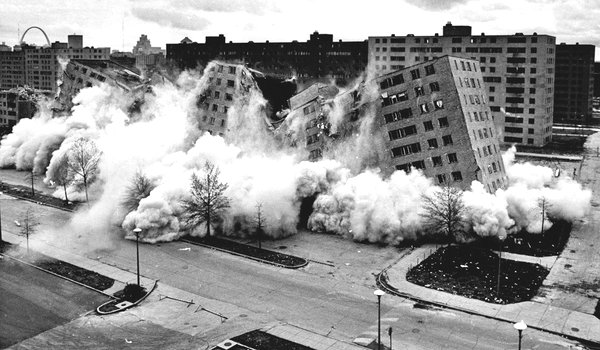
 In 1954, the St. Louis Housing Authority completed a massive urban renewal project, Pruitt-Igoe, a thirty-three-building complex for low-income families that was like a city unto itself. Eighteen years later, mired in crime, violence, poverty, and horrifically unsanitary and unsafe conditions, Pruitt-Igoe was torn down, the implosion famously being shown on news channels around the country as an example of the failure of public policy planning. The short, contentious history of Pruitt-Igoe is explored in the revealing documentary The Pruitt-Igoe Myth. Director Chad Freidrichs (Jandek on Corwood, First Impersonator) revisits Pruitt-Igoe through archival footage, new interviews, and a drive past the site where the iconic housing development, designed by architect Minoru Yamasaki, once stood, revealing the fascinating story of what was first a symbol of the post-WWII boom and then a prime example of the nation’s financial and racial problems of the 1970s. “It was like an oasis in the desert,” Ruby Russell remembers. “I never thought I would live in that kind of a surrounding.” But Brian King, who spent his childhood there, sees it a little differently. “It was hell on earth,” he says. Freidrichs speaks with urban historians Robert Fishman and Joseph Heathcott, sociologist Joyce Ladner, and former residents as they chronologically follow the rise and fall of “the poor man’s penthouse.” Narrated by actor Jason Henry, The Pruitt-Igoe Myth tells a shameful chapter in American history, one that should still be used today as a blueprint on what not to do. “It seemed to me that we were being penalized for being poor,” says former resident Jacqueline Williams. “That caused so much anger.” Named Best Documentary at several festivals and winner of the American Historical Association’s John E. O’Connor Film Award, The Pruitt-Igoe Myth is screening for free at BAMcinématek on June 11 at 6:50, followed by a panel discussion with Freidrichs and urban housing and development experts.
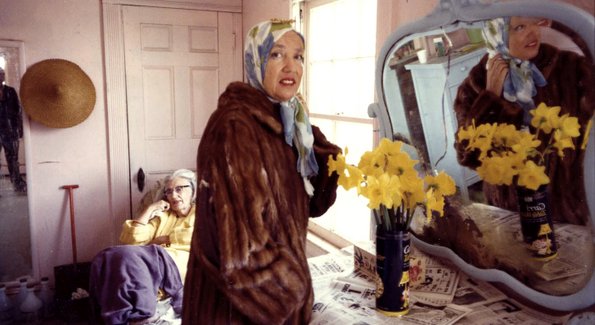
 One of the most influential documentaries ever made, Grey Gardens looks at the bizarre lives of Edith Bouvier Beale and her daughter, Edie, in their dilapidated home in East Hampton. The elder Edie was the sister of Jackie Onassis’s father, so it was hard for the American public to believe that in the mid-1970s, relatives of Jackie O’s were living in such squalor. Little Edie bandies about in odd clothing, singing and dancing, believing that she can still resurrect her once-promising career as an entertainer. Meanwhile, her elderly mother cracks wise at her daughter while also remembering her own long-gone days as a singer. The women seem to be caught up in a world all their own, far from reality, but filmmakers Albert Maysles, David Maysles, Muffie Meyer, and Ellen Hovde don’t judge them in any way; they just let them be as the women greet guests and grumble about whatever they can. Selected for the New York and Cannes Film Festivals, Grey Gardens, which has also been turned into a fiction film and a Broadway musical, will be screening June 9 at 7:30 at the Maysles Institute as part of STAUNCH! A Grey Gardens Celebration IV, which runs June 8-10 and focuses this year on Jerry Torre, the Marble Faun from the original film. The weekend festival includes the world-premiere screening of Steve Pelizza and Jason Hay’s new documentary, The Marble Faun of Grey Gardens, on Friday at 7:30, followed by Q&A and reception with Torre, Albert Maysles, Pelizza, and Hay. The Maysles brothers’ 2006 sequel, The Beales of Grey Gardens, will be shown on Sunday at 7:30.