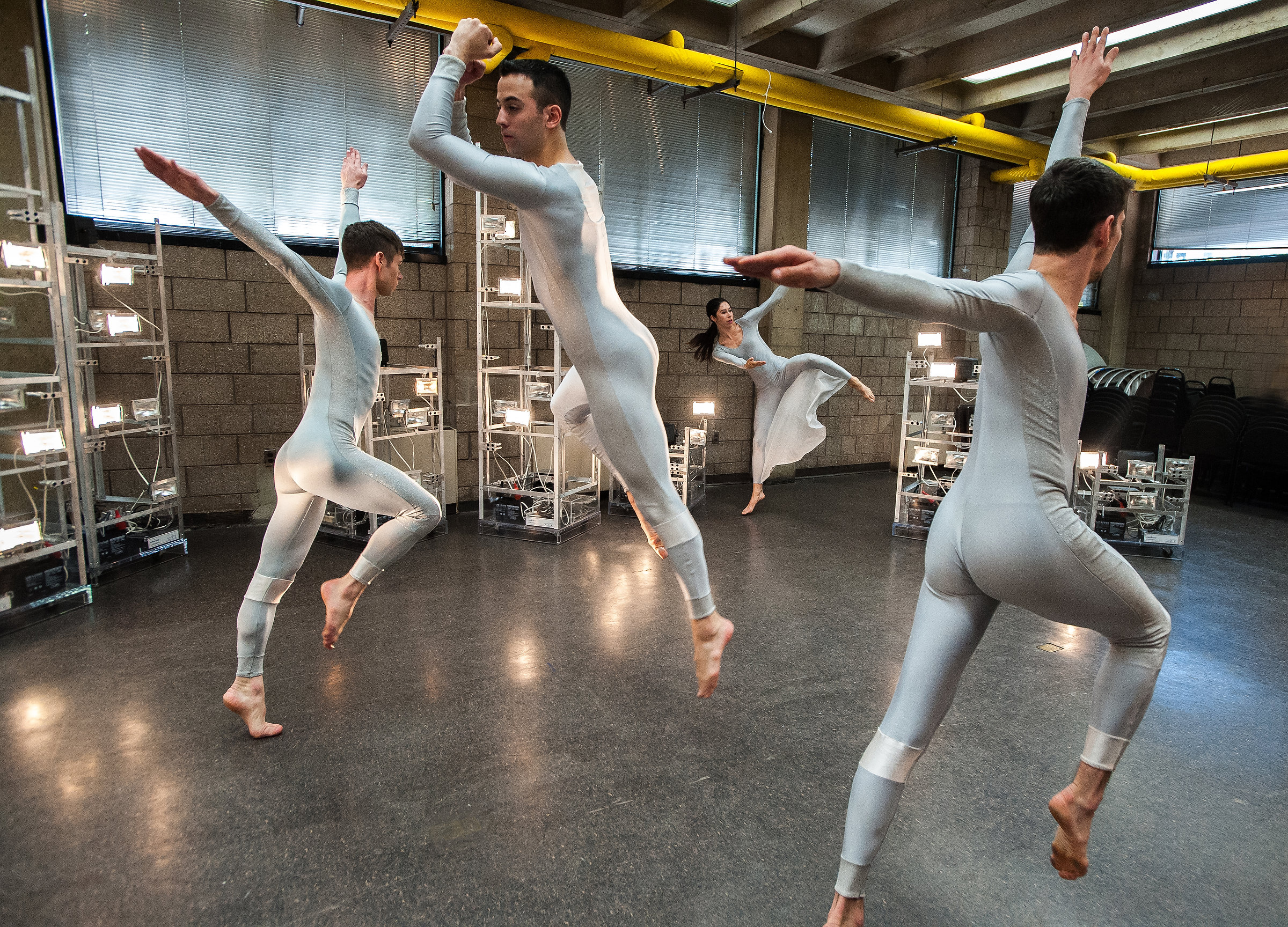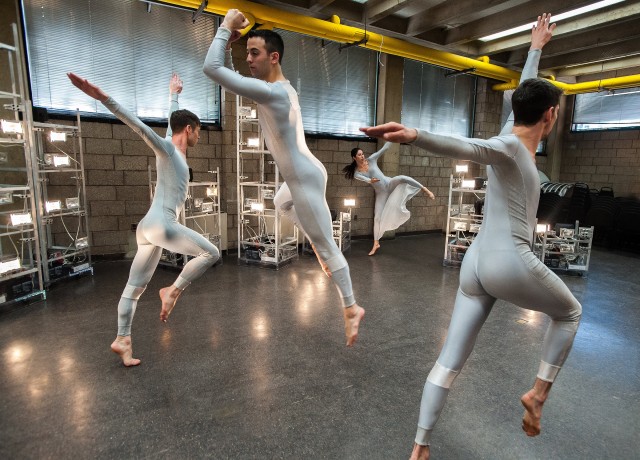
Trisha Brown’s ASTRAL CONVERTED will be performed July 10-14 at the Park Ave. Armory (photo © Stephanie Berger 2012)
Park Avenue Armory
643 Park Ave. at 67th St.
July 10-14, $35-$45, 7:30
212-933-5812
www.armoryonpark.org
www.trishabrowncompany.org
Last year, the Trisha Brown Dance Company celebrated its fortieth anniversary by presenting new works and updated repertory pieces at such locations as the Whitney, the High Line, and, for the first time ever, Dance Theater Workshop. Following a series of open rehearsals, lectures, panel discussions, and children’s workshops on Governors Island as part of the River to River Festival this summer, the company will premiere its latest work, a reconstruction of 1991’s Astral Converted, at another offbeat location, the Park Ave. Armory’s cavernous Ward Thompson Drill Hall, from July 10 to 14. Originally adapted from 1989’s Astral Convertible, Astral Converted features an extraordinary pair of collaborators: Robert Rauschenberg, who designed the set and lighting with Ken Tabatchnik as well as the costumes, and John Cage, who composed the score, which is impacted by motion detectors triggered by the dancers’ movement. The fifty-five-minute Astral Converted is the finale of Brown’s Valiant series, which began in 1985 with Lateral Pass and continued with 1987’s Newark, Astral Convertible, and 1990’s Foray Forêt. In conjunction with the performances, there will be a number of public programs held at the armory, including free screenings July 11-14 at 6:30 of Burt Barr’s 1990 documentary, Aeros, which goes behind the scenes with Brown; the preshow talk “Trisha Brown & John Cage: Seeing the Score” with Julie Martin and Susan Rosenberg on July 10 ($10, 6:00); the postshow talk “Reconstructing Astral Converted” on July 11 with Kristy Edmunds and members of the company and crew (free for ticket holders); the postshow talk “Deconstructing Astral Converted” on July 13 with Neal Beasley and members of the company (free for ticket holders); an onstage master class with company dancer Samuel Wentz on July 14 at 10:00 am ($15 for preregistration, $20 for walk-ins); and an “Astral Artists” family workshop on July 14 (free for ticket holders but advance registration is required).
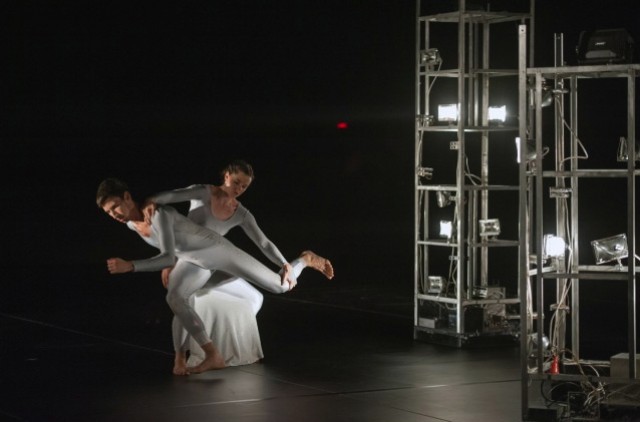
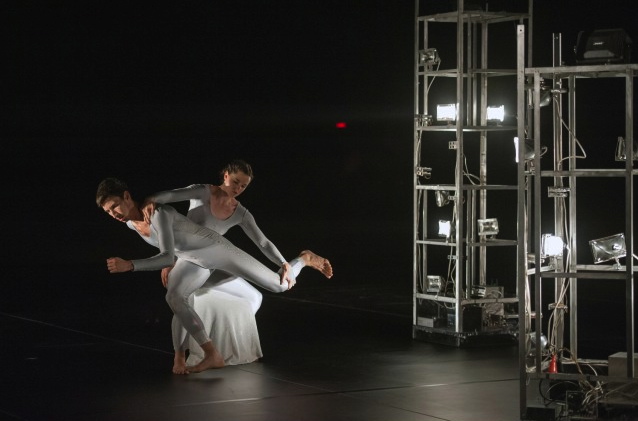
Samuel Wentz and Megan Madorin go cosmic in beautifully reconstructed ASTRAL CONVERTED (photo by Stephanie Berger)
Update: As Trisha Brown’s reconstructed Astral Converted begins, it appears to have picked up right after the previous exhibition in the massive Wade Thompson Drill Hall, Tom Sachs’s charming “Space Program: Mars.” Robert Rauschenberg’s eight wheeled metal towers, which contain car batteries, headlights, and speakers that are triggered by motion, look like leftover lunar equipment from Sachs’s engaging re-creation, and Rauschenberg’s costumes evoke space suits, although much tighter fitting. Even the dancers’ graceful, elegant, fluid movements recall astronauts floating in zero gravity. And when two of the dancers pick up large brooms, well, it’s as if they’re cleaning up the mess left behind when Sachs unsuccessfully tried to dig up the armory floor / lunar landscape. Set to a dazzling electronic score by John Cage — although on opening night the sound of a photographer snapping away in the balcony during the live performance proved to be rather distracting — Astral Converted is a beautiful piece, fifty-five smooth-flowing minutes of human and mechanical interaction, as the towers are occasionally moved around the stage to provide barriers as well as companionship. The dancers — Patrick Ferreri, Tara Lorenzen, Megan Madorin, Leah Morrison, Tamara Riewe, Jamie Scott, Stuart Shugg, Nicholas Strafaccia, and Samuel Wentz — wait their turn on the dark sidelines, then slither across the black mat and fold their bodies into unusual shapes with an intoxicating gentleness that is reminiscent of some of the movement in Stanley Kubrick’s 2001: A Space Odyssey. Running through July 14 at the Park Ave. Armory, Astral Converted, which made its debut in 1991 in Washington, DC, outside by the Mall, is a wonderfully cosmic experience reconstituted for a terrific indoor location that continues to surprise with its many splendid presentations.
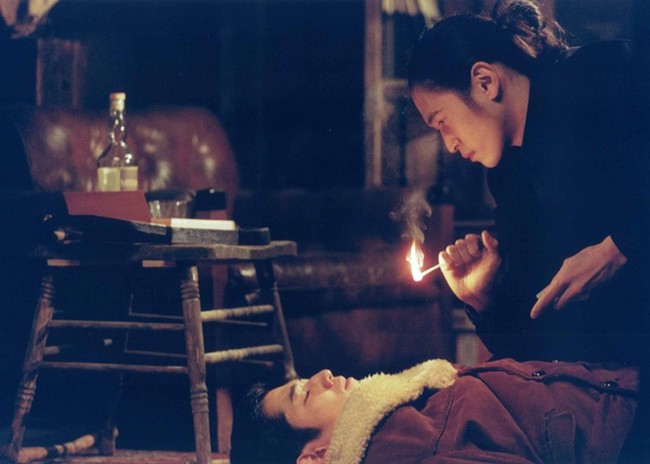
 Two years ago, Japanese auteur Toshiaki Toyoda presented The Blood of Rebirth at the New York Asian Film Festival and Japan Cuts, his first movie in four years following a hiatus involving drug charges, as well as his previous work, 2005’s extraordinary Hanging Garden. The iconoclastic Osaka-born director of such other films as Blue Spring and 9 Souls is now back at the dual festivals with his latest, another bizarre, offbeat tale, Monsters Club. Inspired by Unabomber Ted Kaczynski’s manifesto that called for revolution, Toyoda has crafted another surreal mood piece that can be as mesmerizing as it is frustrating and silly. Ryoichi Kakiuchi stars as Eita, a quiet, disciplined young man who has quit society and instead lives in the middle of a snowy forest, where he calmly chops wood, cleans his cabin, and sends out letter bombs to kill corrupt corporate executives and politicians. There he is visited by his supposedly dead brother, Yuki (Yôsuke Kubozuka), as well as a strange, haunting face-painted creature (Pyuupiru) who is an oddly charming mix of Sid Haig’s freakish Captain Spaulding from House of 1000 Corpses and Hayao Miyazaki’s adorable Totoro. But soon the idyllic little life Eita has built for himself is threatened as he discovers it’s not so easy to escape from today’s must-stay-connected world. A weirdly meditative tone poem, Monsters Club is screening at Japan Society on July 15 at 6:00 and will be followed by a Q&A with director Toyoda.

 Brazilian filmmaker Eryk Rocha’s feature narrative debut, Transeunte (Passerby), is a beautifully poetic, lyrical examination of loneliness and connection. Fernando Bezerra gives a brilliant performance as Expedito, a sixty-five-year-old man who spends his days in Rio de Janeiro walking the streets and riding buses as he puts flowers on his mother’s grave, picks up his benefits check, takes a nap on his couch, goes to the doctor, listens to his old-fashioned transistor radio, and stops by a bar for a few drinks. A simple man who seems to be content in his small life, Expedito is an innocent bystander in the world; Rocha often cuts to extreme close-ups of Expedito’s eyes as the character watches and listens to other people singing, dancing, preaching, celebrating a birthday, and just having regular conversations as he takes it all in from a distance. He rarely even speaks, saying only what is absolutely necessary as he goes about his daily business. Yet he does all this with a quiet confidence, his deeply chiseled face, rigid brow, and slow gait (in opposition to his name) revealing him to be a simple man with simple pleasures instead of a sad, lonely man leading a nowhere life. Rocha, who has made such documentaries as Rocha que Voa and Pachamama and has also been an editor, actor, composer, and cinematographer (though still only in his thirties), uses that varied background to create a mesmerizing tale that mixes fiction and reality, set to a lively score and shot in a lush black-and-white, recalling such seminal films as Charles Burnett’s
 Born in 1945 in rural Georgia to a mother who abandoned him when he was three months old, Winfred Rembert grew up picking cotton, dropped out of high school, spent time in jail and on a chain gang, and lost nearly all his teeth. But it was his years behind bars that turned him into a new man, as he learned to read and write and developed a unique art style that soon had him carving out the tales of his life on leather. Longtime journalist, producer, and writer Vivian Ducat tells Rembert’s amazing story in her engaging feature-length debut, All Me: The Life and Times of Winfred Rembert. Ducat follows the oversized Rembert, who regularly bubbles over with joy, as he returns for a show in Cuthbert, Georgia, and prepares for a big opening in New York City. “I know he’s here for a reason,” his sister Lorraine says in the film. “To help people and to be a witness through his art.” Throughout All Me, Rembert discusses many of his works, in which he uses indelible dyes on carved leather, in great detail, each one representing a part of his life, focusing on being a poor black man in a white-dominated society. It is quite poignant late in the film when he points out that his art seems to be most appreciated by whites even though it is meant as a visual history for blacks. But what really makes the documentary work is not just that Rembert is such an enigmatic, larger-than-life figure but that his art is exceptional, his self-taught, folksy style reminiscent of such forebears as Romare Bearden and Jacob Lawrence, capturing a deeply personal, intensely intimate part of the black experience in twentieth-century America. The film was previously shown at the Maysles Institute this past January, but it’s now back for a return engagement July 11, with Rembert and Ducat participating in a Q&A following the screening of this extraordinary story.