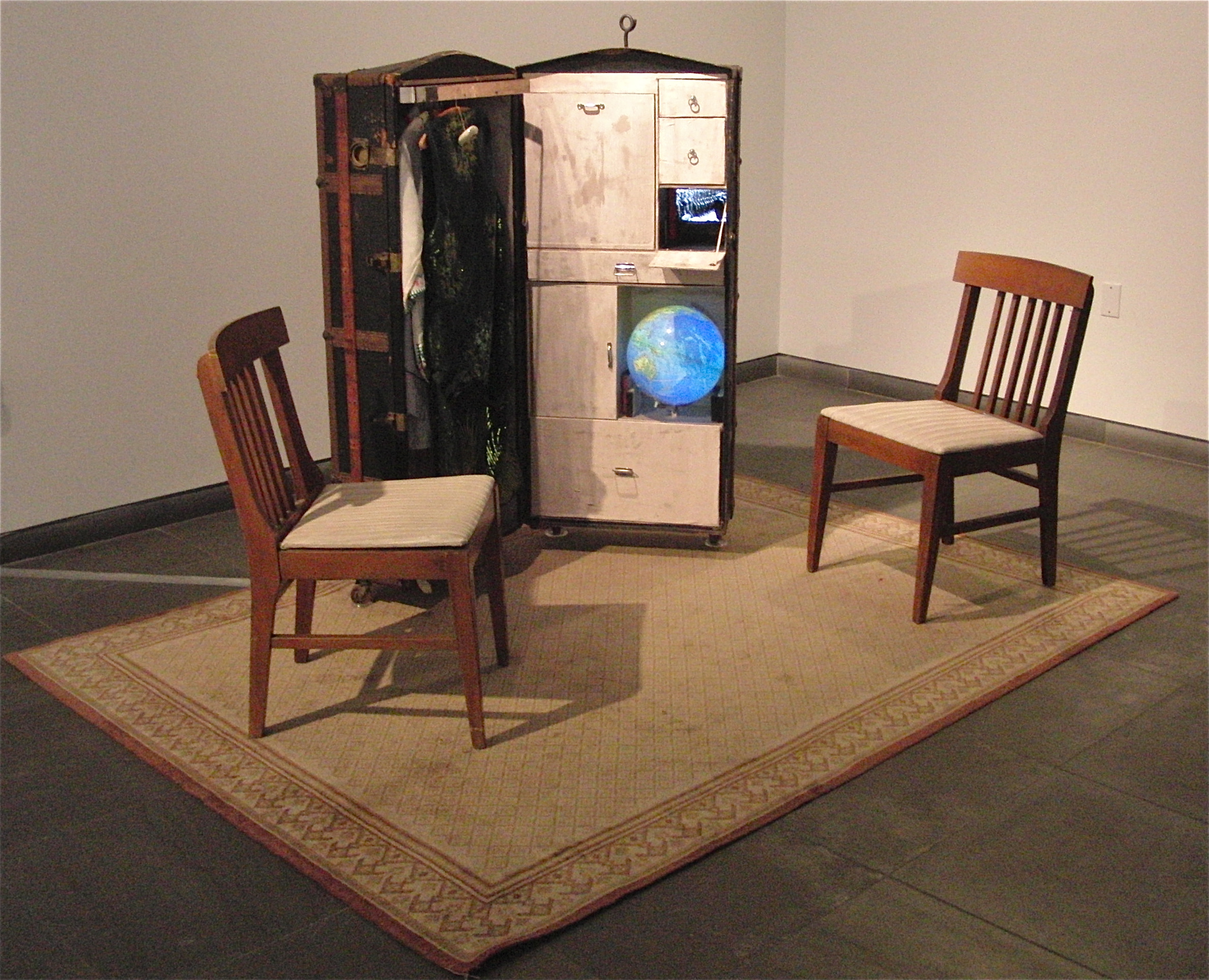
“Unattended Luggage” by Time’s Up gives visitors a chance to explore personal aspects of immigration and home (photo by twi-ny/mdr)
Austrian Cultural Forum
11 East 52nd St. between Madison & Fifth Aves.
Daily through August 26, free, 10:00 am – 5:00 pm
212-319-5300
www.acfny.org
our haus slideshow
In 1970, Crosby, Stills, Nash & Young sang, “Our house is a very, very, very fine house.” The same can be said of architect Raimund Abraham’s stunning Austrian Cultural Forum tower, which turns ten this year. In honor of the anniversary, the ACFNY has put together the multimedia exhibit “Our Haus,” consisting of specially commissioned works that explore the nature of home, the physicality and psychology of place, and the cross-cultural link between New York and Austria. Spread across four floors of the twenty-five-foot-wide, eighty-one-foot-deep, twenty-four-story building that ACFNY director Andreas Stadler calls “an artistic lighthouse in this metropolis of creativity and communication,” the show includes photography, painting, video, sculpture, and site-specific installations that curator Amanda McDonald Crowley says “recognize the ACFNY as a space for conversation, contradiction, intimacy, and conviviality.” In Brünnerstraße 165, Helmut and Johanna Kandl go back to Johanna’s childhood home, combining vintage Super-8 footage of her as a little girl playing in the backyard with contemporary video of her rising out of a pond on the now-abandoned property. Austrian-born artist Rainer Ganahl examines two sides of New York in “Haunted Houses — Vacant Buildings on Third Avenue between 99th and 120th Street,” a two-channel video that he made while riding his bicycle through his adopted home of Spanish Harlem; while the bottom images depict stores and signs of life, the top shows broken windows, empty apartments, and shattered dreams. Judith Fegerl’s “Untitled (cauter)” intrudes on Abraham’s tower itself, as electrical wires burn lines onto the wall. Time’s Up investigates travel and immigration in “Unattended Luggage,” which invites visitors to look through drawers in a large open suitcase filled with items that remind one of home. Matthias Herrmann conjures up Felix Gonzalez-Torres and Bruce Naumann in a series of still-life postcards, free for the taking, that he made during a New York City residency.
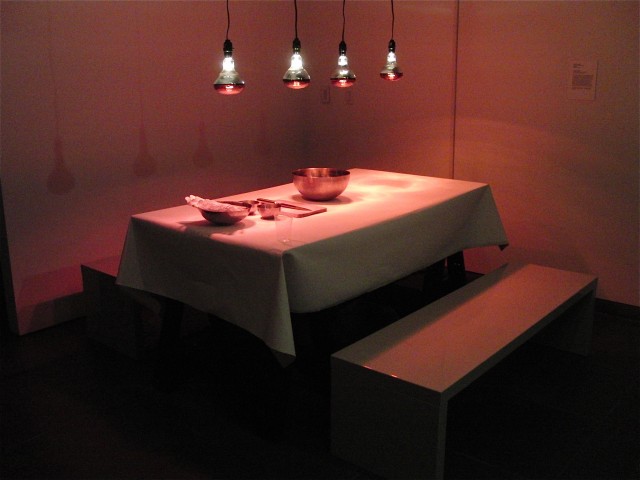
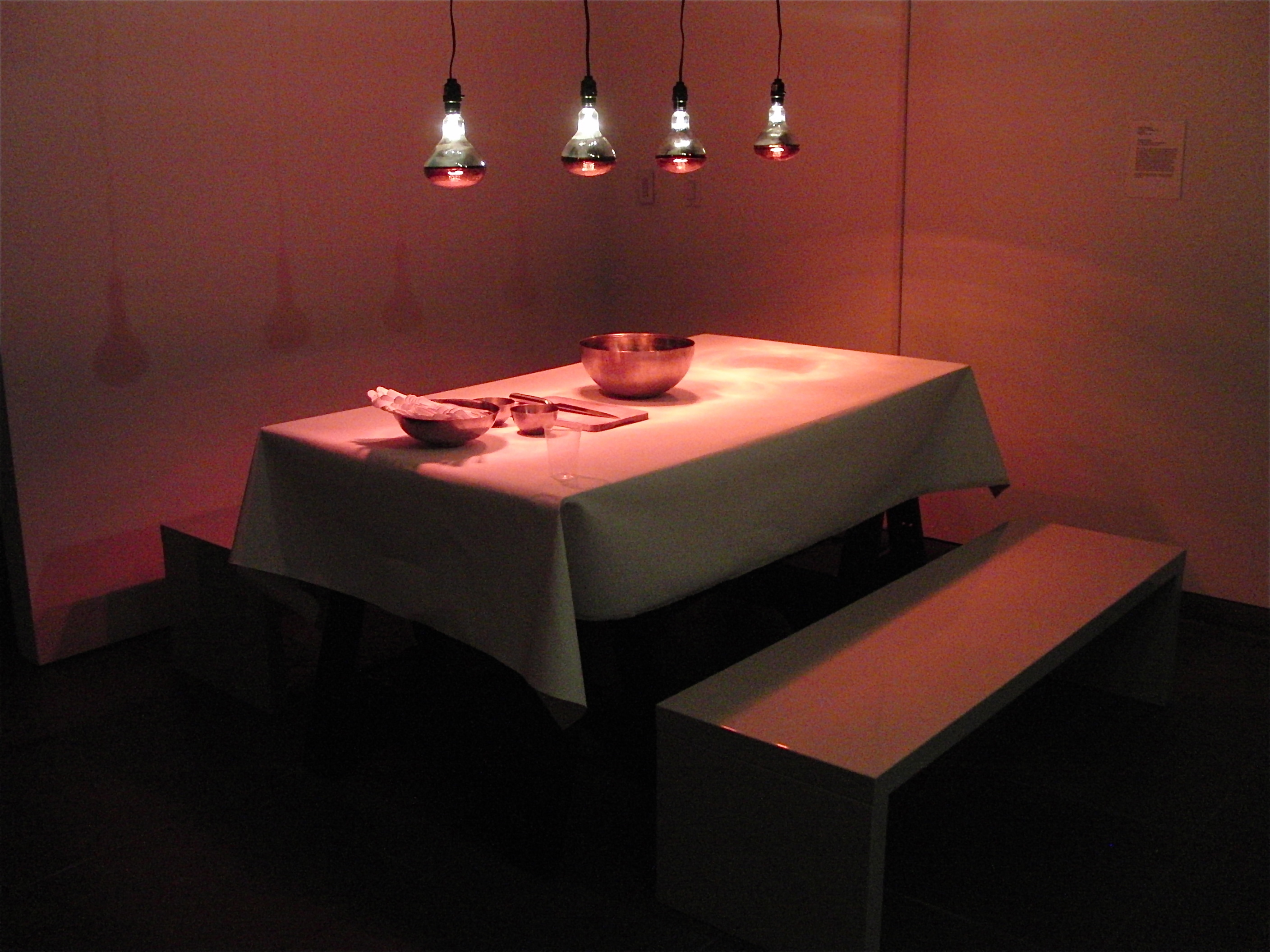
Rainer Prohaska’s “Floor Cuisine, ACF New York” offers a place to gather at the Austrian Cultural Forum (photo by twi-ny/mdr)
In 1982, the British ska band Madness sang, “Our house it has a crowd / There’s always something happening,” and the same can be said for “Our Haus.” Rainer Prohaska’s “Floor Cuisine, ACF New York” features kitchen stations throughout the exhibit, culminating in a table downstairs where people can come together and enjoy a drink from Mathias Kessler’s “Das Eismeer, Die gescheiterte Hoffnung (The Arctic Sea, the Failed Hope),” a refrigerator stocked with beer and containing a sculptural tribute to Caspar David Friedrich in the freezer. Meanwhile, the collective WochenKlausur has set up a meeting room that will host various gatherings over the course of the exhibition; through July 22, “It Came from chashama” will highlight works from the nonprofit organization that displays art in public spaces. (The Center for Urban Pedagogy takes over July 23-29, with a panel discussion that first night at 7:00, followed by Green Guerillas, CAAAV, and Not an Alternative.) And in conjunction with the anniversary, Anthology Film Archives is hosting “The Austrian Cultural Forum New York: The First Decade,” a series of screenings through July 22 of Austrian films made over the last ten years, including Nikolaus Geyrhalter’s Our Daily Bread, Götz Spielmann’s Revanche, Michael Haneke’s The White Ribbon, and Ruth Beckermann’s Zorro’s Bar Mitzva.

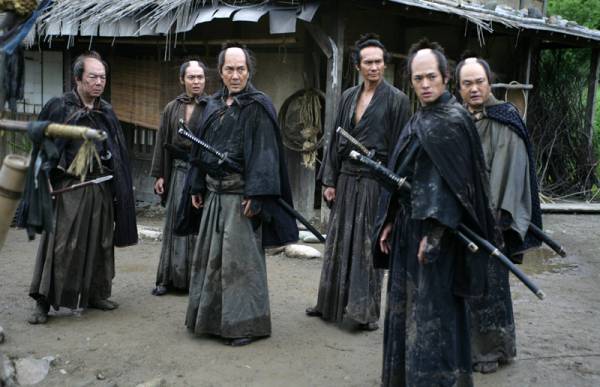
 Japanese director Takashi Miike’s first foray into the samurai epic is a nearly flawless film, perhaps his most accomplished work. Evoking such classics as Kurosawa’s Seven Samurai, Mizoguchi’s 47 Ronin, Aldrich’s The Dirty Dozen, and Eastwood’s High Plains Drifter, 13 Assassins is a thrilling tale of honor and revenge, inspired by a true story. In mid-nineteenth-century feudal Japan, during a time of peace just prior to the Meiji Restoration, Lord Naritsugu (Gorô Inagaki), the son of the former shogun and half-brother to the current one, is abusing his power, raping and killing at will, even using his servants and their families as target practice with a bow and arrow. Because of his connections, he is officially untouchable, but Sir Doi (Mikijiro Hira) secretly hires Shinzaemon Shimada (Kôji Yakusho) to gather a small team and put an end to Naritsugu’s brutal tyranny. But the lord’s protector, Hanbei (Masachika Ichimura), a former nemesis of Shinzaemon’s, has vowed to defend his master to the death, even though he despises Naritsugu’s actions. As the thirteen samurai make a plan to get to Naritsugu, they are eager to finally break out their long-unused swords and do what they were born to do. “He who values his life dies a dog’s death,” Shinzaemon proclaims, knowing that the task is virtually impossible but willing to die for a just cause. Although there are occasional flashes of extreme gore in the first part of the film, Miike keeps the audience waiting until he unleashes the gripping battle, an extended scene of blood and violence that highlights death before dishonor. Selected for the 2009 Cannes Film Festival and nominated for the Silver Lion at the 2010 Venice Film Festival, 13 Assassins is one of Miike’s best-crafted tales; nominated for ten Japanese Academy Prizes, including Best Picture, Best Director, Best Screenplay (Daisuke Tengan), Best Editing (Kenji Yamashita), Best Original Score (Koji Endo), and Best Actor (Yakusho), it won awards for cinematography (Nobuyasu Kita), lighting direction (Yoshiya Watanabe), art direction (Yuji Hayashida), and sound recording (Jun Nakamura). 13 Assassins is screening at Japan Society on July 21 at 8:20 as part of the Japan Cuts sidebar “Focus on Kôji Yakusho” and will be introduced by the actor; the July 20-21 mini-festival also includes such other Yakusho vehicles as his directorial debut, Toad’s Oil, as well as Shuichi Okita’s The Woodsman and the Rain, the New York premiere of Masato Harada’s Chronicle of My Mother, Kiyoshi Kurosawa’s Cure, and Masayuki Suo’s original Shall We Dance?