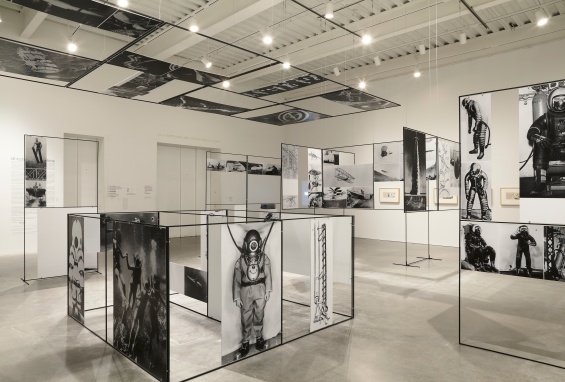
Richard Hamilton, “Man, Machine and Motion,” exhibition reconstruction, 1955/2012 (photo by Benoit Pailley)
New Museum of Contemporary Art
235 Bowery at Prince St.
Friday – Sunday through September 30, $12-$16
212-219-1222
www.newmuseum.org
“From a contemporary perspective, the distance between our machines and our selves has never been closer,” writes Gary Carrion-Murayari in “The Body Is a Machine,” one of several marvelous essays in the catalog of the fascinating New Museum show “Ghosts in the Machine,” which runs through this Sunday. Curated by Carrion-Murayari and Massimiliano Gioni, the exhibit examines the intersection between man, motion, art, and machine in a consumer society growing more and more obsessed with pop culture. Spread across four floors, “Ghosts in the Machine” features painting, sculpture, film, and installations focused on a time before the personal computer, when a developing technology was not as all-pervasive as it is today. In Stan VanDerBeek’s 1960s “Movie-Drome,” visitors can lie down inside a dome and watch myriad images projected onto the curved ceiling, an early version of the internet. A reconstruction of Richard Hamilton’s seminal 1955 “Man, Machine and Motion” follows humanity’s pursuit of going faster, farther, and higher, even foreseeing space travel. “The Medium Is the Medium” is a 1969 public television program in which Allan Kaprow, Nam June Paik, Otto Piene, and Aldo Tambellini create short films using cutting-edge technology. Paul Sharits makes the film projector itself the key element in “Epileptic Seizure Comparison.” Harley Cokeliss’s “Crash!” video, Claus Oldenburg’s “Profile Airflow,” and Thomas Bayrle’s “Madonna Mercedes” examine the world’s growing love affair with the automobile. Works by Channa Horwitz, Bridget Riley, Victor Vasarely, and Emma Kunz play with perception in mathematical, scientific, and architectural patterns. Otto Piene’s “Hängende Lichtkugel” and Gianni Colombo’s “Spazio Elastico” use light to alter reality. Hans Haacke creates a bit of magic in “Sphere in Oblique Air Jet” and “Blue Sail.” Among the more contemporary pieces, Henrik Olesen pays homage to Man Ray, Marcel Duchamp, Alan Turing, and outdated machines in such works as “Apple (Ghost) (1),” an old apple computer wrapped in plastic, and “Imitation/Enigma (2),” a sewing machine tied up in a blanket, while Seth Price repurposes licensed images in “Film/Right” and Philippe Parreno investigates an automaton in the miniature “The Writer.” Other artists represented in the show are J. G. Ballard, Eduardo Paolozzi, Rube Goldberg, Robert Smithson, Konrad Klapcheck, and Herb Schneider. In today’s crazy, fast-paced, constantly connected world, “Ghosts in the Machine” offers an intriguing, involving look back at a different era, one that, knowingly or not, paved the way for today’s consumer-driven digital age. (Also this weekend at the New Museum, the “Propositions” series continues with writer and curator Fionn Meade presenting “When Genealogy Becomes Critique,” a two-day seminar [Friday at 7:00 and Saturday at 3:00, $8 plus half-gallery same-day admission] dealing with art criticism, cinefication, and historiography.)
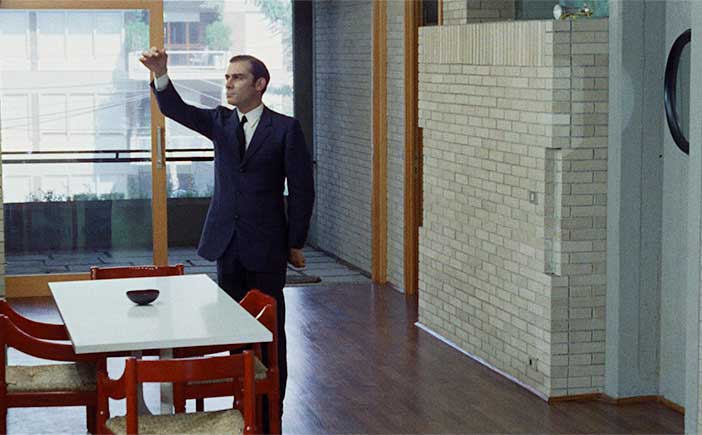
 As Investigation of a Citizen Above Suspicion begins, a man (Gian Maria Volontè) kills a woman (Florinda Bolkan) in the midst of some rather kinky sex. The man then goes out of his way to leave behind evidence tying him to the brutal crime, including making sure he is spotted as he exits the woman’s building complex. It is soon revealed that he is the former head of homicide in Rome who has just been promoted to chief of political intelligence, his victim a married lover of his who enjoyed acting out real murder cases with him. “How will you kill me this time?” she asks in a flashback, not knowing where their games will ultimately lead. For the rest of Elio Petri’s (A Quiet Place in the Country) absurdist farce, the man practically dares his colleagues to catch him as he continues to build a case against himself and rails against criminal and political terrorists and subversives in neo-fascist romps, filmed in daring close-up, that emphasize the importance of keeping the masses repressed. Shot in broad colors and featuring a playful score by Ennio Morricone, Investigation of a Citizen Above Suspicion is an enticing police procedural — in which the culprit is the man in charge of the case — as well as a satiric look at the state of Italian politics in 1970, as social unrest and sexual freedom grew throughout Europe and America. “Repressing all those evils is to cure them,” the man declares in a fiery speech to his department. Volontè (A Fistful of Dollars, For a Few Dollars More) clearly has a ball as a man who either wants to be caught or is out to prove that he is indeed above the law, Petri carefully keeping his motive ambiguous in this wonderful black comedy. Winner of the Oscar for Best Foreign Language Film and the Grand Prize at Cannes, Investigation of a Citizen Above Suspicion will be screening in a new DCP restoration at Film Forum September 28 through October 4, with Sony restoration expert Grover Crisp on hand to introduce the 7:30 screening on opening night.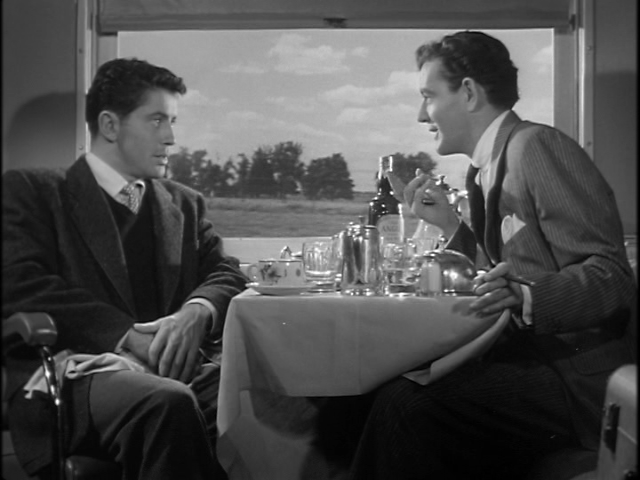
 The Rubin Museum’s Cabaret Cinema series “Happiness Is . . .” continues with one of Alfred Hitchcock’s most multilayered, complex tales, the 1951 psychological double-murder thriller Strangers on a Train. Shortly after introducing himself to amateur tennis star Guy Haines (Farley Granger) on a train, mama’s boy Bruno Anthony (an appropriately creepy Robert Walker) concocts a supposedly foolproof plan in which Bruno will kill Guy’s unfaithful wife, Miriam (Laura Elliott), so Guy can marry his socialite girlfriend, Anne Morton (Ruth Roman), one of the daughters of a U.S. senator (Leo G. Carroll). In return, Guy will kill Bruno’s father (Jonathan Hale). Bruno believes he has devised the perfect crisscross murder, with neither man having a clear motive and nothing for the cops to find to link them together. While Bruno is serious, Guy thinks he’s just a loon (Walker had in fact been recently released from a psychiatric clinic after suffering a nervous breakdown and died at the age of thirty-two before the film even opened), but after the psychopathic Bruno actually does kill Miriam — photographed in an unforgettable way by cinematographer Robert Burks, shown in a pair of broken eyeglasses — he starts shadowing Guy, insisting he keep his part of the bargain and kill Mr. Anthony, something Guy never intended on doing. Soon the cops are involved, along with a broken alibi, a key, and a critical cigarette lighter, leading to a spectacular conclusion on a merry-go-round. Loosely based on Patricia Highsmith’s debut novel and featuring an early screenplay written by Raymond Chandler (whose name was kept in the credits for marquee value despite Hitchcock’s famous — and literal — trashing of his contribution), Strangers on a Train is a powerful, tense mystery built around the idea of the double; from the opening scene of two pairs of shoes — immediately equating, and differentiating between, the two protagonists, as if they were two parts of the same person — to Hitchcock’s appearance carrying a double bass, to Anne’s younger sister, Babs (Patricia Hitchcock, Alfred’s daughter), wearing the same glasses as Miriam, to Bruno’s declaration, upon ordering two double scotches and relating them to tennis, “The only kind of doubles I play,” the film is filled with mirroring or directly opposing elements. As with Hitchcock’s Rope, which also starred Granger, Strangers on a Train also has a clear homosexual subtext; in real life Walker was straight while Granger was bisexual. Shot in a dark black-and-white that adds to the chilling effects, Strangers on a Train is one of Hitchcock’s best, a fully realized, frightening film that ends in a big way. The Rubin Museum screening on September 29 will be introduced by chef and musician Molly Neuman. “All in all,” Granger wrote in his 2007 autobiography, Include Me Out: My Life from Goldwyn to Broadway, “working on Strangers on a Train was my happiest filmmaking experience,” giving it extra reason to be included in this series that looks at different kinds of happiness in the movies.