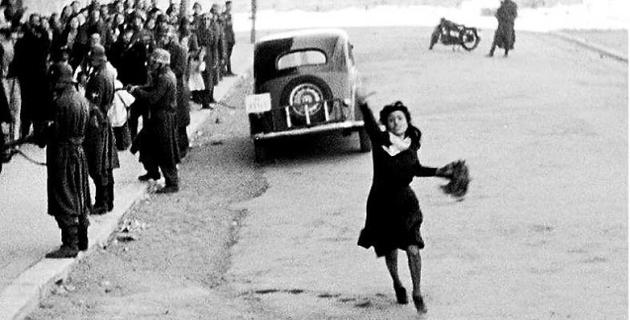
Pregnant widow Pina (Anna Magnani) runs through the streets of German-occupied Rome in Rossellini antiwar masterpiece
CABARET CINEMA: ROME OPEN CITY (ROMA, CITTÀ APERTA) (Roberto Rossellini, 1945)
Rubin Museum of Art
150 West 17th St. at Seventh Ave.
Friday, January 4, free with $7 bar minimum, 7:00
212-620-5000
www.rmanyc.org
 One of six films to be awarded the Grand Prix at the inaugural Cannes Film Festival in 1946, Roberto Rossellini’s Rome Open City is an antiwar masterpiece, the first of three works that together form his War Trilogy, along with Paisan and Germany Year Zero. Begun in January 1945 with Italy still under German occupation, Rome Open City melds neorealism with melodrama in telling the story of a small, tight-knit community secretly battling the Nazis. The leader of the local Italian resistance is Giorgio Manfredi (Marcello Pagliero), an engineer sending messages and money through courier Don Pietro (Aldo Fabrizi), a priest who is generally left alone by the Nazis and the Italian police. Giorgio hides away in his friend Francesco’s (Francesco Grandjacquet) apartment as Francesco prepares to marry Pina (Anna Magnani), a pregnant widow raising a son, Marcello (Vito Annicchiarico), who is part of a gang of young kids also fighting in the resistance and causing a surprising amount of trouble. Meanwhile, Giorgio’s former flame, cabaret performer Marina Mari (Maria Michi), is cozying up to Ingrid (Giovanna Galletti), a suspicious woman with ties to the Nazis, who are led by the relentless Major Bergmann (Harry Feist). With events coming to a head, faith is questioned, and betrayals set in motion violence, torture, and killings that brutally characterize the many horrors of war. Written by Sergio Amidei and Federico Fellini, Rome Open City is a remarkable example of guerrilla filmmaking, with Rossellini and cinematographer Ubaldo Arata shooting on the streets of Rome using whatever dupe negatives they could get their hands on. The mix of professional and nonprofessional actors lends a stark reality to the proceedings. “Above all, the concept was to give an honest account, to show things as they were,” Rossellini explained in a 1963 intro to the film, a staggering achievement that seems to only get better with age. Rome Open City is screening January 4 at 7:00 as part of the Rubin Museum Cabaret Cinema series “Urban Landscapes,” held in conjunction with the exhibition “Radical Terrain: Modernist Art from India,” and will be introduced by David Bragdon of the city Parks Department. The brief series also includes Alain Resnais’s Last Year at Marienbad and Michelangelo Antonioni’s L’Eclisse and Red Desert later this month.
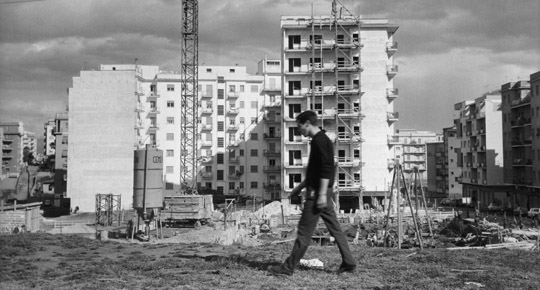
 After collaborating on a number of works by such auteurs as Mauro Bolognini and Federico Fellini, poet and novelist Pier Paolo Pasolini made his directorial debut in 1961 with the gritty, not-quite-neo-realist Accattone (“scrounger” or “beggar”). Somewhat related to his books Ragazzi di vita and Una vita violenta, the film is set in the Roman borgate, where brash young Vittorio “Accattone” Cataldi (Franco Citti) survives by taking crazy bets — like swimming across a river known for swallowing up people’s lives — and working as a pimp. After a group of local men beat up his main money maker (Silvana Corsini), he meets the more naive Stella (Franca Pasut), whom he starts dating with an eye toward perhaps converting into a prostitute as well. Meanwhile, he tries to establish a relationship with his son, but his estranged wife and her family want nothing to do with him. Filmed in black-and-white by master cinematographer Tonino Delli Colli, Accattone is highlighted by a series of memorable shots, from Accattone’s gorgeous dive from a bridge to a close-up of his face covered in sand, many of which were inspired by Baroque art and set to music by Bach. Written with Sergio Citti and featuring a production assistant named Bernardo Bertolucci, the story delves into the dire poverty in the slums of Rome, made all the more real by Pasolini’s use of both professional and nonprofessional actors. Accattone is screening December 14 and 27 as part of MoMA’s “Pier Paolo Pasolini” series, a full career retrospective that runs December 13 to January 5 and includes such special events as “Recital: An Evening Dedicated to Pier Paolo Pasolini the Poet” at MoMA on December 14 and the Sunday Sessions program “Pier Paolo Pasolini: Intellettuale” at MoMA PS1 on December 16 with Paul Chan, Ninetto Davoli, Emi Fontana, Barbara Hammer, Alfredo Jaar, Lovett/Codagnone, and Fabio Mauri. In addition, there will be a number of other Pasolini celebrations around the city, including the December 13 seminar “Pasolini’s Languages” at the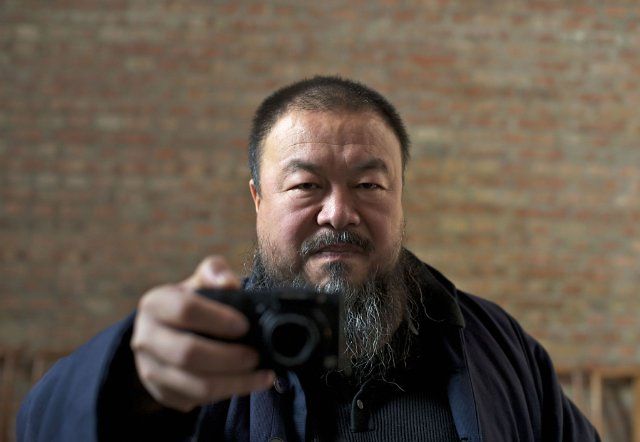
 “I consider myself more of a chess player,” Ai Weiwei says at the beginning of Never Sorry, Alison Klayman’s revealing documentary about the larger-than-life Chinese artist and dissident. “My opponent makes a move, I make a move. Now I’m waiting for my opponent to make the next move.” Over the last several years, Ai has become perhaps the most famous and controversial artist in the world, primarily since he participated in the design of Beijing National Stadium, known as the Bird’s Nest, for the 2008 Summer Olympics, then denounced the Games on political grounds. Ai gives director, producer, and cinematographer Klayman, making her first full-length film, remarkable access to his personal and professional life as he gets physically abused by Chinese police, prepares to open major exhibits in Munich and London, and visits with his young son, Ai Lao, the result of a tryst with Wang Fen, an editor on his underground films. Klayman speaks with Ai Weiwei’s devoted wife, Lu Qing, an artist who publicly fought for his freedom when he disappeared in 2011; his mother, Gao Ying, who spent time in a labor camp with her dissident-poet husband, the late Ai Quing; and such fellow Chinese artists and critics as Chen Danqing, Feng Boyi, Hsieh Tehching, and Gu Changwei, who speak admiringly of Ai’s dedication to his art and his fearless search for the truth. A round man with a long, graying bear, Ai is a fascinating, complicated character, a gentle bull who openly criticizes his country because he loves it so much. He is a social media giant, making documentaries that are available for free on the internet and revolutionizing the way Twitter and the blogosphere are used. Ai risks his own freedom by demanding freedom for all, calling for government transparency before and after he is secretly arrested, not afraid of the potential repercussions. And he is also a proud cat lover — more than forty felines regularly roam around his studio — eagerly showing off one talented kitty that has a unique way of opening a door. Ai Weiwei: Never Sorry shows Ai to be an honorable, supremely principled human being who has deep respect for the history of China and a fierce determination to improve its future, no matter the personal cost. Ai Weiwei: Never Sorry is being shown on December 12 at 7:00 as part of MoMA’s annual series “The Contenders,” consisting of exemplary films they believe will stand the test of time, with Klayman on hand to participate in a postscreening discussion; upcoming entries include Steven Spielberg’s Lincoln, Charles Atlas’s Ocean, and Tim Burton’s Frankenweenie. (To find out more about Ai Weiwei’s art, specifically his recent projects in New York City, please follow these links: