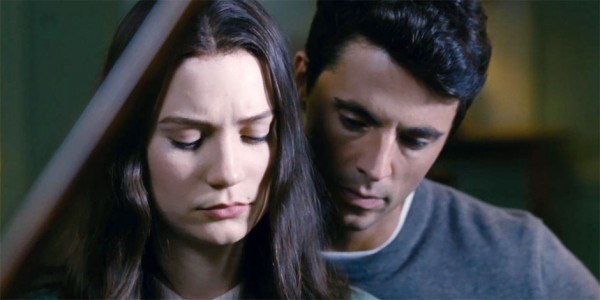
Lauderee (Perla Haney-Jardine) and her grandmother (Amy Madigan) look to save their family and the planet in FUTURE WEATHER
FUTURE WEATHER (Jenny Deller, 2012)
reRun Gastropub Theater
147 Front St. between Jay & Pearl Sts., Brooklyn
March 1 – 7
718-766-9110
www.futureweathermovie.com
www.reruntheater.com
 Jenny Deller’s first feature, Future Weather, is an involving, if overly zealous, coming-of-age drama about a thirteen-year-old loner obsessed with saving the environment. Perla Haney-Jardine (Kill Bill Vol. 2, Dark Water) stars as Lauduree, a smart, independent girl whose flighty single mother, Tanya (Marin Ireland), suddenly bolts from their trailer on the outskirts of Philadelphia and takes off for the West Coast in hopes of becoming a Hollywood makeup artist. At first Lauderee tries to go it alone but eventually starts living with her grandmother, Greta (Amy Madigan), a tough woman who is considering moving to Florida with her longtime boyfriend, the well-meaning Ed (William Sadler). Jenny’s only solace comes in science club, where she and new kid Neel (Anubhav Jain) work on special nature projects with their understanding teacher, Mrs. Markovi (Lili Taylor). While Jenny grows more and more concerned with the disastrous changes that are threatening the planet, she has difficulty dealing with the many changes that are going on in her own ever-more-complicated life. Deller makes an impressive debut with Future Weather, serving as writer, director, and editor, and she produced the film with another first-timer, Kristin Fairweather. The narrative works best when it focuses on Lauderee’s relationship with her mother and grandmother and the teen’s unique individuality, but it tends to get overbearing when making its very serious points about the Earth’s impending man-made doom. However, Deller practiced what she preached, using special environmentally friendly cameras, props, and sets, natural light, and green offices and shot at such locations as the Schuykill Center for Environmental Education and the Pennypack Ecological Restoration Trust. The film will be playing the reRun Gastropub Theater from March 1 to 7, with several special events scheduled. On March 2 at 2:00, Deller, production designer Gino Fortebuono, and cinematographer Zac Mulligan will participate in the panel discussion “Collaborating on the Vision for Future Weather,” and on March 3 at 2:00, Deller, composer Erik Friedlander, and music supervisor Jackie Mulhearn will be on hand for the panel “Creating a Soundtrack.”
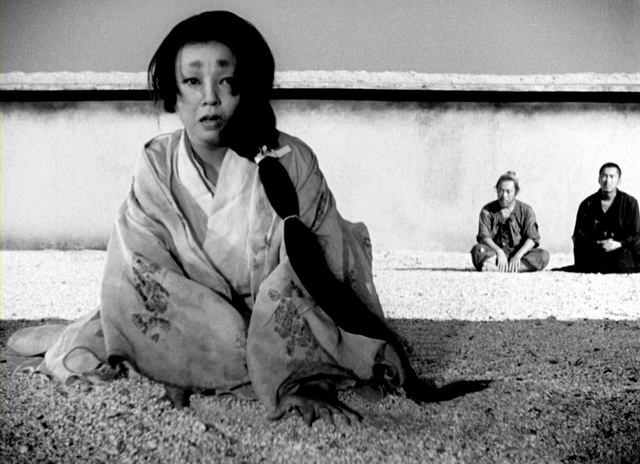
 One of the most influential films of all time, Akira Kurosawa’s 1950 masterpiece stars Toshirô Mifune as a bandit accused of the brutal rape of a samurai’s wife (Machiko Kyo) and the murder of her husband (Masayuki Mori). However, four eyewitnesses tell a tribunal four different stories, each told in flashback as if the truth, forcing the characters — and the audience — to question the reality of what they see and experience. Kurosawa veteran Takashi Shimura — the Japanese Ward Bond — plays a local woodcutter, with Minoru Chiaka as the priest. The mesmerizing work, which won an Oscar for Best Foreign Language Film, is beautifully shot by Kazuo Miyagawa; Rashomon is nothing short of unforgettable. (What is forgettable is the English-language remake, The Outrage, directed by Martin Ritt and starring Edward G. Robinson, Paul Newman, Laurence Harvey, Claire Bloom, and William Shatner.) Rashomon is screening March 1 at 9:30 as part of the Rubin Museum Cabaret Cinema series “Illusions Revealed,” consisting of films that address misperception, and will be introduced by neuroscientist John J. Sakon. The series continues with such films as Rosemary’s Baby, Cinema Paradiso, Black Moon, and Cross of Iron through April 26.

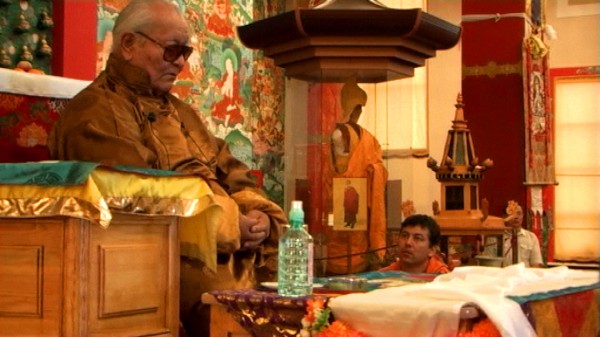
 More than twenty years in the making, Jennifer Fox’s My Reincarnation tells the fascinating story of a very unusual father-son relationship amid the modern world of tulkus, or reincarnated Tibetan lamas. World-renowned high Tibetan Buddhist Master Chögyal Namkhai Norbu travels around the world teaching meditation and Dzogchen practice. He meets with the Dalai Lama, advises students and fans, signs copies of his many books, and builds support for his beleaguered native land, Tibet. But his son, Yeshi Silvano Namkhai, who was born in 1970 in Italy (where Rinpoche Namkhai Norbu taught at university from 1964 to 1992), had no desire to follow in his father’s footsteps and instead went into the computer business, starting a family and rejecting nearly everything his father believes in — including that Yeshi might just be the reincarnation of his great-uncle, Khyentse Rinpoche Chökyi Wangchug, and so is destined for a life of service and tradition. “Everybody knows about me and nobody knows me at all,” Yeshi says about trying to establish his own identity. Father and son and the rest of the family allowed Fox remarkable access, holding nothing back as they talk about their lives and each other; Yeshi is particularly vocal about his father’s treatment of him over the years. But soon Yeshi has a change of heart, and the documentary takes an unexpected turn. Fox, who has previously made such films as Beirut: The Last Home Movie, Flying: Confessions of a Free Woman, and An American Love Story, shot more than one thousand hours of footage, which she edited down to a tight seventy-five-minutes, including archival and newsreel footage as well. As much as it is about a father and a son, My Reincarnation is also about the old vs. the new, tradition vs. modernization, private love vs. public responsibility, the spiritual vs. the technological, and, above all, familial legacy. My Reincarnation is screening at MoMA on March 2 at 5:00 as part of the “MoMA Selects: POV” section of “Documentary Fortnight 2013: MoMA’s International Festival of Nonfiction Film and Media” and will be followed by a Q&A with the director; the POV portion, which runs February 27 to March 4, celebrates a quarter-century of the award-winning PBS program POV and also includes such films as Marlon Riggs’s Tongues Untied, Freida Lee Mock’s Maya Lin: A Strong Clear Vision, Robert Kenner’s Food, Inc., and Alan Berliner’s Nobody’s Business. “As we celebrate our twenty-fifth anniversary on PBS, MoMA’s retrospective program allows us to review our history, share insights about documentary craft and culture with the public, and celebrate with the indie filmmaking community,” POV co-executive producer Cynthia López said in a statement. “The ways in which documentaries have contributed to our culture will be a focus of conversations at the screenings. We hope the public will find that these documentaries inform, entertain, and challenge conventional wisdom.”