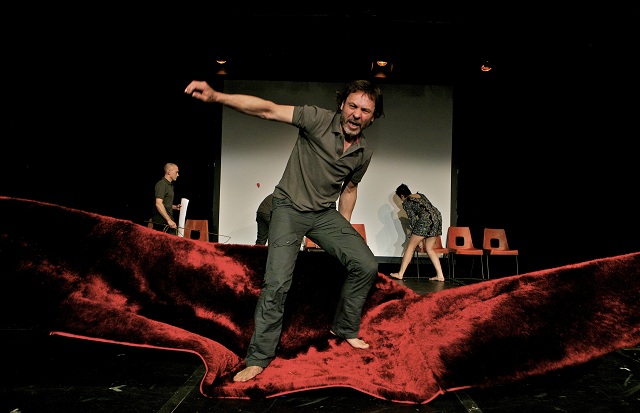
Documentary delves into the fascinating history behind traditional Jewish song that became an international sensation
HAVA NAGILA (THE MOVIE) (Roberta Grossman, 2012)
Film Society of Lincoln Center, Walter Reade Theater
70 Lincoln Center Plaza, 65th St. at Amsterdam Ave.
Tuesday, January 15, 6:00
Festival runs January 9-24
212-875-5601
www.thejewishmuseum.org
www.havanagilamovie.com
www.filmlinc.com
 “What’s up with this song? So kitschy, yet so profound,” director and narrator Roberta Grossman says at the beginning of her rollicking documentary, Hava Nagila (The Movie). “And what’s the deal with the chair?” A staple at Jewish celebrations, primarily weddings and bar/bat mitzvahs, “Hava Nagila” instantly gets friends and family members out on the dance floor, forming a circle and doing the Hora. Grossman delves into the history and mystery of the catchy song, which over the years has been performed by an unlikely crew that has included Harry Belafonte, Connie Francis, Glen Campbell, Johnny Yune, and Regina Spektor, all of whom appear in the film and discuss the tune’s popularity. (There are also archival performances from all around the world as well as an anti-“Hava” song from Bob Dylan.) Also putting “Hava Nagila” into perspective are Yiddish theater veteran Leonard Nimoy, communications professor Josh Kun, and KlezKamp founder Henry Sapoznik, a “Hava” hater who says with a more than a touch of cynicism, “It’s relentless. It’s resilient. But then again, so are cockroaches,” a statement that exemplifies Grossman’s playful attitude, exemplified by her corny captioning and clever clips from such TV shows and movies as Laugh-In, Curb Your Enthusiasm, Thoroughly Modern Millie, The Danny Kaye Show, A Serious Man, Wedding Crashers, History of the World Part I, and Fiddler on the Roof. But she also reveals another side to the song, as described by professor James Loeffler, who explains, “‘Hava’ is a portal into a century and a half of Jewish history.” Grossman ( Blessed Is the Match: The Life and Death of Hannah Senesh) sets off on what she calls a “Hava Quest,” venturing to the village of Sadagora in Ukraine, the birthplace of the song, and later meeting with two warring families battling over authorship of the words and music. She traces its impact on the development of the State of Israel and the Jewish migration to suburban America, and, yes, she lays out precisely what the words of the song mean. Like the song itself, Hava Nagila (The Movie) is a fun and fanciful frolic into the fascinating story behind one of the most famous songs that so many know so little about. Hava Nagila, which opens March 1 at Lincoln Plaza, is screening January 15 at the twenty-second annual New York Jewish Film Festival, presented by the Jewish Museum and the Film Society of Lincoln Center, with Grossman on hand to participate in a Q&A following the show.
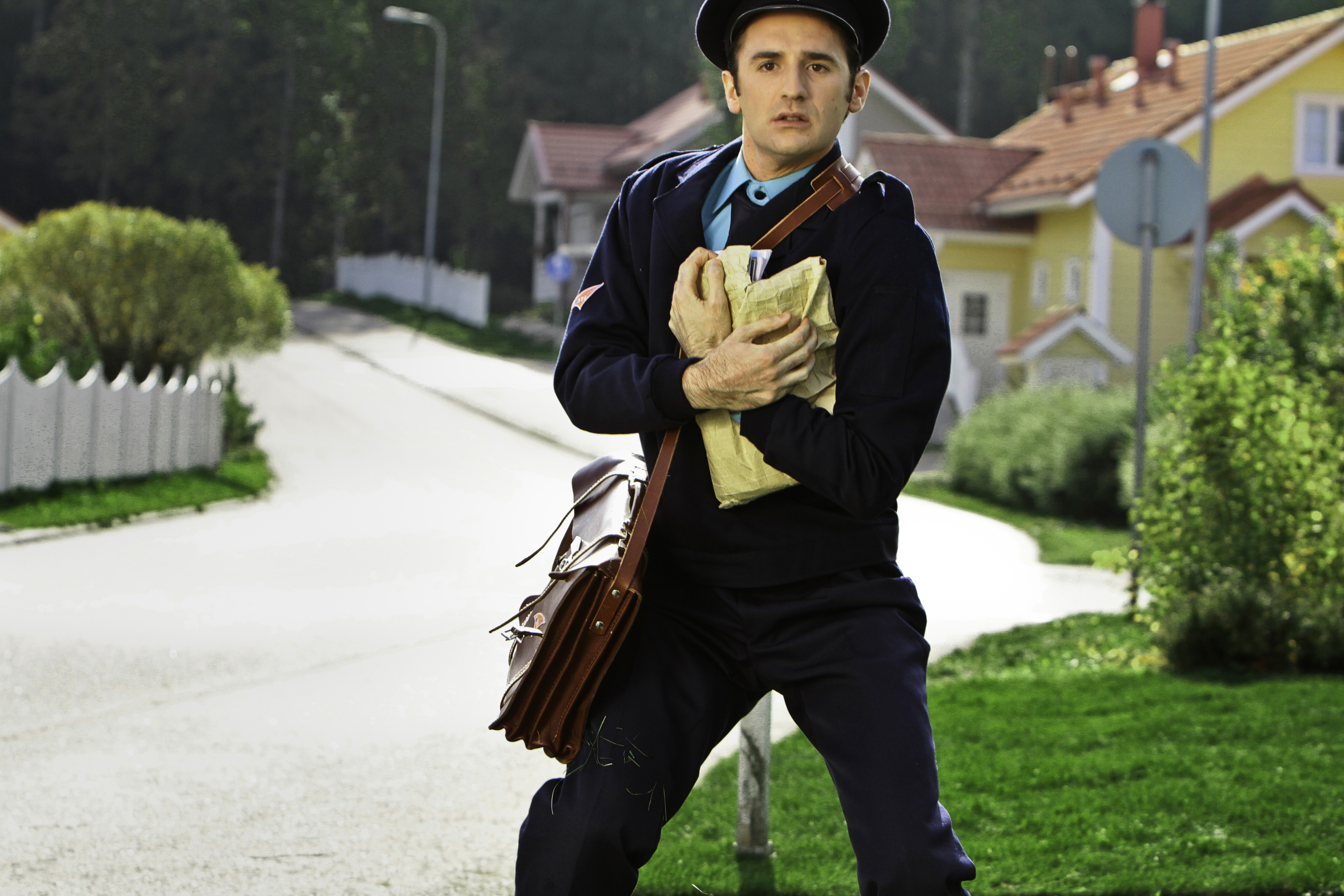
 Mikael Buch’s Let My People Go! is a charmingly wacky, unpredictable comedy that is filled with fun cinematic references, with the first-time feature-film director openly paying tribute to his many influences with an infectious glee. Nicolas Maury stars as Ruben, a French Jew living in Finland with his lover, Teemu (Jarkko Niemi). On his route one day, Ruben attempts to deliver a package to Monsieur Tilikainen (Kari Väänänen), who refuses to accept it once he sees that it contains a whole ton of money. As he suffers a heart attack on his front lawn, he wills the cash to Ruben, who initially doesn’t want it but eventually accepts it. But when he tells Teemu what happened, the incensed Teemu throws him out for having taken the money while leaving the old man dying on the grass. With nowhere else to go, Ruben returns to his crazy family in Paris, where he learns disturbing stories about his mother (Almodóvar regular Carmen Maura) and father (longtime French actor Jean-François Stévenin), his sister (Amira Casar) is in the midst of an ugly fight with her Palestinian-supporting goy husband, and his macho brother (Clément Sibony) is prepared to do whatever it takes to protect the crazy clan. Meanwhile, a distraught Ruben is offered a job in the family dry-cleaning business and gets entangled in an unfortunate sexual tug-of-war with respected lawyer and community leader Maurice Goldberg (Jean-Luc Bideau). Referencing a wide range of filmmakers including Jacques Demy, Wes Anderson, Woody Allen, Douglas Sirk, Vincente Minnelli, and Pedro Almodóvar, Buch and cowriter Christophe Honoré (Ma mère, Love Songs) have a grand old time with the oddball goings-on, which often go way too over the top or are too silly for their own good, but Maury manages to keep it all together with his sad-sack faces and physical comedy, evoking both silent movies and Hollywood musicals. Céline Bozon’s cinematography and Gwendal Bescond’s production designer, particularly in the candy-colored suburban fantasy world of Finland, continues the madness. Buch, who is still in his twenties, was born in France and raised in Taiwan and Barcelona, a diverse background echoed in the many cultural clashes and varied elements depicted in Let My People Go! The film opens January 11 at the Quad, with Buch on hand to participate in Q&As following the 7:20 shows on Friday and Saturday.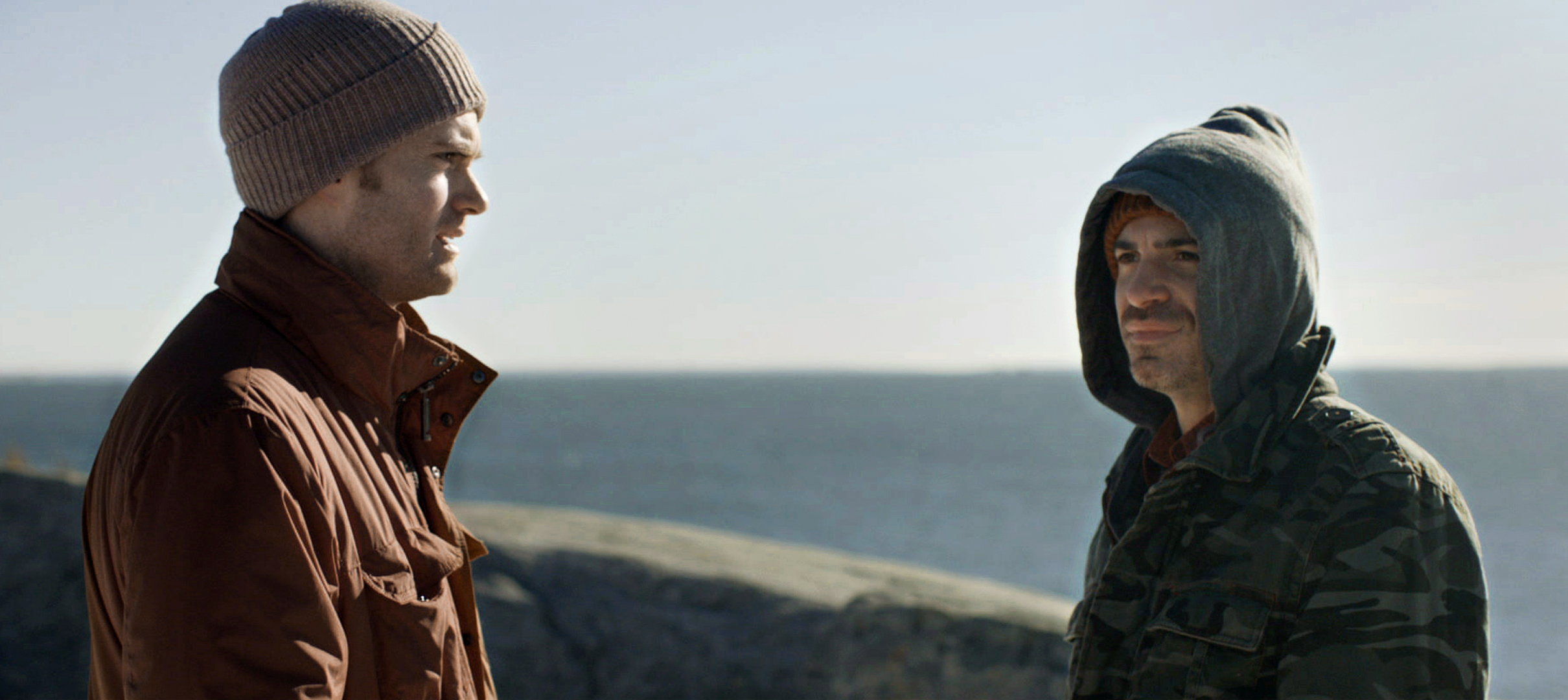
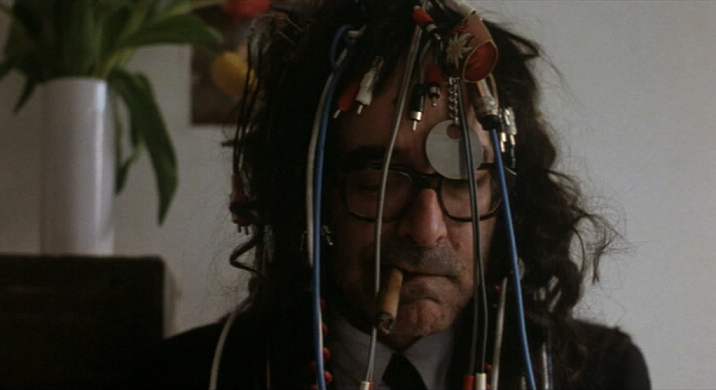
 At the 1985 Cannes Film Festival, producer Menahem Golan, who would go on to make several movies nominated for the Golden Raspberry (Cannonball Run, Cobra), somehow got French auteur Jean-Luc Godard to agree to direct a new version of King Lear, signing the contract on a napkin. Unfortunately, things didn’t go quite as planned, resulting in Godard’s incomprehensible, unintelligible, extremely hard-to-follow Shakespeare flick. Theater director Peter Sellars — he of the Eraserhead-like hairdo — stars as William Shakespeare Jr. the Fifth, a descendant of the Bard’s who is trying to put his famous ancestor’s plays back together in a post-Chernobyl world. After Norman and Kate Mailer get in an argument about turning the script into a gangster picture, Sellars meets Learo (a muttering Burgess Meredith) and his daughter, Cordelia (a monotone Molly Ringwald). Also on hand for this twisted fairy tale are French director Leos Carax (Pola X, Holy Motors) as Edgar, Julie Delpy as Virginia, Woody Allen as Mr. Alien, and Godard himself as the wacky Professor Pluggy. Elements of the play occasionally show up, but it is nearly impossible to figure out just what the hell is going on. By the time it all starts making the least bit of sense and even becomes intriguingly poetic, it’s over. In his inimitable style, Godard subversively defies all expectations, making a film that is about everything, nothing, and no thing. He takes on virtue and power, art and nature, text and image, and storytelling itself, but in this case he ends up with an unwatchable mess. Still not available on DVD, King Lear is having a rare screening January 11 at 7:00 and 9:30 at 92YTribeca, with the early show followed by a Q&A with critics Simon Abrams, Bilge Ebiri, and Richard Brody. When he selected the film for the 2009 New Yorker Festival, Brody wrote, “I consider Godard’s King Lear to be his greatest artistic achievement; in a Y2K poll, I ranked it among the ten best movies ever made.” It should be quite interesting hearing him defend that choice on Friday night.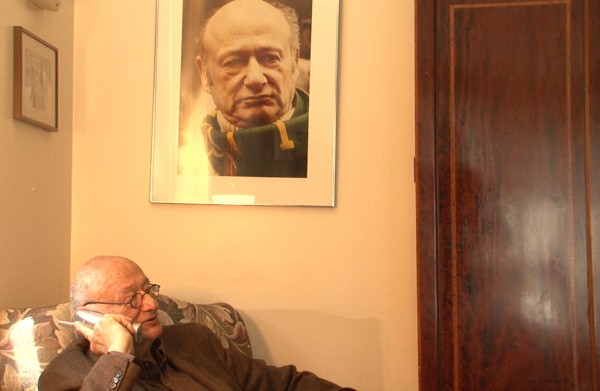
 A bunch of people have a whole lot to say about Ed Koch in a new documentary about the charming yet irascible former three-term mayor of New York City, but none of them goes on quite so eloquently as Hizzoner himself. Longtime journalist and first-time filmmaker Neil Barsky delves into the man behind the legend, the upstart politician who helped save New York from the debt- and crime-ridden 1970s through, among other things, the sheer force of his immense will. Barsky combines new interviews with such political journalists as Michael Goodwin, Sam Roberts, and Wayne Barrett, along with former comptroller Carl McCall and the Rev. Calvin O. Butts, to paint a portrait of Koch as both mensch and meanie, a bully who always speaks his mind and never backs down from a challenge. Barsky and editor Juliet Weber include archival photographs and old film footage of Koch in the 1960s and early 1970s as he first takes on Democratic Party boss Carmine DeSapio, then runs for city council and Congress before getting into a heated seven-person race for mayor in 1977. The present-day Koch is filmed tinkering around in his small kitchen, breaking the Yom Kippur fast with his family, and relaxing in his office, sharing his views on his legacy, his battles with the black community over Sydenham Hospital, and even questions of his sexuality — but only up to a point — that have followed him throughout his career. Although Barsky claims in his director’s statement that “with the exception of one former governor and one former mayor, virtually everyone we reached out to agreed to be interviewed,” the film suffers in that it does not exactly boast an all-star lineup of pundits talking about Koch– but it of course has Koch himself, and that is more than enough. Koch, which opens theatrically February 1, is screening January 10 and 13 at the twenty-second annual New York Jewish Film Festival, presented by the Jewish Museum and the Film Society of Lincoln Center, with Barsky on hand for the January 10 show and the now-eighty-nine-year-old Koch in attendance January 13.