Documentary looks at the complex relationship between a father and son
DOCUMENTARY FORTNIGHT 2013 — MOMA’S INTERNATIONAL FESTIVAL OF NONFICTION FILM AND MEDIA: MY REINCARNATION (Jennifer Fox, 2010)
MoMA Film, Museum of Modern Art
11 West 53rd St. between Fifth & Sixth Aves.
Saturday, March 2, 5:00
Festival runs February 27 – March 4
Tickets: $12, in person only, may be applied to museum admission within thirty days, same-day screenings free with museum admission, available at Film and Media Desk beginning at 9:30 am
212-708-9400
www.moma.org
www.myreincarnationfilm.com
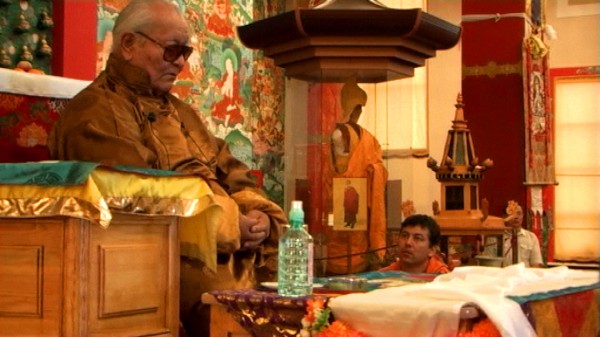
 More than twenty years in the making, Jennifer Fox’s My Reincarnation tells the fascinating story of a very unusual father-son relationship amid the modern world of tulkus, or reincarnated Tibetan lamas. World-renowned high Tibetan Buddhist Master Chögyal Namkhai Norbu travels around the world teaching meditation and Dzogchen practice. He meets with the Dalai Lama, advises students and fans, signs copies of his many books, and builds support for his beleaguered native land, Tibet. But his son, Yeshi Silvano Namkhai, who was born in 1970 in Italy (where Rinpoche Namkhai Norbu taught at university from 1964 to 1992), had no desire to follow in his father’s footsteps and instead went into the computer business, starting a family and rejecting nearly everything his father believes in — including that Yeshi might just be the reincarnation of his great-uncle, Khyentse Rinpoche Chökyi Wangchug, and so is destined for a life of service and tradition. “Everybody knows about me and nobody knows me at all,” Yeshi says about trying to establish his own identity. Father and son and the rest of the family allowed Fox remarkable access, holding nothing back as they talk about their lives and each other; Yeshi is particularly vocal about his father’s treatment of him over the years. But soon Yeshi has a change of heart, and the documentary takes an unexpected turn. Fox, who has previously made such films as Beirut: The Last Home Movie, Flying: Confessions of a Free Woman, and An American Love Story, shot more than one thousand hours of footage, which she edited down to a tight seventy-five-minutes, including archival and newsreel footage as well. As much as it is about a father and a son, My Reincarnation is also about the old vs. the new, tradition vs. modernization, private love vs. public responsibility, the spiritual vs. the technological, and, above all, familial legacy. My Reincarnation is screening at MoMA on March 2 at 5:00 as part of the “MoMA Selects: POV” section of “Documentary Fortnight 2013: MoMA’s International Festival of Nonfiction Film and Media” and will be followed by a Q&A with the director; the POV portion, which runs February 27 to March 4, celebrates a quarter-century of the award-winning PBS program POV and also includes such films as Marlon Riggs’s Tongues Untied, Freida Lee Mock’s Maya Lin: A Strong Clear Vision, Robert Kenner’s Food, Inc., and Alan Berliner’s Nobody’s Business. “As we celebrate our twenty-fifth anniversary on PBS, MoMA’s retrospective program allows us to review our history, share insights about documentary craft and culture with the public, and celebrate with the indie filmmaking community,” POV co-executive producer Cynthia López said in a statement. “The ways in which documentaries have contributed to our culture will be a focus of conversations at the screenings. We hope the public will find that these documentaries inform, entertain, and challenge conventional wisdom.”

 Korean auteur Park Chan-wook has made some of the most suspenseful and violent films of the young century, beginning with the military thriller Joint Security Area and continuing with the Vengeance trilogy, consisting of Sympathy for Mr. Vengeance, Oldboy, and Lady Vengeance, as well as


 Japanese filmmaker Shohei Imamura blurs the lines between reality and fiction in his cinéma vérité masterpiece, A Man Vanishes. The 1967 black-and-white documentary delves into one of Japan’s annual multitude of missing persons cases, this time investigating the mysterious disappearance of Tadashi Ôshima, a plastics wholesaler who vanished during a business trip. Imamura sends out actor Shigeru Tsuyuguchi (The Insect Woman, Intentions of Murder) to conduct interviews with Ôshima’s fiancée, Yoshie Hayakawa, who develops an interest in her inquisitor; Yoshie’s sister, Sayo, who quickly finds herself on the defensive; business associates who talk about Ôshima’s drinking, womanizing, and embezzling from the company; and several people who remember seeing Sayo together with Ôshima, something she adamantly denies despite building evidence. Throughout the 130-minute work, the film references itself as being a film, culminating in Imamura’s pulling the rug out from under viewers and calling everything they’ve seen into question in an unforgettable moment that breaks down the fourth wall and explodes the very nature of truth and cinematic storytelling itself. It also explores individual identity and just how much one really knows those closest to them. Originally supposed to be the first of a twenty-four-part series exploring two dozen missing-persons cases, A Man Vanishes ended up being such a challenging undertaking that it was the only one Imamura made, but what a film it is; it would be more than a decade before he returned to fiction, with 1979’s Vengeance Is Mine, which led the way to a spectacular final two decades that also included The Ballad of Narayama, Eijanaika, Black Rain, The Eel, Dr. Akagi, and Warm Water Under a Red Bridge. The amazing A Man Vanishes is screening February 19 at the IFC Center as part of the Tuesday-night series “Stranger than Fiction,” followed by a Q&A with documentarian Amir Bar-Lev (The Tillman Story, Fighter) and John Walter (How to Draw a Bunny).