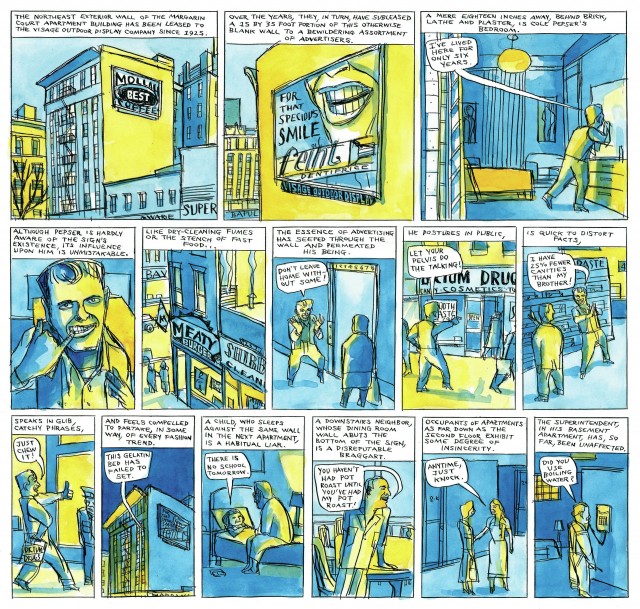
“Cole Pepser’s Bedroom” is one of many marvelous Ben Katchor strips that combine unique, old-fashioned characters and a changing consumer culture amid urban environments (© 2013 by Ben Katchor)
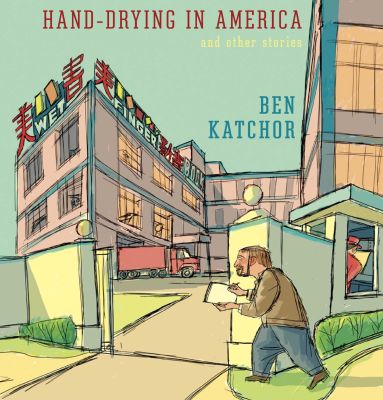
HAND-DRYING IN AMERICA AND OTHER STORIES (Pantheon, March 2013, $29.95)
Monday, April 1, NY Comics & Picture-story Symposium, Parsons the New School, 2 West 13th St., Bark Room, 7:00
Saturday, April 6, MoCCA Arts Festival, 69th Regiment Armory, 68 Lexington Ave. at 26th St. festival admission $12-$15
Monday, April 15, Greenlight Bookstore, 686 Fulton St., Brooklyn, free, 7:30
www.katchor.com
In a March 2011 twi-ny talk, we asked Brooklyn-born cartoonist Ben Katchor whether he was afraid the physical book might be disappearing from the American landscape, and he responded, “Physical books will be around for a long time — I see them used as window and door props, and as structures to support laptop computers.” At that time, Katchor was promoting his first book in more than ten years, the graphic novel The Cardboard Valise, which came with a handle so you could carry it like a piece of luggage. For his latest book, Hand-Drying in America and Other Stories, Katchor has created an even larger, heavier hardcover without the handle, making it almost impossible to carry around, but it is no mere doorstop. Hand-Drying is a marvelous collection of more than 150 strips Katchor has drawn for Metropolis magazine, inventive and funny cartoons filled with the trademark old-fashioned characters, absurdist situations, and unusual city environments that Katchor has been detailing for several decades in such previous books as Cheap Novelties: The Pleasures of Urban Decay, The Jew of New York, and Julius Knipl, Real Estate Photographer: The Beauty Supply District. In Hand-Drying, Katchor continues his exploration of disappearing elements of modern urban living, from architecture and design to advertising and consumer products — including books.
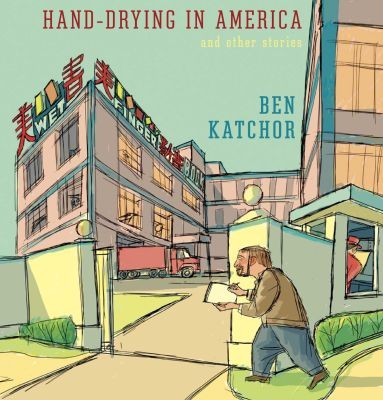
In the front endpaper, investigative reporter Josef Fuss researches the severe environmental costs involved in the publishing process: “Each book is a minor ecological disaster,” he says to himself. In “The Tragic History of the Oversized Magazine,” Katchor is referencing Hand-Drying itself, tracing the development of large-scale magazines, explaining, “Their destiny is linked to the Cadillac Fleetwood Brougham, the porterhouse steak, the zoot suit and other material excesses of history.” In the last word bubble, a man holds a magazine that nearly matches his own size, proclaiming, “Wow, look at this spread!” Readers will be repeating those words over and over as they turn the pages of Hand-Drying, which features such other knockout tales as “Open House Season,” which follows people who are obsessed with visiting open houses even though they are not looking for a new apartment; “The Committee for Architectural Neglect,” in which a group of officials “see no reason for a building to relive its glorious past”; “2nd Thought Mail,” in which a company sets up a ten-day waiting period in case letter writers don’t want to send that missive after all (a fabulous take on that feeling one gets when instantly regretting sending an e-mail that can’t be recalled); and “Contiguous Control,” in which a man ends up in the hospital after refusing to use the remote control. “Who turns the pages of your books?” he asks his son.
But Katchor is no mere crank complaining of the failings of our modern, techno-driven, instant-gratification society, lamenting the passing of the days of getting up and walking to the television set to change the channel, friendly gas-station attendants who would engage customers in small talk while working the pump, and drying one’s hands with paper towels in rest rooms instead of having to use loud, abrasive hand-drying machines. Instead, he celebrates the unique and unusual in the past, present, and future, visualizing a fascinating societal underground that still exists in the nooks and crannies of our daily existence. In the back endpapers, freelance Chinese journalist Fallo Yank disputes Fuss’s findings, determining that “literary and coffee-table books account for an insignificant portion of the world’s print pollution,” that the real problem is the content of the books, including “a deluxe full-color edition of an esoteric literary comic strip.” Hand-Drying in America is no mere window or door prop but rather an endlessly entertaining and extremely funny and insightful look at human nature and our changing world as only Katchor can depict it. The self-deprecating cartoonist will be participating in a conversation with Gil Roth, host of “The Virtual Memories Show,” at the thirty-eighth meeting of the NY Comics & Picture-story Symposium on April 1 at 7:30 at Parsons the New School, will be signing copies of his books at the Pantheon booth at the MoCCA Arts Festival on April 6 at the 69th Regiment Armory, and will take part in an illustrated discussion with writer Nicholas Dawidoff at the Greenlight Bookstore in Brooklyn on April 15 at 7:30.
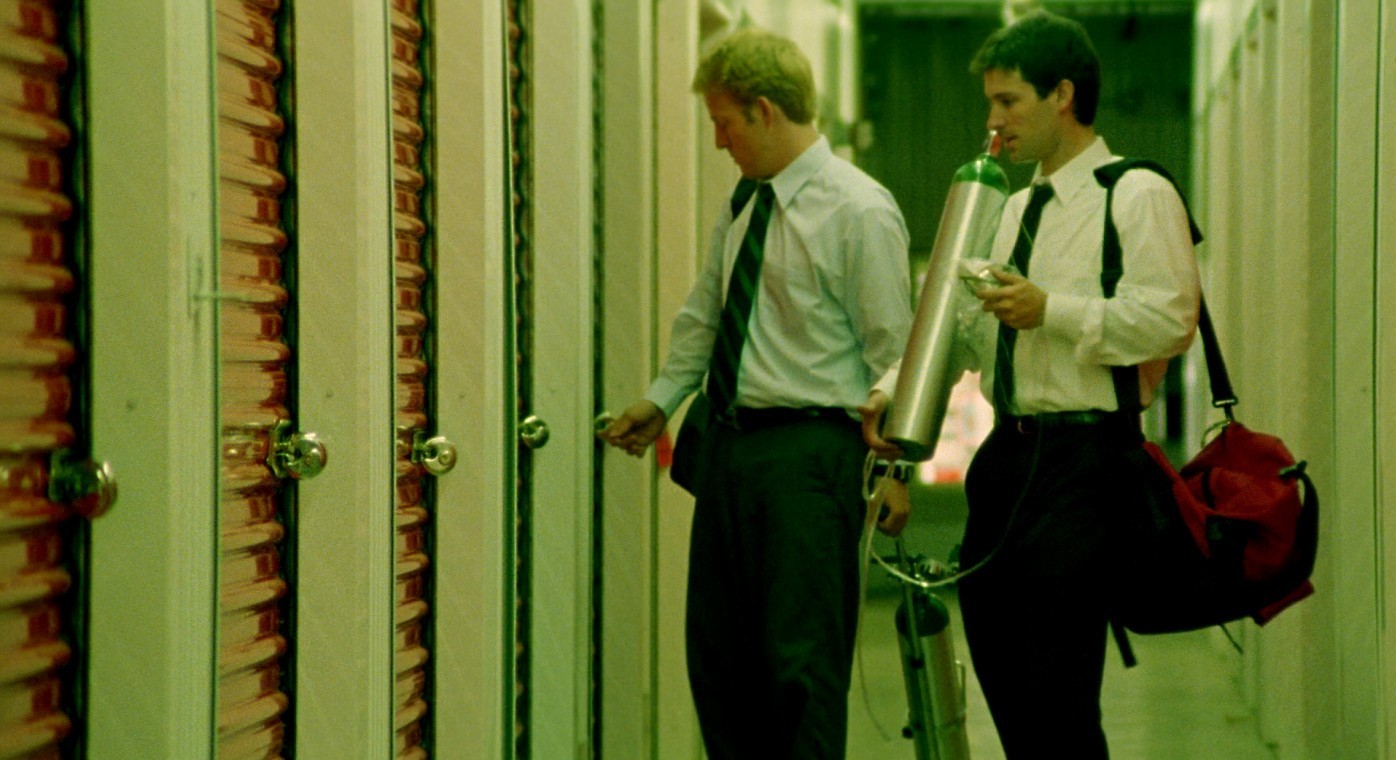
 Former engineer and first-time filmmaker Shane Carruth wrote, directed, edited, scored, and stars in Primer, an utterly confusing, confounding, and ultimately uninvolving tale of two engineers (Carruth and David Sullivan) who accidentally develop a machine that breaks through the time-space continuum and can create doubles of — well, it’s better not to get too specific, because we’re not really sure what it’s all about and what really happens. That can sometimes be a good thing, but not this time around, we’re afraid. Carruth, who made the film for a mere seven grand, is purposefully vague, but it’s to his own detriment, resulting in a story that plays more like an episode of a mediocre sci-fi series than the intriguing, unique, imaginative movie he wanted to make, even if it did win the Grand Jury Prize at Sundance. Carruth wouldn’t make another film for nine years, the romantic thriller Upstream Color, which he wrote, directed, produced, and stars in and opens in New York City on April 5. Primer kicks off the Museum of the Moving Image series “The Life of Film: Celebrating a Decade of Reverse Shot” on April 4, with Carruth on hand to talk about his work. The festival consists of four days of screenings, Q&As, and a panel discussion paying tribute to the tenth anniversary of the quarterly online film magazine founded by editors Michael Koresky and Jeff Reichert (who curated this series) and writers Erik Syngle and Neal Block. We might not have cared much for Primer, but Reverse Shot’s Matthew Plouffe had this to say about it in the autumn 2004 issue: “Irrespective of Shane Carruth’s heroic story or the film’s potential effect on American cinema, Primer ranks among the brightest beacons of uncompromised creative light to hit the silver screens of Utah in recent history. It’s hard to believe. The posh festival that has steadily spiraled into a mire of mediocrity over the last decade finally got it right. Shane Carruth deserves every accolade thrown his way, and if Primer signals what we’ve got to look forward to, his Sundance honors won’t be the last.”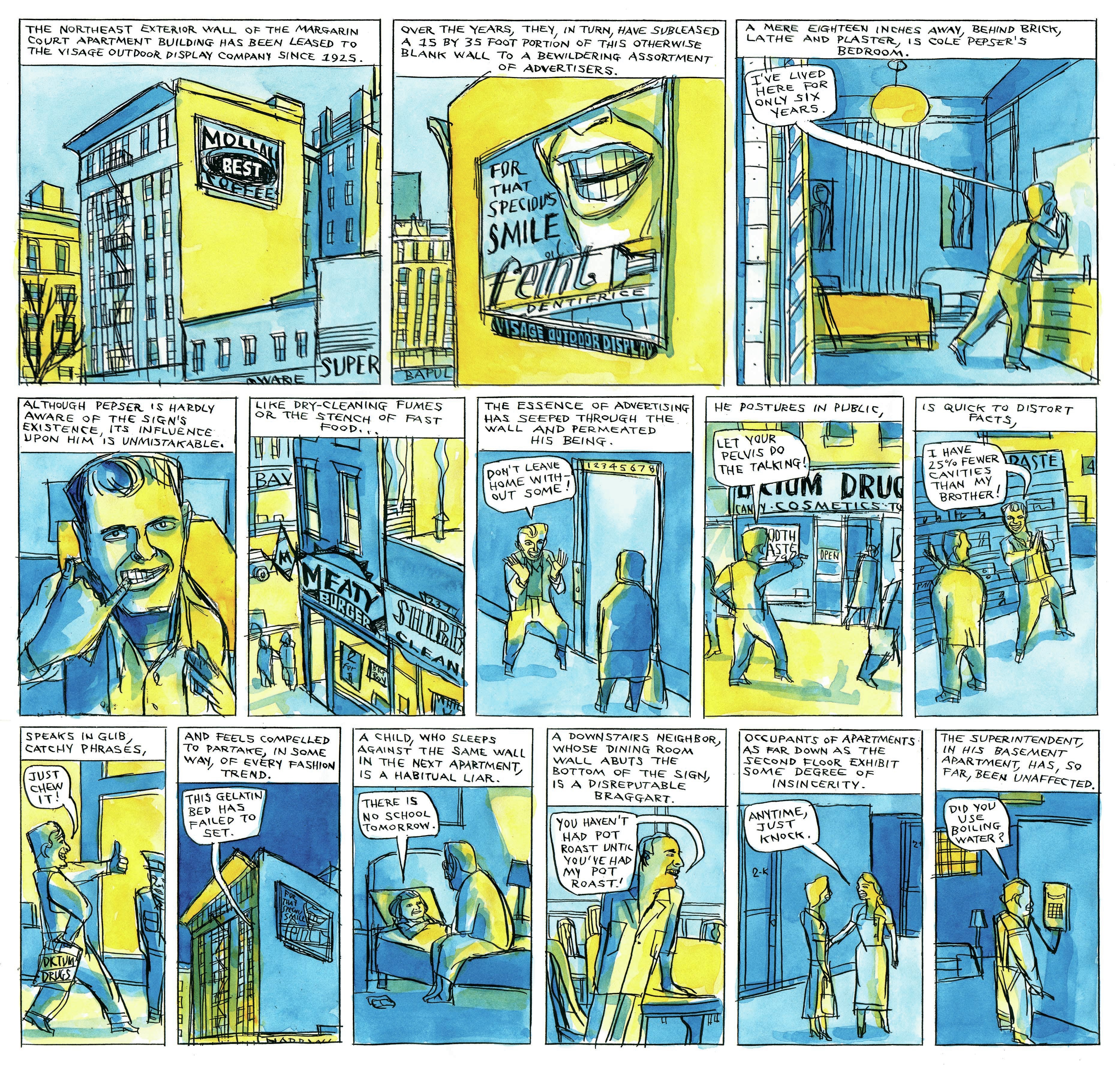

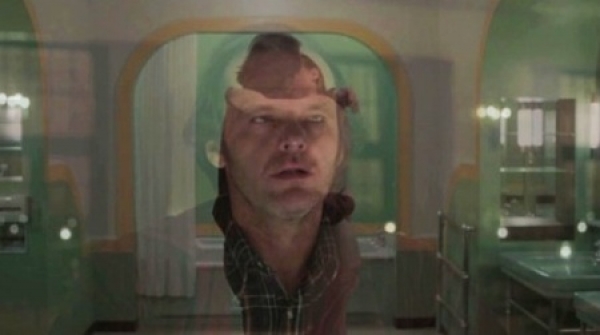
 The next time you watch Stanley Kubrick’s cult classic horror flick, The Shining, you’re gonna want to put on a tinfoil hat while drinking your soda and munching on popcorn after seeing Rodney Ascher’s Room 237, an extremely entertaining study of obsession, the love of movies, and people with a little too much time on their hands. A marvelous exploration of how we watch and individually interpret movies, Room 237 allows a handful of wild theorists to deconstruct and reconstruct Kubrick’s widely examined film, based on Stephen King’s 1975 bestselling novel. From the sweeping opening helicopter shot to the final zoom on a black-and-white photograph, four men and one woman share their deeply researched insight into what virtually every moment of Kubrick’s frightening tale of a writer (Jack Nicholson) and his wife (Shelley Duvall) and son (Danny Lloyd) taking care of a Colorado mountain hotel during the off-season is really about. But these are not just plain nuts; among them is an award-winning journalist, an accomplished historian, a published playwright, and a musician and WFMU deejay. Ascher (The S from Hell) never shows the commentators, instead allowing them to verbally describe their theories while he plays the relevant clips, accompanied by brief shots from all of Kubrick’s films (Dr. Strangelove, Full Metal Jacket, Paths of Glory, A Clockwork Orange, 2001: A Space Odyssey, etc.) and other movies and television programs that cleverly relate to the storytelling. Jay Weidner believes that The Shining is Kubrick’s apology for having directed the faked Apollo 11 moon landing, Bill Blakemore thinks it’s about the genocide of the American Indians, Geoffrey Cocks is sure it’s about the Holocaust, and Juli Kearns finds it to be about the mythical Minotaur; Kearns also has generated a three-dimensional map of the Overlook Hotel to delve into the impossible spatial relationships perpetrated by Kubrick, always, she claims, with a very specific reason. Perhaps the most creative of the subjects is John Fell Ryan, who insists that the film was meant to be seen both forward and backward — at the same time. One of the “leading” Shining explorers, Kevin McLeod, aka “mstrmnd,” declined to appear in the film, but some of his views are included as well. While many of the theories will leave you scratching your head or laughing hysterically, you’re almost sure to start giving credence to a few, so beware; it’s a natural tendency of the human brain to try to detect patterns in things, and in this case the work has already been done for you. But one thing is certainly true: After watching Room 237, you’ll never be able to look at The Shining the same way again. Room 237 opens March 29 at the IFC Center and the Elinor Bunin Munroe Film Center, with Ascher and producer Tim Kirk going back and forth between the two venues on Friday and Saturday for various Q&As and introductions.