this week in lectures, signings, panel discussions, workshops, and Q&As

DANCE UNDER THE INFLUENCE: JARED ANGLE, PONTUS LIDBERG, SUSAN MARSHALL & COMPANY, AND SARA DU|JOUR

SARA DU|JOUR

SARA DU|JOUR will be part of influential presentation at Museum of Arts & Design

Museum of Arts & Design
The Theater at MAD
2 Columbus Circle at 58th St. & Broadway
Friday, April 26, and Saturday, April 27, $20, 7:30
800-838-3006
www.madmuseum.org

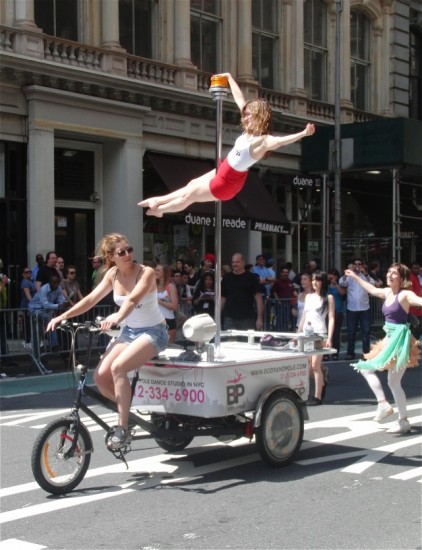
The April edition of the Museum of Arts & Design’s third annual “Dance Under the Influence” series features another wide-ranging, eclectic collection of performers who will present a piece, then discuss the inspirations that went into its creation. New York City Ballet principal Jared Angle, whose brother, Tyler, is also an NYCB principal, blends the classical with the contemporary in the personal exploration Jared. Swedish dancer and choreographer Pontus Lidberg, the current resident artistic director of Morphoses and a filmmaker who has mounted productions for stage and screen, will show a duet from Warriors and a solo from Within (Labyrinth Within). For more than a quarter century, Susan Marshall & Company has been incorporating gesture, pattern, spoken word, and multimedia elements into such pieces as Arms, Kiss, and Frame Dances, which takes place in, out of, and through wooden boxes. And the wild and unpredictable bicoastal duo SARA DU|JOUR, consisting of Jordan Isadore and Nicole Bridgens, answer the question “What would happen if the extremes and ridiculousness of pop celebrity were to infiltrate the contemporary dance world?”

WITHIN (LABYRINTH WITHIN) features choreographer Pontus Lidberg performing a solo at Jacob’s Pillow (photo by Martin Nisser)

WITHIN (LABYRINTH WITHIN) features choreographer Pontus Lidberg performing a solo at Jacob’s Pillow (photo by Martin Nisser)

Update: The April 26 edition of Dance Under the Influence was a wide-ranging evening of movement and discussion on the small stage in the Museum of Arts & Design’s downstairs theater. Actually, the show begins upstairs in the lobby, where Susan Marshall & Company dancer Luke Miller performs Voice 1, standing silently in front of a microphone, moving slowly in place as people pass by; Darrin Wright does the same thing at the entrance to the theater. The presentation then kicked off with Morphoses resident artistic director Pontus Lidberg screening excerpts from three of his films: The Rain, in which two male dancers get hot and heavy in an erotic duet in a room being pounded by rain; Within (Labyrinth Within), in which Lidberg dances across an outdoor stage at Jacob’s Pillow; and Study No. 2, a beautiful underwater solo with an exciting twist at the end. That was followed by NYCB principal Jared Angle’s Jared, a work choreographed by Elena Demyanenko specifically for that shallow stage space as Angle makes his debut as a solo contemporary dancer, set to Elizabeth Hoffman’s “Soundendipities.” After a brief intermission, Susan Marshall & Company showed an excerpt from the work-in-progress Unstrung, including a passage with Christopher Adams, Kristin Clotfelter, Miller, Chin-I Chang, and Wright congregated at the middle of the shallow stage, moving left to right to music by David Lang and the Antlers. And then came the real showstopper, as SARA DU|JOUR’s Jordan Isadore and TJ Spaur exploded with Les Saras, a wild and funky in-your-face dance as the two hairy-legged performers rock the top knot, evoking classic girl groups and vintage photographs from the 1940s and ’50s as they prance about on the stage, with Isadore making riotous faces. Afterward, all of the contributors sat down for a fun Q&A moderated by series curator Valerie Gladstone. The MAD series concludes May 17-18 with Doug Elkins, Rashaun Mitchell, Ramya Ramnarayan, and Blakely White-McGuire.

THE MODERN SCHOOL OF FILM: NAKED

NAKED

Mike Leigh’s award-winning NAKED will have a special screening at the IFC Center on April 25

NAKED (Mike Leigh, 1993)
IFC Center
323 Sixth Ave. at West Third St.
Thursday, April 25, 7:00
212-924-7771
www.ifccenter.com

In writer-director Mike Leigh’s controversial Naked, David Thewlis is mesmerizing as Johnny, a drifter on the run from Manchester who shows up at the London apartment of an old girlfriend, Louise (Lynda Steadman), and develops a strange attraction for Louise’s roommate, Sophie (the excellent Katrin Cartlidge). Leigh, who earned Best Director honors at Cannes for the film, fills Naked with desperate characters, desolate streets, and plenty of graphic, lurid detail. Thewlis won numerous acting awards for his brilliant portrayal of a very difficult character for the audience to care about, especially in a film that runs more than two hours. Sitting through Naked is an exhausting, infuriating, ultimately rewarding experience; among the best scenes are the philosophical conversations Johnny has with the night watchman (Peter Wight). Naked is screening in a high-definition digital projection on April 25 as part of the IFC Center series “The Modern School of Film” and will be followed by a discussion with Iron & Wine’s Sam Beam.

TWI-NY TALK: NICK VAUGHAN & JAKE MARGOLIN: A MARRIAGE: 1 (SUBURBIA)

Nick and Jake

Nick and Jake collaborate both personally and professionally, using their life together as a starting point in their art

HERE
145 Sixth Ave. at Dominick St.
April 23 – May 4 (Tuesday – Sunday, 8:30), $10 in advance, $20 within twenty-four hours
Installation free Tuesday – Sunday 2:00 – 10:00
212-647-0202
www.here.org
www.nickandjakestudio.com

Married couple and professional partners Nick Vaughan and Jake Margolin have taken over HERE, filling the downtown arts center with the multimedia immersive presentation A Marriage: 1 (Suburbia). Employing the visual sensibility of Gilbert & George, Nick and Jake examine what has become of the American Dream and the concept of the nuclear family through photography, video, performance, and installation that will continue to evolve from April 23 through May 4. In the art exhibit, which is free, they employ maps that have been reconfigured to portray superimposed families on them and/or video of the two men in the background; pages from John Updike’s Rabbit Run torn out and put on a wall, with highlighted phrases and blue lines connecting them to tell a different kind of suburban story; a hallway of colorful light boxes depicting the conventional 1950s ideal of the American family; and wall sketches that will be added to over the course of the two weeks. Every night will feature a sixty-minute live show ($10 in advance, $20 within twenty-four hours) featuring text written by Jessica Almasy and performed by Jess Barbagallo, with long-duration actions by Brandon Hutchinson and Libby King (April 23-25), Sean Donovan (April 26-30), and Chantal Pavageaux (May 1-4); brand-new Guggenheim Fellow and award-winning choreographer Faye Driscoll serves as consulting director.

“It was super fun for me to work with Nick and Jake; they are both so earnest, humble, and smart and amazingly open inside their process,” says Driscoll. “I loved working on ideas around performance in a visual art context; it opened up my thinking around my own work and gave me some new structures of making, and permission for a different type of exploration. But I think it really helped that all three of us have backgrounds in working in theater. We very easily found a common language around dramaturgical questions and rigor. And we all have an easy willingness to engage in the labor involved in making things. We did a lot of figuring out on our feet, which is how I think best. I think in A Marriage there is clear play with that merged and excessive space of togetherness of coupledom, but as opposed to the work just becoming insular and exclusive, there is actually something deeply generous and activist happening in what Nick and Jake are creating.” At the center of that togetherness and activism is an exploration of America’s changing relationship with same-sex marriage. Nick and Jake, who are still part of the TEAM arts collective where they met, discussed that and more as they prepared for the start of this fascinating undertaking.

twi-ny: Did either of you grow up in the suburbs?

Jake: Neither of us grew up in the suburbs. We both grew up in small university cities, Nick in Fort Collins, Colorado, and I in Berkeley, California. I think it’s safe to say that we both grew up with a healthy distrust of the suburbs — growing up, my family hosted a singing group at our house in which Malvina Reynolds’s “Little Boxes” was a pretty frequent request. Growing up with parents who had no interest in the suburban version of the American Dream is part of why I grew up thinking that the suburbs were for other people. But I also felt that because I was gay it wasn’t an option, even if I wanted it. I grew up knowing a fair number of kids who lived in the suburbs of the Bay Area, and many of them were nonwhite, and not wealthy, which I mention only to say that I didn’t have a view of the suburbs as a place that was exclusively white or monied. But my sense of it was that the suburbs were exclusively heterosexual. And as I realized that I didn’t fit into that, I had a real sense that even had I wanted anything to do with the suburbs, I wouldn’t be welcome — that the ’burbs weren’t for people like me.

twi-ny: What do you think has happened to that American Dream since your were kids?

Jake: When we talk about the “American Dream” we are talking about the heteronormative version that aspires to a suburban nuclear family. There are as many different versions of the American Dream as there are people in this country, so I just want to clarify that we are using it as a cliché. And I think a major shift has happened since we were kids, which is that this version of the American Dream is now opened up to include LGBTQ people. Even growing up in a hyperliberal place, I had a sense of gay people as being abnormal – a deviance from the norm that are tolerated because Berkeleyites are tolerant and open-minded people, but still a group of people who are in some way going to have to live on the outside of mainstream society. As many things about gay culture have been accepted into the mainstream since we were kids, now that set of aspirations that were traditionally exclusively for heterosexuals, aspirations towards suburbia, the nuclear family, and all of that – are on the table.

Nick and Jake explore the suburban ideal of the American Dream in immersive multimedia installation (photo by twi-ny/mdr)

Nick and Jake explore the suburban ideal of the American Dream in immersive multimedia installation (photo by twi-ny/mdr)

twi-ny: An earlier part of A Marriage at HERE included your watching twenty hours of Fox News. What are your feelings toward America’s evolving relationship with same-sex marriage, primarily as portrayed in the media?

Jake: That piece was trying to get at how we are surrounded by these media portrayals of same-sex marriage, almost swimming in these sound bites. And we’d been floored by the general tone on Fox News about same-sex marriage – it felt so belittling whenever we saw it. That said, I should fess up that Nick and I don’t own a TV, and other than when we are on tour with the TEAM or other projects (or holing up in motels to make art pieces), we watch very little TV. Probably my greatest exposure to how the media portrays same-sex marriage is the package of clippings from the New York Times and various Bay Area publications on the topic that my mother sends us every few months.

In general I am so thrilled by the growing acceptance of same-sex marriage, both by the country in general and by the media that I am exposed to. Thrilled and grateful for the hard work and sacrifices that have been made by so many people to make this happen. However, I feel a certain ambivalence about this acceptance because I wonder who’s terms this acceptance is on. I wonder about the sense that we are accepted as long as we conform to a version of heteronormative social structures that people have spent the last however long – forty years? – trying to dismantle. I grew up with plenty of models of people living outside the construct of marriage – whether it be raising a family with their partner and never getting married or remaining single. So while Nick and I have a pretty traditional marriage in all respects other than our gender, I don’t have a sense that it is an inherently superior situation than any other. It just works for us.

As we were creating this piece, this ambivalence felt very strong – a real sense of “Now we have the option of fitting into all this iconography, but do we want to have anything to do with it? This inevitable-feeling march towards the mainstream, do we want it or are we losing something really important tied to our heritage as a people relegated to being the Other.” And then the Prop 8 case gets argued in front of the Supreme Court, and when I hear the justices waffling about “Is this really the right time?” and “Can’t we just wait for the states to decide on their own?” I find that I swing completely in the opposite direction and feel strongly, “How dare anyone say that I am different or that our relationship is in any way inferior” and find that I want that mainstream acceptance – that I feel completely entitled to it.

twi-ny: Among your collaborators is one of our favorite people, Faye Driscoll. How did that collaboration come about?

Nick: She’s one of our favorite people too! I first met Faye when I designed the set for Taylor Mac’s The Lily’s Revenge a few years ago. For the third section of the epic piece (which Faye choreographed) we stripped the space bare and taped out “‘scenery’ on the wall.” I’ve been following her work ever since and have collaborated on a couple of operas which she choreographed and I designed.

It was after the premiere of You’re Me at the Kitchen, though, that Jake and I decided to ask her to help us out with this project. She has such a clear and deceptively simple way of cutting to the core of visual ideas. You always have the sense watching her work that things are actually happening, that there’s a real exchange taking place. She’s also one of the smartest people I know. It seemed, therefore, only natural to ask her to help us curate and develop the eleven nightly actions for our piece, none of which is dance, per-se. . . .

twi-ny: The images of you and Jake in the installation evoke the work of Gilbert and George. Did they serve as any kind of influence or inspiration?

Nick: Absolutely. I don’t know if it would have been possible for the two of us as a couple and artistic team not to address Gilbert and George in some way. At some level I think their work was probably influencing us from the very beginning of our collaborations, but I don’t know that we realized it until their retrospective at the Brooklyn Museum a few years ago.

I think there is a very different approach to performance and it’s something that has certainly come up multiple times as we’ve developed the nightly actions. G&G were revolutionary in that they presented themselves as objects, stripped (or at least muted) of identity. Our presence in our work (hopefully) serves to frame the world through our eyes so you’re looking with us, not at us.

But there are small references peppered throughout the piece: There’s a large wax panel work that bears a slight reference to G&G in its framing. There are three sprayed-paint performances that I think in some way give a little nod to the silver and red body paint of the duo. But there are also other little nods to other artists who have inspired us.

There’s a piece in the downstairs hallway (and bathrooms) that lightly reference this wonderful Sol Lewitt piece Jake and I saw at MassMOCA last year in which he took an art criticism journal and diligently connected every use of the word “art” so you got this strange kind of matrix and it turned the text into this impenetrable geometric construction. We’ve taken a much looser approach, deconstructing John Updike’s Rabbit Run and attempting to give some kind of graphic anchor to the images that feel related, from a very subjective set of criteria.

Installation includes geographic portraits made of cut maps emphasizing negative space (photo by twi-ny/mdr)

Installation includes geographic portraits made of cut maps emphasizing negative space (photo by twi-ny/mdr)

twi-ny: You met while working together at the Team, and now you’re married. How has the dynamic of living, working, and performing together impacted your relationship?

Jake: One thing we joke about is that normally your spouse is the person you can come home to and gripe about work and your coworkers. . . . We can’t really do that. Our collaboration came out of conversations that we had while on tour with the TEAM as well as while on tour with Yoshiko Chuma. It feels that through the TEAM we have the most wonderful outlet for making theater with a group of the smartest and most talented people we know. And we realized that we shared an interest in installation art and how performance functions in that setting, and what started as daydreaming while on tour turned into works-in-progress at various places and ultimately this residency at HERE.

The show will change over time, with people encouraged to return to see where things have gone. Dare we read anything into the work as coming from your real-life marriage?

Jake: Each night of the show we will do a different performance action, so they will accumulate over the course of the run, while a fourteen-day-long action in which we, Brandon Hutchinson, Libby King, Sean Donovan, and Chantal Pavageaux read the entire oral arguments of Perry v. Schwarzenegger into clear bags, creating an expanding sculpture of the captured breath. We hope that people will come by later in the run to see how this has evolved, and the tickets are structured to encourage that – the ticket that you purchase is good for return visits so that people might stop by for ten minutes on a later night to check in on it all.

This question makes me laugh – I suppose it does feel like our marriage evolves over time and that if you check back in with us at a later point it will have gotten larger and more complicated and more fleshed out . . . but I suspect that is true of all relationships.

Earlier this year we were debating whether we should condense the performance actions into brief excerpts that could all be performed each night — and ultimately decided that they really only function if they are given the room to take a whole evening each — that their duration is at the core of the thing. Perhaps there’s an analogy there with our marriage, and probably with marriage in general – that it’s slow work, and things take time to breathe and grow, and that in fact this expansive time is a really good thing. A great perk of being married is that there isn’t the pressure to get things right immediately, because we’re in it for the long haul.

(A Marriage: 1 (Suburbia) runs April 23 – May 4 at HERE and will include several special programs. The April 24 performance will be preceded by “Cocktails & Context” at 7:30 and will be followed by the panel discussion “The Ambiguity of Acceptance,” and the May 1 show will be followed by a discussion moderated by Risa Shoup and featuring Steven Cheslik-DeMeyer, Erin Markey, Glenn Marla, and Tony Osso.)

BLUES FOR SMOKE

Rodney McMillian, “Asterisks in Dockery,” mixed-media installation, 2012 (photo by Sheldan C. Collins)

Rodney McMillian, “Asterisks in Dockery,” mixed-media installation, 2012 (photo by Sheldan C. Collins)

Whitney Museum of American Art
945 Madison Ave. at 75th St.
Wednesday – Sunday through April 28, $14-$18 (pay-what-you-wish Fridays, 6:00 – 9:00)
212-570-3600
www.whitney.org

In 1960, jazz pianist and composer Jaki Byard released his solo debut, Blues for Smoke, an improvisatory record that features on its cover a train puffing out dark clouds as it makes its way down the tracks. The album lends its name to an exciting multimedia exhibit at the Whitney that examines the impact of the blues on the arts. The show is highlighted by David Hammons’s extraordinary 1989 installation, “Chasing the Blue Train,” which greets visitors on the third floor. A blue train makes its way across tracks that take it through a tunnel covered in coal and a landscape with upturned piano tops as John Coltrane’s 1957 Blue Train album plays from a boom box, the work riffing on Coltrane’s name (coal, train) while celebrating the blues. Zoe Leonard’s “1961, 2002-Ongoing” consists of a row of suitcases of different shades of blue, evoking impermanence and creating a mystery about what might be inside; nearby, Martin Kipperberger’s “Martin, into the Corner, You Should Be Ashamed of Yourself” is a life-size replica of the artist standing in the corner, suffering from a case of the blues. Specially commissioned for the show, Kori Newkirk’s “Yall” consists of a shopping cart nearly completing a circle of blue on the floor, calling to mind exclusion, homelessness, and failed capitalism. Kira Lynn Harris lines a stairwell and entrance with silver Mylar in “Blues for Breuer,” paying tribute to the architect of the Whitney building, which will be taken over by the Met in 2015 when the Whitney moves downtown.

Installation view, Blues for Smoke (photo by Sheldan C. Collins)

Works by Martin Wong, Martin Kipperberger, Zoe Leonard, and others form a blues aesthetic at the Whitney (photo by Sheldan C. Collins)

Curated by Bennett Simpson in consultation with Chrissie Iles, “Blues for Smoke” also features works by Romare Bearden, Carrie Mae Weems, Glenn Ligon, Liz Larner, Jean-Michel Basquiat, Rachel Harrison, Mark Morrisroe, Alma Thomas, Beauford Delaney, Kara Walker, William Eggleston, and Lorraine O’Grady, all contributing to the overall examination of the blues aesthetic. A media room includes viewing stations where people can watch classic performances, while Stan Douglas’s “Hors-champs” plays continuously in its own space on the first floor, offering a unique view of a live recording on the front and back of a screen hanging from the ceiling. In addition, the Whitney is hosting a series of live events that continue through the end of the exhibition, which closes April 28, including “Blues for Smoke: Matana Roberts, Keiji Haino, and Loren Connors” on April 20 at 8:00 (featuring a solo performance by Roberts and a duo guitar improvisation by Haino and Connors), “Through the Lens of the Blues Aesthetic: An Evening of Short Films Selected by Kevin Jerome Everson” on April 25 at 7:00, the live concert “Blues for Smoke: Annette Peacock” on April 26 at 7:00, and the three-day “Blues for Smoke: Thomas Bradshaw,” in which the playwright will be creating a new piece that will be shown April 26-28.

EARTH DAY 2013: THE FACE OF CLIMATE CHANGE

The forty-third annual Earth Day focuses its attention on global warming this year with its personal theme, “The Face of Climate Change,” inviting people to go to the website, upload a photo, and tell their own story about how they’ve been directly affected by the somehow controversial topic and asking them to “be part of the solution.” Grand Central Terminal will host three days of special events, April 20-22, including presentations by Aimee Follette (“How Food Choices Have the Power to Nurture Us and Heal Our Planet”) and Patricia Moreno (“Be a Powerful Force for Positive Change in the World by Training Your Mind and Moving Your Body”), live performances by the Callen Sisters, Avidya & the Kleshas, and the cast of Annie, and screenings of such films as Dear Governor Cuomo and The Vanishing of the Bees. Among the exhibitors in Vanderbilt Hall will be 511 NY Rideshare/Commuter Link, Build It Green!NYC, Common Ground NYC, Global Justice For Animals and the Environment, Rwanda Women in Action, Sane Energy Project, and ThinkEco CoolNYC, among many others.

earth day

Over at the Javits Center, the Green Festival is open to the general public April 20-21, featuring presentations by Neil Chambers (“Resiliency and the Future of Cities”), Stefanie Iris Weis (“Bringing Eco-Sexy Back: Tools, Tips, and Tricks for a Sustainable Love Life”), Sacha Dunn (“Homemade Household Cleaners”), James Fischer (“Urban Beekeeping”), and others as well as a Recycled Runway Eco-Fashion Show and live performances by Reverend Billy and the Earthalujah Chorus and Circa ’95. Union Square will host exhibitor booths, a clothing swap, a CO2 E Drive Green Vehicle Runway Show, and live acts on April 21 and the C02 E Green Drive Project on April 22, while Solar One will have an Earth Day NY CO2 Car Drive on April 21 at 8:00 am.

HERMAN’S HOUSE

HERMAN’S HOUSE

Jackie Sumell wants to build a dream home for a prisoner serving a life sentence in HERMAN’S HOUSE

HERMAN’S HOUSE (Angad Singh Bhalla, 2013)
Cinema Village
22 East 12th St. between University Pl. & Fifth Ave.
Opens Friday, April 19
212-924-3363
www.cinemavillage.com
www.hermanshouse.org

After attending a presentation in 2001 by Robert King, the former Angola 3 inmate, about the controversial conditions in the Louisiana State Penitentiary and the continued incarceration — in solitary confinement — of Albert Woodfox and Herman Wallace, Brooklyn-born multidisciplinary artist Jackie Sumell began a correspondence with Wallace that developed into a fascinating friendship that is explored in Angad Singh Bhalla’s debut documentary, Herman’s House. “I’m not a lawyer and I’m not rich and I’m not powerful, but I’m an artist,” Jackie says in the film. “And I knew the only way I could get him out of prison was to get him to dream.” She gets him to dream by having him describe, in exacting detail, the house he’d like to live in if he were to ever be released, and she goes ahead and designs it, working with architects on the blueprints. She also builds a scale model that becomes part of a traveling art exhibit, “The House That Herman Built,” which includes a precise re-creation in wood of Wallace’s six-by-nine-foot cell, his home for thirty-six years. Bhalla, who wrote, directed, and produced the film, while also serving as director of photography with Iris Ng, never shows Wallace on camera; instead, he paints a portrait of the New Orleans native —who was first convicted of bank robbery in 1967, then of killing a prison guard in 1972, eventually sentenced to life without parole for a crime he claims he didn’t commit — through a series of recorded phone conversations he has with Sumell over the years. Bhalla also visits with ex-convict Michael Musser, who got his life back on track because of Wallace; Wallace’s sister Vickie, who is not afraid to speak her mind; and King, who helped form the Angola chapter of the Black Panther Party with Wallace, Woodfox, and others. “You look at this house, you’re looking at me,” Wallace says. Indeed, viewers might never get to see Wallace, but by the end of the film, they will feel like they know him — and will hope for his release. But Bhalla never steers the narrative into a clarion call condemning the prison system and demanding Wallace’s freedom, instead allowing those elements to be subtle parts of this intriguing tale of a very unusual relationship.

Herman’s House opens April 19 at Cinema Village with a series of special discussions all weekend featuring such guest speakers as NYCLU senior staff attorney Taylor Pendergrass, WNYC reporter Anna Sale, Five Mualimmak of the NYC Jails Action Coalition, King Downing of the Campaign to End the New Jim Crow, executive director Soffiyah Elijah of the Correctional Association, and solitarywatch.com editor Jean Casella in addition to Bhalla and Sumell.

TWI-NY TALK: DONNA UCHIZONO — LIVE IDEAS: THE WORLDS OF OLIVER SACKS

(photo by Mia}

Donna Uchizono will present two works during NYLA festival celebrating Oliver Sacks (photo by Mia}

LIVE IDEAS: THE WORLDS OF OLIVER SACKS — RE: AWAKENINGS (DANCE)
New York Live Arts
219 West 19th St.
Thursday, April 18, 8:00, and Saturday, April 20, 4:00, $40
Festival runs April 17-21
212-691-6500
www.newyorklivearts.org
www.ladonnadance.org

In the preface to the 1990 edition of his bestseller Awakenings, Dr. Oliver Sacks wrote, “It is now 21 years since my patients’ awakenings, and 17 years since this book was first published; yet, it seems to me, the subject is inexhaustible — medically, humanly, theoretically, dramatically. It is this which demands new additions and editions, and which keeps the subject for me — and, I trust, my readers — evergreen and alive.” In celebration of Sacks’s upcoming eightieth birthday (on July 9) and the thirtieth anniversary of the publication of Awakenings, New York Live Arts is hosting its first Live Ideas festival, “The Worlds of Oliver Sacks,” five days of special programs that medically, humanly, theoretically, and dramatically examine and explore the good doctor’s inexhaustible contributions to the field of science and the arts. The festival includes the world premiere of Bill Morrison’s short film Re: Awakenings; a series of talks delving into Sacks’s work with people who have Tourette’s, Parkinson’s, and hearing loss; an evening of music and dance with the Orchestra of St. Luke’s, choreographer Aletta Collins, dancer Daniel Hay-Gordon, and conductor Tobias Picker; back-to-back presentations of Harold Pinter’s A Kind of Alaska, the first with spoken words, the second in American Sign Language; and such panel discussions as “Disembodiedness: Body Image & Proprioception,” “Musicophilia & Music Therapy,” “Neurologists & Philosophers Consider Sacks at 80,” and “Minding the Dancing Body,” the latter bringing together NYLA executive artistic director Bill T. Jones, Miguel Gutierrez, Colin McGinn, Alva Noë, and Gwen Welliver.

Sacks himself will participate in an Opening Keynote Conversation with Jones and will introduce a screening of the 1974 British television documentary Awakenings, followed by a Q&A. “Live Ideas” also features a pair of works by New York-based choreographer Donna Uchizono, performed by Levi Gonzalez, Hristoula Harakas, and Rebecca Serrell Cyr: a “Sacksian version” of Uchizono’s 1999 State of Heads and the newly commissioned Out of Frame. Earlier this week Uchizono discussed her involvement in this inaugural festival while preparing for the April 18 and 20 shows.

twi-ny: How did you get involved in “Live Ideas: The Worlds of Oliver Sacks” in the first place, and how familiar were you with his work prior to becoming part of the festival?

Donna Uchizono: I received a phone call from [NYLA artistic director] Carla Peterson asking me if I would be interested in creating a work about Awakenings based on Oliver Sacks’s work. I was, of course, completely honored and intrigued while simultaneously humbled by the offer. My father had his PhD in psychology and was interested in the workings of the brain. My father had a great love for books and had a huge library. Oliver Sacks’s books were among the many books my father owned. He gave me a copy of The Man Who Mistook His Wife for a Hat to read quite a long time ago. I had also seen the film Awakenings so was somewhat familiar with the horrible loneliness and “silent scream” of sleeping sickness. Heartbreaking. It’s quite a different challenge being commissioned to create a work about a specific topic other than a concept that is driven by oneself. The new work is turning out to be much more representational than work that I normally create, which I think is quite natural given the subject and the context in which it will be performed.

twi-ny: You’ll be presenting State of Heads, which premiered at Dance Theater Workshop in 1999. Why did you choose this to be part of your Sacks presentation?

Donna Uchizono: Coming out of a much larger discussion, the reasons for State of Heads being in the program are many and beyond the scope of this writing. But when the suggestion to move away from a program that included a play, music, and dance on one evening, to that of separate evenings of dance, music, and theater, State of Heads was discussed as a piece that may be included in the evening of dance because of its movement vocabulary. As I wrote in the choreographer’s notes, State of Heads explores the feeling of waiting and the passage of time in the state of hiatus where familiar time and scale are pushed. Using the separation of the head from the body as a point of departure, in an exploration of disjointedness and the sense of a will apart from the mind driving the movement, surprisingly created a world of endearingly odd characters. State of Heads reveals endearment in the awkward where the ordinary become extraordinary. The accounts of the patients that Oliver Sacks writes about in his book Awakenings are remarkable, where most definitely the ordinary become extraordinary and where profound “humanness” is found in the most unlikely places and time.

Live Ideas festival runs April 17-21 at New York Live Arts

Live Ideas festival runs April 17-21 at New York Live Arts

twi-ny: You’re also debuting Out of Frame, incorporating text from Dr. Sacks’s work. What was it like transforming his scientific studies into dance?

Donna Uchizono: I rarely use text in my work, but Oliver Sacks is not only a neurologist of note, he is also a well-known writer, thus it seemed natural to use his words. It was Oliver Sacks’s words that conjured up the images and movement for Out of Frame. I made a conscious decision not to view Bill Morrison’s film that incorporates actual archival footage or revisit the film Awakenings while creating the new work. I did not want to imitate but rather to create the movement vocabulary and images from Sacks’s writings. I was deeply moved by Dr. Sacks’s humane understanding of the plight of his patients. It was the idea of compassion and the need for tenderness towards the individuals that drives the work, rather than his scientific studies. The short solo seems to float between three states — the physical torque of the disease, the human beneath the dress, and the dreamlike temporary state of L-DOPA.

twi-ny: This year marks the twenty-fifth anniversary of your choreographic debut. What are some of the key differences in being a New York City dancer-choreographer in 1988 as opposed to today?

Donna Uchizono: I feel quite lucky to be part of a generation that started to show their work during the late 1980s and early ’90s. At that time it seemed as if anything was possible. We could design spaces, design programs, and find places to create. We were not yet aware of the looming financial shutdown that was about to happen. We looked around at other choreographers and there seemed to be a possible linear path moving from individual and emerging choreographer to having a small dance company. By the mid-’90s the financial wall had crumbled. I think it is much harder to make work now. Well, it is for me anyway. Young choreographers today seem to be much more aware that there is no obvious financial path. What remains the same is the need to make work.

twi-ny: You’ve had a long relationship with Dance Theater Workshop, which recently morphed into New York Live Arts. What do you think of the new venue?

Donna Uchizono: I have had a long relationship with with the wonderful and dedicated Carla Peterson, who continues to champion experimental artists. I am quite thrilled and honored to be in this Live Ideas festival, and the staff at NYLA have treated me with openness and generosity.