Documentary tells the engaging story of a pair of Japanese artists and the life they have made for themselves in Brooklyn
CUTIE AND THE BOXER (Zachary Heinzerling, 2013)
MoMA Film, Museum of Modern Art
11 West 53rd St. between Fifth & Sixth Aves.
Tuesday, November 26, 8:00
Series continues through January 16
Tickets: $12, in person only, may be applied to museum admission within thirty days, same-day screenings free with museum admission, available at Film and Media Desk beginning at 9:30 am
212-708-9400
www.moma.org
www.facebook.com/cutieandtheboxer
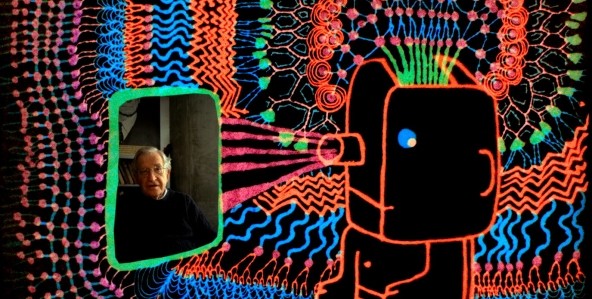
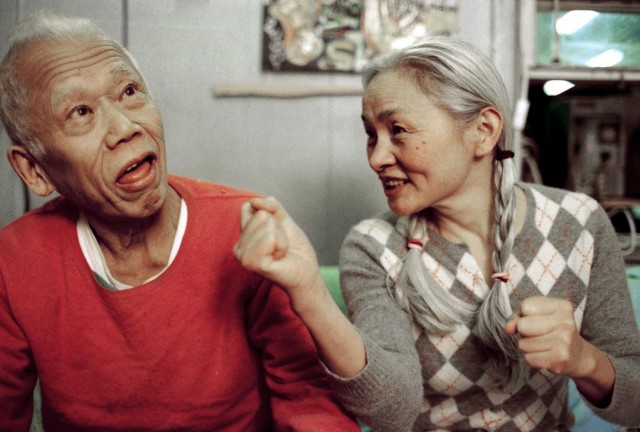
 Zachary Heinzerling’s Cutie and the Boxer is a beautifully told story of love and art and the many sacrifices one must make to try to succeed in both. In 1969, controversial Japanese Neo Dada action painter and sculptor Ushio Shinohara came to New York City, looking to expand his career. According to the catalog for the recent MoMA show “Tokyo 1955-1970: A New Avant-Garde,” which featured four works by Ushio, “American art had seemed to him to be ‘marching toward the glorious prairie of the rainbow and oasis of the future, carrying all the world’s expectations of modern painting.’” Four years later, he met nineteen-year-old Noriko, who had left Japan to become an artist in New York as well. The two fell in love and have been together ever since, immersed in a fascinating relationship that Heinzerling explores over a five-year period in his splendid feature-length theatrical debut. Ushio and Noriko live in a cramped apartment and studio in DUMBO, where he puts on boxing gloves, dips them in paint, and pounds away at large, rectangular canvases and builds oversized motorcycle sculptures out of found materials. Meanwhile, Noriko, who has spent most of the last forty years taking care of her often childlike husband and staying with him through some rowdy times and battles with the bottle, is finally creating her own work, an R. Crumb-like series of drawings detailing the life of her alter ego, Cutie, and her often cruel husband, Bullie. (“Ushi” means “bull” in Japanese.) While Ushio is more forthcoming verbally in the film, mugging for the camera and speaking his mind, the pig-tailed Noriko is far more tentative, so director and cinematographer Heinzerling brings her tale to life by animating her work, her characters jumping off the page to show Cutie’s constant frustration with Bullie.
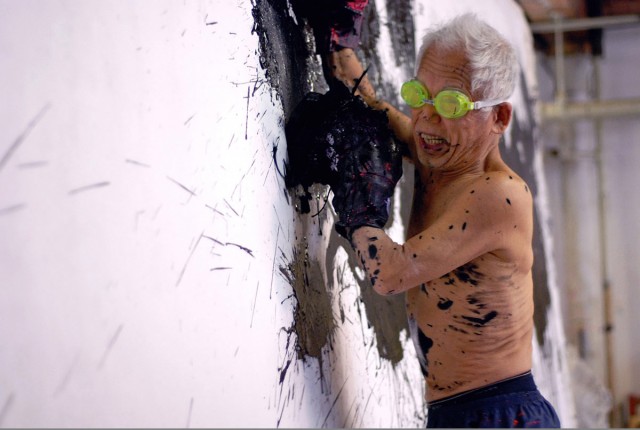
Ushio Shinohara creates one of his action paintings in CUTIE AND THE BOXER
During the course of the too-short eighty-two-minute film — it would have been great to spend even more time with these unique and compelling figures — the audience is introduced to the couple’s forty-year-old son, who has some issues of his own; Guggenheim senior curator of Asian Art Alexandra Munroe, who stops by the studio to consider purchasing one of Ushio’s boxing paintings for the museum; and Chelsea gallery owner Ethan Cohen, who represents Ushio. But things never quite take off for Ushio, who seems to always be right on the cusp of making it. Instead, the couple struggles to pay their rent. One of the funniest, yet somehow tragic, scenes in the film involves Ushio packing up some of his sculptures — forcing them into a suitcase like clothing — and heading back to Japan to try to sell some pieces. Cutie and the Boxer is a special documentary that gets to the heart of the creative process as it applies both to art and love, focusing on two disparate people who have made a strange yet thoroughly charming life for themselves. Cutie and the Boxer is screening November 26 at 8:00 as part of MoMA’s annual series “The Contenders” and will be followed by a discussion with Heinzerling. “The Contenders,” which consists of exemplary films that MoMA believes will stand the test of time and continues with such films as Haifaa Al-Mansour’s Wadjda, Ryan Coogler’s Fruitvale Station, Alexander Payne’s Nebraska, and Richard Linklater’s Before Midnight.
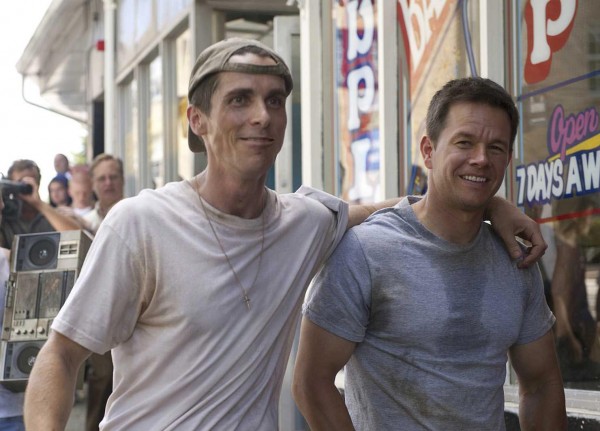
 A lot of professional fighters face adversity in and out of the ring, but “Irish” Micky Ward took it to a whole new level on his quest to be welterweight champion of the world, as documented in the winning motion picture The Fighter. Ward (Mark Wahlberg) surrounded himself with his family, with his mother, Allice Eklund (Melissa Leo), as his manager, his half-brother, the Pride of Lowell (for once knocking down Sugar Ray Leonard), Dicky Eklund (Christian Bale), as his trainer, and his many big-haired sisters, including Tar (Erica McDermott), Little Alice (Melissa McMeekin), Pork (Bianca Hunter), Red Dog (Dendrie Taylor), and Beaver (Kate O’Brien), part of the team as well. Despite getting pummeled over and over again and continually finding his brother at a condemned crack house, Micky stands by the family until Dicky is back in prison and Micky finally decides to go with a new promoter. As his stock begins to rise again, he is deeply affected by his separation from his family, who are blaming the parting on his new girlfriend, local bartender Charlene (Amy Adams). Based on the true story of the Ward/Eklund clan of Lowell, Massachusetts, The Fighter is a poignant tale of fighting and family, of love and responsibility. Bale is a whirlwind as the effusive, drug-addicted Dicky, who dreams of helping his brother get a title shot even as he misses training sessions because of his dependence on crack. Leo, who nearly steals the show, is virtually unrecognizable as Alice, who can’t understand why Micky would go with a new crew and has quite a few battles of her own with Charlene. And Walhlberg, who trained for several years to get himself in shape for the film, is strong and solid as the conflicted yet determined potential boxing champion. Director David O. Russell (Three Kings) gives The Fighter a realistic feel, at times echoing the documentary that HBO made about Dicky in the movie, and even hiring Ward’s trainer, Mickey O’Keefe, to play himself. In fact, much of the cast got to meet their real-life counterparts, all of whom loved how they were portrayed onscreen, which is actually quite funny once you see how some of them come off. You don’t have to love boxing to love The Fighter, although fans of the sweet science will be impressed by the carefully choreographed fight scenes, complete with the original HBO commentary (and shot by some of the same cameramen). Nominated for six Academy Awards including Best Picture, Best Director, and Best Original Screenplay, with Leo winning Best Supporting Actress and Bale taking home the trophy for Best Supporting Actor, The Fighter is screening November 23 at the Museum of the Moving Image, kicking off the series “Three by David O. Russell” in anticipation of the December release of his latest film, American Hustle. The series continues December 7-8 with Silver Linings Playbook, followed by a special presentation of American Hustle on December 19, with Russell on hand to discuss it.
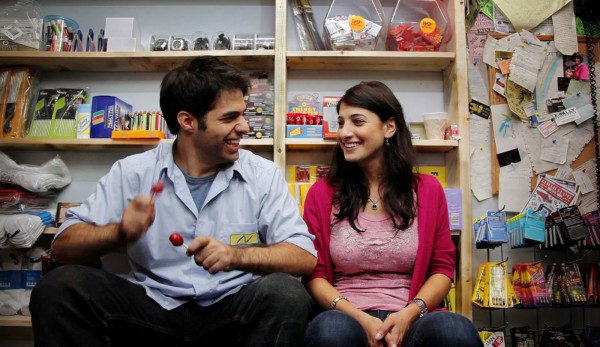
 Expanded from her 2010 short film of the same name, Rola Nashef’s first feature, Detroit Unleaded, is a well-meaning if ultimately standard romantic comedy set within the Motor City’s Arab-American community. Described by Nashef, who was born in Lebanon and raised in Michigan, as a melding of Clerks, Do the Right Thing, and My Big Fat Greek Wedding, the film stars E. J. Assi as Sami, a Lebanese American teenager preparing to go to college in California when his father, Ibrahim (Akram El-Ahmar), is suddenly shot and killed at the family’s gas station / convenience store. With no other choice but to take over the business, Sami soon finds himself behind newly installed protective glass, using a buzzer to let customers into his store. He works with his cousin Mike (Mike Batayeh), who will sell just about anything and has big plans for their operation. Bored and lonely, Sami is surprised when the pretty Najlah (Nada Shouhayib) begins to show an interest in him, although she’s hands-off when it comes to any physical contact, fearful of what her big brother, Fadi (Steven Soro), would do if he finds out she might have a boyfriend. Meanwhile, Sami starts giving his mother, Mariam (Mary Assel), driving lessons so she can begin putting her life back together. Assi and Shouhayib are charming in their film debuts, displaying an endearing chemistry, but the narrative staggers whenever side characters are involved, from Najlah’s friends to the various oddballs who come into the store. Even Mariam’s story feels stagnant and stale. While it’s interesting getting an inside look at the battle between the old ways and the new generation in the Lebanese-American community in Detroit, the film settles on some clichéd plot twists, leading to an ending that will have audiences scratching their heads, wondering if a scene or two was missing. Winner of the Grolsch Film Works Discovery Award at the 2012 Toronto International Film Festival, Detroit Unleaded opens on November 22 at Cinema Village, with Nashef participating in a half dozen Q&As on Friday, Saturday, Sunday, joined by Assi, Batayeh, and Shouhayib at some of them.

 As it turns out,