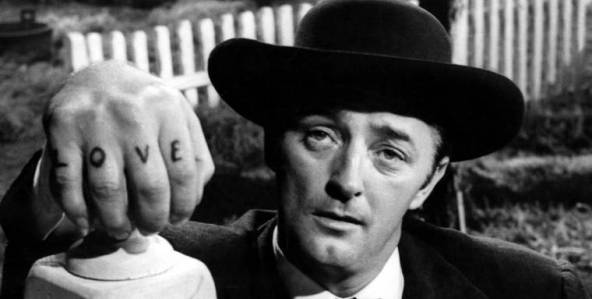
Robert Mitchum gets caught up in some dangerous dichotomies in THE NIGHT OF THE HUNTER
ONE NITE ONLY: THE NIGHT OF THE HUNTER (Charles Laughton, 1955)
Nitehawk Cinema
136 Metropolitan Ave. between Berry St. & Wythe Ave.
Tuesday, December 17, $16, 9:30
718-384-3980
www.nitehawkcinema.com
 Robert Mitchum stars in Charles Laughton’s lurid story of traveling preacher/con man/murderer Harry Powell, who has the word “love” tattooed on one set of knuckles and “hate” on the other. While in prison, Powell bunks with Ben Harper (Peter Graves), who got caught stealing $10,000 — but the only person who knows where the money is is Ben’s young son, John (Billy Chapin). When Preacher is released from jail, he shows up on the Harpers’ doorstep, ready to woo the widow Willa (Shelley Winters) — and get his hands on the money any way he can, including torturing John and his sister, Ruby (Gloria Castillo). Laughton’s only directorial effort is seriously flawed — the scenes in the beginning and end with Lillian Gish are wholly unnecessary and detract from the overall mood. Stanley Cortez’s cinematography is outstanding, featuring his unique use of shadows, the battle between light and dark (which plays off of several themes: old versus young, rich versus poor, good versus evil, and men versus women), and some marvelous silhouettes. Based on Davis Grubb’s 1953 novel, the film has made its way onto many best-of lists, from scariest and most thrilling to all-time great and most beautiful. The Night of the Hunter is screening December 17 at 9:30 as part of Nitehawk Cinema’s “One Nite Only” and “VICE Presents: The Film Foundation Screening Series” and will be introduced by fashion photographer and documentary filmmaker Bruce Weber. The screening will be followed by an after-party in the downstairs bar with complimentary Larceny Bourbon drinks. The VICE series continues on January 28 with Barbara Loden’s Wanda and February 25 with Shirley Clarke’s The Connection.

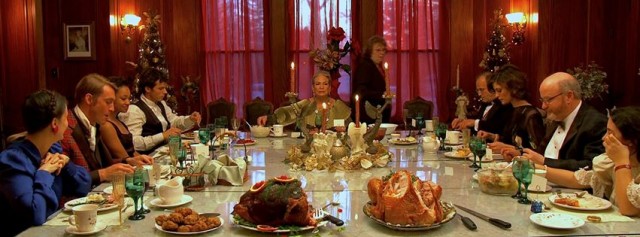
 “I don’t think that this is going to be a boring weekend,” one character says early on in Anna Condo’s debut feature, Merry Christmas. It turns out she couldn’t be more wrong, for the misguided film feels like it goes on for a weekend, even though it’s a mere eighty-three minutes long. Hit hard by the financial crisis, a wealthy New York City family ends up spending its Christmas in a Pennsylvania B&B instead of Aspen, playing a murder-mystery game set in and around a 1974 disco lounge. As the family members move in and out of character, real feelings emerge as they discuss God and Satan, Freud and finance, Park Ave. and the ghetto, race and Fox News, and how much a homeless stranger looks like Charles Manson. Condo, who was born in Armenia, raised in France, and is married to artist