this week in lectures, signings, panel discussions, workshops, and Q&As

EBONY G. PATTERSON: . . . things come to thrive . . . in the shedding . . . in the molting . . .

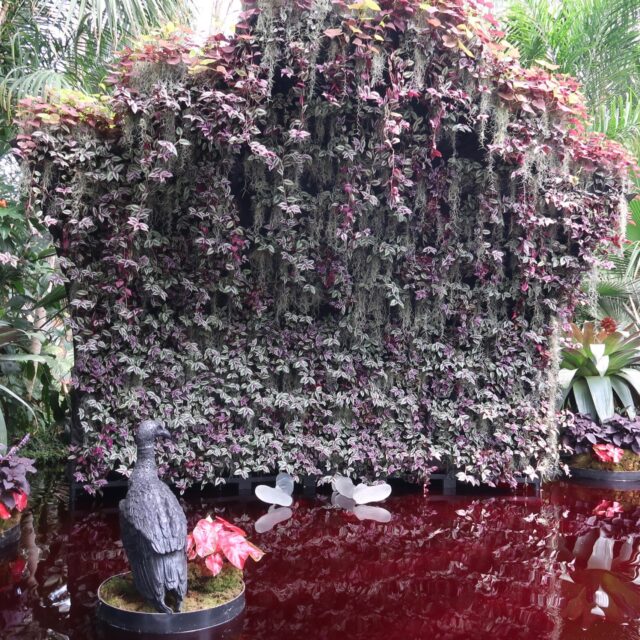
A vulture spies human feet under a wall of plants in bloodred pond in Ebony G. Patterson installation at NYBG (photo by twi-ny/mdr)

. . . things come to thrive . . . in the shedding . . . in the molting . . .
The New York Botanical Garden
2900 Southern Blvd., Bronx
Tuesday – Sunday through October 22, $15 children two to twelve, $31 students and seniors, $35 adults, 10:00 am – 6:00 pm
718-817-8700
www.nybg.org
ebonygpatterson.com
online slide show

“I’m going to give you a show that you’ve not had before,” artist Ebony G. Patterson promised New York Botanical Garden curator Joanna L. Groarke upon preparing for the exhibition “. . . things come to thrive . . . in the shedding . . . in the molting . . . ,” which has just been extended at NYBG through October 22, 2023.

The Jamaica native has done just that, presenting a wide-ranging display that incorporates sculpture, installation, video, collage, and an interactive element, “Things to Be Remembered,” which asks visitors to answer the question “What have you . . . missed . . . felt . . . loved . . . learned . . . witnessed . . . needed . . . heard . . . that you never want to forget?”

“Ebony is the first visual artist to create art at the garden through an immersive residency,” NYBG CEO Jennifer Bernstein said at the preview in May. “This exhibition celebrates the allure of the beautiful while contemplating what lies beneath the enticing surface, the complex tensions of the natural world, and how they reflect the entanglements of race, gender, and colonialism.”

The exhibition features nearly five hundred black foam turkey vultures congregating around the lawn outside the Enid A. Haupt Conservatory and inside the massive greenhouse, as if they’re anticipating a kind of destruction, along with hand-cast glass sculptures of body parts and extinct plants, out in the open and hidden within the confines. You can also hear Patterson’s voice in the soundscape. In the LuEsther T. Mertz Library Building, there are works from Patterson’s “studies from a vocabulary of loss” series, consisting of framed collages with cut-paper flowers and reaching hands, plastic insects, feathered butterflies, and such words as liability, should, wreckage, and goodbye kiss.

The library rotunda is home to . . . fester . . . , a stunning ten-foot horizontal piece laden with woven jacquard fabrics, vertebrae, hand-blown black and white glass plants, and more than a thousand red gloves spreading out onto the floor; yet more vultures hover on ledges above floral patterned wallpaper. Visitors can walk inside the three-channel video installation The Observation: The Bush Cockerel Project, a Fictitious Historical Narrative, in which costumed characters wander through a primordial garden, climate change surrounding the proceedings like, well, vultures.

In putting together the show, Patterson, who lives and works in Kingston and Chicago, was concerned with loss, healing, and regeneration; the intersection of art, horticulture, and science; living and dead plants as ghosts and skeletons; and the materiality of objects, recognizing that both Jamaica and America are postcolonial societies facing problematic issues of income inequality and social injustice.

“What does it mean to think about the word gardens associated with places that are working-class spaces in contrast to a place that is a wealthy neighborhood?” she said. “What does it mean to think about a garden as a site of survival, as a site of social survival? What does it then also mean to think about gardens as it relates to communities that are given particular kinds of care in terms of what is thought of as a space of investment of possibility, and what does it also then mean to think about those gardens that are not given consideration for possibility of care but thrive regardless because that is what happens in nature? Things live on, irrespective of what one puts in nature’s way.”

The centerpiece of the exhibit in the conservatory is an immersive structure topped by a white peacock, as if the rest of the installation bursts from its feathers, ending in a bloodred pond in another room where a wall of plants has seemingly fallen from the sky, a pair of white glass legs sticking out like the feet of the Wicked Witch of the East after Dorothy’s house crushes her in The Wizard of Us. Patterson, who had never before been to NYBG before beginning this project but is a regular at the Hope Botanical Gardens and the adjoining Hope Zoo Kingston in her hometown of Kingston, had only recently seen a rare white peacock there for the first time in her life.

“In seeing this peacock, the peacock was in molting, and it was in a dark enclosure, and the peacock just kind of hovered in the space, ebbing and flowing,” she explained at the preview. “It almost seemed like it was a haunt. And so thinking about what the peacock is — this incredibly beautiful bird with all of its pageantry — and to see it at its ugliest moment remained with me for a year. And so in thinking about that, I couldn’t help but think about the question of what does it mean to witness your ugliness. And so for me, unpacking the garden, in a moment of molting, in a moment of transformation, is about witnessing our collective ugliness, that even in the ugliness, beauty is possible, and in that possibility, we will always find new ways ahead.”
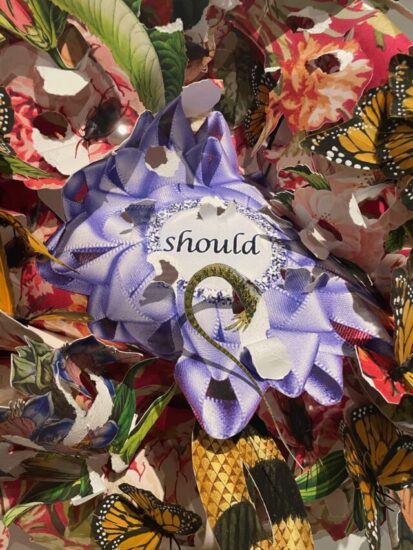
Ebony G. Patterson’s “studies from a vocabulary of loss” are framed collages containing words amid flowers, hands, insects, butterflies, and other elements (photo by twi-ny/mdr)

Patterson was also inspired by her residency at Crystal Bridges Museum of Art in Arkansas, where she developed such works as . . . bugs, reptile, fruit, and bush . . . for those who bear/bare witness.

At the preview, I had a chance to speak with Patterson, whose other projects include “Gangstas for Life,” “Disciplez,” and “Invisible Presence: Bling Memories,” a performative piece with embellished coffins.

twi-ny: The first time you ever came to the New York Botanical Garden was in 2019. What were your first impressions walking the grounds?

egp: At the time, there was a show by Roberto Burle Marx [“Brazilian Modern: The Living Art of Roberto Burle Marx”], who is a Brazilian artist.

twi-ny: Oh, I loved that show.

egp: Yeah, I mean, the sense of sprawl, and there’s a particular kind of splendor that also exists here, as a place like this does because of its expanse. And then also too because part of its mandate is to create a space of beauty. But then I think the other thing that I was also struck by was the demographics. So I was also also very aware of, oh, who are the people that spend time here? Who are the people that spend a lot of time here? And then I had to say that in thinking about the project, I thought about those people a lot. I thought I would hear stories about women who would come during particular seasons, to see particular flowers, and fussing about the fact that a flower doesn’t grow the same way the next season.

But I think about those people. And also too in terms of how this is such a heightened visual experience. Not everybody goes to museums. For some people the garden is their ultimate visual experience. So what does it mean also to disrupt that for a person so that they also think about this place differently in the same way that one would think about an exhibition very differently when one goes to a museum? Each exhibition presents something different. And I sat with that a lot over the course of thinking through the ideas here.

twi-ny: And you were given pretty much carte blanche to go and do what you needed to do?

egp: Correct. Yes. And the gardens . . . I mean, there were some things that I had proposed that I wanted us to explore that were a little difficult to do, given the time. So there is carte blanche and there is carte blanche, right? But that being said, a lot of this is truly a collaboration because as much as I use plants and I think about using plants in relation to history, all of the knowledge about what it means to grow a plant at a particular time, what it is, how it lives with something else, is not something that I consider at all.

And I come from a place of thinking about things as a painter. So I rely very heavily then on the knowledge of the people who are here, in the same way that I would rely on the knowledge of somebody who works in glass. I love glass materially, but ask me, can I go and forge it, do what’s necessary to make it whole myself? No. Can I sew? It’s the same . . . We all rely on the knowledge base of other people to make things possible, and artists are no different in that history.

twi-ny: Mentioning museums, “Dead Treez” was at the Museum of Arts & Design in 2016. Do you see a direct link between the NYBG show and that one?

egp: Oh, absolutely. When MAD gave me that opportunity in the Tiffany Galleries to make a garden inside their galleries, that was such a huge shift in my own practice. But then also too for MAD, it was a new point of departure for them, for them to be inviting an artist to curate a selection of objects. But then I had the show that was also running concurrently [“. . . while the dew is still on the roses . . .” at Pérez Art Museum Miami], and I was like, “How do I make these two things speak to each other?”

So I think for me, the Museum of Arts & Design project that I did in those Tiffany cases is essentially the seed that’s continued to grow over these years. It’s the very thing that ended up also growing the Pérez show, which was centered on this notion of thinking about a night garden. And then what does it also then mean to pull that all out into the living space? But also, too, the garden isn’t an art institution, but then at the same time, doing this at an art institution just would not be possible, it just wouldn’t.

[For a more personal look at the arts in New York City, follow Mark Rifkin on Substack here.]
MIDNIGHT COWBOY / DESPERATE SOULS, DARK CITY AND THE LEGEND OF MIDNIGHT COWBOY

MIDNIGHT COWBOY

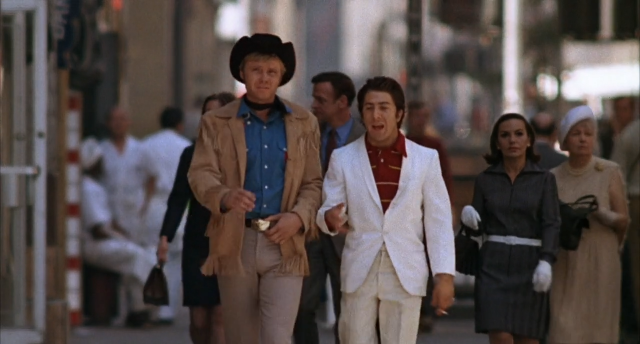
Oscar nominees Jon Voight and Dustin Hoffman try to make it in the big city in John Schlesinger’s powerful Midnight Cowboy

MIDNIGHT COWBOY (John Schlesinger, 1969)
DESPERATE SOULS, DARK CITY AND THE LEGEND OF MIDNIGHT COWBOY (Nancy Biurski, 2022)
Film Forum
209 West Houston St.
Opens Friday, July 7
212-727-8110
filmforum.org

The only X-rated film to win a Best Picture Oscar, John Schlesinger’s masterful Midnight Cowboy follows the exploits of Joe Buck (Jon Voight), a friendly sort of chap who leaves his small Texas town, determined to make it as a male prostitute in Manhattan. Wearing his cowboy gear and clutching his beloved transistor radio, he trolls the streets with little success. Things take a turn when he meets up with Enrico Salvatore “Ratso” Rizzo (Dustin Hoffman), an ill, hobbled con man living in a condemned building. The two loners soon develop an unusual relationship as Buck is haunted by nightmares, shown in black-and-white, about his childhood and a tragic event that happened to him and his girlfriend, Crazy Annie (Jennifer Salt), while Rizzo dreams of a beautiful life, depicted in bright color, without sickness or limps on the beach in Miami.

Adapted by Waldo Salt (Serpico, The Day of the Locust) from the novel by James Leo Herlihy, Midnight Cowboy is essentially a string of fascinating and revealing set pieces in which Buck encounters unusual characters as he tries desperately to succeed in the big city; along the way he beds an older, wealthy Park Ave. matron (Sylvia Miles), is asked to get down on his knees by a Bible thumper (John McGiver), gets propositioned in a movie theater by a nerdy college student (Bob Balaban), has a disagreement with a confused older man (Barnard Hughes), and attends a Warholian party (thrown by Viva and Gastone Rosilli and featuring Ultra Violet, Paul Jabara, International Velvet, Taylor Mead, and Paul Morrissey) where he hooks up with an adventurous socialite (Brenda Vaccaro).

Photographed by first-time cinematographer Adam Holender (The Panic in Needle Park, Blue in the Face), the film captures the seedy, lurid environment that was Times Square in the late 1960s; when Buck looks out his hotel window, he sees the flashing neon, with a sign for Mutual of New York front and center, the letters “MONY” bouncing across his face with promise. The film is anchored by Harry Nilsson’s Grammy-winning version of “Everybody’s Talkin’,” along with John Barry’s memorable theme. Iconic shots are littered throughout, along with such classic lines as “I’m walkin’ here!”

Midnight Cowboy, which was nominated for seven Oscars and won three (Best Picture, Best Adapted Screenplay, and Best Director), is screening at Film Forum in conjunction with the theatrical release of Nancy Buirski’s Desperate Souls, Dark City and the Legend of Midnight Cowboy, which is not a typical making-of documentary; inspired by Glenn Frankel’s 2021 book, Shooting Midnight Cowboy: Art, Sex, Loneliness, Liberation, and the Making of a Dark Classic, Buirski explores the social context in which Midnight Cowboy was created and brought to the public. The film opens with Voight telling a great story about the day shooting wrapped:

“That’s the last shot. . . . John [Schlesinger], he was like this, shaking. I said, ‘John, what’s the matter?’ He said, ‘What have we done? What have we done? We’ve made a movie about a dishwasher who goes and fucks a lot of women in New York. What’ll they say? What’ll they say about this picture?’ I said, and I knew he’s having a complete meltdown, right? I didn’t know what to do. I mean, I was his friend, I want to help him. I grabbed him by the shoulders and I said, ‘John,’ — I looked him in the eye — ‘we will live the rest of our artistic lives in the shadow of this great masterpiece.’ He looks up, ‘You think so?’ [Voight laughs] I said, ‘I’m absolutely certain of it.’ It was the only thing that could get him out of it. I said the most ridiculous thing I could think of but . . . turned out to be true.”

Buirski (The Loving Story, Afternoon of a Faun: Tanaquil Le Clercq) speaks with Jennifer Salt, the daughter of Waldo Salt, who played Crazy Annie; Bob Balaban, who portrayed the college student in the movie theater; Brenda Vaccaro, who plays the socialite; cultural critic Lucy Sante; Schlesinger’s nephew, author Ian Buruma; film critic James Hoberman; Charles Kaiser, author of The Gay Metropolis; photographer Michael Childers, Schlesinger’s longtime partner; and cinematographer Adam Holender, who contributes modern-day photos of New York City. Writer, director, and producer Buirski and editor Anthony Ripoli include a barrage of archival color and black-and-white footage of the Vietnam War, Times Square, the Chicago Seven, and the moon landing; clips from dozens and dozens of movies, from The Graduate, Easy Rider, The Sound of Music, Flaming Creatures, The Boys in the Band, Taxi Driver, and numerous Westerns and Andy Warhol works to such other Schlesinger films as A Kind of Loving, Billy Liar, Darling, and Sunday Bloody Sunday. There are also snippets of older interviews with Waldo Salt, James Leo Herlihy, and Dustin Hoffman; Voight’s original screen test with Salt; and home movies of Schlesinger, who died in 2003 at the age of seventy-seven.

Desperate Souls focuses on the changing postwar class system; homoeroticism, particularly as it relates to the macho image of cowboys, from John Wayne to the Marlboro Man; and the transformation of pop culture in the 1970s, with a soundtrack that includes songs by Don McLean, the Guess Who, Gerry & the Pacemakers, and Janis Ian. There’s a significant amount of information overload about the era and Midnight Cowboy’s legacy instead of more behind-the-scenes details, but you can find out more when Buirski and Holender take part in a Q&A following the 6:00 screening on July 7 at Film Forum.

THE DOCTOR

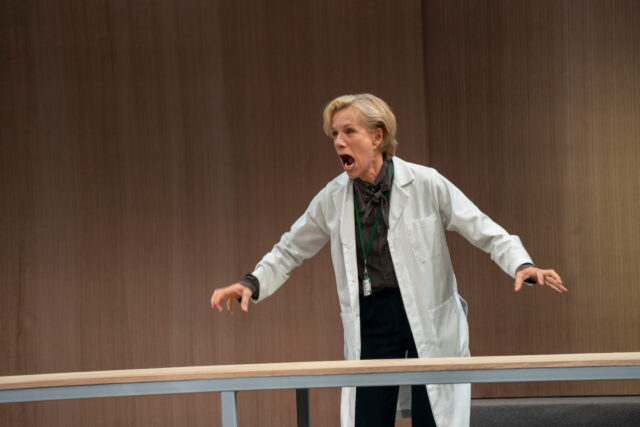
Juliet Stevenson delivers a ferocious performance of intense precision in The Doctor (photo by Stephanie Berger Photography / Park Avenue Armory)

THE DOCTOR
Park Ave. Armory, Wade Thompson Drill Hall
643 Park Ave. at Sixty-Seventh St.
Tuesday – Saturday through August 19, $54-$208
www.armoryonpark.org

“I’m a doctor,” neurosurgeon Ruth Wolff declares throughout Robert Icke’s The Doctor, while others keep categorizing her by her race, religion, gender, and sexual orientation. Identity politics and cancel culture collide in complicated ways with faith and medicine in the riveting play, which also takes on conscious and unconscious bias and the battle between science and religion, in a freely adapted update of Arthur Schnitzler’s 1912 Professor Bernhardi.

Wolff, portrayed by a fierce, unstoppable Juliet Stevenson with boundless energy, is the founding director of the Elizabeth Institute, a well-funded private facility that specializes in treating Alzheimer’s patients. Wolff is currently caring for Emily, a fourteen-year-old girl dying of sepsis after an unregulated abortion; when a priest, Father Jacob (John Mackay), arrives unannounced to deliver last rites, Wolff refuses him entry, stating that whether to receive his visit is Emily’s decision, not that of the priest or the girl’s parents, who are not immediately available.

“Let me make it clearer. Emily is gravely ill. Emily’s parents asked me to be here and to attend to her. Is that not obvious?” Father Jacob demands.

Wolff responds, “It’s obvious when the patient has requested religious assistance, because it’s written on her medical notes. In this instance, there’s nothing of the sort. . . . I have no way of knowing whether she last attended church in a Christening gown. The only thing of relevance is what she herself believes — and I don’t know. I don’t know if you’ve ever met her.”

As Father Jacob attempts to force his way into Emily’s room, Wolff blocks his way — there is some kind of physical confrontation, so cleverly staged that it is impossible to tell who might have struck whom. Emily then dies an awful death, and the characters choose sides based on their personal and professional beliefs, seeing what they want to see, as public pressure builds against Wolff.

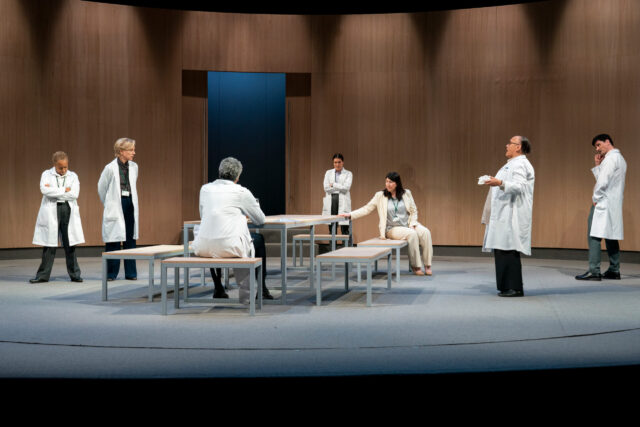
The board of the Elizabeth Institute meet to decide the fate of their chair and director in Robert Icke’s The Doctor (photo by Stephanie Berger Photography / Park Avenue Armory)

Senior consultant and deputy director Robert Hardiman (Naomi Wirthner) views the complex situation as a chance to seize power. Dr. Michael Copley (Chris Osikanlu Colquhoun) displays full confidence in Wolff, but Dr. Paul Murphy (Daniel Rabin), putting faith before medicine, is insulted by what Wolff has done, declaring, “This is a Christian country.” Roberts (Mariah Louca), the press liaison who is Jewish, is having trouble dealing with the media, particularly as the religious angle grows more volatile.

Minister for Health Jemima Flint (Preeya Kalidas) expresses support for Wolff and dangles critical government financing if she apologizes. The new junior staff member (Jaime Schwarz) is generally bewildered by the controversy, suddenly learning that being a doctor is more than just treating patients. Professor Cyprian (Doña Croll) endorses everything Wolff did regarding Emily. Meanwhile, the search for a new head of pharmacology becomes an object lesson in decisions based on identity instead of merit.

Whenever she’s at home, Wolff is visited by Sami (Matilda Tucker), a high school student who lives upstairs. The two talk about sex, witches, and death. “We’re all going to die, though,” Sami posits. “Like — a sell-by date for your soul. It’s a ‘when’ not an ‘if.’ Could be tomorrow. Or tonight. In here. Now.”

Meanwhile, Wolff’s partner, Charlie (Juliet Garricks), mysteriously shows up at the institute, introducing each scene. “It might be the moment to bring me up,” Charlie offers. “At work? They don’t get my life. They don’t get to be involved,” Ruth responds. Charlie: “They don’t get to know about me.” Wolff: “What?” Charlie: “You know.” Wolff: “And why would I not talk about you?” Charlie: “Because you are ashamed of the way it makes you seem.” Wolff: “I go in tomorrow and start talking about you, now it’s going to seem like — like I’m asking for my ‘I’m a human too’ badge — some get me off the hook scheme. No. Not doing it.”

In the shorter second act, Wolff must defend herself on television, facing a panel of presumed experts spouting off about religion, abortion and medical ethics, Jewish history and culture, race and privilege, and bias. Wolff sits in a chair with her back to the audience as she is grilled, her face projected on two large screens, looming behind the pontificating blowhards in front of her. “My identity isn’t the issue,” she argues again and again, but no one is listening. Wolff refuses to see herself as a hero or a villain, but there are certain truths that she’s not listening to either.

Hildegard Bechtler’s set is a semicircular wooden wall that serves as a kind of protective barrier, keeping the characters trapped in rooms the way they are trapped by their minds, locked in judging others, with a turntable that rotates agonizingly slowly, unlike the wheels of justice in the court of public opinion; tables and chairs are moved around and Natasha Chivers’s lighting shifts intensity to signify changing from the institute’s bright conference room to Wolff’s much darker apartment. Bechtler also designed the costumes, primarily doctors’ white coats over everyday wear that tends toward black. Tom Gibbons’s sound design flows from board arguments to television show debate to intimate personal discussions, with Hannah Ledwidge adding drums and percussion from an open cube perched over the stage in the back.

Icke (Judas, Animal Farm) knows the Wade Thompson Drill Hall well, having previously presented Hamlet/Oresteia and Enemy of the People there in just the last two years, making fine use of the grand space. The show is extremely talky, with lots of explication and more than enough didacticism, particularly in the second act, and a late scene between Wolff and Father Jacob is sentimental overkill. In addition, during the TV segment, Wolff uses a racist word that ignites further altercation, but it feels forced to add unnecessary verbal fisticuffs.

The excellent cast challenges stereotypes and categorization by portraying characters that don’t look like them (except for Ruth and Flint); for example, whites play Blacks and women play men, although it is not immediately apparent. (Tucker is a standout as the unpredictable Sami.) In the script, Ickes notes, “Actors should be cast with and against the identity of the characters . . . other than in the debate section, where ideally the actors play with their identity. The design is that the audience have to reconsider characters once an aspect of their identity is revealed by the play.” It can get confusing, but that is part of the point, as Ickes lays the groundwork for people to stop classifying, and demonizing, people by race, gender, religion, et al.

But the show belongs to Emmy nominee and Olivier winner Stevenson (Truly, Madly, Deeply; Death and the Maiden), a veteran of the Royal Shakespeare Company, the Royal Court Theatre, and the National Theatre whose only previous North American stage appearance was as Desiree in a 2003 New York City Opera production of Stephen Sondheim’s A Little Night Music with Jeremy Irons, Claire Bloom, and Anna Kendrick. (Her extraordinary voice narrated Blindness through special headphones at the Daryl Roth two years ago.) Stevenson — Icke wrote the play with her in mind to be the star — is electrifying as Wolff, whether staring someone down, stating her case to doubters, or running around the room in a whirlwind of furious, uncontrollable energy. She stomps across the stage, firmly entrenched in Wolff’s repeated assertions that she is a doctor, justifying her decisions over and over again by adding, “I’m crystal clear.”

The Viennese Schnitzler (Liebelei, Reigen, Das weite Land) wrote dozens of plays, short stories, and novels that were ahead of their time, exploring sexual awareness, social convention, and anti-Semitism in ways that were controversial in his era but relate to what is happening in the twenty-first century. About midway through the first act, when Wolff explains to Copley and Murphy that she is not a practicing Jew, Murphy says, “But you would have been thought of as Jewish — in the 1940s.” She responds by getting to the heart of the story: “Maybe there might be more sensitive ways to reflect on the Jewish identity than the ones pioneered by the Nazis. Thank you, Michael, yes, you and I lost family in that war, and they had stars sewn onto their lapels, but their legacy is this: We now get to choose what defines us — so can we please get on with our lives.

As we learn in The Doctor, that prescription is not so easy to fill.

[Mark Rifkin is a Brooklyn-born, Manhattan-based writer and editor; you can follow him on Substack here.]

THE ALARM: NEW YORK GATHERING 2023

THE ALARM
Gramercy Theatre
127 East 23rd St. at Lexington Ave.
Friday, June 23, and Saturday, June 24, $53-$120
Free special events June 22 and June 25
www.livenation.com
thealarm.com

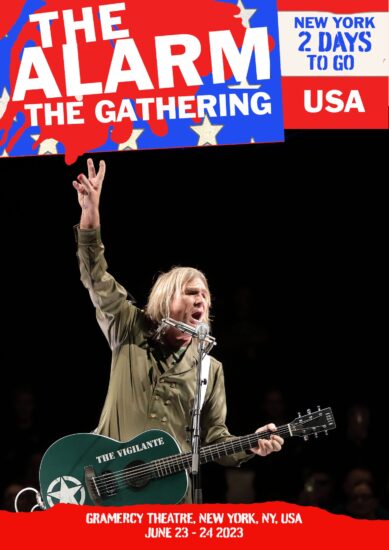
During the pandemic and continuing to today, one of my favorite social media messages has been “The Alarm Is Live,” referring to the Welsh rock band that goes back to the early 1980s. Most recently, the pop-up came with a second meaning, as, for decades, group cofounder and lead vocalist Mike Peters has been battling cancer, including lymph cancer in 1996 and chronic lymphocytic leukemia in 2005, which came back this past September.

As he explained on the band’s website, “I am writing today to let you all know that my leukemia (CLL) has relapsed and I have been admitted to the North Wales Cancer Centre for immediate treatment. I have already started on a brand new chemotherapy regime and so I wanted you to know, personally, that my life living with cancer is about to change for the foreseeable future. My immediate aim is to get fit and well for the Gathering. . . . This coming January will commemorate the thirtieth anniversary of the Gathering, an event that has come to represent all that we stand for — thirty years of Love Hope and Strength, thirty years of friendship and celebration and, through music, helping each other to live life and stay strong. I want you to know that I am going to beat this disease once more and be ready, willing, and able to hit the stage. . . . Since being diagnosed with pneumonia (after the last British tour), the post-recovery period provided far greater challenges for me than I could ever have envisaged (although somehow I managed to find the strength to record the backing tracks for a new Alarm album. I’ve even got my guitar with me on the ward just in case inspiration strikes!)”

Inspiration did strike, as Peters, joined by his wife, keyboardist Jules Jones Peters, kept going live on Facebook, sharing music and stories, even from his hospital bed, while continuing their series “The Big Night In.” Late last month, Peters took off on a solo acoustic tour of England, playing thirty-song sets of Alarm tunes, from the anthemic ’80s hits “Sixty Eight Guns” (“And now they are trying to take my life away / Forever young I cannot stay”), “Blaze of Glory” (“Going out in a blaze of glory / My heart is open wide / You can take anything that you want from me / There is nothing left to hide”), and “The Stand” (“Come on down and meet your maker / Come on down and make the stand / Come on down, come on down / Come on down and make the stand”) to tracks from their brand-new album, Forwards, written from the perspective of an older, wiser man who has looked death in the face — “Forwards” (“In the cities all deserted / In the streets of emptiness / In the church of nonbelievers / I’ve been searching for the way to find new faith . . . I’ve been trying to get myself back home to you / I’m living for today / Trying to find the way forwards”), “Next” (“All the clocks are set to zero, now’s the time to run / I hear the crack of the starting gun and I’m ready for what’s next / All is possible / All is understood / Whatever is trying to kill me makes me feel alive”), and “Transition” (“There’s a line I have to cross tonight / If I want to stay alive and live for a second time / Knowing time / The way it’s passing by / I can’t afford to wait / To see the light of day”).

Peters, who is sixty-four, and the Alarm return to New York City this week for the Gathering, a four-day celebration that begins June 22 at 6:00 with a solo acoustic set and record signing at Rough Trade in Rockefeller Plaza. On Friday and Saturday, Peters and his bandmates — James Stevenson on guitar and bass, Mark Taylor on keyboards and guitar, Steve “Smiley” Barnard on drums, and Jules on keyboards — will be performing at the Gramercy Theatre, with each night offering unique surprises, including acoustic sets, film screenings, and a Q&A for two-day-pass holders. The festivities conclude with a ninety-minute hike around the Central Park lake on Sunday at 11:30 am beginning at Bethesda Fountain in support of Peters’s charity, the Love Hope Strength Foundation, whose mission is “to save lives, one concert at a time”; you can register in advance here.

On the Alarm’s “Diary of a Rock & Roll Life” Facebook posts, Jules wrote on May 9, after Mike got good news from the North Wales Cancer Treatment Centre, “Just being healthy is the greatest gift of all.” Another great gift is Mike Peters and the Alarm back onstage in NYC for these special shows. “The Alarm Is Live,” and this time in person.

REMEMBERING A DANCE: PARTS OF SOME SEXTETS, 1965/2019

Who: Yvonne Rainer, Brittany Bailey, more
What: Book launch and performance
Where: Judson Memorial Church, 55 Washington Square South
When: Tuesday, June 20, free with RSVP, 6:00
Why: In March 1965, Yvonne Rainer presented Parts of Some Sextets at the Wadsworth Atheneum in Hartford and Judson Memorial Church in Greenwich Village, a new piece for ten dancers and twelve mattresses, with text by the Rev. William Bentley (1759-1819). The work, which changed every thirty seconds, featured Rainer, Lucinda Childs, Judith Dunn, Sally Gross, Deborah Hay, Tony Holder, Robert Morris, Steve Paxton, Robert Rauschenberg, and Joseph Schlichter.

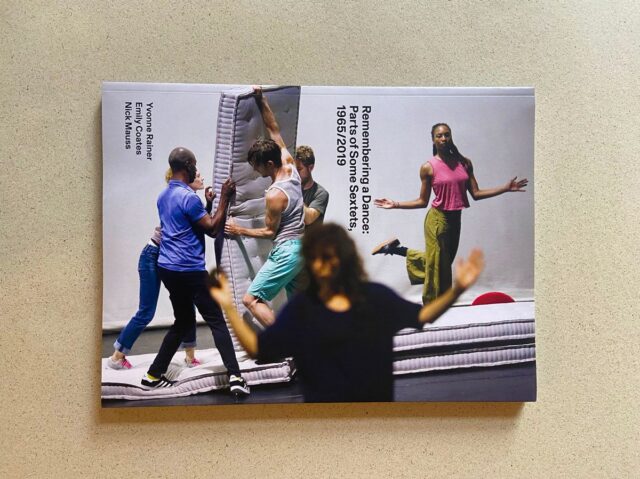
In 2019, Rainer and longtime collaborator Emily Coates revived Parts of Some Sextets at the Gelsey Kirkland Arts Center in DUMBO for the Performa Biennial, with a cast of Coates, Rachel Bernsen, Brittany Engel-Adams, Patrick Gallagher, Shayla Vie Jenkins, Jon Kinzel, Liz Magic Laser, Nick Mauss, Mary Kate Sheehan, David Hamilton Thomson, and Timothy Ward. Performa, Lenz, and the Wadsworth Atheneum have now teamed up to publish the new book Remembering a Dance: Parts of Some Sextets, 1965/2019 (September 2023, $30), which does a deep dive into the origins of the work, its revival, and its legacy, complete with photographs, letters, notes, drawings, and other paraphernalia. Edited by Rainer and Coates and designed by Mauss, the book includes contributions from Rainer, Thomson, Performa founder RoseLee Goldberg, Performa senior curator Kathy Noble, novelist Lynne Tillman, violinist Soyoung Yoon, and the late cultural critic Jill Johnston in addition to a conversation with Rainer, Coates, and Mauss.

On June 20, the eighty-eight-year-old Rainer, who stayed extremely busy during the pandemic, will be at Judson Memorial Church for the launch of Remembering a Dance: Parts of Some Sextets, 1965/2019, discussing the project and signing advance copies of the book. There will also be a special performance of Rainer’s seminal Trio A by Brittany Bailey, who performed the duet “Remembering and Dismembering Trio A” with Rainer in 2020, adding excerpts from Peter Schjeldahl’s “77 Sunset Me” (aka “The Art of Dying”) essay. Admission is free; advance RSVP is recommended in order to meet this towering figure of dance, film, feminist theory, and humanity.

DAVID BOWIE WORLD FAN CONVENTION: DERYCK TODD’S BOWIEBALL

DAVID BOWIE WORLD FAN CONVENTION: DERYCK TODD’S BOWIEBALL
Racket
431 West Sixteenth St. between Ninth & Tenth Aves.
Saturday, June 17, 8:00, $96.83
Sold-out convention runs June 16-18
bowieconvention.com
www.bowerypresents.com

In the introduction to his revised and updated 2016 book The Complete David Bowie, Nicholas Pegg writes, “If you want to enjoy David Bowie’s work to the full, keep an open mind. What makes Bowie such a supremely fascinating artist is that his career presents an implicit challenge to conventional notions of creative continuity. He has repeatedly confounded attempts to pigeonhole him as this or that kind of artist, and the result has been one of rock music’s longest and most successful careers.”

While his career came to an end in January 2016 when the man born David Jones in Brixton died at the age of sixty-nine, the fascination with the Thin White Duke continues unabated, with museum exhibitions such as the spectacular “David Bowie Is” at the Brooklyn Museum, the pandemic livestream benefits “A Bowie Celebration” featuring a multitude of music stars, and the release of a series of posthumous live albums and box sets.

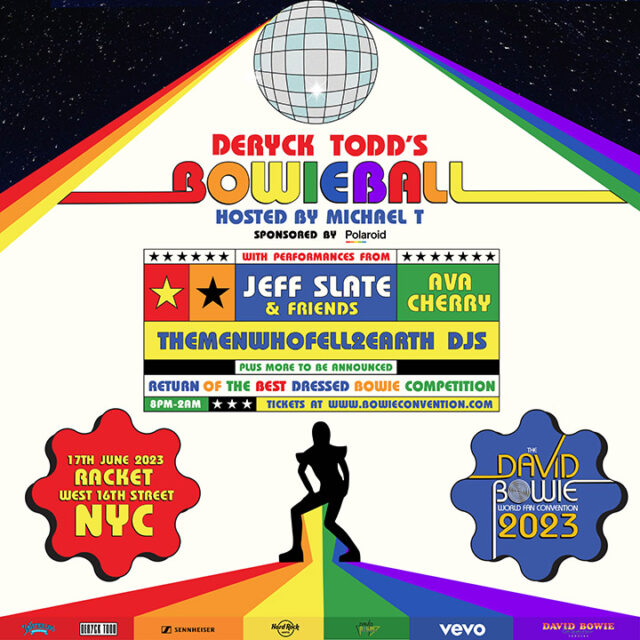
Pegg will serve as compère for the 2023 David Bowie World Fan Convention, taking place June 17 and 18 at Racket, the Chelsea club formerly known as the High Line Ballroom, where Bowie curated the inaugural High Line Festival in 2007, putting together a lineup that included Ricky Gervais, Arcade Fire, Air, Laurie Anderson, Deerhoof, the Polyphonic Spree, Daniel Johnston, Bang on a Can All Stars, and others. The convention, which has a bonus VIP day on June 16, features panel discussions, live performances, and a trivia evening; tickets are still available for Deryck Todd’s “BowieBall” Saturday night, with a “Best Dressed Bowie” costume contest, drag and burlesque, dancing, and live performances by vocalist Ava Cherry, musician and writer Jeff Slate, and Bowie DJs TheMenWhoFell2Earth. This year’s convention honors the fortieth anniversary of Let’s Dance and the fiftieth anniversary of Aladdin Sane, two of Bowie’s most popular records.

Below is the full schedule. In addition, Modern Rocks Gallery is hosting a photography exhibit at the Maker’s Studio in Chelsea Market, with pictures by Sukita, Terry O’Neill, Dennis O’Regan, Kevin Cummins, Brian Aris, and Duffy and an exclusive limited edition print of John Rowlands’s “The Archer.” And you can’t go wrong by starting the weekend with Raquel Cion’s one-woman show, Me & Mr. Jones: My Intimate Relationship with David Bowie, at the Cutting Room on Friday night; held in association with the convention, it is a personal and poignant exploration of fandom and the impact Bowie has had on people’s lives.

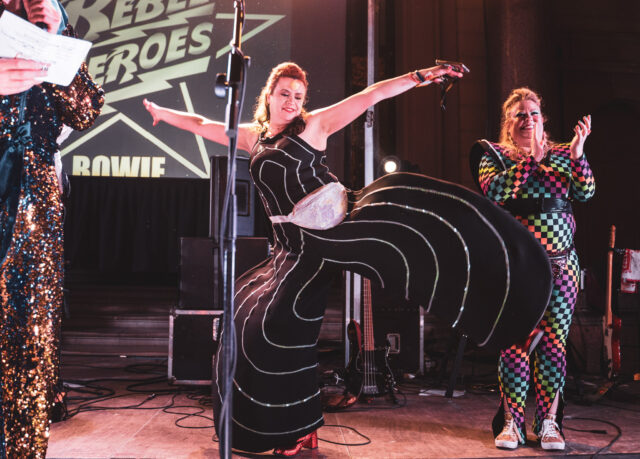
BowieBall features a costume contest, live performances, lots of dancing, and more (photo by Sam McMahon)

Saturday, June 17
Heroes, Zeroes, and Absolute Beginners, with bassist Carmine Rojas and guitarist Kevin Armstrong, moderated by Nicholas Pegg, 10:00 am

Planet Earth Is Blue, with singer and multi-instrumentalist Emm Gryner and producer and multi-instrumentalist Mark Plati, on “Space Oddity” performance aboard the International Space Station, Toy, the Hours Tour, and more, 11:00

Fa-Fa-Fa-Fa-Fashion, with fashion designer Keanan Duffty and musicians Ava Cherry and Joey Arias, 12:15

Fantastic Voyage, with producer, arranger, bassist, and vocalist Tony Visconti and studio engineer and backing vocalist Erin Tonkon, moderated by Nicholas Pegg, 2:00

Golden Years, with guitarist Carlos Alomar, singer Robin Clark, and bassist George Murray, moderated by Nicholas Pegg, 3:00

BowieBall, live performances by vocalist Ava Cherry, musician and writer Jeff Slate, and Bowie DJs TheMenWhoFell2Earth, a “Best Dressed Bowie” costume contest, drag and burlesque, and more, hosted by Michael T, 8:00

Sunday, June 18
Red Shoes, Blue Jeans, and Glass Spiders, with guitarist Carlos Alomar, singer Robin Clark, and bassist Carmine Rojas, moderated by Nicholas Pegg, 11:00

I’ve Got to Write It Down, with Nacho; Chris O’Leary, author of Pushing Ahead of the Dame; Stephen Pitalo, author of Bohemian Rhapsodies, Thrillers & November Rains; and Nicholas Pegg, author of The Complete David Bowie, moderated by Nacho, 12:15

You Belong in Rock’n’Roll, with guitarist Kevin Armstrong and producer Tim Palmer, moderated by Nicholas Pegg, 2:00

Brilliant Adventure, with producer and multi-instrumentalist Mark Plati, moderated by Nicholas Pegg, 3:00

Everyone Says “Hi”: Tony Visconti and Friends, with guitarist Carlos Alomar, singer Robin Clark, studio engineer and backing vocalist Erin Tonkon, bassist George Murray, and producer Tony Visconti, moderated by Nicholas Pegg, 4:00

Nacho’s Videos Presents, with Nacho, Ava Cherry, Michael T, TheMenWhoFell2Earth, and more 5:45

Nicholas Pegg’s David Bowie Quiz, the Cutting Room, 7:30

Closing Party, with TheMenWhoFell2Earth DJs, Bowery Electric, 8:00 pm – 2:00 am

PRIDE REVISED — LINES AND CURVES, DRAWN AND MOVING: THE WATERMELON WOMAN

THE WATERMELON WOMAN

Cheryl Dunye wrote, directed, edited, and stars in The Watermelon Woman

THE WATERMELON WOMAN (Cheryl Dunye, 1996)
Quad Cinema
34 West 13th St. between Fifth & Sixth Aves.
Wednesday, June 14, 5:30 & 7:30
Series continues through
212-255-224
quadcinema.com

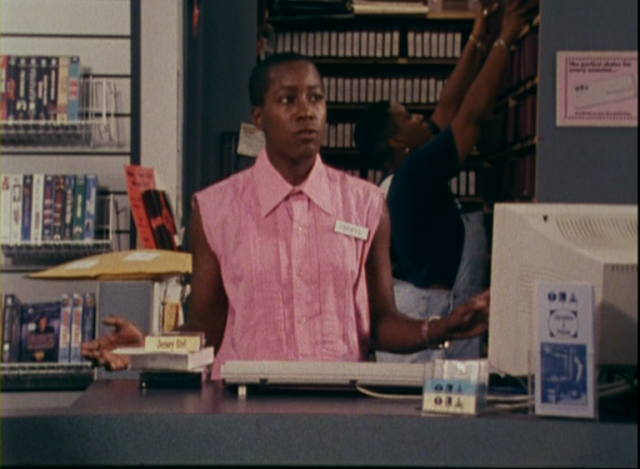
“The idea came from the real lack of information about the lesbian and film history of African American women. Since it wasn’t happening, I invented it,” Cheryl Dunye says about her 1996 debut, The Watermelon Woman, which underwent a twentieth-anniversary 2K HD restoration in 2016. In the film, the first feature by a black lesbian, Dunye plays herself, a twenty-five-year-old black lesbian working at a video store with her goofy best friend, Tamara (Valerie Walker). Searching for a topic to make a movie on, Cheryl becomes obsessed with an actress who played a mammy in Plantation Memories and other 1930s films. The actress was listed in the credits as the Watermelon Woman; Cheryl decides to find out more about her, going on a journey in and around her hometown of Philadelphia, discovering more and more about the actress, also known as Fae Richards, and the battle black lesbians had to fight in the early-to-mid-twentieth century. In the meantime, Cheryl begins a relationship with Diana (Guinevere Turner), a privileged white woman who has just moved into the area, mimicking what Cheryl has found out about Richards, who had an affair with white director Martha Page.

THE WATERMELON WOMAN

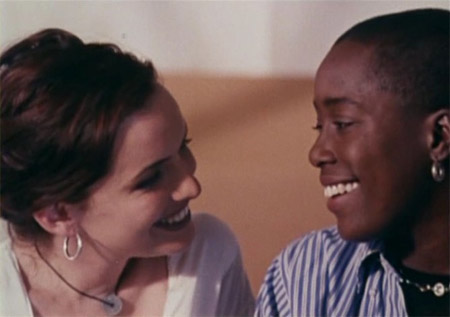
Diana (Guinevere Turner) and Cheryl Dunye (as herself) stars a relationship in The Watermelon Woman

The Watermelon Woman suffers from amateurish filmmaking techniques (Michelle Crenshaw was the cinematographer, while Dunye served as editor as well as writer, director, and star), but its central issue is a compelling one, and Dunye is engaging as her onscreen alter ego. Richards (Lisa Marie Bronson) and Page (producer Alexandra Juhasz) are seen only in photographs and archival footage shot by white lesbian artist Zoe Leonard (her photography assistant was Kimberly Peirce, who went on to make Boys Don’t Cry), while Doug McKeown (The Deadly Spawn) directed the scenes from fake movies Plantation Memories and Soul of Deceit. (The photographs became an art project of its own, touring museums around the world.) The film features numerous cameos by writers, musicians, and activists, including Camille Paglia as herself, V. S. Brodie as a karaoke singer, Sarah Schulman as the CLIT archivist, David Rakoff as a librarian, and Toshi Reagon as a street singer. The Watermelon Woman is a heartfelt tribute to black lesbians by a black lesbian who is restoring one woman’s true identity as a microcosm for all black women who have had theirs taken away. In addition, the film became part of an attempt by certain congressmen to defund the National Endowment for the Arts, which supplied a $31,500 grant to Dunye; Michigan Republican Peter Hoekstra, head of the House Education and Workforce Committee’s Subcommittee on Oversight and Investigations, singled the film out as offensive. The Watermelon Woman is also a reminder of what research was like pre-Google, less than thirty years ago. Dunye has gone on to make such films as Stranger Inside, Black Is Blue, Mommy Is Coming, and My Baby’s Daddy, continuing her exploration of multiracial, gay, and trans culture. The Watermelon Woman is screening June 14 at the Quad as part of the series “Pride Revived: Lines and Curves, Drawn and Moving”; the 7:30 show will be introduced by film critic, comedian, and podcaster Jourdain Searles. Also on the schedule are Shirley Clarke’s Portrait of Jason on June 12, Pier Paolo Pasolini’s Teorema on June 13, and Jack Sholder’s A Nightmare on Elm Street 2: Freddy’s Revenge on June 14.