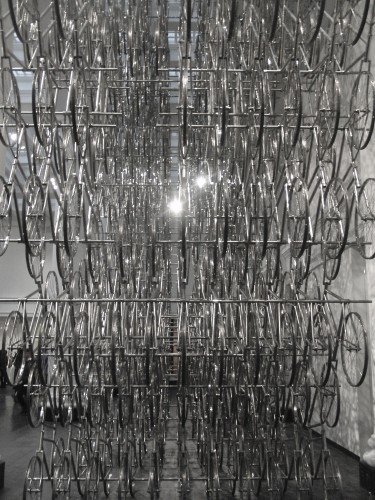
Ai Weiwei, “Stacked,” stainless-steel bicycles, 2014 (photo by twi-ny/mdr)
Brooklyn Museum
Morris A. and Meyer Schapiro Wing, fourth and fifth floors
200 Eastern Parkway at Washington St.
Wednesday – Sunday through August 10, $15
Art Off the Wall: “Ai Weiwei: According to What?,” July 24, $15, 6:00
718-638-5000
www.brooklynmuseum.org
www.aiweiwei.com
Over the last decade, Ai Weiwei has become the most famous, and arguably the most important, artist in the world. The multidisciplinary artist and activist, the son of a poet and activist father, helped design the National Olympic Stadium, aka the Bird’s Nest, for the 2008 Beijing Summer Games, was beaten by police in Chengdu in 2009, had his influential blog shut down by the Chinese government that same year, then was arrested in 2011, his whereabouts unknown for eighty-one days as people around the globe demanded his release. Through it all, Ai, who has been under house arrest since 2011, has remained steadfast in his dedication to challenge belief systems, question the status quo, and explore social issues in his art. All that and more is evident in the impressive “Ai Weiwei: According to What?,” a touring survey that is in the midst of its final stop at the Brooklyn Museum, where it continues through August 10. “Rather than thinking of my projects as art, they attempt to introduce a new condition, a new means of expression, or a new method of communicating,” Ai tells Kerry Brougher in a Q&A in the exhibition catalog, in which he references Ludwig Wittgenstein, Andy Warhol, Confucius, Donald Judd, and Sergei Eisenstein in a few short pages. “If these possibilities didn’t exist, I wouldn’t feel the need to be an artist.”
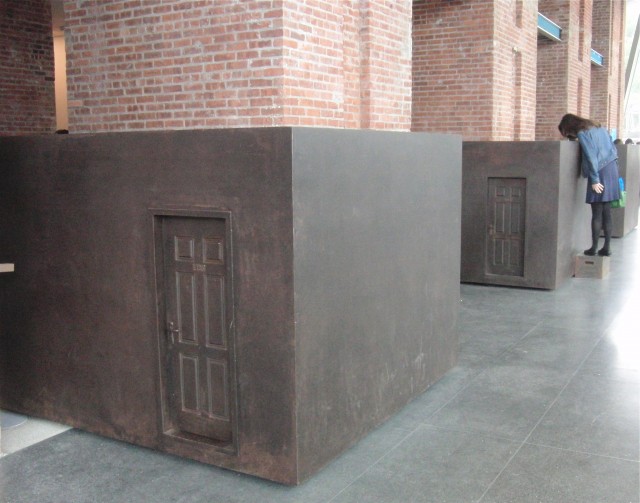
Ai Weiwei’s “S.A.C.R.E.D” invites visitors to see details of his eighty-one-day imprisonment (photo by twi-ny/mdr)
The exhibition began in 2009 at the Mori Art Museum in Tokyo but continued to morph as it made its way through North America toward Brooklyn, where several pieces have been added. Upon entering the Brooklyn Museum’s front lobby, visitors are greeted by “S.A.C.R.E.D.,” six iron boxes that contain detailed re-creations of scenes from Ai’s imprisonment — being led into his small cell by guards, being interrogated, eating, sleeping, using the bathroom, under constant surveillance — instantly turning the Beijing-based artist into a heroic, bigger-than-life figure. The rest of the show, spread across two upper floors, confirms that Ai is indeed a hero, his sculptures, photographs, films, repurposed found objects, and installations all having political, historical, and social relevance, dealing with individual freedom, human rights, and the search for the truth.
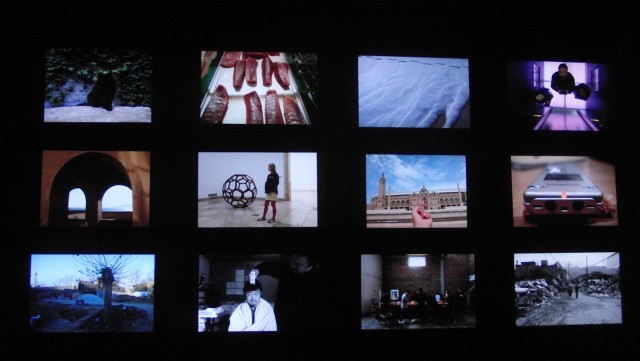
Video installations play a large role in Ai Weiwei exhibition (photo by twi-ny/mdr)
There is critical meaning behind every work, sometimes obvious, as in the marble “Surveillance Camera” and photographs in which Ai shoves his middle finger at Tiananmen and the White House, and often less clear at first, as in “He Xie,” a pile of more than three thousand porcelain crabs gathered at the center of a room. The piece references a dinner of river crabs that Ai, who could not attend because of his house arrest, organized shortly before his Shanghai studio was going to be torn down by the government; the title of the piece sounds like the word “harmonious,” which echoes the communist phrase “a harmonious society.” Ai consistently values people above material objects, mocking monetary worth. In “Dropping a Han Dynasty Urn,” three photographs depict him letting an ancient ceramic vase fall from his hands, smashing at his feet. “Stacked” consists of hundreds of silver bicycles in a dazzling array, not only evoking the popular means of transportation in China but the mass production of consumer goods, in this case made by a company called Forever.
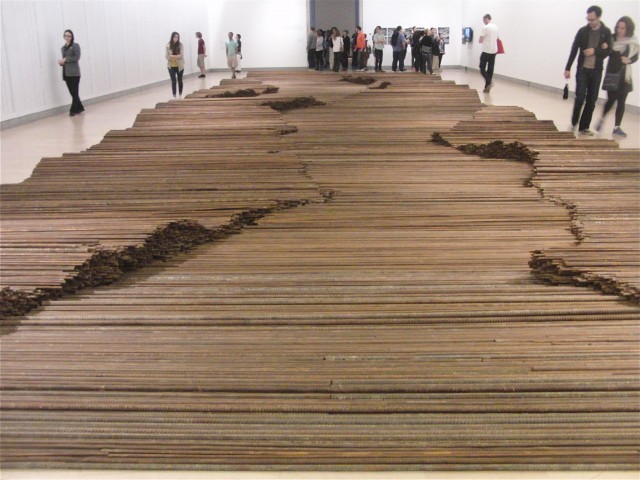
Ai Weiwei, “Straight,” seventy-five tons of steel rebar, 2008-12 (photo by twi-ny/mdr)
Ai has spent much of the last few years investigating the aftereffects of the 2008 Sichuan earthquake, in which poorly constructed buildings, including schools, resulted in approximately ninety thousand missing or dead men, women, and children. For “Straight,” Ai had workers take twisted steel rebar from the sites of the building collapses and pound them back into their original straight form, then laid them out in a vast landscape that appears unfinished, as more bodies need to be found and identified. The victims of the earthquake, who have been mostly ignored by the government, are given back their identities in “Sichuan Namelist,” an inkjet print listing casualties, and “Remembrance,” a nearly four-hour recording on which a voice reads the names of the students who died in the tragedy. The children are also memorialized in “Snake Ceiling,” in which hundreds of children’s backpacks form a serpentine figure lurking above.
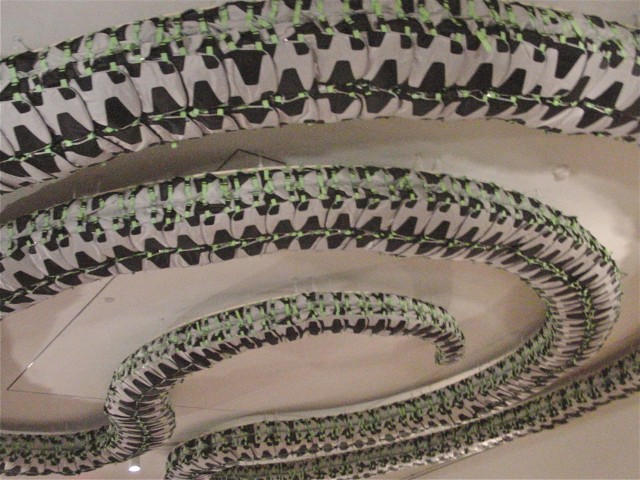
Ai Weiwei, “Snake Ceiling,” backpacks, 2009 (photo by twi-ny/mdr)
“Ai Weiwei: According to What?” also includes dozens of Ai’s photographs from his time in New York City; repurposed furniture that comments on Chinese tradition and the actual map of the country; his film Stay Home!, about a woman who contracted AIDS from a blood transfusion when she was a little girl; the installation “Ye Haiyan,” in which Ai has collected the belongings of a women’s rights activist who keeps getting evicted from her home; a video documenting his “Fairytale” project, in which he brought 1,001 Chinese people, from all classes, to Documenta in Kassel; and works that detail his brain injury suffered at the hands of police. The exhibition is splendidly curated by Sharon Matt Atkins, allowing plenty of space for contemplation of these bold, inspiring works by an artist who is not afraid to speak his mind, fully aware of what the consequences might be. “The relationship between thought and action is the most important source of human wisdom and joy,” Ai says at the end of the catalog interview. “With both, the process of turning art into reality is the path to happiness. It’s like a game. Only through this process can we understand who we are. So the game will continue.” The captivating exhibition — which is positive and delightfully engaging despite the serious nature of so much of its subject matter — makes you want to be part of that game. On Thursday, July 24, there will be a special evening “Art Off the Wall” program, consisting of a talk by Matt Atkins at 6:00, a presentation and workshop by the Asian American Oral History Collective at 6:30, Kelly Zen-Yie Tsai’s multimedia spoken-word piece “Ai Weiwei: The Seed” at 7:30, and a Chinese calligraphy workshop and DJ set at 8:30. (To see Ai answer questions from museum visitors, go here.)
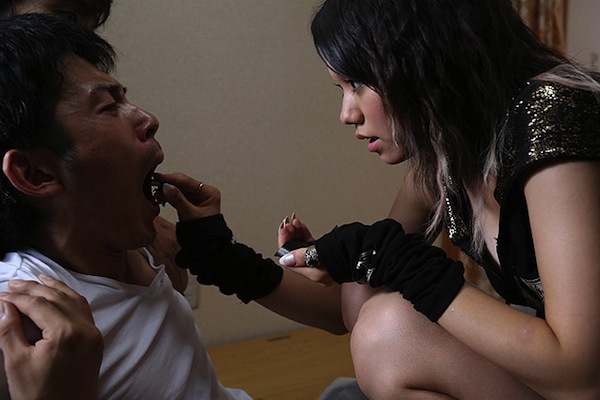
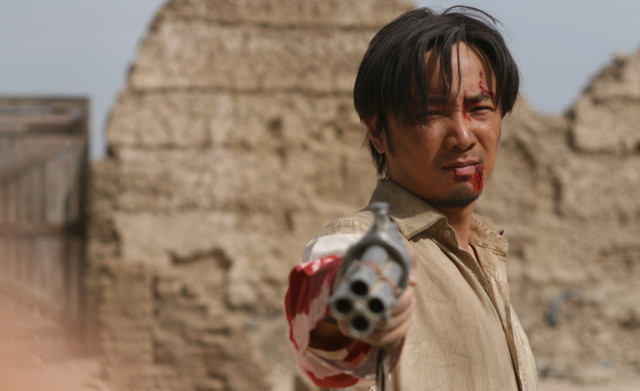
 It might take a while for the two seemingly disparate narratives to come together in Sion Sono’s totally awesome
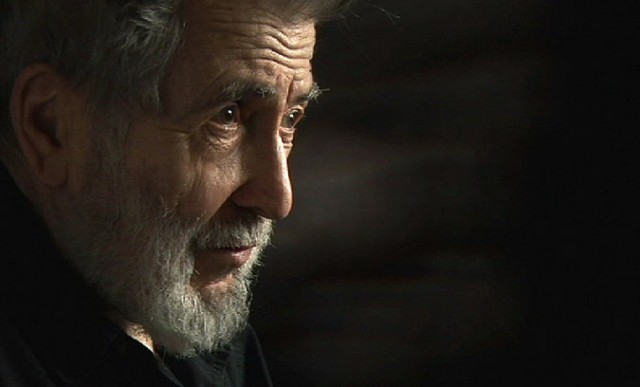
 The seven-decade legacy of one of America’s most important and influential journalists is celebrated in David L. Lewis’s illuminating documentary, The Pleasures of Being / Out of Step: Notes on the Life of Nat Hentoff. The too-short, sometimes scattershot eighty-five-minute film reveals Hentoff to be much more than just a columnist and a critic; Lewis, in his debut feature film, shows Hentoff, who turned eighty-nine earlier this month, to be a fascinating character who speaks his mind, a fierce defender of the First Amendment, a crucial participant in the spread of jazz in the mid-twentieth century (including as a record producer), and an outspoken libertarian who is adamantly antiabortion. “When he came to a room, nobody said, ‘Oh, here’s the critic,’” saxophonist and composer Phil Woods explains. “They said, ‘Here’s a friend of the music.’ It’s a whole different thing. He was part of the family.” Lewis speaks extensively with the Boston-born Hentoff, a bent-over man with thick, silvery-gray hair, beard, and mustache who types with two fingers in his extremely messy and crowded home office, as well as Hentoff’s wife, Margot; cultural critic Stanley Crouch; former Village Voice editor Karen Durbin; First Amendment attorney Floyd Abrams; recently deceased poet and activist Amiri Baraka; jazz historians Dan Morgenstern and John Gennari; and even Voice editor Tony Ortega, who fired Hentoff in 2009. Hentoff discusses his childhood, his start in journalism, his personal and professional relationships with such figures as Bob Dylan, Charles Mingus, and Malcolm X, and his steadfast defense of civil liberties.