Henrik (Henrik Rafaelsen) and Tone (Janne Heltberg Haarseth) goof around in a supermarket in THE ALMOST MAN
THE ALMOST MAN (MER ELLER MINDRE MANN) (Martin Lund, 2012)
Village East Cinemas
181-189 Second Ave. at 12th St.
Opens Friday, August 1
212-529-6799
www.bigworldpictures.org
www.villageeastcinema.com
 So this is thirty-five. Norwegian filmmaker Martin Lund’s feature debut as writer and director, The Almost Man, is a mature, insightful, and very funny look at immaturity. Henrik Rafaelsen, a kind of cross between Liam Neeson and Jason Segel, stars as Henrik, a thirty-five-year-old man who isn’t quite ready to grow up yet. He has a new office job, a new house, and a loving girlfriend, Tone (Janne Heltberg Haarseth, a kind of cross between Julianne Moore and Diane Lane), but he’d rather goof around with his crazy high school buddies than take life seriously. In the opening scene, the happy couple, decorating their new place, lightheartedly imagine what their neighbors might be thinking of them. Next Henrik and Tone are grooving to Lionel Richie. “Let me see you dance without irony,” Tone says. During a group lunch on his first day at work, his fellow employees debate what his name should be. “But my name is Henrik,” he says, appearing unsure of his own identity. (Perhaps it is no coincidence that it is also the first name of the actor himself.) He is awkward and uncomfortable in his own skin, instead choosing to remain a kid who refuses to acknowledge the real world and the responsibilities he is facing. After an argument with Tone, he visits with his mother (Anne Ma Usterud), who still treats him like a child. But soon he is faced with important decisions that could have very serious repercussions on his and Tone’s future.
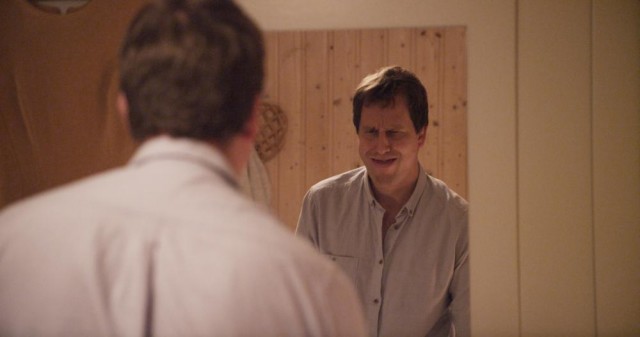
Henrik takes a long look at himself in offbeat coming-of-age film from Norwegian writer-director Martin Lund
Winner of Best Film and Best Actor at the forty-seventh Karlovy Vary International Film Festival, The Almost Man is an unusual coming-of-age film, a genre generally about teens. Rafaelsen (Limbo; Happy, Happy) and Haarseth, in her film debut, are both appealing actors who are terrific together, playing off each other in charming, believable ways. Cinematographer Morten Halfstad Forsberg’s camera is almost always in motion, purposely unsteady as Henrik wanders through a life he is scared of committing to; he’d rather read a Peter Pan picture book than hang out at a party with Tone’s publishing colleagues. (And just wait till you see what he does with the book.) Lund’s script is sharp and incisive, often going to surprising, uneasy places that don’t always paint Henrik in the best light. The score, by Alf Lund Godbolt and Simen Solli Schøien, appears sparingly, with Lund favoring natural sound in most scenes, adding to the realistic feel. At only seventy minutes, The Almost Man is almost shockingly short, but it covers some major territory that most everyone should be able to relate to. The Almost Man opens August 1 at the Village East; Lund and producer Ruben Thorkildsen will participate in a Q&A following the 8:05 screening on August 2.

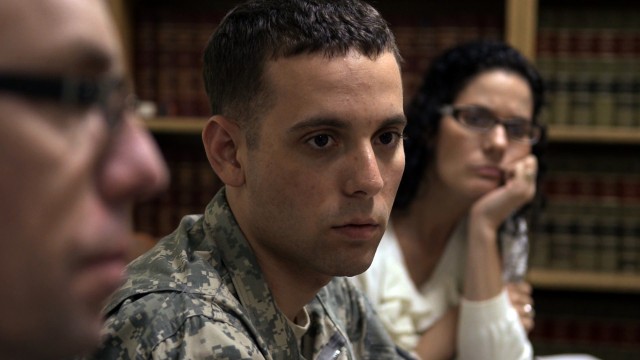
 Ten years ago, Dan Krauss made the Oscar-nominated short The Death of Kevin Carter: Casualty of the Bang Bang Club, telling the harrowing story of a South African war photographer struggling with his decision to take a photo of a starving Sudanese girl being stalked by a vulture rather than trying to help her. In his feature debut, Krauss documents the emotional tale of another man at a crossroads in The Kill Team. Intrigued by the April 2011 New York Times Magazine article “A Beast in the Heart of Every Fighting Man” about a homicidal military platoon in Afghanistan, Krauss follows Specialist Adam Winfield as he faces one count of premeditated murder. After discovering that several of his fellow soldiers had purposely gone out looking to kill an innocent man, then drop a weapon to make it appear that the victim was a terrorist, Winfield sent an agonizing message to his father, a former Marine: “I want to do something about it. The only problem is I don’t feel safe here telling anyone.” Winfield went along on one of the kill missions, which were led by Staff Sergeant Calvin Gibbs, and eventually blew the whistle on Gibbs and the others, but his nightmare continued.