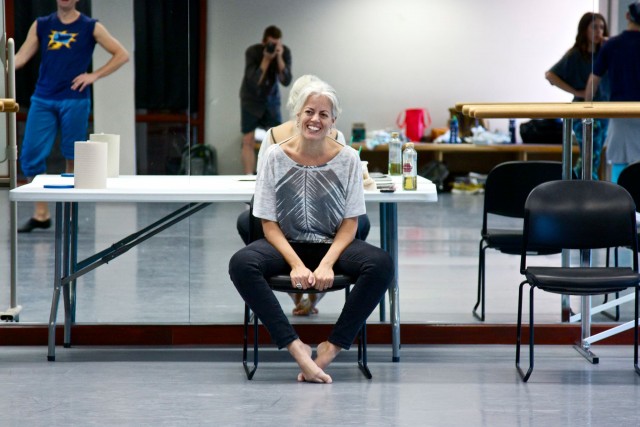
Yanira Castro’s latest work, COURT/GARDEN, premieres October 9-11 at Danspace Project (photo by Simon Courchel)
COURT/GARDEN
Danspace Project
St. Mark’s Church in-the-Bowery
131 East Tenth St. between Second & Third Aves.
October 9-11, $20, 8:00
866-811-4111
www.danspaceproject.org
www.acanarytorsi.org
Since 2009, San Juan-born, Brooklyn-based choreographer Yanira Castro has been creating site-specific dance installations and participatory performances for her company, a canary torsi, in such unusual places as a bathroom in the Gershwin Hotel (Dark Horse/Black Forest) and both indoors and outdoors at the Brooklyn Botanic Garden (Paradis). Her newest piece, Court/Garden, was developed through residencies at the Maggie Allesee National Center for Choreography in Tallahassee, Amherst College, and Governors Island. The work, which Castro calls “a spectacle in three acts,” premieres October 9-11 at Danspace Project at St. Mark’s Church in-the-Bowery, where the audience will be required to move around during the performance. Inspired by the imperial ballets that became popular during the reign of Louis XIV, who was a dancer himself, Court/Garden features Simon Courchel, Tess Dworman, Luke Miller, Pamela Vail, Darrin Wright, and Kimberly Young along with “cupids” Tony Carlson and Kirsten Schnittker. The score will be performed live by composer Stephan Moore, with video by Peter Richards. The crew also includes a “perfumer,” herbalist Jennifer Goodheart; the costumes are by Miodrag Guberinic, while Kathy Couch designed the environment.
Court/Garden was partly informed by dance historian, theorist, and choreographer Mark Franko’s “Dance and the Political: States of Exception,” published in the Summer/Winter 2006 issue of Dance Research Journal. In the article, Franko writes, “I have asked by means of choreography whether some baroque dance could deal with subjugation as an effect of representative publicness rather than only with the embodiment of representative publicness itself. In other terms, I have attempted to conjugate trauma with sovereignty.” On October 11, Castro will delve further into her creative process and “representative publicness” in Conversations without Walls, an afternoon symposium with visual artist Suzanne Bocanegra, Danspace Project Platform curator Claudia La Rocco, choreographer and video artist Jillian Peña, choreographer and dancer Will Rawls, former New York City Ballet dancer Kaitlyn Gilliland, and Franko; in addition, Melissa Toogood will perform a short piece choreographed by Pam Tanowitz. Shortly after moving all the necessary equipment from Governors Island to Danspace Project, Castro discussed location, the performer-spectator dynamic, Kickstarter, the derivation of the name of her company, and more.
twi-ny: Location is central to your work. How does space inform your work? Does space come before concept, or is it the other way around?
Yanira Castro: Concept usually comes first. All the works are interrelated for me in how the works are asking questions about how we see and participate in culture/live performance, how we read and how we form understanding. Once I understand the nature of the question we are asking in a particular work, then I can begin to consider location. For me, location is a container/a frame and also about permission; a space has to invite the relationship between audience and event that we are considering.
I usually know pretty early the kind of frame that is necessary for something — small, enclosed, intimate, public space — a public bathroom — or large, sprawling, outdoor lawn. And then I go looking for the space. In New York, that is half of the adventure.
twi-ny: You spent part of this summer in an LMCC residency on Governors Island. Did you know much about the island and its history before going there? How did it impact your creative process?
Yanira Castro: We really used our time there as studio time. We did not engage with Governors Island as a site. Creatively, it is where we put many of our conceptual ideas together for the first time. So the residency in and of itself was highly important as a point of discussion around the ideas of the work.
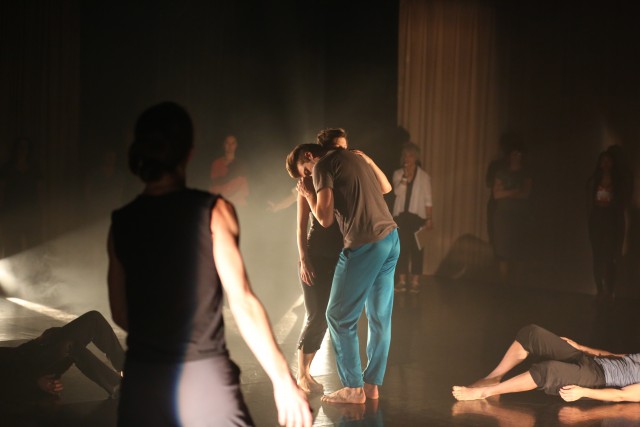
Dancer-choreographers Simon Courchel, Pamela Vail, Kimberly Young, Luke Miller, and Darrin Wright rehearse COURT/GARDEN (courtesy of Maggie Allesee National Center for Choreography / photo by Chris Cameron)
twi-ny: Court/Garden is being presented as part of Danspace Project’s fortieth anniversary. How did the transition go from Governors Island to St. Mark’s Church?
Yanira Castro: We didn’t really work that way. We didn’t try to make it at Governors Island and so there was no transition really. We used Governors Island for more conceptual work and sketches for what would happen at Danspace.
twi-ny: Is there a dream space you’d love to work in that you haven’t yet?
Yanira Castro: Because I don’t start off with a site first, there isn’t a space I long to work in. But I love large spaces in transition. Walking by places at night that are uninhabited and have bare bulbs hanging in the space — vast structures that are left empty or in disarray, building sites, haunted houses — I am romantic that way.
twi-ny: You refer to several of your previous works as “dance installations,” and Court/Garden is “a spectacle in three acts.” Did you always have this drive to take things to a new level?
Yanira Castro: I never think of it as large. I always start saying it is going to be small. They are always intimate pieces for me. But my mind has a tendency to sprawl and find connections. Especially once I am into my research, it always starts from a small thing that then gets all kinds of information glommed on to it. And I find words difficult. Often I call the pieces something like “dance installation” because I don’t quite understand what I mean by the words or even how these pieces function in relationship to concert dance or site-specific dance. It is neither. So, I give it words for a while to see how that works — to denote that it is not this other thing, but it is always uncomfortable.
Spectacle is super uncomfortable. But at the same time it has really freed up my imagination. I have given myself the space to bring in all these fantastical elements where I don’t usually go. It has touched on some of my personal interests in iconography. I came across the word in my research — a book by Georgia J. Cowart, The Triumph of Pleasure: Louis XIV and the Politics of Spectacle. It aptly describes the royal performances of Louis XIV’s court. But right now everything seems like a spectacle to me. It is kind of like saying the same word one hundred times. . . . It begins to lose its definition. It becomes aural. a texture. So . . . yeah . . . I end up with projects that really challenge me and my collaborators . . . in their largeness of scope. But that isn’t the intention at the start. I am really attempting to answer a question — an intimate one about culture and how and why we are in this space together to witness — and the questions lead down rabbit holes. I like getting lost and making sense of the map.
twi-ny: You also enjoy challenging the audience, to get them involved beyond the basic performer-spectator relationship, and that is true about Court/Garden as well, as the audience will have to move around during the show. Was there a “eureka” moment when you decided to start breaking down those walls?
Yanira Castro: It started because Peculiar Works Project invited me to make a piece for Judson House which was being torn down, and we could do anything we wanted with the space we were allotted because it would not exist come Monday. My collaborator, Kevin Kwan, and I decided to paint a small room five layers of glossy white. Everything in it. And then seal the room with scrim. The audience could see the dance that took place inside this hermetic situation through the scrim. But to see it, they had to crouch or peer in and get close. The dancers were sometimes obscured. I remember watching that audience have to lean in to watch and it was what I wanted, I wanted that they should engage in that way. The image of them leaning over the dance was as important as the dance itself.
It is not that I want to challenge the audience. I want to create a scenario for them and to be in conversation with them and I want them to form the picture, craft their experience. Their presence dynamically changes what is occurring. That is what “live” means for me. It is dynamic because of the people in the room.
twi-ny: What does it take to be a dancer for a canary torsi, especially given all the interactivity with the audience?
Yanira Castro: I think that would be a question for the dancers. I don’t think of “interactivity” when I am thinking about working with someone. I think about spending time with them, that I enjoy their presence and love talking to them. I have often invited people to be in work without having seen them dance or perform. And so it is every bit a discovery when we get into the studio together. And I never know what the choreography is going to look like anyway, or what it may require, until we are in it.
twi-ny: You funded part of Court/Garden through Kickstarter. How has online funding changed the game for you and dance in general?
Yanira Castro: Well, I think like anything . . . it becomes part of the machine after a while. So, it is almost expected that you will do some kind of crowdsource funding to put up a production. It has, in many ways, taken the place of traditional individual giving. You know, most of us don’t have patrons with deep pockets who can come in and save the day, so things like Kickstarter feel more democratic to me. I may not have a patron that can give $5,000, $10,000 . . . but almost anyone can give $1 or $5. And yes, it builds up and it can build a sense of camaraderie around a project, create excitement. It is really only a different way of looking at creating investment in a project . . . and one that I feel more comfortable doing than the traditional yearly benefit. I think in general crowdsource funding has been empowering for the arts, even while it has now become a cog in the machine.
twi-ny: Dare I ask where the name “a canary torsi” came from?
Yanira Castro: It is an anagram of my name. I didn’t see the work as fitting a traditional dance company model, so I couldn’t see myself as Yanira Castro Dance or Yanira Castro + Company any longer. But I also wanted to acknowledge that I didn’t work alone. I wasn’t just . . . Yanira Castro. And so I wanted a name, a name that wouldn’t limit. But names are the worst things . . . especially when you have a lifetime to live with them. And I thought about how I did not pick my birth name and yet I carry it around with me. So, I decided to create a chance structure and that the name that resulted from that . . . I would accept. After several steps involving the computer, the dice and my spouse . . . a canary torsi was the name on the page. I don’t love it. I don’t hate it. It is a name. And it has certain uses that I like — the canary was a popular social dance that began when some folks from Spain saw a dance danced by people from the Canary Islands. It was quickly appropriated and spread through most of Europe for centuries with many variations. And torsi is, of course, multiple torsos (which seems very apropos), but also it means “unfinished.” And I liked that . . . an unfinished social dance.



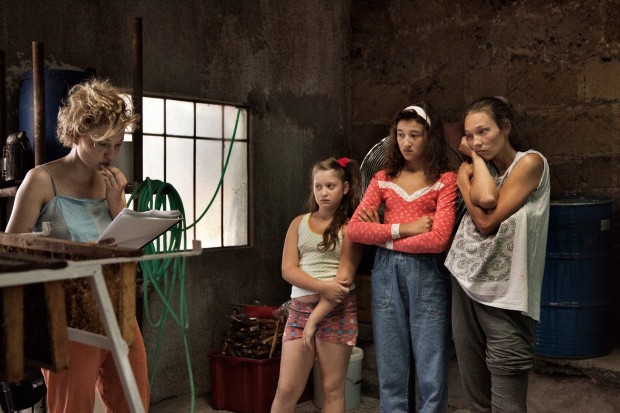
 Winner of the Grand Prix at the Cannes Film Festival, Alice Rohrwacher’s The Wonders is a sweet little gem of a movie, focusing on a German-Italian family that finds itself at a critical crossroads. Set in Rohrwacher’s (Corpo celeste) hometown in the countryside between Umbria-Lazio and Tuscany, the film follows the travails of a beekeeping family led by the gangly Wolfgang (Sam Louwyck), a grumpy ne’er-do-well from one of the Germanic countries who is trying to live some kind of back-to-the-land life away from authorities in an undeveloped backwater. His allegiance to old-fashioned tradition includes overworking his four young daughters while his wife, Angelica (Alba Rohrwacher, the director’s older sister), keeps at a distance and live-in friend Cocò (Sabine Timoteo) keeps stirring up the pot. At the center of it all is twelve-year-old Gelsomina (first-time actress Maria Alexandra Lungu, who was discovered in a catechism class), an exceptional beekeeper who wants her father to allow the family to participate in a television contest, Countryside Wonders, that could earn them much-needed money. But her father prefers taking care of things himself — though not very well, particularly when he acquires a camel for no apparent reason. Suspicious of the government and contemporary society, Wolfgang likes living in relative isolation; inviting strangers into their world could reveal the illegal working conditions, not to mention abuse of child labor laws. But Gelsomina is determined to improve their existence, starting with the competition, which is hosted by the beguiling, fairy-tale-like Milly Catena (Monica Bellucci in a marvelous white head piece, partially poking fun at her own sex-symbol image).
 Vanessa Lapa’s chilling feature documentary debut, The Decent One, reveals that there wasn’t a whole lot that was decent about Heinrich Himmler, the SS chief who was the architect of the Final Solution. In 2006, Lapa’s father purchased a collection of Himmler’s diaries, letters, documents, and photographs that had initially been discovered in his home by U.S. soldiers in May 1945. The treasure trove forms the narration for Lapa’s film, as actors read from many of the items in chronological order while home movies, still images, and rare archival footage of Himmler and the rise of the SS are shown onscreen. The film includes letters, postcards, and diaries from Himmler; his parents; his wife, Marga; his mistress, Hedwig Potthast; his beloved daughter, “Püppi”; his foster son, Gerhard von Ahé; and others, in which the Gestapo head discusses love and romance, racial purity, motherhood, duty and honor, order and obedience, the Jewish question, homosexuality, and subhumans, troubling views he developed from a young age. “People don’t like me,” he writes after not being accepted into a fraternal group at college. Looking for purpose in his life, he explains, “You start to think, if only there was a war again. If only I could put my life on the line. Fight! It would be a pleasure.” He was also fully aware of the brutality of the Nazi regime. “I can predict the horrors of the future,” he notes in 1927.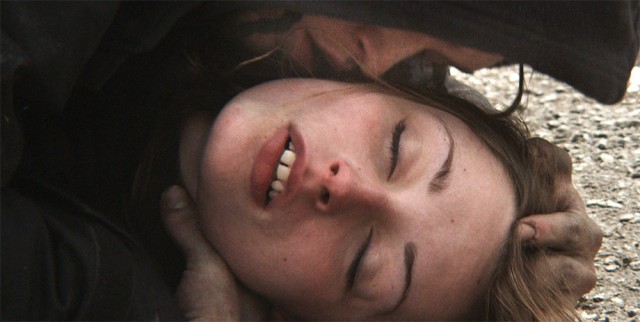
 Josh and Benny Safdie’s Heaven Knows What is a harrowing tale about addiction and obsession, but it turns out that its back story is much more compelling than what shows up onscreen. Josh was researching a film about the Diamond District when he came upon Arielle Holmes, a nineteen-year-old temp assistant. He was determined to find out more about her and shortly discovered that she was a homeless junkie with a wild, unpredictable druggie boyfriend, Ilya. Josh and Benny, who had previous collaborated on such indie features as The Pleasure of Being Robbed and Daddy Longlegs and the documentary Lenny Cooke, commissioned Holmes to write her story, and she quickly delivered 150 pages that ultimately inspired the film, in which Holmes plays Harley, a young heroin addict living on the streets of New York City, spanging money (begging for spare change) for her next fix while in a combative relationship with Ilya (Caleb Landry Jones). Harley has done something to alienate Ilya, and she says she will kill herself to prove her love and devotion. He tells her to go ahead and do it, so she slits one of her wrists and is rushed to the hospital. That sets the stage for the rest of the lurid and sordid narrative, as Haley bounces between the cruel Ilya and her drug dealer, the far more easygoing and mellow Mike (real-life street legend Buddy Duress in his acting debut); she is also followed around by Skully (rapper Necro), who wants to save her from herself but is clearly in no position to do so.