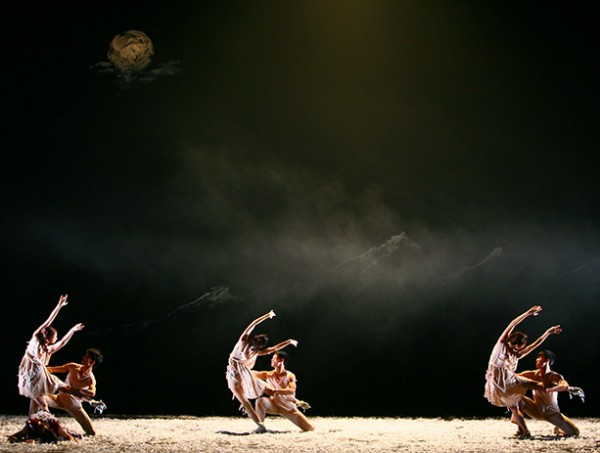
Beijing Dance Theater returns to BAM with poetry-inspired WILD GRASS (photo by Li Huimin)
NEXT WAVE FESTIVAL
Brooklyn Academy of Music
BAM Harvey Theater
651 Fulton St. between Ashland & Rockwell Pl.
October 15-18, $20-$40, 7:30
718-636-4100
www.bam.org
www.beijingdancetheater.org
Three years ago, China’s Beijing Dance Theater made its U.S. debut with the three-part Haze, an emotional, abstract examination of environmental and economic crises that was part of BAM’s 2011 Next Wave Festival. Founded in 2008 by choreographer Wang Yuanyuan, visual artist Tan Shaoyuan, and lighting and set designer Han Jiang, BDT is back in Brooklyn for the 2014 Next Wave Festival this week with another three-part presentation, Wild Grass. In choreographing the work, which combines tradition with modernity, Wang found inspiration in Lu Xun’s seminal 1927 prose-poetry collection, Wild Grass, also known as Yecao and Weeds, which includes such poems as “The Shadow’s Leave-Taking,” “My Lost Love,” “Revenge,” “Hope,” “Snow,” “Tremors of Degradation,” and “The Awakening.” The three sections, “Dead Fire,” “Farewell, Shadows!” (aka “Farewell of the Shadow”), and “Dance of Extremity,” each of which will have a different kind of floor, delve into the nature of human spirit and perseverance. The first movement, in BDT’s own poetic description, “has burning form but no flickering. It stands frozen like corals, with black smoke curdled on its tips that makes you wonder whether it has just emerged from a house on fire — and that is why it looks burnt and dead.” That is followed by “Farewell, Shadows!,” in which “I linger between light and darkness; know not whether it is dusk or dawn. Let me raise my ashen grey hand and feign a toast; I shall journey far, far away, unbeknownst to all.” The evening concludes with “Dance of Extremity,” where “there remains only the vast wilderness; this dried couple, completely naked, sword in hand, stand in the middle. With dead men’s eyes they observe with gusto the withering passers-by in a great bloodless carnage. They are eternally plunged into life’s giddy, excruciating bliss.” Wild Grass runs October 15-18 at BAM’s Harvey Theater; on October 18, Wang will lead an afternoon class at the Mark Morris Dance Center for experienced and professional dancers ($25, 3:00).
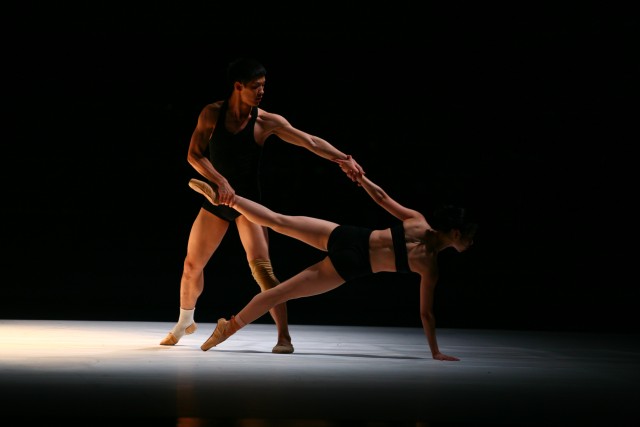
Dancers glide across the smooth stage in “Farewell, Shadows,” second section of WILD GRASS (photo by Jan Jiang)
Update: As with Beijing Dance Theater’s 2011 U.S. debut at BAM, Haze, the company’s 2014 Next Wave Festival presentation, Wild Grass, is very much about surface. However, while the three sections take place on three different floor surfaces, artistic director, choreographer, and cofounder Wang Yuanyuan and the dancers never quite get below the surface in the work, which was inspired by the prose poetry of writer and activist Lu Xun. The fourteen dancers are individually technically proficient, but they never really catch fire as a unit, although Wu Shanshan stands out when she invigorates the second part with passion and humor otherwise missing from the evening. At several points, it’s possible to see how the dancers prepare their bodies for what is going to happen next, like a baseball hurler telegraphing his pitches. The first movement, “Dead Fire,” set to a minimalist piano score composed by Su Cong and played by He Peixun, takes place on a standard black dance floor that is continually littered with paper confetti that evokes snow, with the moon and white-capped mountains on the backdrop; “Farewell, Shadows” features electronic music by Biosphere and Kangding Ray and a slippery white floor across which the women glide, towed by male dancers; and “Dance of Extremity” has music composed by Wang Peng, with Yahg Rui on violin and Wang Zhilin on cello, as the dancers trudge through a straw-covered field that rises slightly in one corner, where a man stands next to a hanging rope. To paraphrase what we said in our review of Haze, there’s a lot to admire about Wild Grass, but Wang never quite achieves the narrative flow she aspires to.