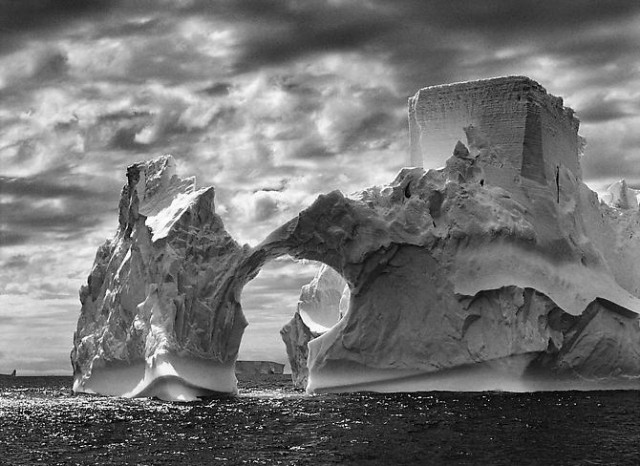
Iceberg between Paulet Island and South Shetland Islands on Weddell Sea in Antarctic Peninsula, 2005 (photo © Sebastião Salgado)
International Center of Photography
1133 Sixth Ave. at 43rd St.
Tuesday – Sunday through January 11, $10-$14 (pay what you wish Fridays 5:00 – 8:00)
212-857-0000
www.icp.org
www.institutoterra.org
In a 2003 International Center of Photography lecture about a year and a half after his “Migrations: Humanity in Transition” exhibit at ICP, Brazilian photographer Sebastião Salgado said, “I came out of ‘Migrations’ very pessimistic about the prospect, for me, of the survival of the human species because I saw so many tough things on this planet. . . . After seven years on the road, seeing these things, I was a little bit disappointed with all the relations that we create between us and this planet.” Mr. Salgado and his wife, curator Lélia Wanick Salgado, further explore this relationship in “Genesis,” going back to the beginning for his third large-scale series. The eye-opening show, which fills both floors at ICP, consists of more than two hundred fifty primarily black-and-white photos of vast landscapes and indigenous peoples and animals divided into five sections: “Amazonia and Pantanal,” “Northern Spaces,” “Africa,” “Sanctuaries,” and “Planet South.”
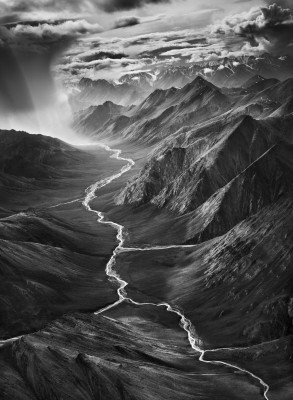
Eastern part of Brooks Range in Arctic National Wildlife Refuge in Alaska, 2009 (photo © Sebastião Salgado)
Although the Salgados primarily let the dazzlingly composed photos speak for themselves, the images have a very specific mission. “As well as displaying the beauty of nature, ‘Genesis’ is also a call to arms,” they state in the exhibition catalog. “We cannot continue polluting our soil, water, and air. We must act now to preserve unspoiled land and seascapes and protect the natural sanctuaries of ancient peoples and animals. And we can go further: We can try to reverse the damage we have done.” And these are no mere words. Like the Genesis Device in Star Trek II: The Wrath of Khan, which brought “life from lifelessness,” the Salgados are reforesting the Valley of the River Doce in Brazil, planting more than two million trees from more than three hundred different species as part of their Instituto Terra project. “‘Genesis’ is a quest for the world as it was, as it was formed, as it evolved, as it existed for millennia before modern life accelerated and began distancing us from the very essence of our being,” Ms. Salgado writes in the catalog. “And it is testimony that our planet still harbours vast and remote regions where nature reigns in silent and pristine majesty.” That “silent and pristine majesty” is on display in full force in the exhibit. Mr. Salgado, whose first large-scale series was “Workers: An Archaeology of the Industrial Age,” goes back to the land for “Genesis,” pointing out that nearly half of the Earth “is still as it was in the time of genesis.” His photos often require extended viewing, as many contain striking details that slowly emerge only as one spends time with them. He frames his images with natural horizontal, vertical, and diagonal lines that cut through the pictures like masterful brushstrokes, from a lightning-like river winding in between a mountain range in Alaska to a sweeping expanse of sand dunes in the Namib Desert in Namibia, from thousands of chinstrap penguins on an iceberg in the South Sandwich Islands to a close-up of one leg of a marine iguana in the Galápagos. Heavenly sunlight glows over a herd of lechwe in Botswana, clouds circle the Roraima Tepui in Venezuela, Zo’é women with poturu cones in their lips color their bodies with the urucum in Brazil, and a Yali man forages for food on a tree in West Papua.
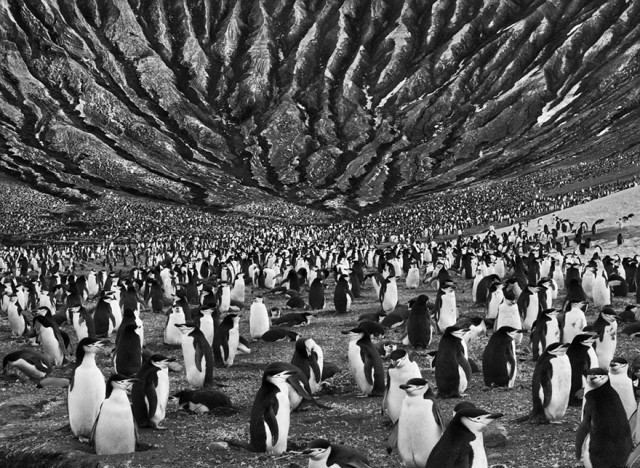
Chinstrap penguins on Saunders Island in South Sandwich Islands, 2009 (photo © Sebastião Salgado)
“[‘Genesis’] is a visual tribute to a fragile planet that we all have a duty to protect,” Ms. Salgado points out, and after experiencing this exhibit, which includes a look at the Instituto Terra project, you’ll feel more responsible for the planet as well. In conjunction with the show, which continues through January 11, ICP will be hosting a series of special events. “Friday Evenings with Climate Scientists” features seismologist Arthur Lerner-Lam on December 5 and climate scientist William D’Andrea on December 12 examining specific parts of the exhibition, while Adam Harrison Levy will moderate “Frack Off!” on December 15, a panel discussion on fracking with photographer Nina Berman and Cornell civil and environmental engineering professor Anthony Ingraffea.
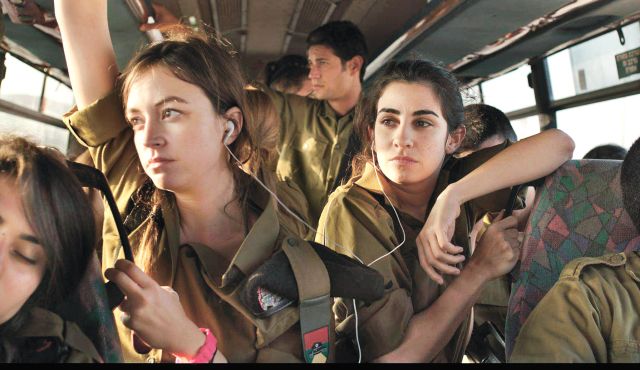
 Writer-director Talya Lavie makes a smashing debut with the outrageously funny black comedy Zero Motivation. Inspired by her own mandatory service in the Israeli army, where she served as a secretary, Lavie skewers both military life and office work as she focuses on a group of woman NCOs who spend most of their time fetching coffee for the male officers, singing, poking fun at one another, and trying to break the Minesweeper record on their aging computers. When Tehila (Yonit Tobi) arrives, Daffi (Nelly Tagar) is positive that the mousy young woman is her replacement and that her request for a transfer to Tel Aviv has finally been approved. Daffi’s best friend, Zohar (Dana Ivgy), refuses to follow orders, continually getting into trouble as she disobeys their commander, Rama (Shani Klein), who is gung ho on joining the men at the big boys’ table, and not just to make sure their cups and plates are full. Irena (Tamara Klingon) is a beautiful blond Russian who develops a curious problem of her own. And Livnat (Heli Twito) and Liat (Meytal Gal) enjoy needling the clueless Daffi and the dour Zohar as often as they possibly can. Not much real work gets done in this office, but with an important inspection on the horizon, the women have to shift into gear, although not all of them are exactly on the same page.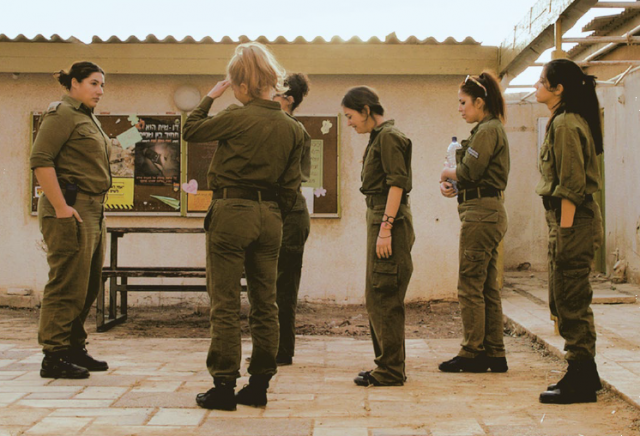


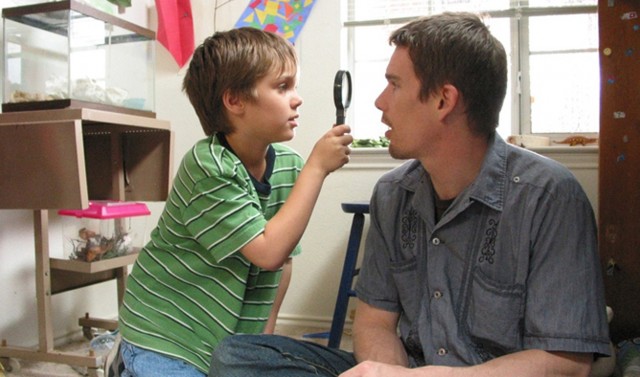
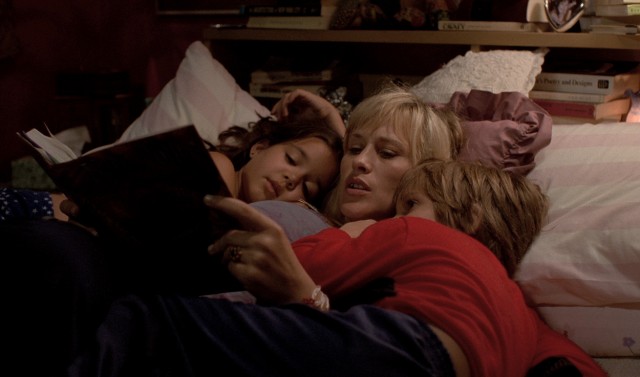
 Since 2002, Austin auteur Richard Linklater has made a wide range of successful films, from the family-friendly School of Rock and Bad News Bears to the second and third parts of the more adult Before series (Before Sunset, Before Midnight), with Ethan Hawke and Julie Delpy, in addition to the Philip K. Dick thriller A Scanner Darkly and the Jack Black black comedy Bernie. But during that entire period he was also making one of the grandest films ever about childhood, the deceptively simple yet mind-blowingly complex Boyhood. The work follows Mason Evans Jr. (Ellar Coltrane) as he goes from six years old to eighteen, maturing for real as both the actor and the character grow up before our eyes. As the film begins, Mason, his older sister, Samantha (Linklater’s real-life daughter, Lorelei), and their mother, Olivia (Patricia Arquette), are preparing to move to Houston just as their usually absent father, Mason Sr. (Hawke), returns from a job in Alaska, supposedly ready to be a more regular part of their lives. But his emotional immaturity leads to divorce, and Mason Jr. spends the next dozen years dealing with school, stepfathers, and the normal machinations of everyday life, including sex, drugs, rock and roll, and, for him, a determination from an early age to become an artist. Along the way, his sister and parents experience significant changes as well as they all learn lessons about life, love, and loss.