this week in lectures, signings, panel discussions, workshops, and Q&As

CHELSEA CLASSICS: STRAIT-JACKET

STRAIT-JACKET

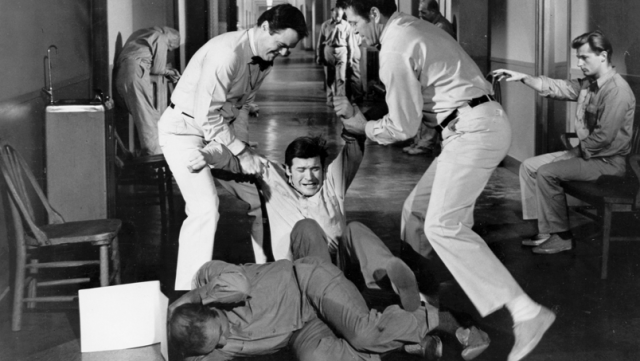
Lucy Harbin (Joan Crawford) doesn’t take kindly to marital infidelity in STRAIT-JACKET

STRAIT-JACKET (William Castle, 1964)
Chelsea Bowtie Cinemas
260 West 23rd St. between Eighth & Ninth Aves.
Thursday, January 22, $8, 7:00
212-777-3456
www.bowtiecinemas.com

One of the posters for William Castle’s 1964 camp classic, Strait-Jacket, screams out, “Warning! Strait-Jacket vividly depicts ax murders!” accompanied by a lurid illustration of an ax swinging down and spraying blood. Indeed, when Lucy Harbin (Joan Crawford) comes home early one night and catches her younger husband (Lee Majors) in bed with another woman (Patricia Crest), she grabs an ax and gives them each a nasty whack. After twenty years in an asylum, she returns to her farm to find her daughter, Carol (Diane Baker), engaged to Michael Fields (John Anthony Hayes), whose parents (Howard St. John and Edith Atwater), don’t particularly approve of the union. Soon heads are rolling, and no one is safe. The first of a handful of low-budget exploitation films made by Crawford at the end of her career — which also included Castle’s I Saw What You Did, Jim O’Connolly’s Berserk! and Freddie Francis’s TrogStrait-Jacket has quite a pedigree, written by Robert Bloch, the screenwriter of Psycho; produced and directed by Castle, who had previously made House on Haunted Hill and The Tingler; photographed in black-and-white by two-time Oscar nominee Arthur E. Arling (The Yearling, I’ll Cry Tomorrow); a Theremin-heavy soundtrack by bandleader and composer Van Alexander; and costarring future Oscar winner George Kennedy, Six Million Dollar Man Majors, WWII navy hero Leif Erickson, and Pepsi vice president and nonactor Mitchell Cox. (Crawford was the widow of former Pepsi president Al Steele and was still on the board of directors of the company, resulting not only in Cox’s appearance but also in overt product placement in the movie.)

But most of all, Strait-Jacket has Crawford, who chews up the scenery with relish, living up to Faye Dunaway’s portrayal of her in Mommie Dearest. Just wait till you see her light a match using a record on a turntable and her reaction to a bust of her that her daughter has made — an actual bust of Crawford from her time at MGM in the 1930s. And be sure not to miss the Columbia Pictures logo at the end. Strait-Jacket is being shown January 22 at Chelsea Bowtie Cinemas as part of Hedda Lettuce’s weekly Chelsea Classics series, in which the self-described “eco-friendly drag queen” hosts screenings of popular movies; the long-running series continues in January and February with Thelma and Louise, Titanic, All About Eve, It Happened One Night, and From Here to Eternity, so Strait-Jacket finds itself in some pretty good company.

STRANGER THAN FICTION — FAR OUT ISN’T FAR ENOUGH: THE TOMI UNGERER STORY

(photo by Sam Norval /  Corner of the Cave Media)

Illustrator Tomi Ungerer talks about his fascinating life in compelling documentary (photo by Sam Norval / Corner of the Cave Media)

FAR OUT ISN’T FAR ENOUGH: THE TOMI UNGERER STORY (Brad Bernstein, 2012)
IFC Center
323 Sixth Ave. at West Third St.
Monday, January 19, 8:00
Winter series runs Tuesdays at 8:00 through March 24
212-924-7771
www.faroutthemovie.com
www.stfdocs.com

“I am a self-taught raving maniac, but not as crazy as Tomi, or as great as Tomi,” Maurice Sendak says early on in Brad Bernstein’s engaging documentary, Far Out Isn’t Far Enough: The Tomi Ungerer Story, adding, “He was disarming and funny and not respectable at all.” Another children’s book legend, Jules Feiffer, feels similarly, explaining, “Tomi was this wonderfully brilliant, innovative madman.” Born in Alsace in 1931, Tomi Ungerer developed a remarkably diverse career as an illustrator, incorporating the emotional turmoil he suffered after losing his father when he was still a young child and then living under Nazi rule. In Far Out Isn’t Far Enough, Ungerer takes Bernstein and the audience on a fascinating journey through his personal and professional life, traveling to Strasbourg, Nova Scotia, New York City, and Ireland, which all served as home to him at one time or another as he wrote and illustrated such picture books as The Three Robbers and Crictor for editor Ursula Nordstrom, made bold political posters in support of the civil rights movement and against the Vietnam War, and published a book of erotic drawings, Fornicon, that ultimately led to a twenty-three-year exile from America during which he stopped making books for children. “I am full of contradictions, and why shouldn’t I be?” the eighty-one-year-old Ungerer says in the film. Ungerer discusses how he uses fear, tragedy, and trauma as underlying themes in his stories, trusting that kids can handle that amid the surreal nature of his entertaining tales.

He opens up his archives, sharing family photographs and old film footage, which reveal that he’s been pushing the envelope for a very long time, unafraid of the consequences. He also visits the Eric Carle Museum to check out a retrospective of his work for children, appropriately titled “Tomi Ungerer: Chronicler of the Absurd.” Meanwhile, Rick Cikowski animates many of Ungerer’s drawings, bringing to life his characters, both for children and adults, adding another dimension to this wonderful documentary. Far Out Isn’t Far Enough is a lively, engaging film about a seminal literary figure with an infectious love of life and art, and a unique take on the ills of society, that is a joy to behold. The film kicks off the IFC Center’s winter season of Stranger than Fiction on January 19 at 8:00, followed by a Q&A with Bernstein and Ungerer; Ungerer aficionados will also want to check out the new exhibit ”Tomi Ungerer: All in One” at the Drawing Center through March 22. Stranger than Fiction continues Tuesday nights through March 24 with such other nonfiction works as The Hand that Feeds, Freeway: A Crack in the System, Occupation: Dreamland, Seymour: An Introduction, and A Dangerous Game; each screening will be followed by a Q&A with the director(s), producer(s), and/or subject.

MLK DAY 2015

New York City celebration of MLK Day includes a screening of KING: A FILMED RECORD...MONTGOMERY TO MEMPHIS at Film Forum

New York City celebration of MLK Day includes a screening of KING: A FILMED RECORD…MONTGOMERY TO MEMPHIS at Film Forum

Multiple venues
Monday, January 19
www.mlkday.gov

In 1983, the third Monday in January was officially recognized as Martin Luther King, Jr. Day, honoring the birthday of the civil rights leader who was assassinated in Memphis on April 4, 1968. Dr. King would have turned eighty-six this month, and you can celebrate his legacy on Monday by participating in a Martin Luther King, Jr. Day of Service project or attending one of numerous special events taking place around the city. BAM’s twenty-ninth annual free Brooklyn Tribute to Dr. Martin Luther King, Jr. includes a keynote speech by Dr. Cornel West, live performances by Sandra St. Victor & Oya’s Daughter and the New York Fellowship Mass Choir, the theatrical presentation State of Emergence, the NYCHA Saratoga Village Community Center student exhibit “Picture the Dream,” and a screening of Ken Burns, Sara Burns, and David McMahon’s 2012 documentary The Central Park Five. The JCC in Manhattan will host an Engage MLK Day of Service in Brooklyn: Feeding Our Neighbors community initiative, a screening of Rachel Fisher and Rachel Pasternak’s 2014 documentary Joachim Prinz: I Shall Not Be Silent, and “Thank You, Dr. King,” in which Dance Theater of Harlem cofounder Arthur Mitchell shares his life story, joined by dancers Ashley Murphy and Da’Von Doane.

The Harlem Gospel Choir will play a special matinee at B.B. Kings on MLK Day

The Harlem Gospel Choir will play a special matinee at B.B. King’s on MLK Day

The Children’s Museum of Manhattan will teach kids about King’s legacy with the “Martin’s Mosaic” and Mugi Pottery workshops, the “Heroic Heroines: Coretta Scott King” book talk, and Movement & Circle Time participatory programs, while the Brooklyn Children’s Museum hosts the special hands-on crafts workshops “Let’s March!” and “Let’s Join Hands,” screenings of Rob Smiley and Vincenzo Trippetti’s 1999 animated film Our Friend, Martin, and a Cultural Connections performance by the Berean Community Drumline. The Museum at Eldridge Street will be hosting a free reading of Kobi Yamada and Mae Besom’s picture book What Do You Do with an Idea? along with a collage workshop. Also, Film Forum will show the 1970 three-hour epic documentary King: A Filmed Record . . . Montgomery to Memphis at 7:00, and the Harlem Gospel Choir will give a special MLK Day matinee at 12:30 at B.B. King’s in Times Square.

NEW YORK JEWISH FILM FESTIVAL — WAR AGAINST WAR: FEAR AND DESIRE

Stanley Kubrick’s first film is a curious, intense psychological war drama

FEAR AND DESIRE (Stanley Kubrick, 1953)
Film Society of Lincoln Center, Walter Reade Theater
165 West 65th St. between Eighth Ave. & Broadway
Tuesday, January 20, 6:15
Festival runs January 14-29 at the Film Society of Lincoln Center and the Jewish Museum
212-875-5050
www.nyjff.org
www.filmlinc.com

Fear and Desire, Stanley Kubrick’s seldom-seen 1953 psychological war drama and his first full-length film, made when he was just twenty-four, is a curious tale about four soldiers (Steve Coit, Kenneth Harp, Paul Mazursky, and Frank Silvera) trapped six miles behind enemy lines. When they are spotted by a local woman (Virginia Leith), they decide to capture her and tie her up, but leaving Sidney (Mazursky) behind to keep an eye on her turns out to be a bad idea. Meanwhile, they discover a nearby house that has been occupied by the enemy, and they argue over whether to attack or retreat. Written by Howard Sackler, who was a high school classmate of Kubrick’s in the Bronx and would later win the Pulitzer Prize for The Great White Hope, and directed, edited, and photographed by the man who would go on to make such powerful, influential war epics as Paths of Glory, Full Metal Jacket, and Dr. Strangelove or: How I Learned to Stop Worrying and Love the Bomb, Fear and Desire features stilted dialogue, much of which is spoken off-camera and feels like it was dubbed in later. Many of the cuts are jumpy and much of the framing amateurish. Kubrick was ultimately disappointed with the film and wanted it pulled from circulation; instead it was preserved by Eastman House in 1989 and restored twenty years later, which was good news for film lovers, as it is fascinating to watch Kubrick learning as the film continues. His exploration of the psyche of the American soldier is the heart and soul of this compelling black-and-white war drama that is worth seeing for more than just historical reasons.

FEAR AND DESIRE

The sudden arrival of a local woman (Virginia Leith) complicates things in FEAR AND DESIRE

“There is a war in this forest. Not a war that has been fought, nor one that will be, but any war,” narrator David Allen explains at the beginning of the film. “And the enemies who struggle here do not exist unless we call them into being. This forest then, and all that happens now, is outside history. Only the unchanging shapes of fear and doubt and death are from our world. These soldiers that you see keep our language and our time but have no other country but the mind.” Fear and Desire lays the groundwork for much of what is to follow in Kubrick’s remarkable career. Fear and Desire is screening with Peter Watkins’s The War Game on January 20 at 6:15 at the Walter Reade Theater as part of the War Against War sidebar program of the twenty-fourth annual New York Jewish Film Festival, which focuses on antiwar films from the 1950s and 1960s; the schedule also includes Gillo Pontecorvo’s Battle of Algiers, Kon Ichikawa’s Fires on the Plain, Konrad Wolf’s I Was Nineteen, and Jean-Luc Godard’s Les Carabiniers, centered by a panel discussion on January 19 at 3:00 at the Elinor Bunin Munroe Film Center (free with advance RSVP) with Kent Jones, Martha Rosler, Harrell Fletcher, and Trevor Paglen, moderated by Jens Hoffmann. Dr. Strangelove is part of the NYJFF as well, showing at the Walter Reade on January 18 at 9:15, introduced by Jennie Livingston.

NEW YORK JEWISH FILM FESTIVAL — WAR AGAINST WAR: FIRES ON THE PLAIN

Kon Ichikawa’s harrowing FIRES ON THE PLAIN is part of War Against War sidebar of 2015 New York Jewish Film Festival

FIRES ON THE PLAIN (NOBI) (Kon Ichikawa, 1959)
Film Society of Lincoln Center, Walter Reade Theater
165 West 65th St. between Eighth Ave. & Broadway
Monday, January 19, 1:00
Festival runs January 14-29 at the Film Society of Lincoln Center and the Jewish Museum
212-875-5050
www.nyjff.org
www.filmlinc.com

Kon Ichikawa’s Fires on the Plain is one of the most searing, devastating war movies ever made. Loosely based on Shohei Ooka’s 1952 novel and adapted by Ichikawa’s wife, screenwriter Natto Wada, the controversial film stars Eiji Funakoshi as the sad sack Tamura, a somewhat pathetic tubercular soldier on the island of Leyte in the Philippines at the tail end of World War II. After being released from a military hospital, he returns to his platoon, only to be ordered to go back to the hospital so as not to infect the other men. He is also given a grenade and ordered to blow himself up if the hospital refuses him, which it does. But instead of killing himself, Tamura wanders the vast, empty spaces and dense forests, becoming involved in a series of vignettes that range from darkly comic to utterly horrifying. He encounters a romantic Filipino couple hiding salt under their floorboards, a quartet of soldiers stuffed with yams trying to make it alive to a supposed evacuation zone, and a strange duo selling tobacco and eating “monkey” meat. As Tamura grows weaker and weaker, he considers surrendering to U.S. troops, but even that is not a guarantee of safety, as the farther he travels, the more dead bodies he sees. Fires on the Plain is a blistering attack on the nature of war and what it does to men, but amid all the bleakness and violence, tiny bits of humanity try desperately to seep through against all the odds. And the odds are not very good. Fires on the Plain is screening January 19 at 1:00 at the Walter Reade Theater as part of the War Against War sidebar program of the twenty-fourth annual New York Jewish Film Festival, which focuses on antiwar films from the 1950s and 1960s; the schedule also includes Gillo Pontecorvo’s Battle of Algiers, Stanley Kubrick’s Fear and Desire, Konrad Wolf’s I Was Nineteen, Jean-Luc Godard’s Les Carabiniers, and Peter Watkin’s The War Game, anchored by a panel discussion on January 19 at 3:00 at the Elinor Bunin Munroe Film Center (free with advance RSVP) with Kent Jones, Martha Rosler, Harrell Fletcher, and Trevor Paglen, moderated by Jens Hoffmann.

ORSON WELLES 100: TOUCH OF EVIL

Three different versions of neo-noir masterpiece TOUCH OF EVIL will be shown as part of Orson Welles centennial celebration at Film Forum

TOUCH OF EVIL (Orson Welles, 1958)
Film Forum
209 West Houston St.
Pre-release preview version: Wednesday, January, January 14, 12:30, 2:40, 4:50, 7:00, 10:00
Theatrical release version: Thursday, January 29, 7:00 & 9:00
Reconstruction version: Sunday, February 1, 1:10, 3:20, 8:00, and Monday, February 2, 12:30, 2:40, 4:50, 9:45
Series continues through February 3
212-727-8110
www.filmforum.org

They don’t come much bigger than Orson Welles in his dark potboiler Touch of Evil, as he nearly bursts through the frame as spectacularly dastardly police captain Hank Quinlan. A deliciously devious corrupt lawman, Quinlan is an enormous drunk who has no trouble breaking the rules to get his man. Charlton Heston took a lot of criticism playing Mike Vargas, a Mexican drug enforcement agent newly married to beautiful blonde Susan (Janet Leigh), who soon finds herself menaced by a dangerous gang as a weak-kneed, pre-McCloud Dennis Weaver looks the other way. The film famously opens with a remarkable crane shot that goes on for more than three minutes, setting the stage like no other establishing shot in the history of cinema. And the final scene with Marlene Dietrich as sultry hooker Tana is a lulu as well, highlighted by one of the great all-time movie lines. What goes on in between is a lurid tale of murder and revenge filled with unexpected twists and turns, featuring appearances by such Welles regulars as Joseph Cotten, Akim Tamiroff, Joseph Calleia, and Ray Collins. There was a lot of hype surrounding the film in 1998 when it was restored to match Welles’s original desires, but the final product lives up to its billing. As part of its “Orson Welles 100” festival, honoring the centennial of the always controversial auteur’s birth, Film Forum is screening three different versions of this deeply affecting noir masterpiece: the 108-minute pre-release version on January 14 (with the 7:00 show introduced by Welles historian Joseph McBride), the 93-minute original theatrical edition on January 29, and the 111-minute reconstruction on February 1-2. The Welles festival continues through February 3 with such double features as The Lady from Shanghai and The Third Man, Compulsion and The Long, Hot Summer, and Jane Eyre and Tomorrow Is Forever, multiple versions of Macbeth, and two evenings of Wellesiana rarities hosted by series consultant McBride, author of What Ever Happened to Orson Welles? A Portrait of an Independent Career.

NEW YORK JEWISH FILM FESTIVAL OPENING NIGHT: THE MUSES OF BASHEVIS SINGER

THE MUSES

Documentary delves into Isaac Bashevis Singer’s love of women and their work as his translators

THE MUSES OF BASHEVIS SINGER (Asaf Galay & Shaul Betser, 2014)
Film Society of Lincoln Center, Walter Reade Theater
165 West 65th St. between Eighth Ave. & Broadway
Wednesday, January 14, 4:00 & 8:45
Festival runs January 14-29
212-875-5050
www.filmlinc.com
www.the-muses-of-bashevis-singer.com

Who ever thought that little old Yiddish mensch Isaac Bashevis Singer was such a horndog? Asaf Galay and Shaul Betser begin The Muses of Bashevis Singer, their light and playful documentary, with the following quote from the Nobel Prize-winning author: “In my younger days I used to dream about a harem full of women. Lately I’m dreaming of a harem full of translators. If those translators could be women in addition, this would be paradise on earth.” Well, it seems that Singer, who was born in Poland in 1902, emigrated to the United States in 1935, and died in Florida in 1991 at the age of eighty-eight, found that paradise, as Galay and Betser meet with a series of women who were among many hand-picked by Singer, the man who nearly singlehandedly preserved Yiddish literature in the twentieth century, to serve as his translators, and not necessarily because of their language skills. “There were certain women who were more than just translators to him. It happened quite often,” says his Swedish publisher, Dorothea Bromberg, who also talks about Alma, Singer’s wife of more than fifty years. “He loved her, I’m sure, in his own way,” she adds. “She was very jealous of him, and she was completely right.” Galay and Betser meet with translators Eve Fridman, Evelyn Torton Beck, Dvorah Telushkin, Marie-Pierre Bay, Duba Leibell, and Dr. Bilha Rubenstein as well as Singer biographers Florence Noiville and Janet Hadda, his granddaughters Hazel Karr and Merav Chen-Zamir, Yentl the Yeshiva Boy playwright Leah Napolin, and his longtime secretary and proofreader, Doba Gerber, who share intimate, surprising tales about the author of such books as The Family Moskat, The Magician of Lublin, Shosha, and Enemies, a Love Story and such short stories as “Gimpel the Fool,” “A Friend of Kafka,” and “Zlateh the Goat.”

The seventy-two-minute film, lifted by a bouncy, airy soundtrack by Jonathan Bar-Giora, also includes footage of Singer making speeches, appearing on interview programs, going to a Jewish deli, walking on the Coney Island boardwalk, and writing with pen on paper and on a typewriter with Yiddish characters. But as the title implies, The Muses of Bashevis Singer doesn’t depict him as a callow cad but as a determined writer — and father and husband — who just loved women, loved being surrounded by women, using them as inspiration for his marvelous stories that mixed fiction with reality. “Isaac was a very frisky old man,” says Leibell, who worked with Singer in his later years after he moved to Florida with Alma. “That’s to put it very mildly.” The Muses of Bashevis Singer will have its U.S. premiere as the opening-night selection of the New York Jewish Film Festival on January 14 with screenings at 4:00 and 8:45 at the Walter Reade Theater, both followed by Q&As with the directors. The twenty-fourth annual festival continues through January 29 with screenings and special events at the Film Society of Lincoln Center and the Jewish Museum.