Bacon and Beer Classic will take the field at Mets’ home stadium on April 25
Citi Field
123-01 Roosevelt Ave.
Saturday, April 25, brunch session 12 noon – 3:00 pm, evening session 7:00 – 10:00, $29-$129 www.baconandbeerclassic.com
Two great tastes that taste great together — bacon and beer — make up the menu at the annual Bacon and Beer Classic, returning to Citi Field on April 25 while the Mets are playing the Yankees up north in the Bronx. More than one hundred craft brews will be available, along with more than fifty bacon-inclusive dishes from local restaurants. There will also be workshops, demonstrations, live music, interactive games, a DJ, and other activities. Among the participating breweries are Broken Bow, Two Roads, Central Waters, Thirsty Dog, Knee Deep, the Radiant Pig, Elysian, River Horse, and Angry Orchard, while bacon delicacies will be served by City Crab, Landhaus, Route 66 Smoke House, Pig Guy NYC, Bamboo Bites, BarBacon, Ribs Within, BacoBurger, Carnal, and others. There are two sessions, one for brunch and one for dinner, with VIP tickets gaining you early admission, as well as access to the warning track and dugouts. If you’re not an imbiber, you can get in for a mere $29 for food and nonalcoholic beverages; otherwise, ticket packages range from $59 to $129. In addition there will be various awards given out by a panel of judges consisting of Liza De Guia, Lisa Fernandes, Derrick Prince, Adam Poch, and David “the Rev” Cancio.
Macy’s Flower Show is dedicated to “Art in Bloom” (photo by twi-ny/mdr)
Macy’s Herald Square
151 West 34th St. at Broadway
Daily through Sunday, April 4, free
212-494-4495 macys.com art in bloom slideshow
Macy’s annual Flower Show is up and running, offering a lovely indoor respite during this cold start to spring. This year’s theme is “Art in Bloom,” with displays dedicated to abstract art, surrealism, impressionism, Pop art, the Renaissance, Art Nouveau, Contemporary, and portraiture. Bouquets of the Day will be designed by Martha Stewart (March 22-24), DeJuan Stroud (March 26-26), Kenji Takenaka (March 27-29), Polux Fleuriste (March 30-31), Olivier Giugni (April 1-2), and Jes Gordon (April 3-4). Among the related special events are a floral seminar with Michael Gaffney on March 27 at 1:00, the Puzzle Art Installation & Collaboration Project on March 28 at 2:00, an H.BLOOM floral seminar on March 30 at 1:00, and a Starbright floral seminar on April 3 at 1:00.
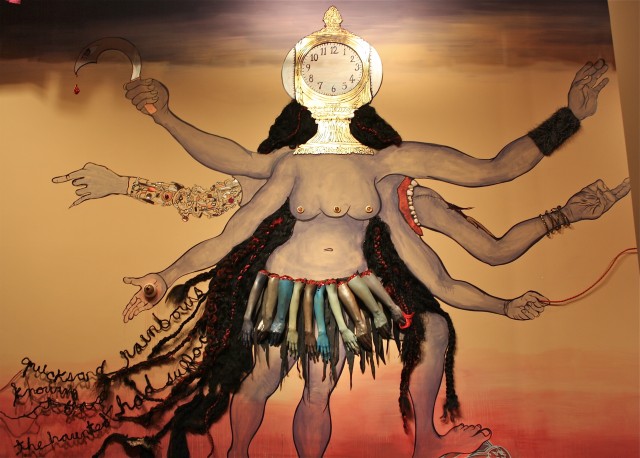
Chitra Ganesh, “Eyes of Time,” detail, mixed-media wall mural, 2015 (photo by twi-ny/mdr)
Brooklyn Museum
Elizabeth A. Sackler Center for Feminist Art, Herstory Gallery, fourth floor
200 Eastern Parkway at Washington St.
Thursday, March 26, free with museum admission, 6:00-9:30
Exhibition continues through July 12
212-864-5400 www.brooklynmuseum.org www.chitraganesh.com eyes of time online slideshow
In her exceptional new site-specific installation, “Eyes of Time,” in the Brooklyn Museum’s Herstory Gallery, multimedia artist Chitra Ganesh investigates female divinity, multiplicity, and power, inspired by the goddess Kali, one of the women honored with a place setting in Judy Chicago’s seminal work “The Dinner Party,” the centerpiece of the museum’s Elizabeth A. Sackler Center for Feminist Art, home to the Herstory Gallery. Ganesh, a lifelong Brooklynite, supplements her wall sculpture with selections from the museum’s collection, comprising contemporary works by Kiki Smith, Shoichi Ida, and Barbara Jones-Hogu as well as a small seventeenth-century Indian bronze of a standing Kali and an ancient Egyptian bronze of a seated Sekhmet. “In mythic tales both Sekhmet and Kali are connected to blood, death, destruction, and protection, and to fierce animals such as lions and tigers,” Ganesh writes in a wall label. “These qualities contrast with characteristics typically idealized in women today and point to the formidable roles played by the ancient goddesses.” About Louise Bourgeois’s 1996 drypoint, “Eyes,” Ganesh adds, “The third eye, as seen on Kali, has often been associated with supernatural powers in Indian mythology and continues to appear in contemporary imagery. The act of gazing into numerous eyes might also recall the practice of darshan, a dialectical and spiritual way of looking that considers the object as both image and living being, providing an experience of seeing that informs South Asian culture.”
Those explanations also offer just the right way to approach “Eyes of Time,” a sprawling mural of three women that covers one wall of the gallery. At the left is a contemporary figure holding a jagged, starlike piece of the universe over one eye while the other eye looks directly at the viewer. In the middle is a figure based on Kali, the goddess of time, change, and destruction, who has six arms, three legs, three breasts, and a skirt of severed arms of different colors. Words emerge from her long hair, including “quicksand,” “rainbows,” and “knowing.” One hand has an eyeball in its palm, one holds a whip, while another wields a blood-dripping scythe with an eye on it. Instead of a head, on her neck is the Grand Central clock, without its hands. And on the right is a science-fiction woman made out of such machine parts as gears and speakers laid out in a kind of architectural rendering. All three women, representing the past, the present, and the future, have shiny jewels embedded into their being, while two rows of decorated flags hang above them. In some ways, it’s like the three figures have escaped from Ganesh’s comic book Tales of Amnesia, which is also on view, giving three-dimensional life to these superhero characters. “These narrative devices allude to the power of multiple forms of femininity that coexist within the same frame and, at times, within a single being, as well as to darker aspects of Kali,” Ganesh writes about her 2002 book. On March 26, the Brooklyn Museum’s next edition of “Art Off the Wall” will celebrate “Eyes of Time” with an evening of special activities, consisting of an artist and curator talk with Ganesh and Saisha Grayson, a zine library inspired by Tales of Amnesia, screenings of three of Ganesh’s short films (Rabbithole; What Remains; My dreams, my works must wait till after hell…), a movement workshop with Ajna Dance Company, and a Bhangra dance party with DJ Rekha.
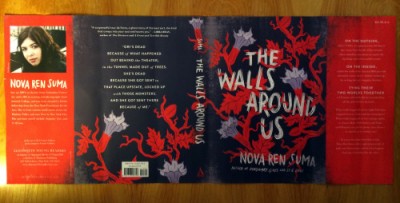
THE WALLS AROUND US (Algonquin Young Readers, March 24, $17.95)
McNally Jackson
52 Prince St. between Lafayette & Mulberry Sts.
Monday, March 23, free, 7:00
212-274-1160 mcnallyjackson.com novaren.com
“We went wild that hot night. We howled, we raged, we screamed. We were girls — some of us fourteen and fifteen; some sixteen, seventeen — but when the locks came undone, the doors of our cells gaping open and no one to shove us back in, we made the noise of savage animals, of men.” So begins Nova Ren Suma’s third YA novel, the ghost story The Walls Around Us. Her follow-up to Imaginary Girls and 17 & Gone, Suma’s latest book is told from the point of view of a convicted killer and a ballerina (Suma herself danced from the age of six to sixteen) and includes quotes from Shirley Jackson’s The Haunting of Hill House, Alice Sebold’s The Lovely Bones, and Margaret Atwood’s The Handmaid’s Tale to help set the mood. Suma, who we once had the extreme pleasure of working with in the children’s books business, is a master of her craft, creating warm, believable characters, writing sharp, realistic dialogue, and bringing intriguing situations to life with atmospheric dexterity. A very active member of the YA community, Suma took a big leap of faith with The Walls Around Us, letting her ideas run wild and trusting her instincts instead of worrying what her editor, agent, reviewers — and she herself — expected.
The result is a novel that was named the #1 Indie Next pick for Spring ’15, is an Amazon Best Book of the Month, and has garnered numerous starred reviews. Suma, who gave her first official public YA reading at twi-ny’s tenth anniversary celebration in 2011, will be at McNally Jackson in SoHo on March 23, launching The Walls Around Us with her friend and colleague, Michael L. Printz Award winner Libba Bray (The Diviners, Going Bovine). There will be a short reading, a conversation between the two literary stalwarts, a Q&A with the audience, and a signing. In addition, Suma will be giving away lots of Walls tattoos. And don’t worry; Suma isn’t really like one of her narrators, Violet, who explains early in the book, “I slip behind the curtain — it’s almost time, get the spotlight ready, soon I’ll be on. This’ll be my last dance before I leave town. My last chance to make them remember me, and remember me they will. When I’m onstage, I’m all for them, and they’re all for me. I feed off what they give me, and they bask in what I give them. When I’m offstage, these people are nothing to me. I’ve got some level of hate for practically almost everyone I run into on any given day. But in the midst of dancing? When they’re watching me and I’m letting them watch? I’ve got so much love, I’m like a whole different person.” Suma, who teaches writing workshops around the country, will also be participating in the “Exploring Feminist YA” panel on March 21 at 1:10 at the NYPL on Forty-Second St. with keynote speaker Bray, Gayle Forman, Scott Westerfeld, and moderator David Levithan for the 2015 NYC Teen Author Festival.
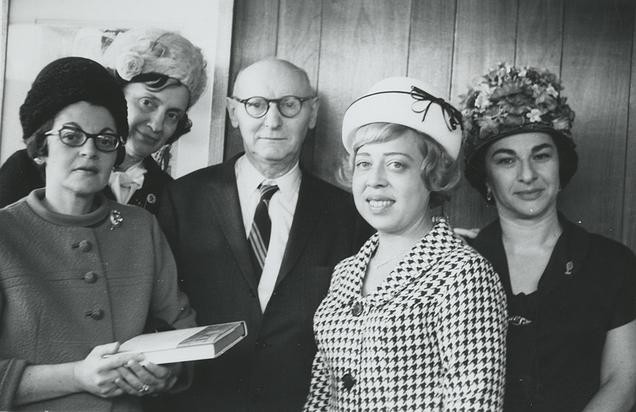
Who ever thought that little old Yiddish mensch Isaac Bashevis Singer was such a horndog? Asaf Galay and Shaul Betser begin The Muses of Bashevis Singer, their light and playful documentary, with the following quote from the Nobel Prize-winning author: “In my younger days I used to dream about a harem full of women. Lately I’m dreaming of a harem full of translators. If those translators could be women in addition, this would be paradise on earth.” Well, it seems that Singer, who was born in Poland in 1902, emigrated to the United States in 1935, and died in Florida in 1991 at the age of eighty-eight, found that paradise, as Galay and Betser meet with a series of women who were among many hand-picked by Singer, the man who nearly singlehandedly preserved Yiddish literature in the twentieth century, to serve as his translators, and not necessarily because of their language skills. “There were certain women who were more than just translators to him. It happened quite often,” says his Swedish publisher, Dorothea Bromberg, who also talks about Alma, Singer’s wife of more than fifty years. “He loved her, I’m sure, in his own way,” she adds. “She was very jealous of him, and she was completely right.” Galay and Betser meet with translators Eve Fridman, Evelyn Torton Beck, Dvorah Telushkin, Marie-Pierre Bay, Duba Leibell, and Dr. Bilha Rubenstein as well as Singer biographers Florence Noiville and Janet Hadda, his granddaughters Hazel Karr and Merav Chen-Zamir, Yentl the Yeshiva Boy playwright Leah Napolin, and his longtime secretary and proofreader, Doba Gerber, who share intimate, surprising tales about the author of such books as The Family Moskat, The Magician of Lublin, Shosha, and Enemies, a Love Story and such short stories as “Gimpel the Fool,” “A Friend of Kafka,” and “Zlateh the Goat.”
The seventy-two-minute film, lifted by a bouncy, airy soundtrack by Jonathan Bar-Giora, also includes footage of Singer making speeches, appearing on interview programs, going to a Jewish deli, walking on the Coney Island boardwalk, and writing with pen on paper and on a typewriter with Yiddish characters. But as the title implies, The Muses of Bashevis Singer doesn’t depict him as a callow cad but as a determined writer — and father and husband — who just loved women, loved being surrounded by women, using them as inspiration for his marvelous stories that mixed fiction with reality. “Isaac was a very frisky old man,” says Leibell, who worked with Singer in his later years after he moved to Florida with Alma. “That’s to put it very mildly.” The Muses of Bashevis Singer concludes the IFC Center’s winter Stranger than Fiction series on March 24 and will be followed by a Q&A with the director.
Who: Drama critic and author Alisa Solomon What: Theatre for a New Audience’s Open Books Series 2015 Where:Polonsky Shakespeare Center, 262 Ashland Pl. between Fulton St. & Lafayette Ave., 212-229-2819 When: Monday, March 23, free with advance RSVP, 7:00 Why: Theatre for a New Audience’s Open Books series continues with Alisa Solomon presenting her book Wonder of Wonders: A Cultural History of Fiddler on the Roof (Picador, September 2014), an engaging analysis of one of Broadway’s most popular musicals ever, which was adapted into an Oscar-nominated film. “As the first work of American popular culture to recall life in a shtetl — the Eastern European market towns with large Jewish populations — Fiddler felt tender, elegiac, even holy,” Solomon writes in the introduction. “It arrived just ahead of (and helped to instigate) the American roots movement. It was added to multicultural curricula and studied by students across the country in Jewish history units, as if Fiddler were an artifact unearthed from a destroyed world rather than a big-story musical assembled by showbiz professionals.” The free evening will include a conversation between Solomon and moderator Jonathan Kalb, an audience Q&A, a book signing, complimentary food and drink, and a meet-and-greet with Solomon.
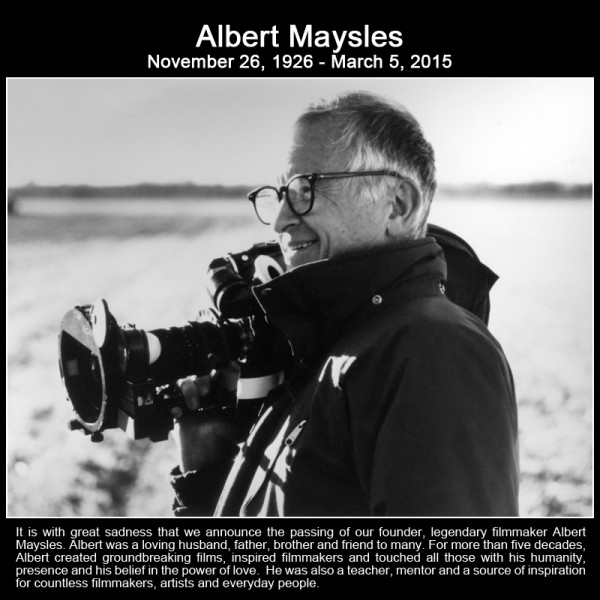
The life and career of Albert Maysles will be celebrated on March 22 at the Maysles Documentary Center
Maysles Documentary Center
343 Lenox Ave./Malcolm X Blvd. between 127th & 128th Sts.
Sunday, March 22, free with advance registration, 11:00 am – 11:00 pm maysles.org
In the 1960s and ’70s, Albert Maysles, his brother, David, and Charlotte Zwerin changed the face of documentary filmmaking and cinéma vérité with such genre-redefining works as What’s Happening! The Beatles in the USA, Salesman, Gimme Shelter, and Grey Gardens, breaking down the fourth wall as they photographed their subjects. “As a documentarian I happily place my fate and faith in reality,” Albert explained. “It is my caretaker, the provider of subjects, themes, experiences — all endowed with the power of truth and the romance of discovery. And the closer I adhere to reality the more honest and authentic my tales. After all, knowledge of the real world is exactly what we need to better understand and therefore possibly to love one another. It’s my way of making the world a better place.” David passed away in January 1987 at the age of fifty-five, Zwerin died in 2004 at seventy-two, and now Albert has left us, saying farewell on March 5 at the age of eighty-eight, having helped make the world a better place. Of course, his legacy lives on, in the works of so many other documentarians, from Errol Morris to Andrew Jarecki, as well as with the film center that bears his name, the Maysles Documentary Center in Harlem. On Sunday, March 22, the MDC will host an all-day tribute to its legendary founder with an open house, screenings, and special introductions; admission is free with advance registration. The celebration begins at 11:00 with the 1965 short Meet Marlon Brando, 1964’s What’s Happening! The Beatles in the USA, and a reception. Other programs include With Love from Truman and Salesman at 2:00, Ozawa and Muhammad and Larry at 5:00, and Running Fence,Cut Piece,Salvador Dali’s Fantastic Dream, and excerpts from Muhammad and Larry and Iris at 8:00. “Remember, as a documentarian you are an observer, an author but not a director, a discoverer, not a controller,” Maysles said in describing his craft. “Don’t worry that your presence with the camera will change things. Not if you’re confident you belong there and understand that in your favor is that of the two instincts, to disclose or to keep a secret, the stronger is to disclose.” He changed things indeed.



 Who ever thought that little old Yiddish mensch Isaac Bashevis Singer was such a horndog? Asaf Galay and Shaul Betser begin The Muses of Bashevis Singer, their light and playful documentary, with the following quote from the Nobel Prize-winning author: “In my younger days I used to dream about a harem full of women. Lately I’m dreaming of a harem full of translators. If those translators could be women in addition, this would be paradise on earth.” Well, it seems that Singer, who was born in Poland in 1902, emigrated to the United States in 1935, and died in Florida in 1991 at the age of eighty-eight, found that paradise, as Galay and Betser meet with a series of women who were among many hand-picked by Singer, the man who nearly singlehandedly preserved Yiddish literature in the twentieth century, to serve as his translators, and not necessarily because of their language skills. “There were certain women who were more than just translators to him. It happened quite often,” says his Swedish publisher, Dorothea Bromberg, who also talks about Alma, Singer’s wife of more than fifty years. “He loved her, I’m sure, in his own way,” she adds. “She was very jealous of him, and she was completely right.” Galay and Betser meet with translators Eve Fridman, Evelyn Torton Beck, Dvorah Telushkin, Marie-Pierre Bay, Duba Leibell, and Dr. Bilha Rubenstein as well as Singer biographers Florence Noiville and Janet Hadda, his granddaughters Hazel Karr and Merav Chen-Zamir, Yentl the Yeshiva Boy playwright Leah Napolin, and his longtime secretary and proofreader, Doba Gerber, who share intimate, surprising tales about the author of such books as The Family Moskat, The Magician of Lublin, Shosha, and Enemies, a Love Story and such short stories as “Gimpel the Fool,” “A Friend of Kafka,” and “Zlateh the Goat.”