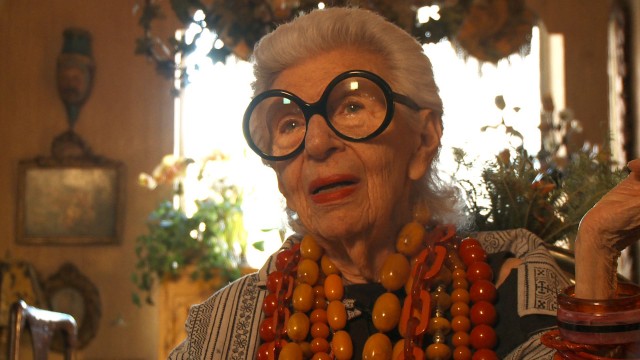
Iris Apfel shows off her unique and influential fashion sense in Albert Maysles documentary (photo courtesy Magnolia Pictures)
IRIS (Albert Maysles, 2014)
Film Forum, 209 West Houston St., 212-727-8110
Lincoln Plaza Cinema, 1886 Broadway between 62nd & 63rd Sts., 212-757-2280
Opens Wednesday, April 29
www.magpictures.com
mayslesfilms.com
 “I like individuality,” self-described “geriatric starlet” and nonagenarian fashion doyenne Iris Apfel says at the beginning of octogenarian Albert Maysles’s penultimate film, Iris. “It’s so lost these days. There’s so much sameness. Everything is homogenized. I hate it. Whatever.” Iris celebrates that individuality, not only Apfel’s, who at ninety-three is still active in the fashion world, but Maysles’s, who passed away in March at the age of eighty-eight, leaving behind a legendary legacy that changed the face of documentary cinema, including such classics as Salesman, Grey Gardens, and Gimme Shelter. Throughout the film, Apfel speaks directly to Maysles, who ends up on camera several times, breaking that once-impenetrable fourth wall that he, his brother, David, and their partner, Charlotte Zwerin, helped tear down years ago. Maysles spent four years filming the Queens-born Apfel as she shared her lovely story, growing from an interior designer and textile-business owner to a world-renowned fashion collector, tastemaker, and rule breaker, accompanied all along the way by her husband of more than sixty-six years, Carl. Maysles shows Iris, in her trademark enormous circular-framed glasses and unique, colorful ensembles that mix designer clothing with a healthy dose of inexpensive accessories, as she bargains at a cheap local store, advises women at a special Loehmann’s event, prepares for her 2005 show at the Metropolitan Museum of Art’s Costume Institute, hawks her jewelry line on the Home Shopping Network, works on a window display at Bergdorf Goodman, and talks fashion with Martha Stewart, Tavi Gevinson, and others. Maysles interviews such designers as Alexis Bittar, Duro Olowu, Naeem Khan, and Dries van Noten, Met curator Harold Koda, Architectural Digest editor in chief Margaret Russell, and J. Crew head Jenna Lyons, who have only the most kind and generous things to say about the always positive Apfel, who has a genuine love of life. “It’s better to be happy than well dressed,” she tells friend and photographer Bruce Weber.
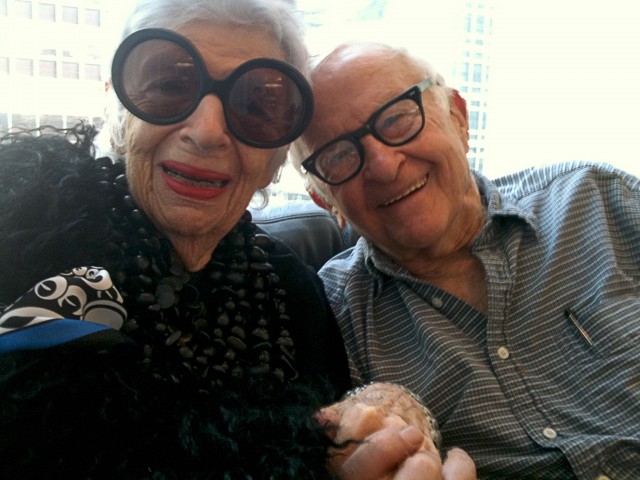
Nonagenarian Iris Apfel and octogenarian Albert Maysles display a love of life in IRIS (photo courtesy of Magnolia Pictures)
Maysles also explores the Apfels’ inspiring relationship, filled with humor, a love of collecting knickknacks and tchotchkes (strewn about their cluttered apartment), and an infectious yen for trying anything and everything that life has to offer. The film concludes with Carl’s one-hundredth birthday party. Early on, Iris tells a story about one of her first jobs, toiling for Frieda Loehmann in Brooklyn. “One day she called me over and she said, ‘Young lady, I’ve been watching you.’ She said, ‘You’re not pretty, and you’ll never be pretty, but it doesn’t matter. You have something much better. You have style.’” Iris indeed has style, as this wonderful documentary extols, a marvelous tribute both to her and Carl as well as Albert Maysles. Who needs pretty when something this beautiful is what emerges? Iris opens April 29 at Lincoln Plaza and Film Forum, where it will be preceded by Vivian Ostrovsky’s fashion short, Losing the Thread. Producers Laura Coxson and Rebekah Maysles, one of Albert’s children, will be at Film Forum for the 6:20 show on April 29, while Iris herself will participate in a Q&A following the 6:20 screening on May 1 and will then introduce the 8:20 show.