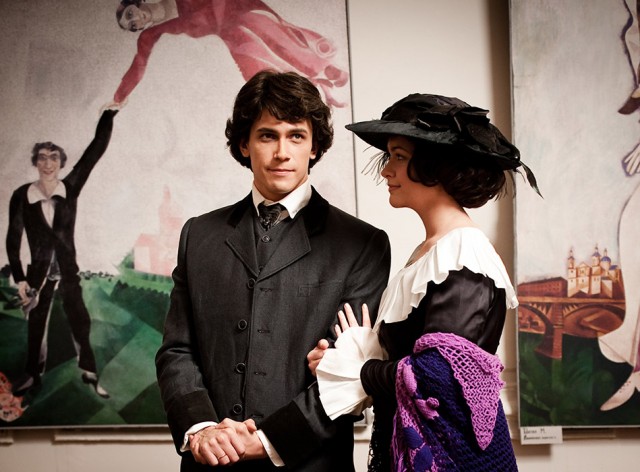
Marc Chagall (Leonid Bichevin), and Bella Rosenfeld (Kristina Schneidermann) open an art academy in Vitebsk during the Russian Revolution in CHAGALL-MALEVICH
CHAGALL-MALEVICH (Alexander Mitta, 2013)
Cinema Village
22 East 12th St. between University Pl. & Fifth Ave.
Opens Friday, June 12
212-924-3363
chagall-malevich.com
www.cinemavillage.com
 For his first film in a dozen years, Russian writer-director Alexander Mitta tells the intriguing story of the little-known relationship between early modernist painter Marc Zakharovich Chagall and avant-garde Suprematist Kazimir Malevich. In 1917, Chagall (Leonid Bichevin), already a success in Paris, returns to his home in Vitebsk to marry his sweetheart, Bella Rosenfeld (Kristina Schneidermann), who is being wooed by their childhood friend, Naum (Semyon Shkalikov). Chagall initially wants to return to Paris with Bella and continue his burgeoning career, but with the onset of the Russian Revolution he decides that he will use the power of art to provide much-needed culture and creativity for the community, opening the Academy of Modern Art. Trouble ensues when he hires Malevich (Anatoliy Belyy) to teach there, as Malevich brings his own very different ideas about art and politics. Meanwhile, Naum, who is still in love with Bella, has become the Red Commissar, ruling Vitebsk with fear and violence. Made with the support of Chagall’s granddaughter, Meret Meyer Graber, a vice president of the Marc Chagall Committee, and inspired by his memoirs, Chagall-Malevich is a highly stylized, fanciful film, evoking the work of Wes Anderson (Rushmore, The Grand Budapest Hotel) and Michel Gondry (Eternal Sunshine of the Spotless Mind, The Science of Sleep); cinematographer Sergei Machilsky shot the movie in colors based on the paintings of Chagall and Malevich, set at sharp angles that can be both cool and disorienting. But Mitta’s (Lost in Siberia, My Friend, Kolka!) screenplay is far too sentimental and idealistic in its celebration of the brush over the gun. Chagall-Malevich might be beautiful to look at — Malevich’s bold geometric shapes are a wonderful foil for Chagall’s dreamscapes, and some of the more fantastical elements are rather funny — but the central plot is overly whimsical and often just plain silly, its palette lacking in subtlety and gradation. Chagall-Malevich opens June 12 at Cinema Village, with Schneidermann participating in a Q&A following the 7:30 show on Friday night.
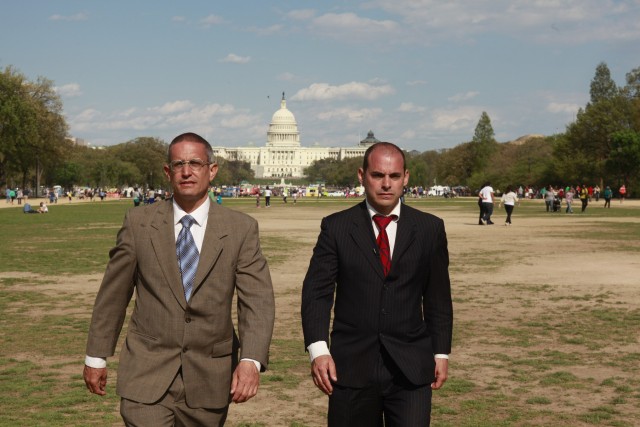
 Since 1999, culture-jamming pranksters Mike Bonanno (Igor Vamos) and Andy Bichlbaum (Jacques Servin) have been staging events to call attention to economic and environmental abuses perpetrated by big business and international governments, including Dow Chemical, the World Trade Organization, ExxonMobil, and BP. In their latest film, The Yes Men Are Revolting, the follow-up to 2003’s The Yes Men and 2009’s
 The never-ending battle between Israel and the Palestinians is reduced to a single incident attempting to be a microcosm of the conflict in the relatively silly and uneven documentary The Wanted 18. In 1988, shortly after the first Intifada began, an Israeli kibbutz sold eighteen cows to the Palestinian town of Beit Sahour. As the small, tight-knit community rallied around the cows, seeing them as a crucial part to their goal of freedom and independence, the Israelis grew suspicious of the Palestinians’ growing self-sufficiency and declared the cows “a threat to the national security of the state of Israel.” Codirectors Amer Shomali, whose family came from Beit Sahour, and Canadian Paul Cowan (Going the Distance, Westray) tell the story of the fight over the cows through contemporary interviews, drawings, reenactments, archival footage, and stop-motion animation in which four of the cows share their thoughts on the matter: Rivka (voiced by Holly Uloth “O’Brien”), Ruth (Heidi Foss), Lola (casting director Rosann Nerenberg), and Goldie (Alison Darcy). The heavily one-sided tale delves into such issues as taxation, bigotry, boycotts, curfews, and civil disobedience, as people from Beit Sahour give first-person accounts of what happened, along with Ehud Zrahiya, who at the time was advisor to the Israeli military governor on Arab affairs. “We were concerned that Beit Sahour may become a model for other places,” Zrahiya admits. “We were certainly concerned that this might infect other places and would spread to other localities throughout the West Bank.”