this week in lectures, signings, panel discussions, workshops, and Q&As

NEW MUSIC SEMINAR: DAY THREE

Summer Heart will be at DROM for the New Music Seminar

Summer Heart will be at Pianos for the New Music Seminar

Wyndham New Yorker Hotel and downtown music venues
481 Eighth Ave. between 34th & 35th Sts.
Through June 23, registration $499, individual concerts free – $12
www.newyorkerhotel.com
newmusicseminar.com

The New Music Seminar continues to offer industry panels and education programs through Tuesday — more than fifteen on Tuesday alone, including a morning A&R critique session and panels with COOs and CFOs from Warner, SiriusXM, Def Jam, and more talking about subscription music and new international markets — at the Wyndham New Yorker Hotel, but at night it’s time to hear the music. Four staple venues of the LES offer four different slates tonight, showcasing Artists on the Verge. On a steaming hot night one could do worse than drift into the cool, Swedish pop of Summer Heart at Pianos (hear their latest EP here) or dive into the heat and pump up New York’s own urban energy with DJ SANiTY from Queens at DROM.

Music Xray’s Live A&R Listening and Critique Sound Sessions, conducted by Mike McCready, with label managers and A&R scouts, Crystal Ballroom, 10:15 am

Label Heads: The Music, the Media, the Money, conducted by Ralph Simon, with Tom Corson, Avery Lipman, Craig Kallman, Steve Bartels, Dave Hansen, and Emmanuel de Buretel, Grand Ballroom, 12:30

The Developing World: Music Explosion, with Ralph Simon, Michael Abbattista, Julien Simon, Prashant Bahadur, Paramdeep Singh, Ed Peto, Ademola Ogundele, and Emmanuel Zuna, Sutton Place, 2:45

Frances Rose, Summer Heart, Chaos Chaos, Ayer, and HIGHS, Pianos, 158 Ludlow St., $8, 7:00

Frances Cone, ONWE, End of an Era, Phosphene, and Paper Fleet, Cake Shop, 152 Ludlow St., $8, 8:15

Janita, the Collection, City of the Sun, DJ SANiTY, and AOV Class of 2015 winner, DROM, 85 Ave. A., free, 8:15

Beecher’s Fault, Lilly Wolf, Fort Lean, and Dinner and a Suit, the Delancey, $8, 8:15

NEW MUSIC SEMINAR 2015

new music seminar

Wyndham New Yorker Hotel and downtown music venues
481 Eighth Ave. between 34th & 35th Sts.
June 21-23, registration $499, individual concerts free – $12
www.newyorkerhotel.com
newmusicseminar.com

The New Music Seminar takes place in Manhattan June 21-23, with three days of panel discussions, master classes, sound sessions, and special speakers that are geared to music makers and business insiders. “Everything we do at New Music Seminar is about belief in building the music business, belief in change, and belief in long-term success for artists and businesses alike,” the seminar manifesto explains. “We provide a platform for discourse by the voices who disrupt the conventional, tackle key issues, and give a stage for emerging artists to shine.” Each night features live shows at four downtown clubs that give the opportunity for emerging artists to shine, open to everyone, with either free admission or tickets costing no more than twelve bucks. Below are some of the highlights.

Sunday, June 21
NMS Opening Night Party, with Grace Weber, Fictionist, and Belmont Lights, the Studio at Webster Hall, $12, 6:30

NMS Opening Night Party, with Melanie Martinez, Jay Stolar, Bad Veins, and Alessia Cara, the Marlin Room at Webster Hall, 6:30

Monday, June 22
Music Xray’s Live A&R Listening and Critique Sound Sessions, conducted by Mike McCready, with label managers and A&R scouts, Crystal Ballroom, 10:15 am

Songwriter’s Movement, conducted by Peter Asher, with Denis Leary, Jenna Andrews, Alex Bilowitz, James Adam Shelley, Jonnie Davis, Adam Palin, Holly Knight, and Sean Douglas, Grand Ballroom, 12:30

Women in Music Open Forum, with Diana Akin, Neeta Ragoowansi, and Ariel Hyatt, Gramercy Park Suite, 4:00

New Music Nights, with Little Racer, Lewis Lane, Dear Rouge, Twiceyoung, and Tribe Society, Pianos, 158 Ludlow St., $8, 7:00

New Music Nights, with Julia Weldon, the Como Brothers, Dolly Spartans, SYKA, and Valerie Orth, Cake Shop, 152 Ludlow St., $8, 8:15

New Music Nights, with SPZRKT, Bizzy Crook, Ace Cosgrove, and Shirley House, DROM, 85 Ave. A., free, 8:15

New Music Nights, with Nalani and Sarina, Lovebettie, Animal Years, and AJ Smith, the Delancey, $8, 8:15

Tuesday, June 23
Music Xray’s Live A&R Listening and Critique Sound Sessions, conducted by Mike McCready, with label managers and A&R scouts, Crystal Ballroom, 10:15 am

Label Heads: The Music, the Media, the Money, conducted by Ralph Simon, with Tom Corson, Avery Lipman, Craig Kallman, Steve Bartels, Dave Hansen, and Emmanuel de Buretel, Grand Ballroom, 12:30

The Developing World: Music Explosion, with Ralph Simon, Michael Abbattista, Julien Simon, Prashant Bahadur, Paramdeep Singh, Ed Peto, Ademola Ogundele, and Emmanuel Zuna, Sutton Place, 2:45

New Music Nights, with Frances Rose, Summer Heart, Chaos Chaos, Ayer, and HIGHS, Pianos, 158 Ludlow St., $8, 7:00

New Music Nights, with Frances Cone, ONWE, End of an Era, Phosphene, and Paper Fleet, Cake Shop, 152 Ludlow St., $8, 8:15

New Music Nights, with Janita, the Collection, City of the Sun, DJ SANiTY, and AOV Class of 2015 winner, DROM, 85 Ave. A., free, 8:15

New Music Nights, with Beecher’s Fault, Lilly Wolf, Fort Lean, and Dinner and a Suit, the Delancey, $8, 8:15
ANYWHERE IN TIME: A CONLON NANCARROW FESTIVAL

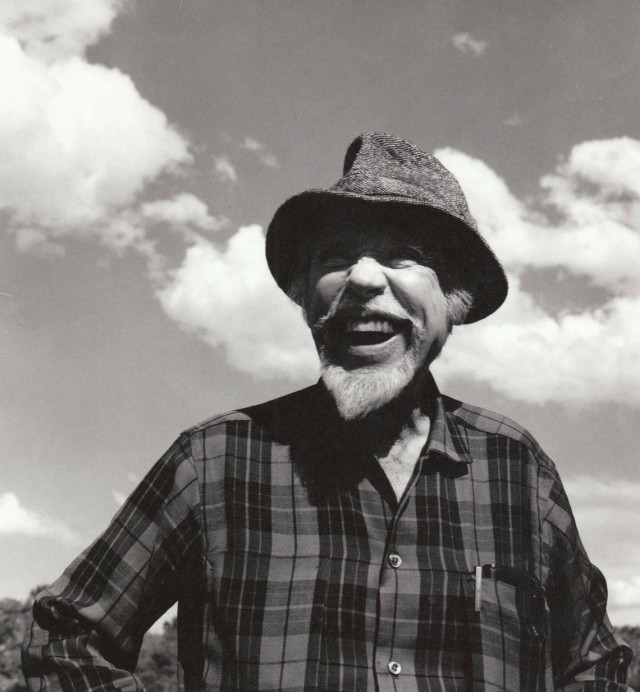
(photo courtesy Charles Amirkhanian)

The life and career of one-of-a-kind composer Conlon Nancarrow will be celebrated at twelve-day fest at the new Whitney (photo courtesy Charles Amirkhanian)

Whitney Museum of American Art
Susan and John Hess Family Theater, third floor
99 Gansevoort St.
June 17-28, $22 (includes admission to galleries)
212-570-3600
whitney.org

In a 1981 letter to Charles Amirkhanian, György Ligeti wrote, “This music is the greatest discovery since Webern and Ives . . . something great and important for all music history! His music is so utterly original, enjoyable, perfectly constructed but at the same time emotional . . . for me it’s the best of any composer living today.” Ligeti was referring to the little-known Conlon Nancarrow, an American-born composer who had become a Mexican citizen and had done extraordinary work with the player piano. The recipient of a MacArthur genius grant, Nancarrow, who passed away in 1997 at the age of eighty-four, will be celebrated at the new Whitney Museum of American Art with “Anywhere in Time: A Conlon Nancarrow Festival,” twelve days of special live performances, talks, and films paying tribute to Nancarrow’s influential career. Among those taking the stage in the Susan and John Hess Family Theater will be Steve Coleman and Five Elements, dancers from the Merce Cunningham Trust Fellowship Program performing Crises (1960) (reconstructed and staged by Jennifer Goggans), percussionist Chris Froh, Alarm Will Sound, and Henry Kaiser and Lukas Ligeti with Charles Amirkhanian. Cocurated by Dominic Murcott and Jay Sanders, “Anywhere in Time” also features screenings of James Greeson’s 2012 documentary Conlon Nancarrow: Virtuoso of the Player Piano, the panel discussion “Nancarrow Deconstructed” with Froh and Murcott, and a 1921 Marshall and Wendell Ampico upright player piano on view on the veranda with Nancarrow’s “Study #36” piano roll, which will occasionally play. “Conlon Nancarrow had perhaps the most single-minded career of any great American composer, devoting his life to exploring the rhythmic possibilities of juxtaposing multiple simultaneous tempos,” notes Alarm Will Sound conductor and artistic director Alan Pierson. “The combination of Nancarrow’s catchy materials and the complex way he deals with them puts his work in a sweet spot of immediacy and complexity occupied by much of the music we love. And the challenge of performing music not meant to be played by human beings is a stimulating one.” The festival comes to a close on June 28 with the eight-hour “Complete Studies for Player Piano: A Marathon Concert Event,” presented in numerical order from 11:00 am to 7:00 pm and including appearances by Nancarrow’s wife, Yoko, and their son, Mako. Most of the events require ticketing, and it’s best if you get them in advance; the cost is the same as museum admission, and the ticket gets you into all the galleries.

JEAN-CLAUDE CARRIERE — WRITING THE IMPOSSIBLE: EVERY MAN FOR HIMSELF

EVERY MAN FOR HIMSELF

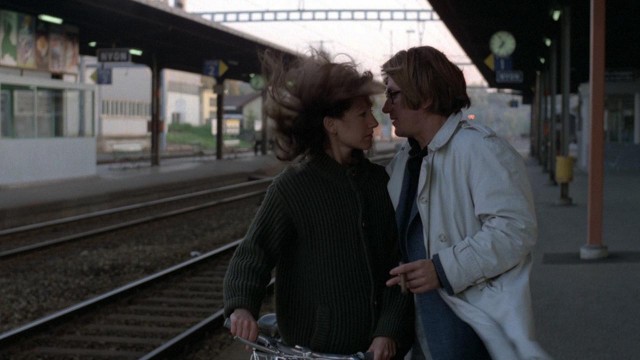
Denise Rimbaud (Nathalie Baye) and Paul Godard (Jacques Dutronc) nearly get swept away in Jean-Luc Godard’s born-again film, EVERY MAN FOR HIMSELF

CinéSalon: EVERY MAN FOR HIMSELF (SAUVE QUI PEUT [LA VIE]) (Jean-Luc Godard, 1980)
French Institute Alliance Française, Florence Gould Hall
55 East 59th St. between Madison & Park Aves.
Tuesday, June 16, $13, 4:00 & 7:30
Series continues Tuesdays through July 28
212-355-6100
fiaf.org

In 1980, Jean-Luc Godard told journalist Jonathan Cott, “When you have a first love, a first experience, a first movie, once you’ve done it, you can’t repeat it,” the French auteur said about his latest film, Every Man for Himself, which he considered his “second first” film. “If it’s bad, it’s a repetition; if it’s good, it’s a spiral. It’s like when you return home — to mountains and lakes, in my case — you have a feeling of childhood, of beginning again. But in films, it’s very seldom that you have the opportunity to make your first film for the second time.” For Godard, whose real first film was 1960’s Breathless and who went on to make such other avant-garde masterworks as Contempt, Pierrot le Fou, Masculine Feminine, and Two or Three Things I Know About Her, Every Man for Himself might have been somewhat of a return to narrative, but only as Godard can do it. He still plays with form and various technological aspects, including a fascination with slow motion and an unusual, often very funny use of incidental music, and his manner of episodic storytelling would not exactly be called traditional. Sometimes it’s good, and sometimes it’s bad. Jacques Dutronc stars as mean-spirited, self-obsessed Swiss television director Paul Godard, who has recently broken up with his girlfriend, Denise Rimbaud (Nathalie Baye), who wants to leave their apartment in the city for the idyllic greenery of the country. (Yes, the characters have such names as Godard and Rimbaud, and the voice of Marguerite Duras shows up.) Paul then meets a prostitute, Isabelle Rivière (Isabelle Huppert), who is interested in Paul and Denise’s apartment, planning on bettering her life even as she still must submit to the whims of her clients, including a businessman who orchestrates a strange orgy that would make Secretary’s James Spader proud.

The film is divided into four main sections, “The Imaginary,” “Fear,” “Commerce,” and “Music,” as the protagonists’ paths cross both thematically and, ultimately, physically. Among the motifs Godard explores are violence against women, incest, freedom, and choice, in addition, of course, to the art and craft of filmmaking itself. Along the way he pokes fun at commercialism, with numerous references to Marlboro (including a man who drives up to a gas station convenience store in a Formula One racecar sponsored by the cigarette brand) and Coca-Cola. Men don’t fare very well either; interestingly, while the U.S. title is Every Man for Himself, the film was released as Slow Motion in England, and the original French title, Sauve Qui Peut (La Vie), can be translated to colloquially mean “Run for your life!,” and that’s what you’d most likely do if you ever met any of these male characters in real life. (Godard has said that Save Your Ass would be a better translation.) Godard, who is credited with “composing” the film as opposed to directing it and wrote the screenplay with Anne-Marie Miéville and Jean-Claude Carrière, also makes frequent mention of anal sex and assholes, both literally and figuratively. “You happy?” one of Isabelle’s johns says to his imaginary wife in a hotel room. “That’s what you wanted, right?” “No,” a woman’s voice responds. “I wanted something else.” In Every Man for Himself, each character wants something else as they search through their most inner desires. The film looks and sounds dated today, very much a product of its time; add half a star if you think Godard can do no wrong, and delete a full star if Godard makes you want to bang your head against the wall. Nominated for three César Awards, for Best Director, Best Film, and Best Supporting Actress, which Baye won, Every Man for Himself is screening June 16 in the French Institute Alliance Française’s CinéSalon series “Jean-Claude Carrière: Writing the Impossible.” (The 7:30 show will be introduced by a special guest, and both the 4:00 and 7:30 shows will be followed by a wine reception.) The two-month festival consists of a wide range of films written by two-time Oscar winner Carrière, who, at eighty-three, is still hard at work. The series continues through July 28 with such other Carrière collaborations as Volker Schlöndorff’s Swann in Love, Andrzej Wajda’s Danton, and Louis Malle’s May Fools.

NORTHSIDE FESTIVAL 2015: THE KITE APP

Kite introduces its app at Northside Innovation Conference and Expo party at the Counting Room (photo by twi-ny/ees)

Kite introduces its app at Northside Innovation Conference and Expo party at the Counting Room (photo by twi-ny/ees)

The Northside Festival is known for music, but its Innovation Conference and Expo is shaping up on a SXSW model. Thursday’s launch party for the Kite social news feed app was packed, and Kite founder Trond Werner Hansen was on hand to give twi-ny an interview and insight into what Kite is all about. An app for Mac devices (downloadable on the App Store), Kite lets users read and share articles from any website. They can also follow other users to see what sites they read and share so each person’s news feed is socially curated. Users can follow other users who share content they like, just as they do on Instagram, but they’ll see news articles rather than photos. Kite is also a browser that can go to any website, so users can build whatever kind of feed they like — it’s not limited by who’s signed on to Kite — or who’s paid to be there. On the hot summer street corner of Berry and North Eleventh, twi-ny asked Trond — a tall, amiable Norwegian who lives in Bushwick and is well known for his work developing browser software for Mozilla and others: “Why Kite?” He gave three reasons:

Screenshot of sites Trond follows via Kite — and you can too

Screenshot of sites Trond follows via Kite — and you can too

1) The Open Web. As a content platform, until now we have taken that for granted, but in the fall Apple is launching Apple News, and then you don’t have an open free platform anymore. Now they don’t have that control, but we don’t even want to go in that direction.

2) Convenience. You know people are starting to be pushed to individual apps — the CNN app, the New York Times app — and that’s just not the best way for the user. [News sites] should focus on making great content, not on making apps. Kite brings all sources into one container, but when you go to each of them, you go to their direct website, so they control their own thing, but they’re contained within one user experience, so that’s better for the user.

3) The social aspect. We’ve seen now that social curation of content works. I want to read what you read. So there’s two ways of curation: There’s the old-fashioned way — you go to CNN to see what kind of information they have curated for you, that works, and now we have the social curation that works, and Kite brings those two things together, kind of like the yin to the yang. And we also believe while Twitter, Facebook, LinkedIn, or these other social networks cater to sharing, they were not specifically made for content sharing. For example, on Kite I can go on your profile and see what kind of curation comes to you. You can’t do that on Facebook.

“I’ve learned through doing the web browser for so many years that algorithmic curation of things generally doesn’t work over scale over time,” Trond added. “Social curation works; brand curation works. But not algorithmic curation. I like food, so then I’m gonna get food articles. It’s unpredictable. . . . Engineers love to do algorithmic things, because that’s what they can do with their machines. ‘Look, you enter cheese, you can get a lot of articles about cheese!’ But it’s not really valuable or interesting. You can see on the Kite app, when you click another person, you can see his feed and his sites, what he reads. It’s useful, it’s predictable, it’s not algorithmic.”

We clicked on Trond’s feed and it’s fascinating. Try Kite and save some screen space — no need to clutter your iPhone with separate apps from CNN, WSJ, NYT, BBC, Guardian, Economist, etc. ThisWeekInNewYork is starting a Kite feed now, and curious readers can download the app for free on the App Store; during the festival, which continues through June 14 and has a terrific app of its own, you can use the invite code: northside.

HUMAN RIGHTS WATCH FILM FESTIVAL 2015: THE LOOK OF SILENCE

THE LOOK OF SILENCE

Joshua Oppenheimer’s THE LOOK OF SILENCE stares directly into the eyes of perpetrators of genocide in Indonesia

THE LOOK OF SILENCE (Joshua Oppenheimer, 2014)
IFC Center
323 Sixth Ave. at West Third St.
Saturday, June 13, $14, 9:15
Festival runs June 11-21 at multiple venues
ff.hrw.org/new-york
thelookofsilence.com

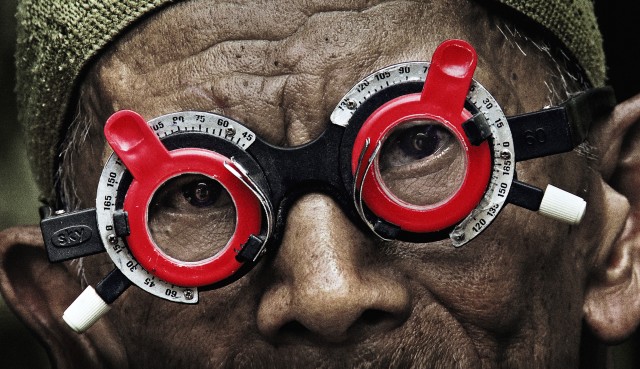
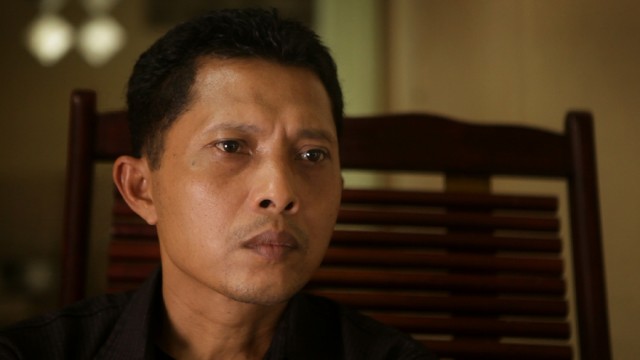
Joshua Oppenheimer’s The Look of Silence opens with an old man, wearing a pair of red optic trial lens frames, gazing into and around the camera for twelve uncomfortable seconds, in complete silence, showing no emotion. It is a striking metaphor for the rest of the film, a shocking documentary about the 1965–66 Indonesian genocide and a bold man determined to confront the men who brutally murdered his brother then, along with a million other supposed communists. In 2012, Oppenheimer made the Oscar-nominated The Act of Killing, in which the leaders of the genocide, who are still in power today, restaged their killings as if they were Hollywood movie scenes. Created as a companion piece to that documentary, The Look of Silence follows forty-four-year-old optometrist Adi as he learns the details of what happened to his brother, Ramli, who was butchered two years before Adi was born. Adi has decided to do what no one else in his country will: break his culture’s silence and denial and face the perpetrators to make them take responsibility for what they did. If they are willing to show remorse, he is willing to forgive. But he has set out on what appears to be an impossible mission; the men he meets with still run Indonesia, and they are more than comfortable threatening the well-being of Adi and his family. Meanwhile, Adi’s parents and patients don’t want to talk about what occurred back in 1965–66, or what is still going on today, as they live in fear of these same men. “No, nothing happened,” one woman says when asked about the killings in her town of Aceh. “You ask too many questions,” she adds. Kemat, a survivor of the Snake River massacres, says, “The past is the past. I’ve accepted it. I don’t want to remember. It’s just asking for trouble.” Adi learns horrifying details as he meets with village death squad leader Inong (the old man shown at the beginning of the film), Snake River death squad commander Amir Siahaan, and regional legislature speaker M. Y. Basrun, all of whom defend their actions, and their power and wealth, while more than hinting that Adi should end his quest. But Adi isn’t about to back down.
THE LOOK OF SILENCE

Adi faces a group of mass murders, including his brother’s killers, in powerful documentary

Adi is often shown in front of a television, mystified as Oppenheimer shows him footage taken for The Act of Killing; Adi stares ahead in disbelief and silence, much like we did when watching the final film, amazed at what we were seeing. It is a fascinating coincidence that Adi is an optometrist, going around his community fitting people for glasses, helping them see better, even if they don’t always want to look at certain things. He is appalled that his children’s school still teaches that the evil communists deserved to die; it’s particularly telling when his young daughter playfully puts on two pairs of glasses, as if perhaps the next generation will not look away — and to emphasize that, Oppenheimer cuts directly to Adi’s aging, decrepit father, Rukun (whom his wife, Adi’s mother, Rohani, claims is 140), his eyes closed, as he can barely see or hear anymore and needs to be taken care of like a baby. Adi has become a folk hero in Indonesia, where some regions have banned the film and screenings had to be canceled because of threats of violence from the police and military. But the film itself depicts Adi as an everyman; he could be any one of us, saying the things that need to be said. “Making any film about survivors of genocide is to walk into a minefield of clichés, most of which serve to create a heroic (if saintly) protagonist with whom we can identify, thereby offering the false reassurance that, in the moral catastrophe of atrocity, we are nothing like the perpetrators,” Oppenheimer (The Globalisation Tapes) writes in his extensive, must-read notes on the film’s official website. “But presenting survivors as saintly in order to reassure ourselves that we are good is to use survivors to deceive ourselves. It is an insult to survivors’ experience, and does nothing to help us understand what it means to survive atrocity, what it means to live a life shattered by mass violence, and to be silenced by terror. To navigate this minefield of clichés, we have had to explore silence itself.” In that way, to use a cliché, The Look of Silence speaks volumes. And although it’s specifically about the Indonesian genocide, it could just as easily be made about many other mass murders that have occurred, and are still going on, around the world.

Adi might be receiving long standing ovations at screenings where he appears, but it’s telling that the film’s closing credits include more than two dozen people listed as “Anonymous,” from the codirector and a coproducer to a camera operator and production managers. Clearly, fear still rules in Indonesia. An unforgettable film that needs to be widely seen, The Look of Silence, which was executive produced by Werner Herzog, Errol Morris, and André Singer, is screening June 13 at 9:15 at the IFC Center as part of the Human Rights Watch Film Festival and will be followed by a discussion with journalist Antonius Made Tony Supriatma and Human Rights Watch Asia division deputy director Phelim Kine. (The film will open theatrically in New York City on July 17 at the Landmark Sunshine.) The HRW festival runs through June 21 at IFC, the Film Society of Lincoln Center, and the Times Center, featuring such other socially, culturally, and politically sensitive and important works as Stanley Nelson’s The Black Panthers: Vanguard of the Revolution, Joey Boink’s Burden of Peace, François Verster’s The Dream of Shahrazad, and Tamara Erde’s This Is My Land.

BIG APPLE BARBECUE BLOCK PARTY 2015

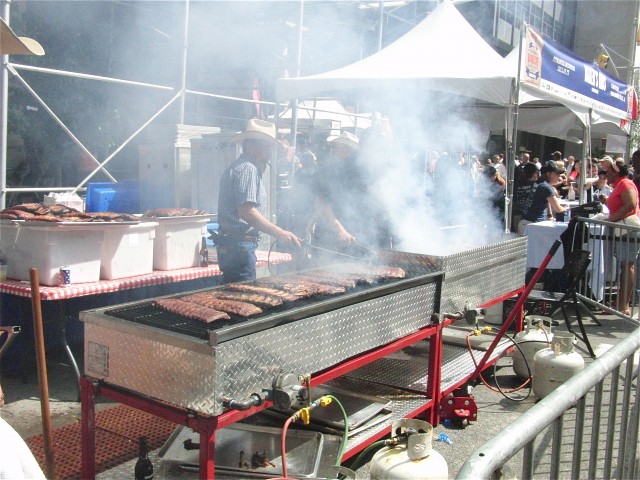
There’s plenty of smokin’ good ’cue at annual BBQ Block Party in Madison Square Park (photo by twi-ny/mdr)

There’s plenty of smokin’ good ’cue at annual BBQ block party in Madison Square Park (photo by twi-ny/mdr)

Madison Square Park
23rd to 26th Sts. between Fifth & Madison Aves.
Saturday, June 13, and Sunday, June 14, 11:00 am – 6:00 pm
Admission: free; $9-$12 per plate of barbecue
Fast Pass: $125; BigPiggin’ Pass: $265
www.bigapplebbq.org
www.madisonsquarepark.org

The immensely popular and ridiculously crowded Big Apple Barbecue Block Party is upon us, as pitmasters from around the country gather in Madison Square Park and serve up some damn fine BBQ. The thirteenth annual event, being held June 13-14, features some old favorites as well as some up-and-comers: Mike Mills of the 17th Street Bar & Grill (Murphysboro, Illinois; baby back ribs with baked beans), Tim Love (the Woodshed Smokehouse, Dallas/Ft. Worth; lamb brisket with borracho beans), Chris Lilly of Big Bob Gibson Bar-B-Q (Decatur, Alabama; pulled pork sandwich with spicy mustard coleslaw), Mike Emerson of Pappy’s Smokehouse (St. Louis; baby back ribs with baked beans), Jimmy Hagood of BlackJack Barbecue (Charleston, South Carolina; pulled pork with coleslaw), Wayne Mueller of Louie Mueller Barbecue (Taylor, Texas; Texas beef rib with pickled southern vegetables), Patrick Martin of Martin’s Bar-B-Que Joint (Nashville; Western Tennessee whole hog sandwich with coleslaw), Garry Roark of Ubon’s Barbeque of Yazoo (Yazoo City, Mississippi; pulled pork shoulder sandwich with coleslaw), Scott Roberts of the Salt Lick Bar-B-Que (Driftwood, Texas; beef brisket, sausage, and coleslaw), Brad Orrison of the Shed Barbeque & Blues Joint (Ocean Springs, Mississippi; pulled whole hog sandwich with baked beans), John Wheeler of Memphis Barbecue Co. (Horn Lake, Mississippi; baby back ribs with baked beans), Drew Robinson of Jim N’ Nick’s Bar-B-Que (Birmingham, Alabama; smoked pork hot links with pimento cheese), Samuel Jones of the Skylight Inn (Ayden, North Carolina; chopped whole hog sandwich with coleslaw), and local purveyors Jean-Paul Bourgeois of Blue Smoke (pork spare ribs with pickled peppers), Charles Grund Jr. of Hill Country (beef brisket sandwich with sweet and spicy pickles), John Stage of Dinosaur Bar-B-Que (beef brisket with BBQ beans), and Bill Durney of Hometown Bar-B-Que (Jamaican jerk St. Louis ribs with Caribbean slaw). The lines can get extremely long, so the best way to enjoy the event is to go with a bunch of friends, get on different lines, and then gather somewhere in the park to devour your meal (while also checking out Teresita Fernandez’s new mirrored installation, “Fata Morgana”). Each plate of ’cue will run you between nine and twelve bucks, with desserts from Sugaree’s and Robicelli’s. The FastPass is no more, so if you want to go VIP, you need to pick up the BigPiggin’ Pass, where for $275 you get your food brought to you in the comfort of the hospitality tent. Saturday’s music lineup consists of the Reed Turner Band at 1:00, Shook Twins at 2:45, and Andrew Combs at 4:30, while Sunday’s is Whiskey Shivers at 1:00, Nikki Lane at 2:45, and Jonny Fritz at 4:30.