this week in lectures, signings, panel discussions, workshops, and Q&As

SUMMER OF MUSIC: ZIGGY STARDUST AND THE SPIDERS FROM MARS

ZIGGY STARDUST concert film will have a special free screening in Morningside Park on July 27, along with a look-a-like contest

ZIGGY STARDUST concert film will have a special free screening in Morningside Park on July 27, along with a look-a-like contest

Who: D. A. Pennebaker, David Bowie fans and wannabes
What: Outdoor screening of Ziggy Stardust and the Spiders from Mars (D. A. Pennebaker, 1973), introduced by the director, preceded by Night of 1000 Bowies’ Dance Party and Look-a-Like Contest with DJ Cosmo Baker
When: Monday, July 27, free, 6:30
Where: Morningside Park, 113th St. & Morningside Dr.
Why: A few weeks ago, a young woman we work with had no idea who Ziggy Stardust was. Well, she’ll know all about the David Bowie alter ego if she attends what should be a wild night July 27 in Morningside Park, which begins with a dance party and Bowie look-alike contest, followed by a screening of Pennebaker’s 1973 film, with Pennebaker on hand to talk about the work, which documented the July 3, 1973, performance of Ziggy Stardust and the Spiders from Mars at the Hammersmith Odeon in London. Bowie’s record, The Rise and Fall of Ziggy Stardust and the Spiders from Mars, came during a particularly fruitful period, right in between Hunky Dory and Aladdin Sane. The soundtrack features such Bowie greats as “Moonage Daydream,” “Space Oddity,” “Cracked Actor,” “Changes,” “Suffragette City,” and “Rock ’n’ Roll Suicide” as well as the Bowie-penned Mott the Hoople hit “All the Young Dudes” and covers of the Stones’ “Let’s Spend the Night Together” and the Velvet Underground’s “White Light/White Heat.” The evening is presented by Maysles Cinema and Reel Harlem: The Historic Harlem Parks Film Festival.

LOIZA FESTIVAL OF EL BARRIO

loiza festival

THE FESTIVAL OF SANTIAGO APOSTOL
105th St. between Park & Lexington Aves.
July 24-26, free
www.facebook.com

The annual celebration of James the Greater, known as the Loiza Festival del Barrio and the Festival of Santiago Apostol, takes place this weekend on East 105th St., three days that focus on the African influence of the Puerto Rican community of Loíza on New York City with live entertainment, family-friendly activities, a religious processional, and a tribute to those affected by the March 2014 gas explosion on 116th St. On Friday, Taino Towers Day: El Barrio Fuerte . . . !Basta Ya! features art workshops, storytelling, children’s games, and music by 5 en Plena and salsa music and dance from Swing y Sabor. On Saturday, there will be a special installation of La Casita/La’Kay (with Adrian “Viajero” Roman, Manny Vega, Sophia Dawson, David Zayas, and Damaris Cruz) and live music by DJ Geko Jones, the Palladium Mambo All Stars, !BOMBA YO!, Johnny Olivo & Herencia de Plena, Jose Mangual & Son Boricua, and !Retumba! On Sunday, the processional kicks off at 12:30 at Iglesia Catolica de la Santa Agonía, with Frankie Vasquez as Padrino and Olga Rosa as La Madrina, followed by live performances by Danza Fiesta, Legacy Women, Milteri Tucker y Bombazo Dance Company, Tipica 73, Evelyn Jimenez y Orgullo Taino, and the Family Affair Mambo Dance team.

MUSIC DRIVEN / ONE NITE ONLY: REVENGE OF THE MEKONS

Sally Timms and Jon Langford fight the curse of the Mekons in stirring documentary

Sally Timms and Jon Langford fight the curse of the Mekons in stirring documentary

REVENGE OF THE MEKONS (Joe Angio, 2013)
Nitehawk Cinema
136 Metropolitan Ave. between Berry St. & Wythe Ave.
Wednesday, July 22, $15, 9:45
718-384-3980
www.mekonsmovie.com
www.nitehawkcinema.com

Called “the most revolutionary group in the history of rock ‘n’ roll” by Lester Bangs, the Mekons have been making some of the best music on the planet for more than thirty-five years. But despite a rabid fan base and constant critical adoration, the band, which formed at the University of Leeds back in 1977, has never quite made the big time. Joe Angio captures the wild, DIY spirit of this unique music and art collective in the stirring documentary Revenge of the Mekons. Angio (How to Eat Your Watermelon in White Company [and Enjoy It]) follows the self-deprecating band — the members of which are quick to joke about their lack of financial and popular success, especially when they’re onstage and learn from fans that an upcoming gig has been canceled — as they celebrate their thirtieth anniversary and record their most recent excellent album, Ancient and Modern. Angio talks with the current Mekons lineup, which includes cofounders Tom Greenhalgh and Jon Langford along with Susie Honeyman, Rico Bell, Lu Edmonds, Sarah Corina, Steve Goulding, and Sally Timms, as well as such former members as Kevin Lycett, Mark “Chalkie” White, Andy Corrigan, and Dick Taylor, as they recount the band’s rollicking history, beginning with its Leeds days as a socialist punk band battling over shows with Gang of Four through its mid-1980s transformation into alt-country folk rockers.

Mekons doc is one heckuva wild and crazy show

Mekons doc is one helluva wild and crazy ride, just like their long career

Angio mixes in amazing raw footage from the 1970s with more contemporary scenes as the Mekons, with their usual reckless abandon and utter joyfulness, play such songs as “Where Were You,” “The Hope and the Anchor,” “Ghosts of American Astronauts,” “Millionaire,” “Hello Cruel World,” “Hard to Be Human,” “Memphis, Egypt,” and “The Curse.” Sharing their love of all things Mekons are such wide-ranging pundits as Jonathan Franzen, Greil Marcus, Gang of Four’s Hugo Burnham and Andy Gill, Will Oldham, Greg Kot, Craig Finn, Luc Sante, Mary Harron, and performance artist Vito Acconci. Back in October 2011, we wrote that “a world that includes the Mekons is just a better place for everyone,” and that still holds true. So start by watching this wonderfully crazy documentary, about a group of crazy characters who have formed a crazy kind of family, then go out and pick up such seminal records as Fear and Whiskey, The Mekons Honky Tonkin’, So Good It Hurts, The Mekons Rock‘n’Roll, Natural, Ancient Modern, etc., and be sure to catch them live — the full band will be in town July 21 for a show at Bowery Ballroom, and there are still a few tickets left. However, their Mekonception performance at Jalopy on Thursday night, in which they will be recording their next record, is sold out. Revenge of the Mekons is screening July 22 as part of Nitehawk Cinema’s “One Nite Only” and “Music Driven” series, and Angio will be on hand for a Q&A with members of the band, so you have several chances to see just what you’ve been missing.

THE LOOK OF SILENCE

THE LOOK OF SILENCE

Joshua Oppenheimer’s THE LOOK OF SILENCE stares directly into the eyes of perpetrators of genocide in Indonesia

THE LOOK OF SILENCE (Joshua Oppenheimer, 2014)
Landmark Sunshine Cinema
143 East Houston St. between First & Second Aves.
Opens Friday, July 17
212-330-8182
www.landmarktheatres.com
thelookofsilence.com

Joshua Oppenheimer’s The Look of Silence opens with an old man, wearing a pair of red optic trial lens frames, gazing into and around the camera for twelve uncomfortable seconds, in complete silence, showing no emotion. It is a striking metaphor for the rest of the film, a shocking documentary about the 1965–66 Indonesian genocide and a bold man determined to confront the men who brutally murdered his brother then, along with a million other supposed communists. In 2012, Oppenheimer made the Oscar-nominated The Act of Killing, in which the leaders of the genocide, who are still in power today, restaged their killings as if they were Hollywood movie scenes. Created as a companion piece to that documentary, The Look of Silence follows forty-four-year-old optometrist Adi as he learns the details of what happened to his brother, Ramli, who was butchered two years before Adi was born. Adi has decided to do what no one else in his country will: break his culture’s silence and denial and face the perpetrators to make them take responsibility for what they did. If they are willing to show remorse, he is willing to forgive. But he has set out on what appears to be an impossible mission; the men he meets with still run Indonesia, and they are more than comfortable threatening the well-being of Adi and his family. Meanwhile, Adi’s parents and patients don’t want to talk about what occurred back in 1965–66, or what is still going on today, as they live in fear of these same men. “No, nothing happened,” one woman says when asked about the killings in her town of Aceh. “You ask too many questions,” she adds. Kemat, a survivor of the Snake River massacres, says, “The past is the past. I’ve accepted it. I don’t want to remember. It’s just asking for trouble.” Adi learns horrifying details as he meets with village death squad leader Inong (the old man shown at the beginning of the film), Snake River death squad commander Amir Siahaan, and regional legislature speaker M. Y. Basrun, all of whom defend their actions, and their power and wealth, while more than hinting that Adi should end his quest. But Adi isn’t about to back down.

THE LOOK OF SILENCE

Adi faces a group of mass murders, including his brother’s killers, in powerful documentary

Adi is often shown in front of a television, mystified as Oppenheimer shows him footage taken for The Act of Killing; Adi stares ahead in disbelief and silence, much like we did when watching the final film, amazed at what we were seeing. It is a fascinating coincidence that Adi is an optometrist, going around his community fitting people for glasses, helping them see better, even if they don’t always want to look at certain things. He is appalled that his children’s school still teaches that the evil communists deserved to die; it’s particularly telling when his young daughter playfully puts on two pairs of glasses, as if perhaps the next generation will not look away — and to emphasize that, Oppenheimer cuts directly to Adi’s aging, decrepit father, Rukun (whom his wife, Adi’s mother, Rohani, claims is 140), his eyes closed, as he can barely see or hear anymore and needs to be taken care of like a baby. Adi has become a folk hero in Indonesia, where some regions have banned the film and screenings had to be canceled because of threats of violence from the police and military. But the film itself depicts Adi as an everyman; he could be any one of us, saying the things that need to be said. “Making any film about survivors of genocide is to walk into a minefield of clichés, most of which serve to create a heroic (if saintly) protagonist with whom we can identify, thereby offering the false reassurance that, in the moral catastrophe of atrocity, we are nothing like the perpetrators,” Oppenheimer (The Globalisation Tapes) writes in his extensive, must-read notes on the film’s official website. “But presenting survivors as saintly in order to reassure ourselves that we are good is to use survivors to deceive ourselves. It is an insult to survivors’ experience, and does nothing to help us understand what it means to survive atrocity, what it means to live a life shattered by mass violence, and to be silenced by terror. To navigate this minefield of clichés, we have had to explore silence itself.” In that way, to use a cliché, The Look of Silence speaks volumes. And although it’s specifically about the Indonesian genocide, it could just as easily be made about many other mass murders that have occurred, and are still going on, around the world. Adi might be receiving long standing ovations at screenings where he appears, but it’s telling that the film’s closing credits include more than two dozen people listed as “Anonymous,” from the codirector and a coproducer to a camera operator and production managers. Clearly, fear still rules in Indonesia. An unforgettable film that needs to be widely seen, The Look of Silence, which was executive produced by Werner Herzog, Errol Morris, and André Singer, opens July 17 at the Landmark Sunshine, with Oppenheimer taking part in Q&As following the 7:00 & 9:45 screenings on Friday and Saturday and the 4:35 & 7:00 shows on Sunday.

JELLYFISH EYES

JELLYFISH EYES

Masashi (Takuto Sueoka) and cuddly cute Kurage-bo have to save their strange Japanese town in Takashi Murakami’s JELLYFISH EYES

JELLYFISH EYES (Takashi Murakami, 2015)
IFC Center
323 Sixth Ave. at West Third St.
Opens Wednesday, July 15
212-924-7771
www.jellyfisheyesthemovie.com
www.ifccenter.com

Japanese artist and brand name Takashi Murakami — his 2008 exhibition at the Brooklyn Museum was unironically titled “© Murakami” — brings his unique take on his country’s culture and history to the big screen in his feature debut, Jellyfish Eyes. In his catalog essay “Flat Boy vs. Skinny: Takashi Murakami and the Battle for ‘Japan,’” Dick Hebdige wrote, “Combining shock and awe in equal measure with a destruction/solicitation strategy aimed at winning over jaded hearts and minds, Superflat functions like the ancient Trojan horse to penetrate the art and fashion world’s defenses and to neutralize whatever vestiges remain in the age of the corporate-sponsored art opening of the hermeneutics of suspicion.” That shock and awe is at the center of Murakami’s film, a battle for Japan as seen through the eyes of children, the only ones left with any semblance of humanity in a post-Hiroshima, post-Fukushima world. Sixth grader Masashi Kusakabe (Takuto Sueoka) has just moved to a strange suburban town with his recently widowed mother, Yasuko (Shizuko Amamiya). Masashi instantly makes a new friend, Kurage-bo, a ridiculously adorable jellyfish-like flying creature who goes with him everywhere. Once at school, Masashi discovers that all of the kids have a F.R.I.E.N.D. (the acronym comes from “life-Form, Resonance, Inner Energy, Negative emotion, Disaster prevention”), a kind of avatar/yōkai reminiscent of the daemons in Philip Pullman’s His Dark Materials trilogy. Some of the boys engage their cute or scary buddies in fights akin to bullying, controlling them with electronic devices that evoke the global obsession with smartphones and video games. Masashi makes a real friend in Saki Amamiya (Himeka Asami), a fellow student who abhors fighting and protects herself with her hairy oversize companion, Luxor. As the adults get caught up in strict rules, religious cults, and an unhealthy obsession with safety, a quartet of kids known as the Black Cloaked Four — Blue Dragon (Masataka Kubota), White Tiger (Shota Sometani), Black Tortoise (Hidemasa Shiozawa), and Vermilion Bird (Ami Ikenaga) — is working with Masashi’s uncle, Naoto (Takumi Saito), to capture enough negative energy to destroy and rebuild Japan. Oh, did we mention that this is a kids movie?

JELLYFISH EYES

JELLYFISH EYES director Takashi Murakami playfully poses with some F.R.I.E.N.D.s (photo by Chika Okazumi)

It comes as no surprise that Jellyfish Eyes is a bright, colorful film set in a magical otaku/kawaii-crazed society (designed by art director Nori Fukuda), like Murakami’s paintings and sculptures come to life, with dazzling hues jumping off the screen; only the symbol of the Black Cloaked Four, the yin and yang sign, is in cold black-and-white. The F.R.I.E.N.D.s, from Masashi’s Kurage-bo and Saki’s Luxor to Tatsuya’s evil Yupi and Juran’s violent Shimon, as well as Koh’s Ko2, a large-scale, round-eyed anime girl, are tailor made for merchandising, and they are indeed available for purchase. Murakami has always had a dark side, perhaps never so clear as in his most recent exhibition, “In the Land of the Dead, Stepping on the Tail of a Rainbow,” a reaction to the devastation of the 2011 earthquake and tsunami, and it’s at the center of Jellyfish Eyes, the first of a proposed trilogy. But it’s also part of the problem, creating a murkiness and confusion in a narrative that doesn’t always make sense. The soundtrack, by KZ (livetune) and Yoshihiro Ike, is treacly sweet to a fault, and Murakami overdoes the CGI fight scenes. He’s also not shy about declaring this a message picture; “In the wake of 3/11, the damage sustained by Japan runs deep. We must all do our best to emerge from that shadow,” he has stated in reference to the film, as well as “In a sense, one of the few places in which the darkness still lurks in our time is inside mobile phones. Their screens are pitch black.” Murakami and screenwriter Jun Tsugita liberally borrow from such familiar tales as Godzilla, Where the Wild Things Are, Pokémon, and E.T. the Extra-Terrestrial, and the overload of cultural references threaten to pull Jellyfish Eyes down. But Sueoka’s charming innocence and Kurage-bo’s angelic delightfulness eventually triumph over the film’s various shortcomings. Jellfyish Eyes opens July 15 at the IFC Center, with Murakami on hand for a Q&A at the 7:00 show on Wednesday night.

JAPAN CUTS 2015: ASLEEP

ASLEEP

Terako (Sakura Ando) hides from life in her bed in Shingo Wakagi’s ASLEEP

FESTIVAL OF NEW JAPANESE FILM: ASLEEP (SHIRAKAWAYOFUNE) (Shingo Wakagi, 2015)
Japan Society
333 East 47th St. at First Ave.
Thursday, July 16, $13, 6:30
Series runs July 9-19
212-715-1258
www.japansociety.org

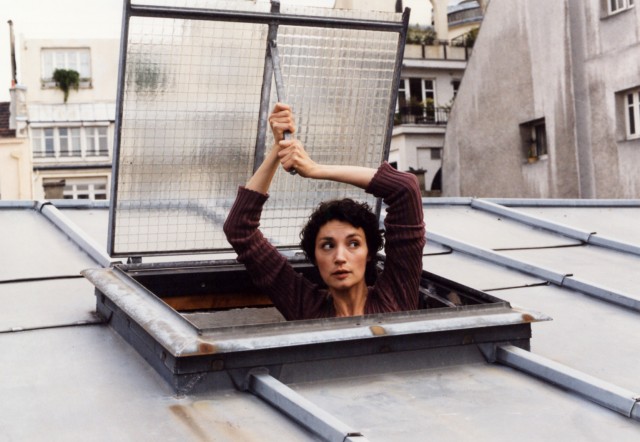
Shingo Wakagi’s Asleep is a quiet gem of a film, a poignant drama about three women’s relationship with beds and sleep. Sakura Ando stars as Terako, a young woman who is sleeping most of her life away. The only time she wakes up and gets out of bed is when her married lover, the somewhat older Mr. Iwanaga (Arata Iura), calls her to make a date. Terako’s best friend and former roommate, Shiori (Mitsuki Tanimura), recently committed suicide shortly after complaining about the difficulties of her job as a soineya, providing companionship — but not sex — by lying in bed with strangers who do not want to sleep alone. And Terako soon discovers that Iwanaga’s wife is languishing in a hospital bed in a deep coma. As Terako cares more and more for Iwanaga, she finds it harder and harder to get out from under the covers, trying to hide from a life surrounded by loneliness and death.

ASLEEP

Terako (Sakura Ando) and Mr. Iwanaga (Arata Iura) try to find love and romance in ASLEEP

Ando (Love Exposure) and Iura (After Life, Air Doll), who played rival siblings in Yang Yong-hi’s Our Homeland, have an offbeat yet sweet chemistry as lovers in Asleep, each in need of different forms of physical and psychological comfort. Wakagi (Waltz in Starlight, Totemu: Song for Home) cowrote, directed, and photographed the film, based on Banana Yoshimoto’s 1989 novella, and he gives it a literary quality with soft voice-over narration by Ando as the troubled Terako, who is first shown lying flat on her back on her futon, in black-and-white, as if she’s dead. “If someone could guarantee that this is really love, I’d be so relieved I’d kneel at her feet,” she says after receiving a phone call from Iwanaga, continuing, “And if it isn’t love, don’t let me hear when he calls,” hiding under the sheets and plowing her head deeper into her pillow. Asleep is an intimate tale, playing out almost like a confessional as a young woman deals with love and depression, nearly paralyzed by a fear of taking control of her life. Wakagi includes little dialogue and no musical score, only the natural sounds of the city and the deafening silence of the bedroom, broken only by the buzzing of the telephone offering her an opportunity that both excites and frightens her. Asleep is part of the Centerpiece Presentation of Japan Society’s annual Japan Cuts Festival of New Japanese Film, screening July 16 at 6:30, with Ando on hand to introduce the film and participate in a Q&A afterward. The festival runs through July 19 with such other works as co-Centerpiece Presentation 100 Yen Love, also starring Ando; The Voice of Water, with an intro by and Q&A with director Masashi Yamamoto and special guests Yui Takagi and Shigetaka Komatsu; and This Country’s Sky, with director Haruhiko Arai and star Youki Kudoh at Japan Society to talk about the film.

PIERRE HUYGHE AT MoMA AND THE MET

Pierre Huyghe’s Met Garden Rooftop Commission melds magic and science, ecology and archaeology (photo by twi-ny/mdr)

Pierre Huyghe’s Met Garden Rooftop Commission melds magic and science, ecology and archaeology (photo by twi-ny/mdr)

PIERRE HUYGHE: THE ROOF GARDEN COMMISSION
Metropolitan Museum of Art, Iris and B. Gerald Cantor Roof Garden
1000 Fifth Ave. at 82nd St.
Daily through November 1, recommended admission $12-$25
212-535-7710
www.metmuseum.org
rooftop slideshow

Native Parisian Pierre Huyghe is having quite a summer, with installations and films on view at both MoMA and the Met. Through November 1, his site-specific Roof Garden Commission at the latter will slowly devolve, affecting the surrounding cement slabs and dirt underneath it. A curious aquarium that seems to leak water, the piece resembles an architectural dig of sorts, an intervention on the popular Met roof that offers spectacular vistas and in past years has featured works by Jeff Koons, Ellsworth Kelly, Roxy Paine, and Dan Graham. Inside the aquarium, the 2002 Hugo Boss Prize winner has placed a large boulder of Manhattan schist that somehow is floating (perhaps referencing Koons’s basketballs?) along with some living lamprey and tadpole shrimp. Meanwhile, creatures are turning up in the mini-swamps that spring up amid the dirt and water around the central fixture as the paving stones are upended because of the evolving damage. (The water is not actually leaking from the fish tank but dripping separately.) Huyghe also works in some additional magic into his science-and-art environment; the aquarium occasionally clouds up so visitors can temporarily not see inside it. The ecological, archaeological work feels right at home amid the views of Central Park; as Huyghe notes in the small exhibition catalog, “Walking through Central Park, you realize that all events there — the stone, the frozen lake, the plane overhead, the maintenance worker — are equally necessary. The important thing is not necessarily the big event. There is an ecology in the broadest sense of the word; different states of life, each element playing a role — even sometimes antagonistically.”

HUMAN MASK

Pierre Huyghe, video still, HUMAN MASK, 2014 (photo courtesy of the artist, Hauser & Wirth, London, and Anna Lena Films, Paris)

UNTITLED (HUMAN MASK) (Pierre Huyghe, 2014)
Metropolitan Museum of Art, Gallery 916
1000 Fifth Ave. at 82nd St.
Daily through August 9, recommended admission $12-$25
www.metmuseum.org

Inside the Met, in Gallery 916, Huyghe’s intriguing nineteen-minute Untitled (Human Mask) is screening through August 9. The 2014 film follows what appears to at first to be a young girl as she wanders through an abandoned restaurant in Japan. However, the star is in fact a macaque monkey in a wig and a smooth, expressionless Noh-like white mask, inspired by the YouTube clip “Fuku-chan Monkey in wig, mask, works Restaurant!” Huyghe, who has worked with animals in masks before, shot the film in Fukushima shortly after the 2011 earthquake and tsunami. The monkey, one of the actual waitresses from the Kayabuki sake house in the viral video, makes her way through the restaurant as if wandering in a postapocalyptic landscape, evoking evolution and what humanity hath wrought on the earth. Despite the mask covering her face, she appears filled with emotion as she looks out the window and dreams of a green forest. It’s an eerie, affecting film that serves as a fascinating companion piece to Huyghe’s rooftop installation. On July 24, MetFridays — Conversation with an Educator will delve deeper into the work in an interactive dialogue with museum education assistant Marianna Siciliano.

Pierre Huyghe. Untilled (Liegender Frauenakt) [Reclining female nude]. 2012. Concrete with beehive structure, wax, and live bee colony; figure: 29 1/2 x 57 1/16 x 17 11/16" (75 x 145 x 45 cm), base: 11 13/16 x 57 1/16 x 21 5/8" (30 x 145 x 55 cm), beehive dimensions variable. The Museum of Modern Art, New York. Purchase. © 2015 Pierre Huyghe

Pierre Huyghe, “Untilled (Liegender Frauenakt) [Reclining female nude],” concrete with beehive structure, wax, and live bee colony, 2012 (The Museum of Modern Art, New York. Purchase. © 2015 Pierre Huyghe)

PIERRE HUYGHE: “UNTILLED (LIEGENDER FRAUENAKT)”
Museum of Modern Art
The Abby Aldrich Rockefeller Sculpture Garden
11 West 53rd St. between Fifth & Sixth Aves.
Through August 15, $25 (including admission to galleries and film screenings)
212-708-9400
www.moma.org

Meanwhile, over at MoMA, another outdoor sculpture incorporating living creatures and an indoor film by Huyghe are being highlighted. MoMA is unveiling its recent acquisition, Huyghe’s 2012 “Untilled (Liegender Frauenakt),” through August 15 in the Sculpture Garden, a reclining female nude whose head is a live bee colony. The work references classical Greek statuary (although it was actually cast from a bronze by Max Weber) as well as such concepts as the hive mentality and the controversy over the importance of the survival of the bees in relation to the future of the planet. The Italian honeybees have been overseen by Manhattan beekeeper Andrew Cote since April, and they’ve been getting busy under a shady tree in the garden. Cote and MoMA expect the colony to reach as many as 75,000 bees at its densest point, meaning they might provide a little extra buzz to the upcoming Summergarden: New Music for New York concerts in the Sculpture Garden on July 19 & 26.

The Host and The Cloud. 2009–10. France. Directed by Pierre Huyghe. Courtesy the artist and Marian Goodman Gallery, New York

Pierre Huyghe’s 2009–10 THE HOST AND THE CLOUD will be shown at MoMA July 14 & 16 (photo courtesy the artist and Marian Goodman Gallery, New York)

MOMA PRESENTS: PIERRE HUYGHE’S THE HOST AND THE CLOUD
MoMA Film, Museum of Modern Art
The Lewis B. and Dorothy Cullman Education and Research Building
4 West 54th St. between Fifth & Sixth Aves.
Tuesday, July 14, and Thursday, July 16, 7:00
Tickets: $12, in person only, may be applied to museum admission within thirty days, same-day screenings free with museum admission, available at Film and Media Desk and online beginning at 9:30 am
212-708-9400
www.moma.org

The very welcome Huyghe infestation continues with two screenings of his rather cerebral 2009–10 film, The Host and the Cloud, on July 14 and 16 at 7:00 in the research and education building. The two-hour depiction of a controlled experiment is set in the abandoned Musée National des Arts et Traditions Populaires, focusing on the Day of the Dead, Valentine’s Day, and May Day, as different forms of entertainment, ritual, and political actions are performed over the course of one year by characters wearing LED masks. As always, Huyghe melds fiction and reality as he explores ethnographic representation. The official description notes, “Navigating through history within the museum, a group of people is exposed to influence, live situations that appear accidentally, simultaneously, or without any sense of order in the building. Nothing that takes place is staged. People can imitate, repeat, or transform these situations endlessly to variable intensity.” The July 14 show will be introduced by MoMA curators Stuart Comer (Department of Media and Performance Art) and Laura Hoptman (Department of Painting and Sculpture), while the July 16 screening will be introduced by Artist’s Institute director and curator Jenny Jaskey.