Joshua Oppenheimer’s THE LOOK OF SILENCE stares directly into the eyes of perpetrators of genocide in Indonesia
THE LOOK OF SILENCE (Joshua Oppenheimer, 2014)
Landmark Sunshine Cinema
143 East Houston St. between First & Second Aves.
Opens Friday, July 17
212-330-8182
www.landmarktheatres.com
thelookofsilence.com
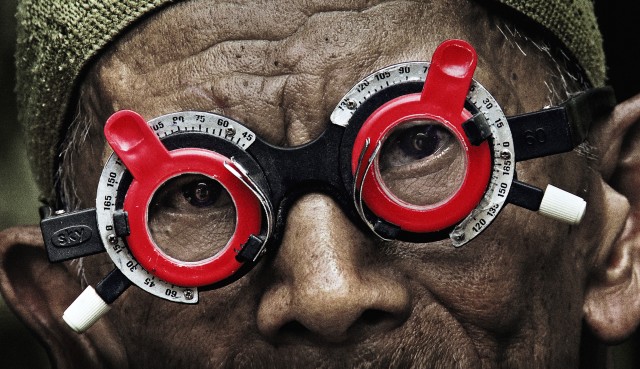
 Joshua Oppenheimer’s The Look of Silence opens with an old man, wearing a pair of red optic trial lens frames, gazing into and around the camera for twelve uncomfortable seconds, in complete silence, showing no emotion. It is a striking metaphor for the rest of the film, a shocking documentary about the 1965–66 Indonesian genocide and a bold man determined to confront the men who brutally murdered his brother then, along with a million other supposed communists. In 2012, Oppenheimer made the Oscar-nominated The Act of Killing, in which the leaders of the genocide, who are still in power today, restaged their killings as if they were Hollywood movie scenes. Created as a companion piece to that documentary, The Look of Silence follows forty-four-year-old optometrist Adi as he learns the details of what happened to his brother, Ramli, who was butchered two years before Adi was born. Adi has decided to do what no one else in his country will: break his culture’s silence and denial and face the perpetrators to make them take responsibility for what they did. If they are willing to show remorse, he is willing to forgive. But he has set out on what appears to be an impossible mission; the men he meets with still run Indonesia, and they are more than comfortable threatening the well-being of Adi and his family. Meanwhile, Adi’s parents and patients don’t want to talk about what occurred back in 1965–66, or what is still going on today, as they live in fear of these same men. “No, nothing happened,” one woman says when asked about the killings in her town of Aceh. “You ask too many questions,” she adds. Kemat, a survivor of the Snake River massacres, says, “The past is the past. I’ve accepted it. I don’t want to remember. It’s just asking for trouble.” Adi learns horrifying details as he meets with village death squad leader Inong (the old man shown at the beginning of the film), Snake River death squad commander Amir Siahaan, and regional legislature speaker M. Y. Basrun, all of whom defend their actions, and their power and wealth, while more than hinting that Adi should end his quest. But Adi isn’t about to back down.
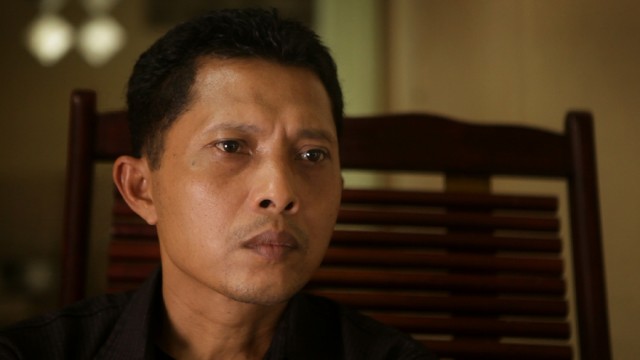
Adi faces a group of mass murders, including his brother’s killers, in powerful documentary
Adi is often shown in front of a television, mystified as Oppenheimer shows him footage taken for The Act of Killing; Adi stares ahead in disbelief and silence, much like we did when watching the final film, amazed at what we were seeing. It is a fascinating coincidence that Adi is an optometrist, going around his community fitting people for glasses, helping them see better, even if they don’t always want to look at certain things. He is appalled that his children’s school still teaches that the evil communists deserved to die; it’s particularly telling when his young daughter playfully puts on two pairs of glasses, as if perhaps the next generation will not look away — and to emphasize that, Oppenheimer cuts directly to Adi’s aging, decrepit father, Rukun (whom his wife, Adi’s mother, Rohani, claims is 140), his eyes closed, as he can barely see or hear anymore and needs to be taken care of like a baby. Adi has become a folk hero in Indonesia, where some regions have banned the film and screenings had to be canceled because of threats of violence from the police and military. But the film itself depicts Adi as an everyman; he could be any one of us, saying the things that need to be said. “Making any film about survivors of genocide is to walk into a minefield of clichés, most of which serve to create a heroic (if saintly) protagonist with whom we can identify, thereby offering the false reassurance that, in the moral catastrophe of atrocity, we are nothing like the perpetrators,” Oppenheimer (The Globalisation Tapes) writes in his extensive, must-read notes on the film’s official website. “But presenting survivors as saintly in order to reassure ourselves that we are good is to use survivors to deceive ourselves. It is an insult to survivors’ experience, and does nothing to help us understand what it means to survive atrocity, what it means to live a life shattered by mass violence, and to be silenced by terror. To navigate this minefield of clichés, we have had to explore silence itself.” In that way, to use a cliché, The Look of Silence speaks volumes. And although it’s specifically about the Indonesian genocide, it could just as easily be made about many other mass murders that have occurred, and are still going on, around the world. Adi might be receiving long standing ovations at screenings where he appears, but it’s telling that the film’s closing credits include more than two dozen people listed as “Anonymous,” from the codirector and a coproducer to a camera operator and production managers. Clearly, fear still rules in Indonesia. An unforgettable film that needs to be widely seen, The Look of Silence, which was executive produced by Werner Herzog, Errol Morris, and André Singer, opens July 17 at the Landmark Sunshine, with Oppenheimer taking part in Q&As following the 7:00 & 9:45 screenings on Friday and Saturday and the 4:35 & 7:00 shows on Sunday.
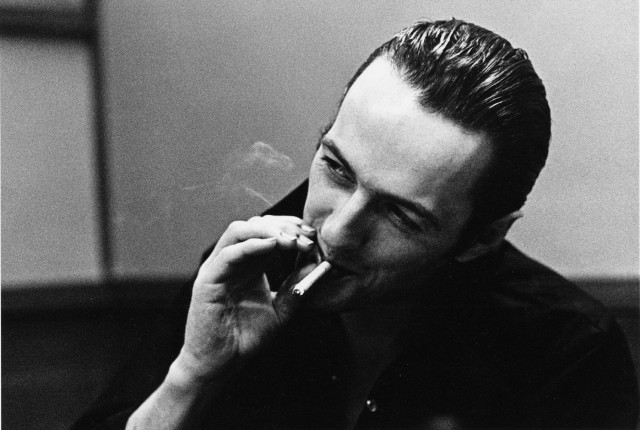
 Director Julien Temple, who has made two outstanding documentaries about the Sex Pistols (The Great Rock and Roll Swindle and The Filth and the Fury), turns his camera on Joe Strummer of the British punk group the Clash in The Future Is Unwritten. Temple collects remarkable home movies of Strummer, from his early days as young John Mellor, a career diplomat’s son, through his time as the leader of one of the most famous and controversial bands in the world and his death at the age of fifty from a congenital heart defect. Strummer’s friends and family gather around a campfire in Brooklyn’s Empire St.-Fulton Ferry Park and talk about Strummer’s life and career, sharing keen insight in a format that the musician loved; his campfire get-togethers came to be known as Strummerville, a place for people to assemble and discuss life, art, and anything else that came to mind. Temple adds lots of footage of the Clash in action, as well as clips from Strummer’s earlier band, the 101ers, made up of squatters fighting the power, and his last band, the Mescaleros. Temple also brings some of Strummer’s drawings to life, animating them in humorous ways. Strummer essentially narrates the film himself, as Temple includes audio excerpts from Strummer’s “Last Call” radio show and interviews he gave over the years. Temple, a close friend of Strummer’s, paints a fascinating portrait of the complex man, featuring stories from the likes of Bono, Johnny Depp, Flea, Mele Mel, Courtney Love Cobain, Martin Scorsese, Steve Jones, John Cusack, Matt Dillon, Steve Buscemi, Damien Hirst, Roland Gift, Don Letts, Mick Jones, and many others. And there’s lots of music as well, of course, including several versions of “White Riot.” The Future Is Unwritten is screening August 1 at 3:30 in the “I Was There: The Music Docs of Julien Temple” sidebar of Lincoln Center’s annual “Sound + Vision” series, which also includes The Filth and the Fury, The Clash: New Year’s Day ’77, Dave Davies: Kinkdom Come, Ray Davies: Imaginary Man, Glastonbury, Never Mind the Baubles: Christmas with the Sex Pistols, and The Liberty of Norton Folgate, with Temple on hand for various introductions and Q&As.
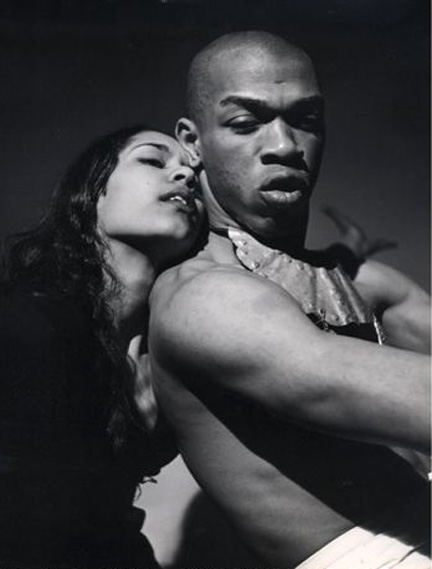
 Carmen & Geoffrey is an endearing look at Carmen de Lavallade and Geoffrey Holder’s lifelong love affair with dance — and each other. The New Orleans-born de Lavallade studied with Lester Horton and went to high school with Alvin Ailey, whom she brought to his first dance class. Best known as a pitchman for 7UP (the “uncola”) and playing the intriguing Baron Samedi in Live and Let Die, Trinidadian Holder was a larger-than-life gentle giant who was a dancer, choreographer, composer, costume designer, actor, stage director, writer, photographer, painter, and just about anything else he wanted to be. The two met when they both were cast in Truman Capote and Harold Arlen’s Broadway show House of Flowers in 1954, with Holder instantly falling in love with de Lavallade; they remained together until Holder’s death this past October at the age of eighty-four. Directors Linda Atkinson and Nick Doob combine amazing archival footage — of Eartha Kitt, Josephine Baker, Ulysses Dove, de Lavallade dancing with Ailey, and other splendid moments — with contemporary rehearsal scenes, dance performances, and interviews with such stalwarts as dance critic Jennifer Dunning, former Alvin Ailey artistic director Judith Jamison, and choreographer Joe Layton (watch out for his eyebrows), along with family members and Gus Solomons jr, who still works with de Lavallade, and Dudley Williams, who just died last month. The film was made on an extremely low budget, and it shows, but it is filled with such glorious footage that you’ll get over that quickly. Carmen & Geoffrey, along with additional rare archival footage, is screening August 1 as part of the free Lincoln Center Out of Doors program “A Celebration of the Life of Geoffrey Holder” and will be preceded by the panel discussion “The Life and Work of Geoffrey Holder” with Doob and Atkinson, moderated by Leo Holder, Geoffrey and de Lavallade’s son. Fans should also check out the new exhibition

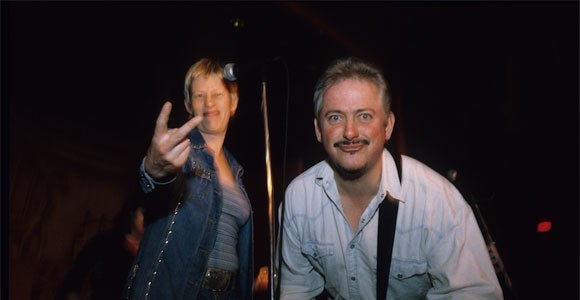
 Called “the most revolutionary group in the history of rock ‘n’ roll” by Lester Bangs,