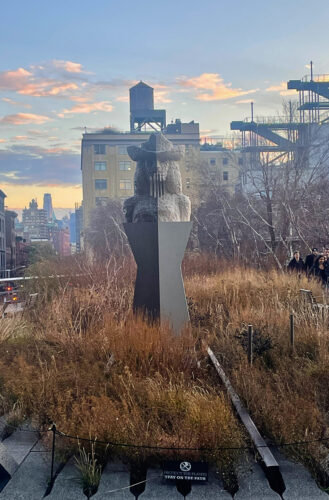
Raven Halfmoon will discuss High Line commission West Side Warrior on March 3 (photo by twi-ny/mdr)
Who:Raven Halfmoon,Cecilia Alemani What: Artist talk about West Side Warrior Where: Friends of the High Line Headquarters, 820 Washington St., fourth floor When: Tuesday, March 3, free with RSVP, 12:30 Why: In a July 2023 interview with Forbes, artist Raven Halfmoon (Caddo Nation) explained, “When I was in those anthropology classes [at the University of Arkansas], not only was I learning about my own tribe and our histories, but also about the Olmec heads in Mexico and the Easter Island heads and then not only that, but the earthworks that are in America: Spiro Mounds in Oklahoma, Moundville in Alabama, Serpent Mound in Ohio. A lot of those earthworks my ancestors made, Caddo ancestors, especially in the Mississippi region, so I was always interested in large scale works and being a part of that, the idea of community being in those works.”
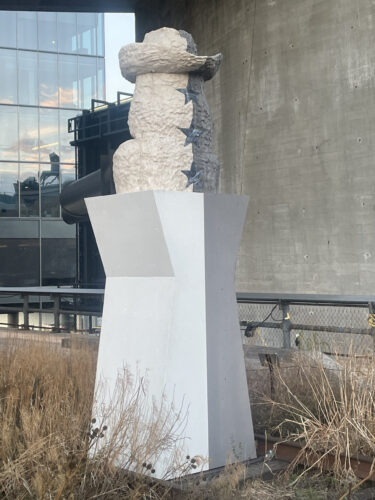
That description fits well with her latest piece, the High Line commission West Side Warrior, in which Halfmoon employs the ancient coiling method as she honors tradition and her heritage while exploring gender and personal experience. Located on the old railway at Little West Twelfth St., the bust, sitting on a plinth, depicts a Native American female horse rider in a cowboy hat, her left side white, her right side black; there are four vertical tattoos on her face and three stars on the back of her head, representing the Red River. In addition, the hand of the artist is present in the clay, which is not smooth. The piece refers not only to the American West, where she is from, but also to the West Side Cowboys, who protected pedestrians and carriages on Death Avenue by guiding New York Central freight trains down the street beginning in the 1850s.
Raven Halfmoon’s West Side Warrior explores indigenous culture, the Old West, gender, and High Line history (photo by twi-ny/mdr)
On March 3 at 12:30, Halfmoon, who is based in her hometown of Norman, Oklahoma, will discuss West Side Warrior with High Line Art chief curator Cecilia Alemani inside the Friends of the High Line Headquarters on Washington St.; admission is free with advance RSVP. The next scheduled talk takes place March 12 at 6:30, when Saba Khan will discuss her three videos, Leaking Ocean,Water Lords, and The Dolphin, with High Line associate curator Taylor Zakarin.
[Mark Rifkin is a Brooklyn-born, Manhattan-based writer; you can follow him on Substack here.]
The life and career of Billy Preston held many surprises revealed in documentary
BILLY PRESTON: THAT’S THE WAY GOD PLANNED IT (Paris Barclay, 2024)
Film Forum
209 West Houston St.
Opens Friday, February 20 filmforum.org
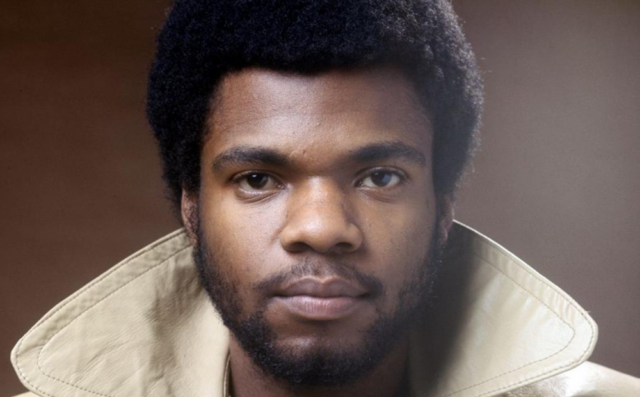
“Will it go ’round in circles? / Will it fly high like a bird up in the sky?” Billy Preston sang in his 1973 smash hit. He might not have realized it then, but that line foretold his career, which had a seemingly endless series of ups until it all came crashing down.
The rise and fall of one of popular music’s most talented and beloved figures is intimately detailed in Paris Barclay’s revelatory documentary, Billy Preston: That’s the Way God Planned It.
Born in 1946 and raised in the church by his mother, gospel singer Robbie Lee Williams, Preston began playing the piano at age three, appeared on The Nat “King” Cole Show in 1957, accompanied Mahalia Jackson and Pearl Bailey on keyboards in the 1958 film St. Louis Blues, played with the gospel group the Cogics (Church of God in Christ), and as a teenager toured with Little Richard and the Rolling Stones. An enthusiastic man with an infectious gap-toothed smile and a collection of impressive wigs, Preston was soon recording with the Stones, Sam Cooke, Sly Stone, Ray Charles, and Aretha Franklin.
He singlehandedly rescued the Beatles when the Fab Four was preparing the Let It Be album and concert, just dropping by to say hello but then taking a seat at the organ and starting to improvise with John, Paul, George, and Ringo, infusing them with the energy they had been previous lacking as rumors swirled that the band was breaking up. The tabloids nicknamed him the Fifth Beatle and the Black Beatle. “He never put his hands in the wrong place,” Starr says in the film.
Preston might have been the ultimate sideman, but when performing he couldn’t help himself, often getting up and dancing wildly, joy emanating out of every pore. He couldn’t read music and never used charts but just felt the music blaze through him, even when playing backup. “He would steal the record without you even knowing until later, and you’d go, ‘He’s done it again,’” Clapton explains.
When Preston brought an original song to George Harrison for a potential solo LP, the Quiet Beatle quickly assembled an all-star roster to back him up: Harrison, Eric Clapton, Keith Richards, and Ginger Baker.
In the 1970s, he hit the charts with such songs as “Outa-Space,” “Will It Go Round in Circles,” “Nothing from Nothing,” and “With You I’m Born Again,” all of which are featured prominently in the film. He was a musical guest on the very first episode of Saturday Night Live. Most people don’t realize that Preston wrote and originally recorded “You Are So Beautiful,” made famous by Joe Cocker; one of the highlights of the documentary is Preston’s performance of the song at the Apollo 50 celebration, joined by Cocker and Patti LaBelle on vocals. We also learn that it is a love song — to his mother, who he also plays it with in the film.
But his life started falling apart as he got lost in a haze of drugs and alcohol (Courvoisier, coke, eventually crack), starred as Sgt. Pepper in the ill-fated movie Sgt. Pepper’s Lonely Hearts Club Band, and continued to hide his sexuality, even though his friends, family, and musical colleagues knew he was gay going back to his youth. He was often seen with young men he referred to as cousins, but he was overcome with loneliness.
In their debut documentary, three-time Emmy winner Barclay (NYPD Blue,Glee) and cowriter Cheo Hodari Coker (Ray Donovan,Luke Cage) also delve into the sexual abuse Preston suffered as a child, which added to his problems as an adult. In the 1990s, he was arrested for DUI, charged with assault and child molestation, and spent time in prison, but he kept on playing music until his death in 2006 at the age of fifty-nine.
“He couldn’t move on,” soul and gospel singer Merry Clayton says. “No one knew what had transpired but us, the inner circle, family people. He’d have that smile, but his heart would be broken.”
Producer Suzanne de Passe notes, “Billy Preston was a gifted, genius, wonderful, talented human being, and he had a very, very self-destructed aspect to who he was. I wish I could have been more of a help in the parts that weren’t any of my business.”
Similarly, engineer Bob Margouleff says wistfully, “I don’t think anyone, including me, knew how to help him.”
The film has a bevy of revelatory archival material, from photographs and home movies to rare clips of Preston from childhood through his entire career, including key segments from a 2004 live appearance. Barclay also speaks with Billy Porter, producer Tony Jones, recording artists Gloria Jones and Blinky Williams, Pastor Sandra Crouch, musician Cory Henry, A&M publicist Don Mizell, biographer David Ritz, Preston’s cowriter Bruce Fisher, his nephew Derrick Preston, his managers Bob Ellis and Joyce McRae Moore, and numerous members of his bands, who all share poignant stories of Preston as a performer and a human being, a man bursting with life but hiding so much inside.
“I just want to be free, to play the music that God’s given to me,” Preston says.
It’s a tragic, if not unfamiliar, story, in this case happening to a cherished person who could not conquer his demons. But as he sang in his first big hit: “Let not your heart be troubled / Let mourning sobbing cease / Learn to help one another / And live in perfect peace.”
[Billy Preston: That’s the Way God Planned It opens February 20 at Film Forum, with Q&As with the filmmakers and special guests at the 7:00 shows on Friday and Saturday.]
[Mark Rifkin is a Brooklyn-born, Manhattan-based writer; you can follow him on Substack here.]
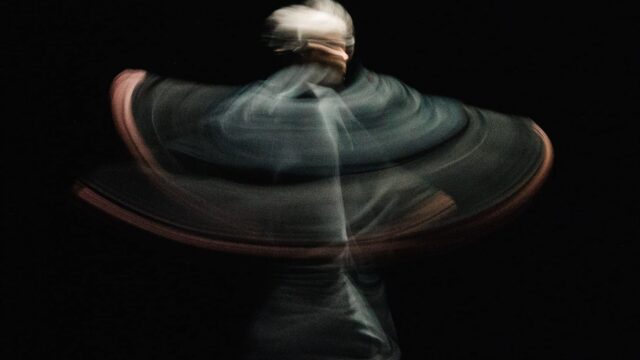
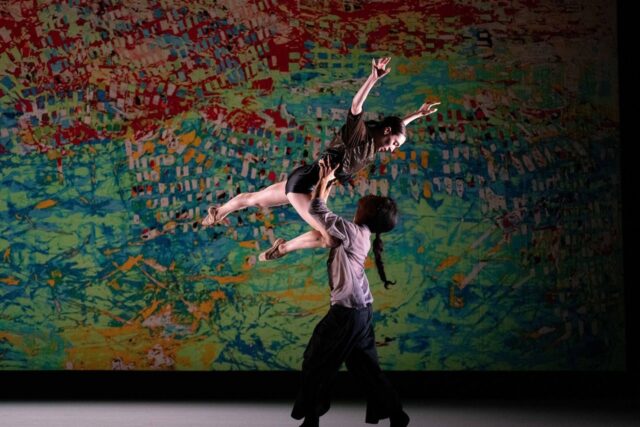
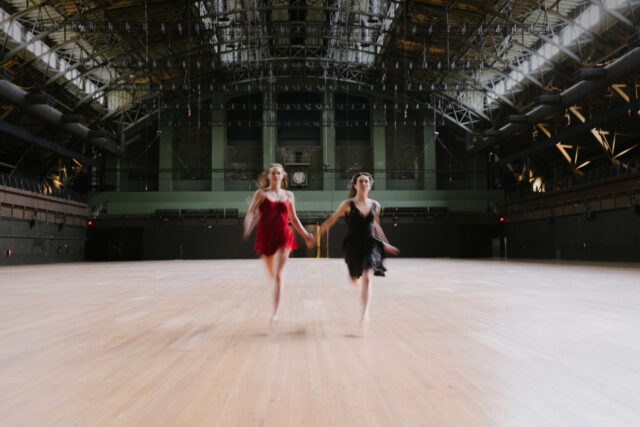
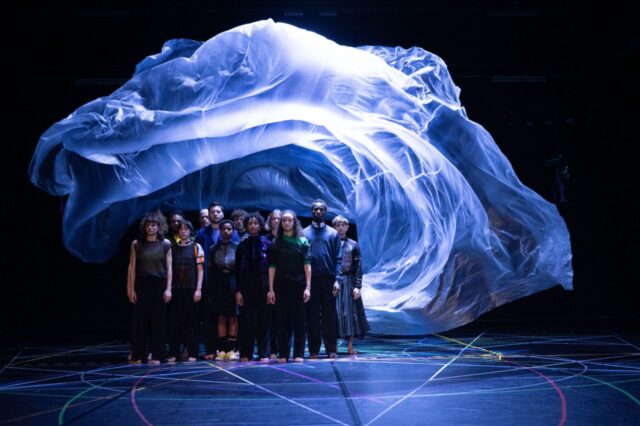
The second Dance Reflections by Van Cleef & Arpels Festival returns to New York City with sixteen performances and twenty-four workshops by some of the finest companies in the world, running February 19 through March 21.
The exciting series kicks off February 19-21 with the Lyon Opera Ballet presenting Merce Cunningham’s BIPED and Christos Papadopoulos’s Mycelium at City Center and the Ballet national de Marseille bringing (LA)HORDE’s Age of Content to BAM’s Howard Gilman Opera House from February 20 to 22. The lineup continues with such shows as Jan Martens’s The Dog Days Are Over 2.0 at NYU Skirball, Leïla Ka’s Maldonne at New York Live Arts, Noé Soulier’s The Waves at the Joyce, and Lucinda Childs’s Early Works for the Guggenheim’s Works & Process program.
Below is a look at five more of the highlights.
LA Dance Project’s On the Other Side is part of triptych at PAC NYC (photo by Jade Ellis)
BENJAMIN MILLEPIED AND THE L.A. DANCE PROJECT: REFLECTIONS: A TRIPTYCH
Perelman Performing Arts Center (PAC NYC)
251 Fulton St.
Saturday, February 21, 8:00, and Sunday, February 22, 3:00, $61-$157 www.dancereflections-vancleefarpels.com pacnyc.org
Benjamin Millepied merges dance, music, and visual art in the New York premiere of Reflections: A Triptych, three pieces inspired by precious stones. The thirty-minute Reflections (2013) boasts a score by David Lang and a bold scenic design by Barbara Kruger, with six dancers musing on longing and memory. The seventeen-minute Hearts and Arrows (2014) features a set by Liam Gillick, music by Philip Glass performed by Kronos Quartet, and fab costumes by Janie Taylor. Several Glass compositions and a set by Mark Bradford anchor the forty-five-minute On the Other Side (2016), which explores communal human experience. Audrey Sides will teach a “Hearts & Arrows Repertory” workshop at the New York Center for Creativity & Dance on March 12.
Trisha Brown and the Merce Cunningham Trust celebrate their extensive collaboration with Robert Rauschenberg, and the artist’s recent centennial, with two classic works for which Rauschenberg created the visual design and the costumes. Commissioned by BAM in 1983, Set and Reset is a postmodern masterpiece, with music by Laurie Anderson, that was recently reconceived as an art installation at the Tate. The vaudevillian pièce de résistance Travelogue (1977) is set to John Cage’s “Telephones and Birds,” which has been adapted for mobile devices, and is performed within Rauschenberg’s Tantric Geography environment. “I feel like this is the one time I can let the cat out of the bag and let you know just how dear this man is to me,” Brown once said about Rauschenberg. “Bob understands how I construct movement.” Bob returned the compliment: “Particularly with Trisha, it’s always a challenge because she remains so unpredictably fresh.” Cecily Campbell and Jamie Scott will lead a “Trisha Brown Discovery” workshop at the New York Center for Creativity & Dance on February 28.
Benjamin Millepied reconfigures his Romeo & Juliet Suite specifically for Park Ave. Armory
Benjamin Millepied follows up his PAC NYC Reflections tryptych with an eighty-minute multimedia adaptation of Sergei Prokofiev’s 1930s ballet Romeo and Juliet, combining dance, theater and film reconfigured specifically for the entire Park Ave. Armory building. The cast of eighteen dancers will rotate as Shakespeare’s doomed young couple, with the presentation spreading from the Wade Thompson Drill Hall to the historic period rooms and other spaces, so be sure to get there early. “Of all the places I’ve shown Romeo & Juliet Suite, the armory is by far the most fitting, as it provides the massive scale, flexibility, and grandeur needed to present this work at its fullest potential,” Millepied, who will participate in an artist talk with NYU professor André Lepecki on March 4, said in a statement. “I invite audiences to forget what you think you know about the story of these two star-crossed lovers — and how it should be told — and open your mind to experiencing a radically reimagined tale about love suited for modern day.”
Exciting Belgian choreographer Anne Teresa De Keersmaeker displays her principle of “My walking is my dancing” in Exit Above, in which thirteen dancers move to the sounds of Meskerem Meesre interpreting the blues of Robert Johnson in addition to music by TC Matic’s Jean-Marie Aerts and dancer-guitarist Carlos Garbin, with scenic design by Michel François, costumes by Aouatif Boulaich, and opening text taken from Walter Benjamin’s “On the Concept of History.” In a 2023 interview, De Keersmaeker explained, “Less is more, I increasingly think. For me that means going back to the source, to the real thing. Blues goes all the way back to that essence, also content wise: It is about sorrow and joy, my sorrow, my joy but also our sorrow, our joy. Both individual and collective: That tension is crucial to me. Blues the ultimate emotional alchemy: we sing about our sadness, but by singing about it with others we transform it into a strength, something joyful. Singing about sorrow immediately contains the consolation for that sorrow. Isn’t this ultimately why we make art? To mourn together and to celebrate joy together. Beauty and solace. I know that beauty is considered to be old-fashioned, but we need it more than ever: Our relationship with nature is disturbed, we are living on the edge of an ecological catastrophe. When you’re lost, it’s a good idea to retrace your footsteps.” Jacob Storer and Clinton Stringer will lead an Exit Above workshop at the New York Center for Creativity & Dance for professionals on March 6 and everyone on March 7.
Compagnie Hervé KOUBI will worship the sun again in Sol Invictus at the Joyce (photo by Nathalie Sternalski)
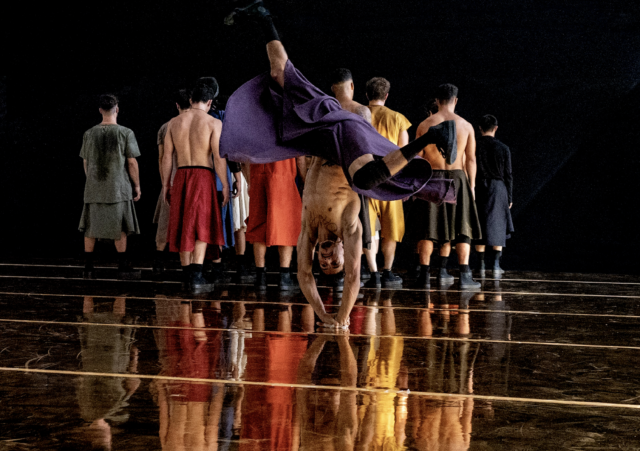
French choreographer Hervé Koubi studied dance and biology at the University of Aix-en-Provence, and he combines the two elements gorgeously in Sol Invictus as his company of eighteen performers pushes the limits of what the human body can do. Previously staged at the Joyce in 2023, Koubi calls the seventy-five-minute piece “a manifesto for life,” and he fills it with sections that explore ritual, worship, faith in a higher power — in this case, the sun — and life, death, and rebirth. “I want to talk about light, solidarity, and those bonds that unite us,” Koubi explains about the work, which features music and soundscapes by Mikael Karlsson, Maxime Bodson, Beethoven (the funeral procession from the Seventh Symphony), and Steve Reich and costumes by musical arranger Guilaume Gabriel. Several of the dancers will lead a “Sol Invictus Discovery” workshop at the New York Center for Creativity & Dance on March 13, and there will be a Curtain Chat following the March 11 show.
[Mark Rifkin is a Brooklyn-born, Manhattan-based writer; you can follow him on Substack here.]
“The words of the prophets are written on subway walls and tenement halls,” Paul Simon sang in 1964.
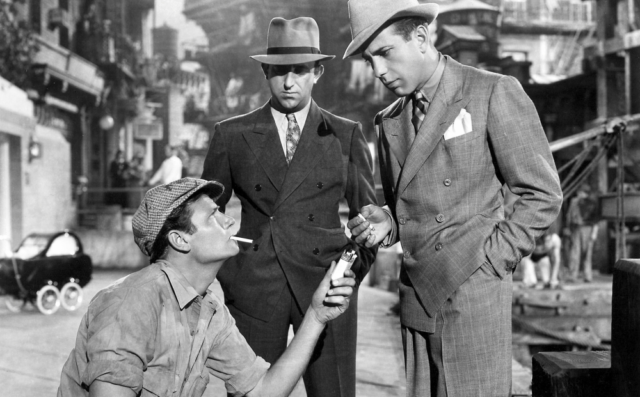
Film Forum, which just named Tabitha Jackson its new director, has teamed up with the Tenement Museum to present the wide-ranging sixty-plus-movie series “Tenement Stories: From Immigrants to Bohemians,” in which there are plenty of prophets. Running February 6–26, the program includes classic favorites, lesser-known gems, and plenty of surprises that take place in old New York, from D.W. Griffith’s The Musketeers of Pig Alley with Lillian Gish and The New York Hat with Mary Pickford and Lionel Barrymore, both released in 1912, to Film Forum repertory artistic director Bruce Goldstein’s 2010 Les Rues de Mean Streets (screening with Martin Scorsese’s 1973 Mean Streets) and 2020 Uncovering the Naked City (shown with Jules Dassin’s 1948 The Naked City) in addition to Aicha Cherif’s 2025 Heat (accompanying Diego Echeverria’s 1984 Los Sures).
“In the silent and early talkie eras, Hollywood churned out cinematic fantasies about the super-rich, but there were also many movies set in New York’s so-called tenement districts, particularly the Lower East Side of Manhattan, once the most densely populated place on earth,” Goldstein said in a statement. “That and other neighborhoods, like Harlem, East Harlem, and parts of Brooklyn and the Bronx, also had an avid moviegoing population — in the 1930s and ’40s, the Lower East Side alone had over thirty movie theaters, from fleapits to palaces — so people were seeing versions of their own lives reflected onscreen. The same neighborhoods would show up in later movies, but with New York’s changing population represented.”
The festival boasts films by Francis Ford Coppola, King Vidor, Charlie Chaplin, Buster Keaton, Hal Ashby, Ken Jacobs, Sergio Leone, John Huston, D. W. Griffith, Leon Ichaso, Raoul Walsh, Preston Sturges, Sean Baker, and many more; among the stars are James Cagney, Loretta Young, Bette Davis, Humphrey Bogart, Robert De Niro, Harvey Keitel, Edward G. Robinson, Ginger Rogers, James Woods, Elizabeth McGovern, Joe Pesci, Natalie Wood, Rita Moreno, Dick Gregory, Marilyn Monroe, Sidney Poitier, Ruby Dee, Al Pacino, Diane Keaton, Jack Kerouac, and Allen Ginsberg.
Tenement Museum president Annie Polland added, “Abraham Cahan, editor of the Jewish Daily Forward, famously wrote to his readers, ‘Under your tenement roofs is real life — the very stuff of which the greatest books are written.’ In 1900, 75% of Manhattanites lived in a tenement — a shared experience for decades of New Yorkers and their descendants. Every day the Tenement Museum shares the stories of those tenement dwellers — immigrant, migrant, and refugee families — by taking people into their re-created homes. The Film Forum series shows these real life dramas through film, letting you time travel through the tenements, from the Yiddish-speaking sweatshop in Uncle Moses, to a young Irish American girl’s awakening in A Tree Grows in Brooklyn, to Martin Scorsese’s portrait of his parents in ItalianAmerican,, to more recent tenement life, as seen through the eyes of Latino, Chinese, Iranian, and other New Yorkers.”
On February 8 and 13, the museum is hosting “Love at the Tenement,” a Valentine’s Day holiday tour of 97 Orchard St., followed by “Crime in the Tenements: Fact and Fiction,” which will have their own real-life tenement stories.
There will be numerous special presentations during the series, including live piano accompaniment by Steve Sterner; introductions by Cathy Sorsese, Uncle Floyd Show alum Michael Townsend Wright, and Kaity Tong; postscreening conversations with Peter McCrea, Cherif, and Mari Rodríguez Ichaso; and a Yiddish vaudeville performance by Allen Lewis Rickman, Yelena Shmulenson, Steve Sterner, and Shane Baker, who have been involved in such Yiddish treats as The Essence: A Yiddish Theatre Dim Sum and Tevye Served Raw. On February 16, “16mm Treasures from the New York Public Library” comprises four shorts introduced by NYPL collection manager Elena Rossi-Snook.
Below is a look at several of the films, which shine a light on the history of New York City since the turn of the twentieth century, particularly as a new home for immigrant families.
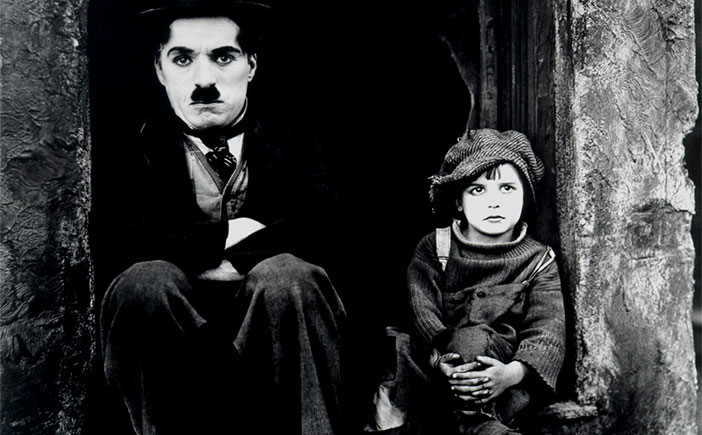
A Tramp (Charlie Chaplin) and an abandoned child (Jackie Coogan) form a family in The Kid
THE KID (Charles Chaplin, 1921)
Sunday, February 8, 11:00 am filmforum.org
Charlie Chaplin’s first feature, The Kid, was a breakthrough for the British-born silent-film star, a touching and tender sixty-eight-minute triumph about a poor soul getting a second chance at life. When a baby arrives at his doorstep, a Tramp (Chaplin) first tries to ditch the boy, but he ends up taking him to his ramshackle apartment and raising him as if he were his own flesh and blood. Although he has so little, the Tramp makes sure the child, eventually played by Jackie Coogan, has food to eat, clothes to wear, and books to read. Meanwhile, the mother (Edna Purviance, Chaplin’s former lover), who has become a big star, regrets her earlier decision and wonders where her son is, setting up a heartbreaking finale.
In addition to playing the starring role, Chaplin wrote, produced, directed, and edited the film and composed the score for his company, First National, wonderfully blending slapstick comedy, including a hysterical street fight with an angry neighbor, with touching melodrama as he examines poverty in post-WWI America, especially as seen through the eyes of the orphan boy, played beautifully by Coogan, who went on to marry Betty Grable, among others, and star as Uncle Fester in The Addams Family. Chaplin’s innate ability to tell a moving story primarily through images reveals his understanding of cinema’s possibilities, and The Kid holds up as one of his finest, alongside such other silent classics as 1925’s The Gold Rush and 1931’s City Lights. The film is screening with Chaplin’s 1917 short Easy Street, with live piano accompaniment by Steve Sterner.
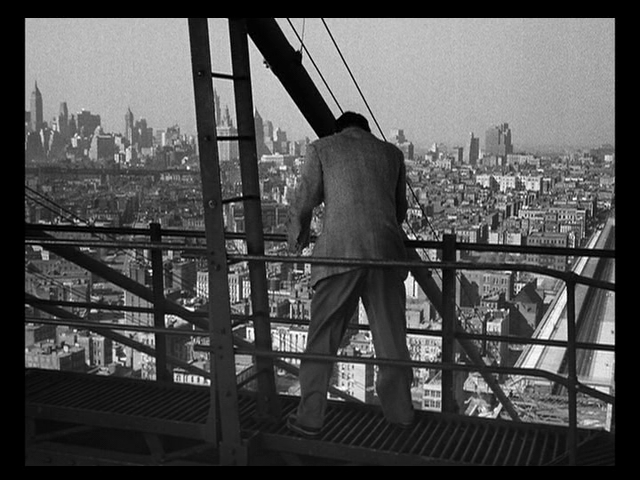
The Naked City features more than one hundred NYC locations
THE NAKED CITY (Jules Dassin, 1948)
Thursday, February 12 , 12:50
Wednesday, February 18, 8:10 www.filmforum.org
Jules Dassin’s police procedural was one of the first films shot on location in New York City, bringing to life the grit of the streets. Barry Fitzgerald stars as Lt. Muldoon, an Irish cop who knows the game, never allowing anything to get in the way of his sworn duty to uphold the law while never getting too emotionally involved. A model has turned up dead, and young detective Jimmy Halloran (Don Taylor) is heading up the investigation, which includes such suspects as swarthy Frank Niles (Howard Duff). Producer Mark Hellinger’s narration is playful and knowing, accompanying William Daniels’s great camerawork through Park Avenue and the Lower East Side, stopping at little city vignettes that have nothing to do with the story except to add to the level of reality. The thrilling conclusion takes place on the Williamsburg Bridge. The film will be followed by Bruce Goldstein’s 2020 documentary Uncovering the Naked City, which visits many of The Naked City’s locations.
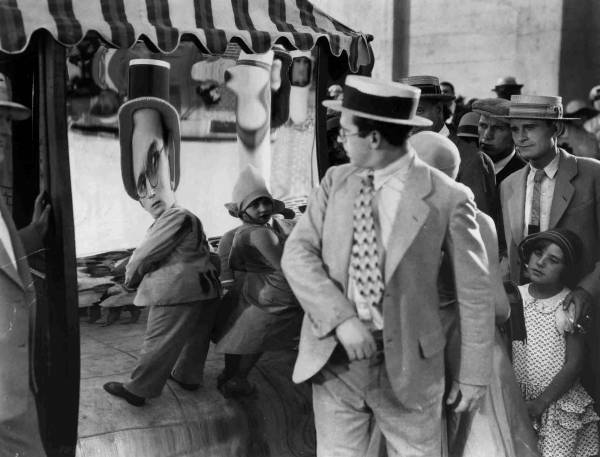
Harold Lloyd has a crazy time in Coney Island in Speedy
Much like the end of the silent film era itself, the last horse-drawn trolley is doomed in Harold Lloyd’s final silent film. Big business is playing dirty trying to get rid of the trolley and classic old-timer Pop Dillon. Meanwhile, Harold “Speedy” Swift, a dreamer who wanders from menial job to menial job (he makes a great soda-jerk with a unique way of announcing the Yankees score), cares only about the joy and wonder life brings. But he’s in love with Pop’s granddaughter, Jane, so he vows to save the day. Along the way, he gets to meet Babe Ruth. Ted Wilde was nominated for an Oscar for Best Director, Comedy, for this thrilling nonstop ride through beautiful Coney Island and the pre-depression streets of New York City. The 4K restoration will feature live piano accompaniment by Steve Sterner.
The Connection is a gritty, jazzy New York City story
THE CONNECTION (Shirley Clarke, 1962)
Thursday, February 19, 4:20
Friday, February 20, 8:00
Tuesday, February 24, 1:00 filmforum.org
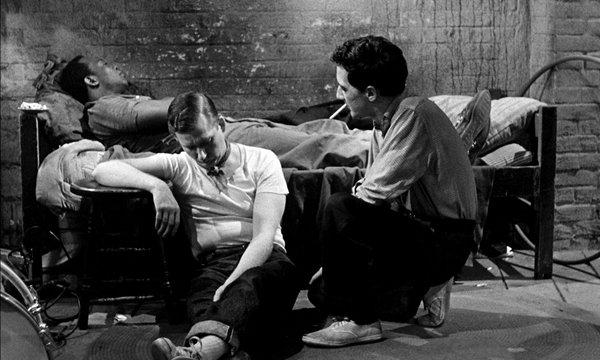
“Now look, you cats may know more about junk, see,” square film director Jim Dunn (William Redfield) says midway through The Connection, “but let me swing with this movie, huh?” Adapted by Jack Gelber from his play and directed and edited by Shirley Clarke, The Connection is a gritty tale of drug addicts awaiting their fix that was banned for obscenity after only two matinee screenings back in October 1962. In 2012, a sharp new fiftieth-anniversary print was released, beautifully restored by Ross Lipman of the UCLA Film & Television Archive. In a New York City loft, eight men are waiting for their man: Leach (Warren Finnerty), the ringleader who has an oozing scab on his neck; Solly (Jerome Raphael), an intelligent philosopher who speaks poetically about the state of the world; Ernie (Garry Goodrow), a sad-sack complainer who has pawned his horn but still clutches tight to the mouthpiece as if it were a pacifier; Sam (Jim Anderson), a happy dude who tells rambling stories while spinning a hula hoop; and a jazz quartet consisting of real-life musicians Freddie Redd on piano, Jackie McLean on sax, Larry Richie on drums, and Michael Mattos on bass. Dunn and his cameraman, J. J. Burden (Roscoe Lee Browne), are in the apartment filming the men as Dunn tries to up the drama to make it more cinematic as well as more genuine. “Don’t be afraid, man,” Leach tells him. “It’s just your movie. It’s not real.” When Cowboy (Carl Lee) ultimately shows with the stuff, Bible-thumping Sister Salvation (Barbara Winchester) at his side, things take a decidedly more drastic turn.
Mixing elements of the French New Wave with a John Cassavetes sensibility and cinema verité style, Clarke has made an underground indie classic that moves to the beat of an addict’s craving and eventual fix. Shot in a luridly arresting black-and-white by Arthur Ornitz, The Connection is like one long be-bop jazz song, giving plenty of time for each player to take his solo, with standout performances by McLean musically and Raphael verbally. The film-within-a-film narrative allows Clarke to experiment with the mechanics of cinema and challenge the audience; when Dunn talks directly into the camera, he is speaking to Burden, yet he is also breaking the fourth wall, addressing the viewer. Cutting between Burden’s steady camera and Dunn’s handheld one, Clarke adds dizzying swirls that rush past like a speeding subway train. A New York City native, Clarke made such other films as The Cool World and Portrait of Jason and won an Academy Award for her 1963 documentary Robert Frost: A Lover’s Quarrel with the World. The restoration is part of Milestone Films’ Shirley Clarke Project, which has preserved and restored a quartet of her best work, inclduing the 1985 documentary Ornette: Made in America.
Young Elgar Winthrop Julius Enders’s (Beau Bridges) spoiled life of privilege is about to dramatically change in The Landlord
THE LANDLORD (Hal Ashby, 1970)
Friday, February 20, 3:40
Saturday, February 21, 6:10
Thursday, February 26, 4:50 filmforum.org
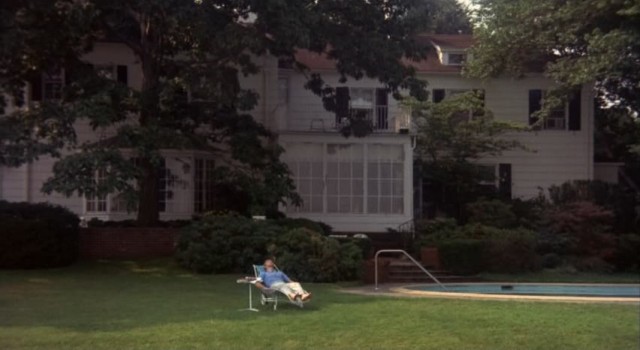
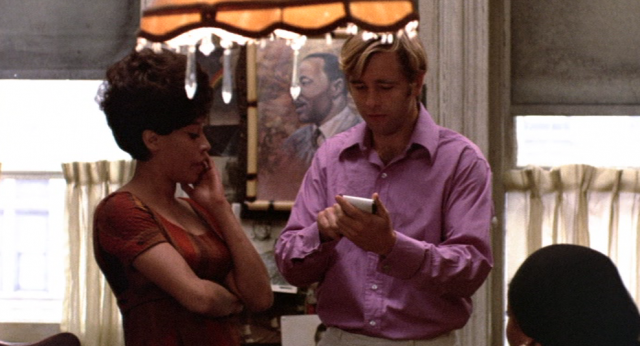
When rich kid Elgar Winthrop Julius Enders (Beau Bridges) finally decides to do something with his spoiled life of privilege, he takes a rather curious turn, buying a dilapidated tenement in a pregentrified Park Slope that resembles the South Bronx in Hal Ashby’s poignant directorial debut, The Landlord. At first, the less-than-worldly Elgar doesn’t quite know what he’s gotten himself into, believing it will be easy to kick out the current residents and then replace the decrepit building with luxury apartments. He pulls up to the place in his VW bug convertible, thinking he can just waltz in and do whatever he wants, but just as his car is vandalized, so is his previously charmed existence, as he gets to know wise house mother Marge (Pearl Bailey), the sexy Francine (Diana Sands), her activist husband, Copee (Louis Gossett Jr.), and Black Power professor Duboise (Melvin Stewart), none of whom is up-to-date with the rent. Meanwhile, Elgar starts dating Lanie (Marki Bey), a light-skinned half-black club dancer he assumed was white, infuriating his father, William (Walter Brooke), and mother, Joyce (a delightful, Oscar-nominated Lee Grant), who are in the process of setting up their daughter, Susan (Susan Anspach), with the white-bread Peter Coots (Robert Klein).
Elgar has a whole lot of learning to do in Hal Ashby’s New York City–set black comedy
Based on the novel by Kristin Hunter, The Landlord is a telling microcosm of race relations and class conflict in a tumultuous period in the nation’s history, as well as that of New York City, coming shortly after the civil rights movement and the free-love late ’60s. The film is masterfully shot by Astoria-born cinematographer Gordon Willis (Klute, Annie Hall, Manhattan, all three Godfather movies), who sets the bright, open spaces of the Enderses’ massive estate against the dark, claustrophobic rooms of the dank tenement. Screenwriter Bill Gunn (Ganja and Hess) and Ashby avoid getting overly preachy in this at-times outrageous black comedy, incorporating slapstick along with some more tender moments; the scene in which Joyce meets Marge is a marvel of both. And just wait till you see Coots’s costume at a fancy fundraiser. The Landlord began quite a string for Ashby, who followed it up with Harold and Maude, The Last Detail, Shampoo, Bound for Glory, Coming Home, and Being There in a remarkable decade for the former film editor (In the Heat of the Night), who died in 1988 at the age of fifty-nine.
[Mark Rifkin is a Brooklyn-born, Manhattan-based writer whose maternal grandparents grew up in Lower East Side tenements; you can follow him on Substack here.]
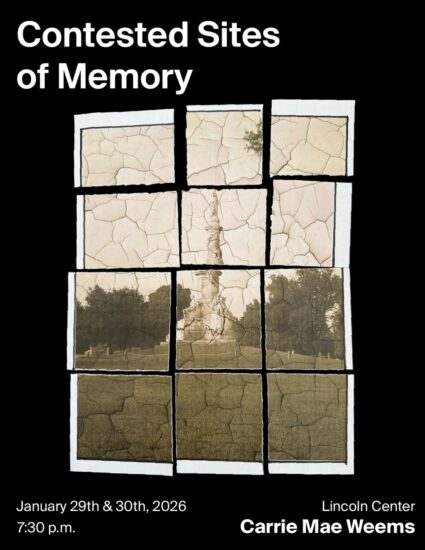
On January 29 and 30, Weems will be at Alice Tully Hall for her latest gathering, “Contested Sites of Memory.” Produced in collaboration with Shore Art Advisory and Lincoln Center, it will feature live music, video art screenings, spoken word, and more, with trombonist, composer, sonic shaman, and musical director Craig Harris, British-born Brooklyn-based playwright, radio host, author, and Armah Institute of Emotional Justice CEO Esther Armah, singer, songwriter, producer, and activist Nona Hendryx, Grammy-winning violinist Jennifer Koh, poet, playwright, novelist, essayist, composer, pianist, professor, and writer Vijay Iyer, and recording artist Carl Hancock Rux, and emcee, trumpeter, composer, producer, educator, and social activist Jawwaad Taylor. The focus is on the purpose and meaning of American monuments and how they relate to the past, present, and future of the country.
Born in Portland, Oregon, and based in Syracuse, Weems is best known for such highly influential photographic projects as “The Kitchen Table Series,”“Family Pictures and Stories,”“The Louisiana Project,”“Constructing History,” and “Museums.” A National Academician and MacArthur Genius, she was busy during the pandemic, making the hypnotic short film The Baptism with Rux and hosting a podcast for the Whitney, “Artists Among Us,” in which she spoke with a wide range of artists, curators, and writers, including Glenn Ligon, Bill T. Jones, Lucy Sante, Jessamyn Fiore, An-My Lê, and Adam Weinberg.
“Contested Sites of Memory” should be another unique and fascinating high point in the career of one of America’s genuine treasures, who has been documenting the shape of things for more than four decades.
[Mark Rifkin is a Brooklyn-born, Manhattan-based writer and editor; you can follow him on Substack here.]
On January 26, they are following that up with “We the People: An Assembly of New York Artists,” a town-hall-style gathering at St. Mark’s Church in-the-Bowery where the focus will be more local. The panel features Classical Theatre of Harlem producing artistic director Ty Jones, award-winning playwright and performer Lisa Kron (Fun Home,Well), the People’s Theatre executive artistic director and cofounder Mino Lora, former Creatives Rebuild New York executive director Sarah Calderon, New York Philharmonic vice president of education and community engagement Gary A. Padmore, and playwright and author Sara Farrington (CasablancaBox,A Trojan Woman). Farrington, who writes the indispensable Substack Theater Is Hard, will make her way through the audience with a microphone, giving members of the community the chance to speak their mind for sixty seconds (and maybe more); it is pointed out that “everyone who comes will already know that art is good, so be specific.”
The presentation will be recorded for online viewing, and a detailed report will be sent to Mayor Mamdani and Governor Hochul. Attendance is free with advance RSVP, although it is all dependent on the weather.
[Mark Rifkin is a Brooklyn-born, Manhattan-based writer and editor; you can follow him on Substack here.]
John Wilson, Maquette for Martin Luther King, Jr. (United States Capitol, Washington, DC, bronze, 1985 (collection of Julia Wilson / courtesy of Martha Richardson Fine Art, Boston / photo by twi-ny/mdr)
WITNESSING HUMANITY: THE ART OF JOHN WILSON
Met Fifth Avenue
Metropolitan Museum of Art
1000 Fifth Ave. at 82nd St.
Through February 8, $17-$30 www.metmuseum.org
“I wanted people to recognize him, but also I wanted to suggest the intangible energy and strength, this sense of dogged strength he had that allowed him to carry out these impossible campaigns,” John Wilson (1922–2015) said of the Rev. Dr. Martin Luther King, Jr. “He was able to use his verbal skills to convince masses of ordinary people to do these extraordinary things . . . all of that is what I’m trying to put into a head.”
Several depictions of Dr. King are included in the revelatory and necessary exhibition “Witnessing Humanity: The Art of John Wilson,” featuring more than one hundred paintings, lithographs, drawings, sculptures, and children’s books by artist and educator John Wilson, on view at the Met through February 8. Talking about his monumental bust of Dr. King, Wilson further explained, “King’s head is titled forward — not bowed — so that someone standing below will have a kind of eyeball-to-eyeball confrontation with him. I wanted to show that kind of brooding, contemplative, inner-directed person that’s the essence of the man.”
Born in Roxbury, Massachusetts, in 1922, Wilson was driven by community activism against racial injustice, creating works that detailed the Black experience in America. “An artist is ipso facto critical of society . . . constantly dissecting,” he noted. “I want my art to reach people. I want people to get the message that my art has. I want their social attitudes to change as a result of the things I do.”
The exhibition is splendidly curated by the Met’s Jennifer Farrell, Maryland Institute College of Art’s Leslie King-Hammond, and the MFA’s Patrick Murphy and Edward Saywell, with detailed information and lots of powerful quotes by Wilson, who died in Brookline in 2015, leaving behind a remarkable legacy that is finally reaching people, getting the attention it deserves. On January 23 at 6:00, printmaker Karen J Revis will present an “Artists on Artworks” talk on the exhibit, and on February 3 at 6:00, the Met is hosting the free program “A Celebration of John Wilson” in Grace Rainey Rogers Auditorium with Lisa Farrington, Lowery Stokes Sims, Derrick Adams, and King-Hammond.
Below are Wilson’s own words accompanying several important works.
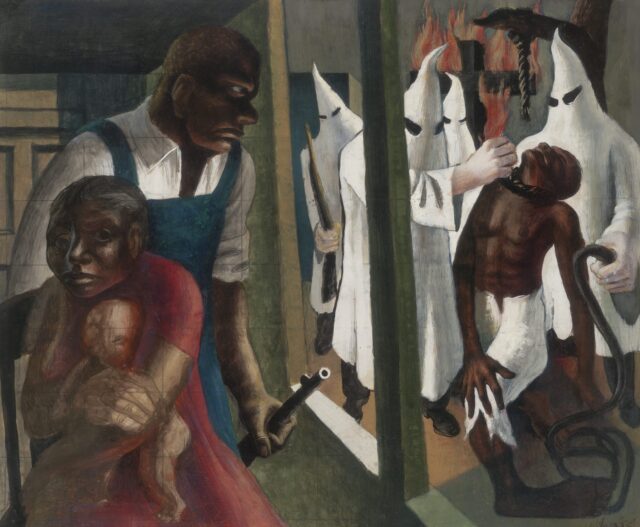
John Wilson, study for the mural The Incident, opaque and transparent watercolor, ink, and graphite, 1952 (Yale University Art Gallery [courtesy the Estate of John Woodrow Wilson] / licensed by VAGA at Artists Rights Society (ARS), New York)
“He put into words what I wanted to express visually, the struggle of African Americans to maintain their human dignity in an oppressive world,” Wilson said of Richard Wright.
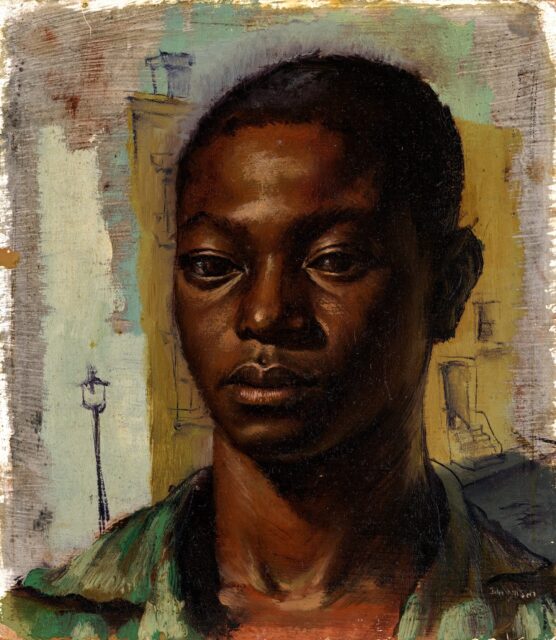
John Wilson, My Brother, oil on panel, 1942 (Smith College Museum of Art / courtesy the Estate of John Wilson)
“I am a Black artist. I am a Black person. To me, my experience as a Black person has given me a special way of looking at the world and a special identity with others who experience some injustices. . . . Themes I have dealt with are not because I sat down and said I wanted to make a political statement but because of emotional experiences.”
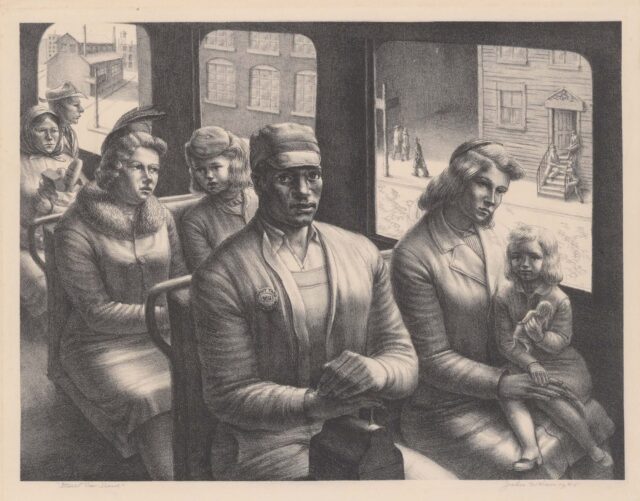
John Wilson, Streetcar Scene, lithograph, 1945 (the Metropolitan Museum of Art / courtesy the Estate of John Wilson)
“I drew scenes of the world around me which reflected the sense of alienation I felt as a Black artist in a segregated world. I saw no examples of art that depicted the people and the realities of the Black neighborhood I lived in.”
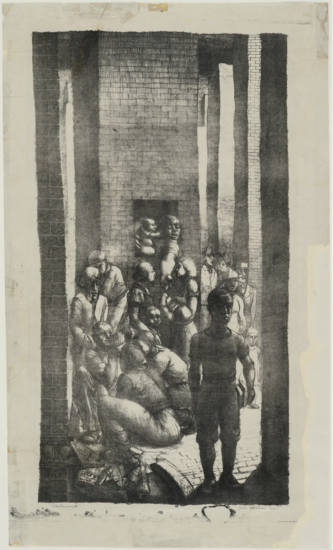
John Wilson, Adolescence, lithograph, 1943 (courtesy the Estate of John Wilson/Artists Rights Society (ARS), Museum of Fine Arts, Boston)
Adolescence is “an imaginative interpretation of the street I lived on . . . [an attempt to express] the bewilderment and search for understanding of a Negro boy growing up in the midst of the inconsistencies, the squalor, and the cramped poverty-stricken confusion of life in a typical North American Negro ghetto. . . . I don’t even know if I was conscious of that boy in the foreground as a self-portrait or not. But I look back on it, [and] clearly it’s a self-portrait.”
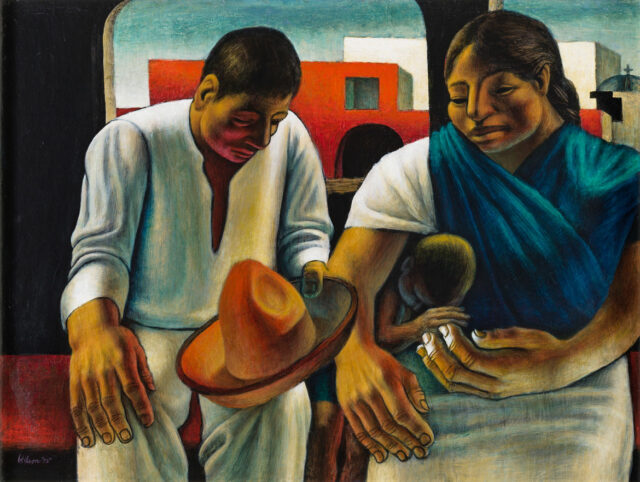
“The aim of the Mexican muralist movement was to be spokespeople for the common man. They wanted to create works of art expressing the reality of the forgotten ones, revealing their history, their celebrations, and struggles. . . . Through Mexican art I began to experience a sense of how to depict my reality.”
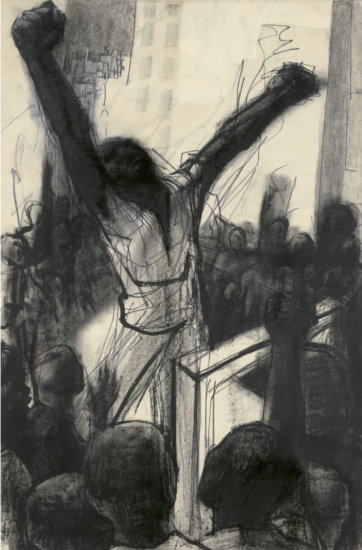
John Wilson, Oracle, ink, chalk, and collage on paper, 1965 (courtesy the Estate of John Wilson / licensed by VAGA at Artists Rights Society (ARS), New York)
“As a Black art student in 1940–41, I became increasingly aware that the illustrations in art history books and the great works in this museum which were statements of profound truth and beauty did not include images of Black people. By omission this seemed to be saying that Black people were not significant. I lived in a world in which the only public images of Blacks were stereotypical, dehumanized caricatures. These were the only images that I saw of Blacks in the newspapers and films and all public media of that time.”
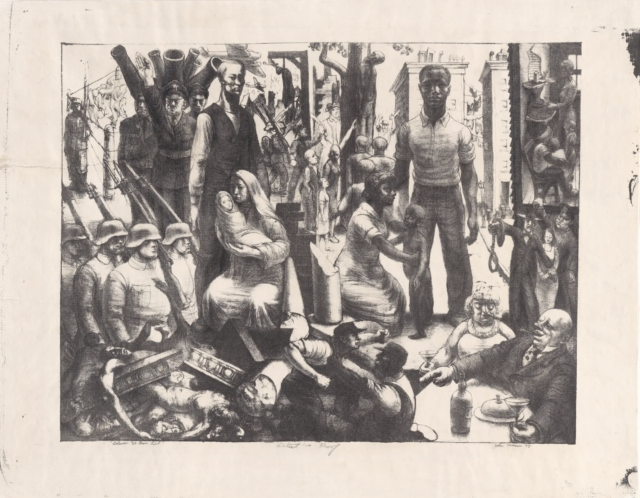
John Wilson, Deliver Us from Evil, lithograph, 1943 (courtesy the Estate of John Wilson/Artists Rights Society (ARS), New York)
“I was an idealistic young African American art student, struggling to find a way to express my fears and anger about the oppression of African American people in America. For me, the ruthless, efficient, invincible German storm troopers became a symbol of all-powerful forces of oppression, in which individuals were modeled into collective killing machines, fueled by ideologies of hate and racial superiority. I identified with the victims of this [Nazi] army, and [War Machine] is my attempt to make a graphic image of the terror engendered by these troops.”
“This business of the terror that was used to keep Black people in their place really worked. I wasn’t born in the South, but the South was a microcosm. There was actual physical lynching in the North. . . . I heard someone make a speech once in which he said, ‘Well, this lynching and the threat of lynching is what keeps Black people in their place.’”
[Mark Rifkin is a Brooklyn-born, Manhattan-based writer and editor; you can follow him on Substack here.]