this week in lectures, signings, panel discussions, workshops, and Q&As

TICKET ALERT: AN EVENING WITH JOEL SHAPIRO

Sculptor Joel Shapiro will be at the National Academy on November 4 to discuss the evolution of his work

Sculptor Joel Shapiro will be at the National Academy on November 4 to discuss the evolution of his work

Who: Joel Shapiro
What: An Evening with Joel Shapiro
Where: Assembly Hall, National Academy Museum & School, 1083 Fifth Ave. at 5 East 89th St., 212-369-4880
When: Wednesday, November 4, free with advance RSVP, 6:00
Why: National Academician and sculptor supreme Joel Shapiro will be at the National Academy on November 4, discussing the evolution of his extensive and impressive career, “focusing on the development of form, its possible meaning, and the relationship between sculpture and drawing to the plane.” The New York native is represented in the current “On the Square Part II” group show at Pace on East Fifty-Seventh St., and his work can also be found in museums, galleries, lobbies, and public spaces around the world, including the Sony Building at 550 Madison Ave. “I was always interested in art, but I didn’t pursue it. I mean, I had this sort of idea that I was supposed to become a physician,” Shapiro told Lewis Kachur in a 1988 interview for the Archives of American Art Oral History Program. “It was tough to come to the realization that in fact what I really was good at, and what interested me, and what satisfied me, was doing art work. That came much later.” (Oral history interview with Joel Shapiro, 1988 July 15 – December 14, Archives of American Art, Smithsonian Institution.) The talk will be followed by a reception in the Sonia Gechtoff Gallery.

CONSEQUENCES: ALPHAVILLE

ALPHAVILLE

Lemmy Caution (Eddie Constantine) seeks help from Natasha Vonbraun (Anna Karina) in Jean-Luc Godard’s masterful ALPHAVILLE

ALPHAVILLE: A STRANGE ADVENTURE OF LEMMY CAUTION (ALPHAVILLE: UNE ÉTRANGE AVENTURE DE LEMMY CAUTION) (Jean-Luc Godard, 1965)
Rubin Museum of Art
150 West 17th St. at Seventh Ave.
Friday, October 16, $10, 9:30
212-620-5000
rubinmuseum.org

“Sometimes, reality is too complex for oral communication. But legend embodies it in a form which enables it to spread all over the world,” a growly, disembodied, mechanical-like voice says at the beginning of Jean-Luc Godard’s futuristic sci-fi noir thriller, Alphaville: Une étrange aventure de Lemmy Caution. Godard’s 1965 black-and-white masterpiece takes place in an unidentified time period in a dark, unadorned, special-effects-free Paris. A tough-as-nails man in hat and trench coat named Lemmy Caution (Eddie Constantine) has arrived in Alphaville from the Outlands, claiming to be journalist Ivan Johnson, on assignment from the Figaro-Pravda newspaper. But his real mission is to first find fellow agent Henry Dickson (Akim Tamiroff), then capture or kill Alphaville leader and death-ray inventor Professor Vonbraun (Howard Vernon), the former Leonard Nosferatu. A Guadalcanal veteran who drives a Ford Galaxie, Caution — a character Constantine played in a series of films based on the novels of Peter Cheyney, including This Man Is Dangerous, Dames Get Along, and Your Turn, Darling — is a no-nonsense guy who takes nothing for granted. “All things weird are normal in this whore of cities,” he tells a blond seductress third class, who apparently comes with his hotel room. Documenting everything he sees with an Instamatic flash camera, Caution (perhaps a stand-in for Godard himself?) is soon visited by Natasha Vonbraun (Anna Karina), the professor’s daughter, setting off on an Orwellian journey through a grim city where poetry and emotion, and such words as “love,” “why,” and “conscience,” are banned in favor of “because” and “Silence. Logic. Security. Prudence,” where the hotel Bible is actually an ever-changing dictionary and enemies of the state are killed in swimming pools and pulled out by clones of Esther Williams, all overseen by a computer known as Alpha 60 (whose text, based on writings by Jorge Luis Borges, is eerily spoken by a man without a larynx, using a mechanized voice box).

ALPHAVILLE

Henry Dickson (Akim Tamiroff) attempts to shed light on a grim situation in intellectual sci-fi film noir

Meanwhile, Caution travels everywhere with his paperback copy of Paul Éluard’s Capital of Pain, which includes such short poems as “To Be Caught in the Trap,” “In the Cylinder of Tribulations,” and “The Big Uninhabitable House.” Paul Misraki’s relentless noir score fits right in with Raoul Coutard’s bleakly beautiful cinematography, which often shows Caution through glass doors and windows and in enclosed spaces. Godard infuses Alphaville with cinematic flourishes, inside jokes, political statements, and intellectual references, directly and indirectly evoking Jean Cocteau’s Orpheus, Orson Welles’s Mr. Arkadin, Chris Marker’s La Jetée, American cartoons (a pair of white-coated professors who announce a memory problem with 183 Omega Minus are named Eckel and Jeckel, played by Cahiers du cinema’s Jean-Louis Comolli and Jean-André Fieschi), and even his own films, with Jean-Pierre Léaud making a very brief cameo as a waiter. But one of the myriad pleasures of Alphaville — which won the Golden Bear at Berlin and at one time had the working title Tarzan vs. IBM — is that it can be enjoyed on many different levels, as dystopian warning, fascist parable, cinema about cinema, individual vs. the state thriller, or, quite simply, classic French noir. Recently digitally restored with a new translation and subtitles by Lenny Borger and Cynthia Schoch, Alphaville is screening October 16 in the Rubin Museum Cabaret Cinema series “Consequences” and will be introduced by Buddhist studies professor Christopher Kelley. “All is linked, all is consequence,” a scientist tells Caution in the film. The series is being held in conjunction with “Karma: Cause, Effect and the Illusion of Fate,” which continues through December 30 with conversations (David Eagleman + Whoopi Goldberg, Noah Hutton + Jonathan Demme, Gary Indiana + Tracey Emin, Ian Somerhalder + Carol Anne Clayson) and such other karma-related films as George Romero’s Night of the Living Dead, Ken Russell’s Altered States, Josef von Sternberg’s The Blue Angel, and Sherwood Hu’s Prince of the Himalayas.

HANK WILLIS THOMAS: THE TRUTH IS I SEE YOU

(photo by twi-ny/mdr)

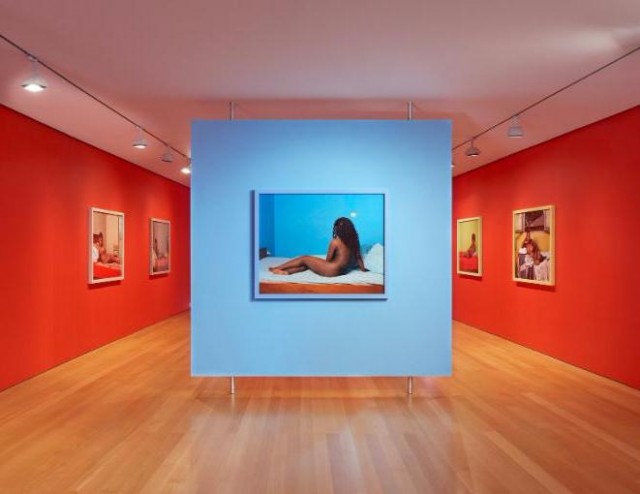
Hank Willis Thomas installation in MetroTech Commons explores different aspects of truth around the world (photo by twi-ny/mdr)

MetroTech Commons, Brooklyn
The Truth Booth: Thursday, October 15, free, 12 noon – 8:00 pm
Fall Talks: The New School, Wednesday, October 21, $10, 6:30
Installation continues through June 3, 2016
publicartfund.org
the truth is i see you slideshow

Throughout his career, Brooklyn-based visual artist Hank Willis Thomas has attempted to uncover the truth while investigating race, popular culture, gender, branding, and commodification. In works such as “B®ANDED,” “Unbranded,” “What Goes without Saying,” and “All Things Being Equal . . . ,” Thomas strips away the surface of media and advertising to get to the heart of black identity in America. For his latest work, the Public Art Fund project “The Truth Is I See You,” Thomas has filled the main walkway in MetroTech Commons with twenty-two speech bubbles of varying sizes, mounted near the tops of lampposts, each a quote about truth, in English on one side and in a foreign language spoken in Brooklyn on the other. Each bubble is accompanied by a placard that gives the translation and pronunciation of the phrase in the second language, all of which are from a poem written together by Thomas and ©ause Collective cofounder Ryan Alexiev: “The truth is I love you / The truth is I know you /The truth is I see you / The truth is I hear you / The truth is I feel you / The truth is I respect you / The truth is I follow you / The truth is I choose you / The truth is I remember you / The truth is I remind you / The truth is I liberate you / The truth is I believe you / The truth is I am you / The truth is I understand you / The truth is I need you / The truth is I miss you / The truth is I reflect you / The truth is I accept you / The truth is I trust you / The truth is I support you / The truth is I balance you / The truth is I welcome you.”

(photo by twi-ny/mdr)

Visitors will be able to share their own thoughts on truth on October 15 in MetroTech Commons (photo by twi-ny/mdr)

Among the languages are Swahili, Italian, French, Japanese, Russian, Chinese, Yiddish, Vietnamese, and Hebrew. In the center of the path is a video monitor playing “In Search of the Truth,” consisting of clips of various people finishing the statement “The truth is . . .” that they recorded in the large, inflatable “Truth Booth,” a collaboration between Thomas, Alexiev, and Jim Ricks of the ©ause Collective that has been traveling around the world, stopping in Afghanistan, Ireland, and South Africa as well as the U.S. so far. Meanwhile, across the commons, a metal tree with bare branches holds aloft a half dozen cushiony speech bubbles that spell out “The truth is I love you,” along with question marks. “The Truth Is I See You” makes a powerful statement about inclusion, referencing America’s supposed melting pot, particularly in a borough containing so many different ethnicities. On October 15 from 12 noon to 8:00, “The Truth Booth” will be in MetroTech Commons, where visitors are invited to add their own thoughts about truth. Thomas also has contributed to the Public Art Fund group show “Image Objects” in City Hall Park (through November 20); his sculpture, “Liberty,” features a purple arm spinning a basketball atop a plinth. And on October 21, Thomas will be at the New School for a Public Art Fund Talk as part of the “Public Context, Private Meaning” series. (Thomas can also be seen in Thomas Allen Harris’s 2014 documentary, Through a Lens Darkly: Black Photographers and the Emergence of a People, based on the book Reflections in Black: A History of Black Photographers 1840 to the Present by his mother, Deborah Willis.)

LIVE FROM THE NYPL: TA-NEHISI COATES / KHALIL GIBRAN MUHAMMAD

(photo by Nina Subin)

Ta-Nehisi Coates will discuss his incendiary new book at the New York Public Library on October 13 (photo by Nina Subin)

Who: Ta-Nehisi Coates and Khalil Gibran Muhammad
What: Live from the NYPL
Where: New York Public Library, Stephen A. Schwarzman Building, Celeste Bartos Forum, Fifth Ave. at 42nd St., 917-275-6975
When: Tuesday, October 13, $25-$40, 7:00
Why: With Between the World and Me (Spiegel & Grau, July 2015, $24), Atlantic national correspondent Ta-Nehisi Coates has written one of the most important books ever about the history of institutionalized racism in the United States, an intimate, angry, and eye-opening treatise in the form of a cautionary tale being told to his adolescent son. Coates, who also wrote the 2008 memoir The Beautiful Struggle: A Father, Two Sons, and an Unlikely Road to Manhood, holds nothing back in the new book, telling his son about the danger the black body is in every day in America. He writes about his childhood, the lessons he learned from his father, his experiences attending Howard University (which he calls the Mecca), and the tragedies involving Eric Garner, Michael Brown, Tamir Rice, Renisha McBride, John Crawford, and other African Americans killed by white police officers. Although the book is a mere 156 pages, it is a dense read; you’ll want to pore over passages again and again to get the full effect of what Coates is saying. And nearly every page is filled with quotes you’ll want to remember and share with others, stinging indictments of the current state of the nation. “Race is the child of racism, not the father. And the process of naming ‘the people’ has never been a matter of genealogy and physiognomy so much as one of hierarchy,” he explains early on. “Difference in hue and hair is old. But the belief in the preeminence of hue and hair, the notion that these factors can correctly organize a society and that they signify deeper attributes, which are indelible — this is the new idea at the heart of these new people who have been brought up hopelessly, tragically, deceitfully, to believe that they are white.” Between the World and Me is a book that should be required reading in every high school in America. Coates will be at the New York Public Library on October 13 to discuss the state of racism and more with Schomburg Center for Research in Black Culture director Khalil Gibran Muhammad.

WILLIAM KENTRIDGE IN NEW YORK

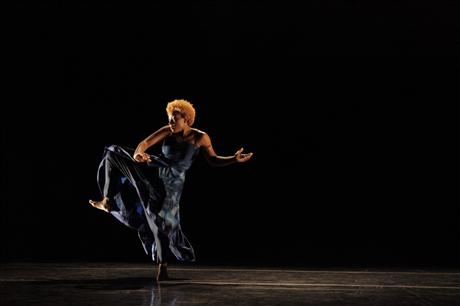
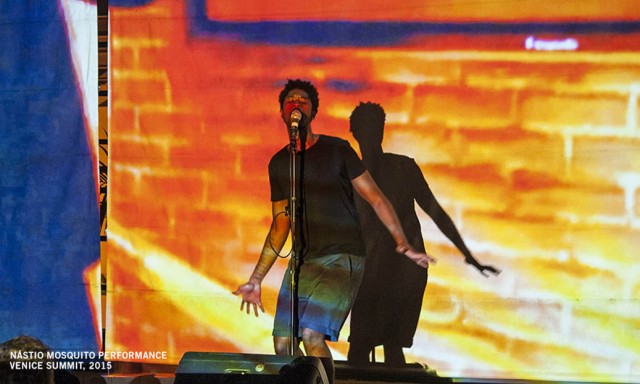
William Kentridge invades New York this fall with an opera at the Met, a performance at BAM, and a number of discussions and lectures (photo courtesy the Metropolitan Opera)

William Kentridge invades New York this fall with an opera at the Met, a multimedia performance at BAM, and a number of discussions and lectures (photo courtesy the Metropolitan Opera)

When William Kentridge comes to town, he really comes to town. Back in 2010, the South African multidisciplinary artist was all over New York City, with the smashing “Five Themes” retrospective at MoMA, his production of Shostakovich’s The Nose at the Metropolitan Opera, a unique artist book at Dieu Donné, a screening of some of his animated films accompanied by live music at the World Financial Center, and a performance of his one-man show “I am not me, the horse is not mine” at MoMA. He’s back in the city this fall, with a host of wide-ranging events, exhibits, and performances all over town. On October 12 (free, 7:00), he’ll be giving a lecture, “The Sentimental Machine,” at the New York Studio School of Drawing, Painting & Sculpture. On October 13 ($30, 6:30), he’ll be at the Metropolitan Museum of Art, in conversation with printer Andrew Hoyem in the Grace Rainey Rogers Auditorium discussing the limited-edition letterpress book The Lulu Plays, delving into the nature of human imagination and time. On October 14 (free, 5:00), Kentridge will deliver the Belknap Lecture at Princeton, “O Sentimental Machine,” about his Trotsky-inspired multimedia installation.

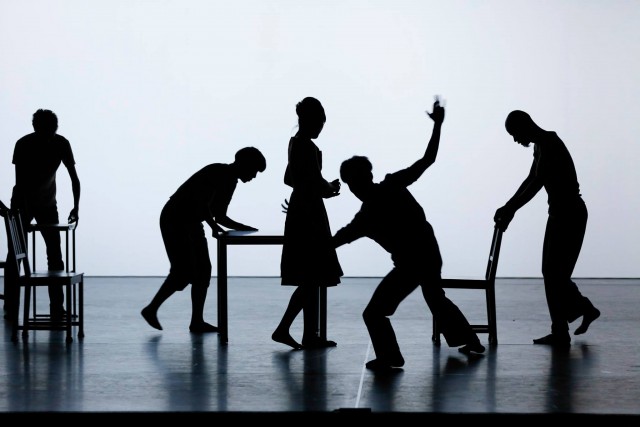
From October 22 to 25 ($30-$100), Kentridge teams up with longtime collaborator Philip Miller for the audiovisual chamber opera Refuse the Hour at the BAM Harvey, a wildly inventive lecture-performance with dance, music, projections, and more, a companion piece to his wildly inventive “The Refusal of Time” 2013 installation at the Metropolitan Museum of Art. In conjunction with Refuse the Hour, Kentridge will be at BAM Rose Cinemas on October 24 ($15, 5:00) for a discussion with physicist and Refuse the Hour collaborator Peter Galison, moderated by Dennis Overbye. From November 2 to December 31 (free), the Marian Goodman Gallery will be showing works by Kentridge in the third-floor project room. From November 4 to 8 ($10-$40), The Lulu Plays will be on view at the IFPDA Print Fair at the Park Avenue Armory. And from November 5 through December 3 ($27-$335), there will be eight performances of Kentridge’s four-hour-plus version of Alban Berg’s Lulu at the Met, featuring Marlis Petersen in the title role, Susan Graham as Geschwitz, Paul Groves as the painter and the African prince, and Johan Reuter as Dr. Schön and Jack the Ripper, conducted by Lothar Koenigs. We’re exhausted just reading about all the sixty-year-old Kentridge has planned; we can’t even begin to imagine doing it all, but we’re going to see as many of these events as we can, and we urge you to do the same.

PALEYFEST NY

The real Tatiana Maslany will be at PaleyFest NY to discuss ORPHAN BLACK

The real Tatiana Maslany will be at PaleyFest NY on October 18 to talk about her hit BBC America show, ORPHAN BLACK

The Paley Center for Media
25 West 52 St. between Fifth & Sixth Aves.
October 10-19, $10 (Viewing Room) – $50 (main theater)
paleycenter.org

It’s time to stop all that binge-watching, get off the couch, and actually go outside, where you can see the real deal at PaleyFest NY, taking place October 10-19 at the Paley Center for Media in Midtown. Each day, the Paley Center will be featuring a panel discussion on a different series, with many of the stars and creators in person to talk about the show. Some events ($50) are already sold out, but you can still get a ticket ($10) to watch them projected live in the Viewing Room. Things kick off on October 10 with “Dr. Horrible’s Sing-Along Blog Reunion,” gathering together Neil Patrick Harris, Nathan Fillion, Felicia Day, and Joss Whedon. That is followed by Pretty Little Liars (Lucy Hale, Ashley Benson, Troian Bellisario, Sasha Pieterse, I. Marlene King, Oliver Goldstick, Joe Dougherty), The Affair (Dominic West, Ruth Wilson, Maura Tierney, Joshua Jackson, Josh Stamberg, Julia Goldani Telles, Sarah Treem), Ash vs Evil Dead (Bruce Campbell, Lucy Lawless, Ray Santiago, Dana DeLorenzo, Jill Marie Jones, Sam Raimi, Craig DiGregorio), Mr. Robot (Rami Malek, Christian Slater, Carly Chaikin, Portia Doubleday, Sam Esmail), Fargo (Kirsten Dunst, Jesse Plemons, Jean Smart, Noah Hawley, Warren Littlefield), The Mindy Project (Mindy Kaling, Ike Barinholtz, Ed Weeks, Beth Grant, Xosha Roquemore, Matt Warburton, Charlie Grandy, Tracey Wigfield, Lang Fisher, Chris Schleicher, David Stassen), Orphan Black (Tatiana Maslany, Jordan Gavaris, Maria Doyle Kennedy, Kristian Bruun, Graeme Manson), and Transparent (Jeffrey Tambor, Judith Light, Amy Landecker, Jay Duplass, Gaby Hoffmann, Jill Soloway).

A WOMAN LIKE ME

Alex Sichel and Lily Taylor

Filmmaker Alex Sichel and her onscreen alter ego, actress Lili Taylor, face mortality head-on in A WOMAN LIKE ME

A WOMAN LIKE ME (Alex Sichel & Elizabeth Giamatti, 2015)
Village East Cinemas
181-189 Second Ave. at 12th St.
Opens Friday, October 9
212-529-6799
www.awomanlikemefilm.com
www.villageeastcinema.com

When filmmaker Alex Sichel was diagnosed with metastatic breast cancer a few years ago, she turned to her stock in trade: making movies. But Sichel, the writer-director of the indie gem All Over Me and an episode of HBO’s If These Walls Could Talk 2 starring Michelle Williams and Chloë Sevigny, decided to share her situation in an unusual way, combining documentary with fiction in the intimate, moving A Woman Like Me. In the film, which she codirected with Elizabeth Giamatti, Sichel shows herself going through chemotherapy, meeting with holistic healers, and dealing with family issues with her husband, Erich Hahn, who is not exactly thrilled with many of his wife’s choices and constantly being on camera himself; their seven-year-old daughter, Anastasia, with whom they have chosen not to share the details of Sichel’s illness; and Sichel’s parents and sisters, who have their own opinions about how she should be facing her cancer, which doctors say is terminal. As the film opens, Sichel’s voice floats over a black screen, talking about the Buddhist meditation on death. “The point is, we’re all going to die, and it sounds so obvious, but that’s the point that I don’t accept,” she says. “Somehow I’m going to be the exception. It’s crazy.”

Alongside the documentary part of A Woman Like Me, Sichel is also making a fictionalized account of what she’s going through, with Lili Taylor as Anna Seashell, Jonathan Cake as her husband, Walter, and Maeve McGrath as their young daughter, Zoe. “The only way you even have a chance of living longer with the disease is if you face your fear of death, and the movie is a way of trying to do that,” Sichel says in voiceover as Taylor walks over to a window, puts her hands on the glass, and looks out as, ultimately, Sichel watches the scene unfold on her director’s monitor. It’s a powerful moment, as is a scene in which Sichel and Taylor go over the script together. Sichel is bold and blunt throughout A Woman Like Me, especially when her situation worsens, but she’s able to temper her fears by having her fictional self face death in a much more positive light. Despite its serious subject matter, A Woman Like Me is a celebration of life that avoids mundane sentimentality and self-indulgence, instead intelligently and honestly depicting how one brave woman and her family come to grips with mortality. “How do you make a movie about cancer,” Sichel says into the camera after undergoing a medical test. She and Giamatti have certainly found one unusual, and successful, way. Winner of the SXSW Special Jury Prize for Directing, A Woman Like Me opens October 9 at Village East, with panel discussions taking place after the 7:00 shows on October 9, 10, 11, and 13 and the 4:30 screenings on October 10 and 11.