this week in lectures, signings, panel discussions, workshops, and Q&As

NEW EAR FESTIVAL

Phill Niblock will be at Fridman Gallery for inaugural New Ear Festival on January 9

Phill Niblock will be at Fridman Gallery for inaugural New Ear Festival on January 9

Fridman Gallery
287 Spring St. by Hudson St.
January 6-12, $10 unless otherwise noted ($50 festival pass), 8:00
www.fridmangallery.com

New to the January performance festivals (COIL, Under the Radar, Prototype, American Realness, APAP) is the New Ear Festival, a celebration of sound art hosted by SoHo’s Fridman Gallery and MC Mona Chromatic. More than fifteen sound artists will be presenting works from January 6 to 12, beginning with the pairing of composer and experimental turntablist Marina Rosenfeld and Ben Vida, who enjoys recalibrating people’s ears. The impressive lineup on January 7 features Byron Westbrook, who incorporates social engagement into his work, former punk guitarist and Nam June Paik collaborator Stephen Vitiello, and improvisational electric accordionist Andrea Parkins. January 8 brings together Leila Bordreuil with Peter Evans, Jaimie Branch, and Joanna Mattrey. On January 9, multimedia minimalist Phill Niblock will be on hand for a screening of Maurits Wouters’s new documentary, The Movement of Phill Niblock, and the New York premiere of piece by guitarist David First. On Sunday, January 10, a video and sound installation by Cecilia Lopez will be on view (suggested donation, 12 noon – 8:00 pm). On January 11, the event series CT::SWaM (Contemporary Temporary:: Sound Works and Music) will present sound works and discussions. The inaugural festival concludes on January 12 (suggested donation) with Kevin Beasley’s Listening Room with Taja Cheek, Eli Keszler, Malik Gaines, and Yulan Grant. If you miss any of the performances, you can catch them later online here.

UNDER THE RADAR FESTIVAL

(photo by Laura Fouqueré)

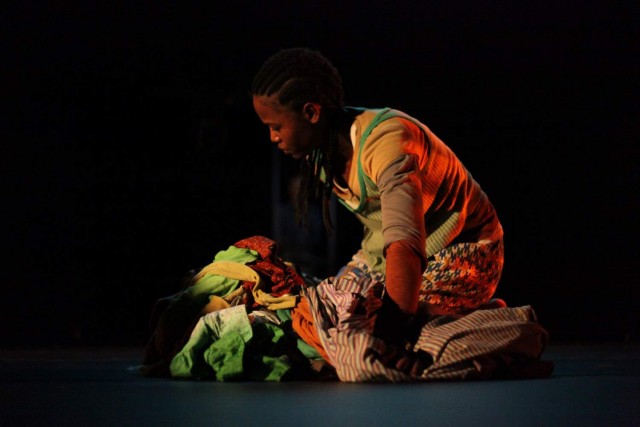
Dorothée Munyaneza and Compagnie Kadidi’s SAMEDI DÉTENTE is part of Public Theater’s annual Under the Radar Festival (photo by Laura Fouqueré)

The Public Theater unless otherwise noted
425 Lafayette St. by Astor Pl.
January 6-17, $25 unless otherwise noted
212-967-7555
www.undertheradarfestival.com

The Public Theater’s 2016 Under the Radar Festival features eighteen innovative music, dance, and theater hybrids from around the globe, taking place primarily at the Public’s many stages. The fun begins with the French duo of Halory Goerger and Antoine Defoort and Germinal (January 6-9, the Public’s Newman Theater), who use the magic of theater to build the world from scratch. Lars Jan and Early Morning Opera combine a 1950s typewriter with kinetic light sculptures in The Institute of Memory (TIMe) (January 8-17, the Public’s Martinson Hall), as Jan delves into his father’s past as a Cold War operative. Director Andrew Scoville, composer Joe Drymala, technologist Dave Tennent, and writer Jaclyn Backhaus team up for the live podcast People Doing Math Live! (January 8 & 17, the Public’s Shiva Theater), complete with audience participation. Canadian duo Liz Paul and Bahia Watson’s two-woman show pomme is french for apple returns to Joe’s Pub on January 10 & 17, exploring womanhood in unique ways. DarkMatter, the trans South Asian spoken-word duo of Alok Vaid-Menon and Janani Balasubramanian, will perform the concert #ItGetsBitter at Joe’s Pub on January 12 & 14. Individual tickets for Martha Redbone’s new Bone Hill (January 13-16, Joe’s Pub), a collaboration with Aaron Whitby and Roberta Uno, are sold out, but you can still catch the show as part of a UTR Pack (five shows for $100). Nikki Appino and Saori Tsukuda’s Club Diamond (January 13 & 17, Shiva) combines silent film, live music, and Japanese techniques to explore the concept of truth in thirty-five minutes. Dorothée Munyaneza, who was born in Rwanda and currently lives in France, brings her Compagnie Kadidi to the Public’s LuEsther Hall for Samedi détente (January 14-17), looking back at the 1994 genocide, joined by Ivorian dancer Nadia Beugré and French musician Alain Mahé. Japan’s Toshiki Okada, who was previously at UTR in 2011 with Hot Pepper, Air Conditioner, and the Farewell Speech and in 2013 with the Pig Iron Theatre Company for Zero Cost House, will be back at Japan Society with God Bless Baseball (January 14-17, $35), which examines America’s pastime in Korea and Japan.

(photo by Nadya Kwandibens)

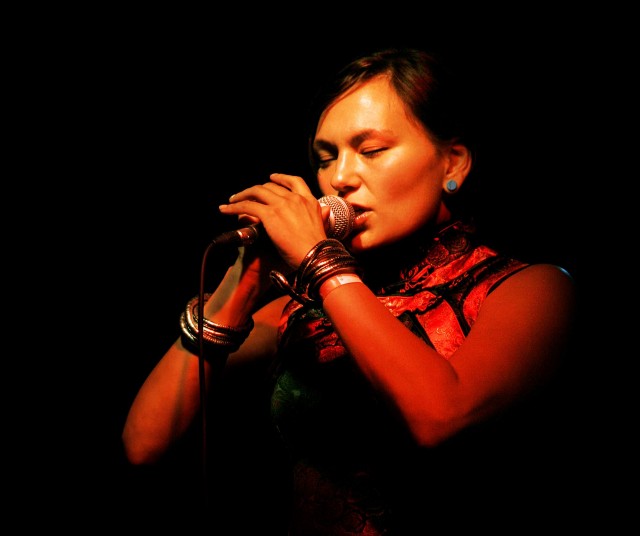
Canadian Inuit throat singer Tanya Tagaq takes a unique look at NANOOK OF THE NORTH at Under the Radar Festival (photo by Nadya Kwandibens)

Canadian Inuit throat singer Tanya Tagaq will perform live to Robert J. Flaherty’s 19922 silent film, Nanook of the North, January 15-17 at the Newman, reclaiming her heritage, joined by percussionist Jean Martin and violinist Jesse Zubot. The 2016 Under the Radar Festival also includes 600 Highwaymen’s Employee of the Year (January 7-17, Martinson Hall), Royal Osiris Karaoke Ensemble’s The Art of Luv (Part I): Elliot (January 8-17, the Public’s Anspacher Theater), Sister Sylvester’s They Are Gone But Here Must I Remain (January 9 & 16, Shiva), I Am a Boys Choir’s demonstrating the imaginary body or how i became an ice princess (January 10 & 16, Shiva), Ahamefule J. Oluo’s Now I’m Fine (January 12-17, Newman), Guillermo Calderón’s Escuela (January 13-17, LuEsther Hall), Wildcat!’s I Do Mind Dying — Danse Précarité (January 14 & 17, Shiva), and Dane Terry’s Bird in the House (January 15-16, Shiva). In addition, numerous performances will be followed by Q&As with members of the creative teams, and there will be two free round-table discussions at the Public, “Assembly Required: New Media, New Dramaturgies” with Jan, André M. Zachery, and others on January 16 at noon and “Destroyer of Worlds” with Janani Balasubramanian, Abigail Browde, Calderón, Michael Silverstone, and Vaid-Menon on January 17 at noon.

THE GOLDEN BRIDE (DI GOLDENE KALE)

(photo by Ben Moody)

The National Yiddish Theatre Folksbiene inaugurates its new home at the Museum of Jewish Heritage with THE GOLDEN BRIDE (photo by Ben Moody)

Museum of Jewish Heritage — A Living Memorial to the Holocaust
Edmond J. Safra Plaza, 36 Battery Pl.
Tuesday-Wednesday and Thursday-Sunday through January 3, $40
866-811-4111
nytf.org
www.mjhnyc.org

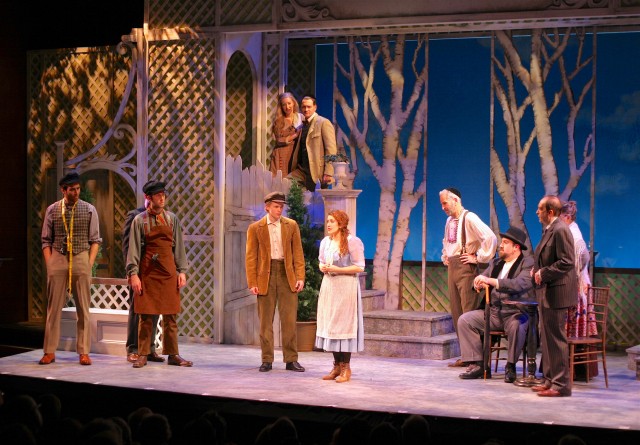
The utterly delightful Yiddish operetta The Golden Bride returns to New York City at just the right time, a very tasty appetizer to the latest Broadway revival of Fiddler on the Roof. But the work, known in Yiddish as Di Goldene Kale, is more than just a mere precursor to the award-winning 1964 musical and 1971 film about the Jewish experience in Tsarist Russia; it stands alone as an engaging celebration of shtetl life as it explores the hopes and dreams of its many charming characters. The operetta premiered in February 1923 at the two-thousand-seat Second Avenue Theater and ran for eighteen weeks before going on tour around America and the world; it was last performed in 1948 before disappearing into obscurity until musicologist, librarian, and editor Michael Ochs uncovered parts of the long-lost work while preparing an exhibition in 1992, then spent more than two decades putting it back together again. The new production kicks off the National Yiddish Theatre Folksbiene’s 101st season, the first in its cozy new 375-seat home in Edmond J. Safra Hall at the Museum of Jewish Heritage. In a small, close-knit Russian village, Goldele (Rachel Policar), an abandoned child raised by innkeepers Pinkhes (Bruce Rebold) and Toybe (Lisa Fishman), has suddenly come into a large inheritance at the death of her long-absent father, making her the most desirable woman in the shtetl. She is in love with Misha (Cameron Johnson), Pinkhes and Toybe’s handsome son, but she offers her hand in marriage to any man who can find her mother, who she is sure is still alive. Thus, cobbler Berke (Jeremy Weiss), choir singer Motke (Zachary Spiegel), and tailor Yankl (Adam Kaster) set off in a race with Misha to track down Goldele’s mother and marry the Golden Bride, who in the meantime is moving to America to live with her uncle Benjamin (Bob Ader), whose wealth has already turned the shtetl “upside-down,” as Pinches and Toybe exclaim, with the help of the chorus, “We’ll become as rich as Korach, / We’ll live, laugh, it’ll be a sensation. / The dear millionaire will be my guest, / The dear millionaire will be his guest, / I’ll give him kugel with tsimmes. / She’ll give him kugel with tsimmes.” However, Benjamin wants Goldele to marry his son, Jerome (Glenn Seven Allen), who just happens to be smitten with Khanele (Jillian Gottlieb), Pinkhes and Toybe’s daughter. “Don’t you know what I want? Come here, I’ll tell you. I want a kiss from your sweet little lips,” Jerome says to Khanele, who replies, “Oh, go away — it’s Sabbath already.” “You shouldn’t kiss on Sabbath?” Jerome asks, to which Khanele declares, “Certainly you shouldn’t. A lot you know about Judaism! Even a goy knows more than you.” In the second act, the action travels overseas to America, where everyone tries to establish their future, built on love and money.
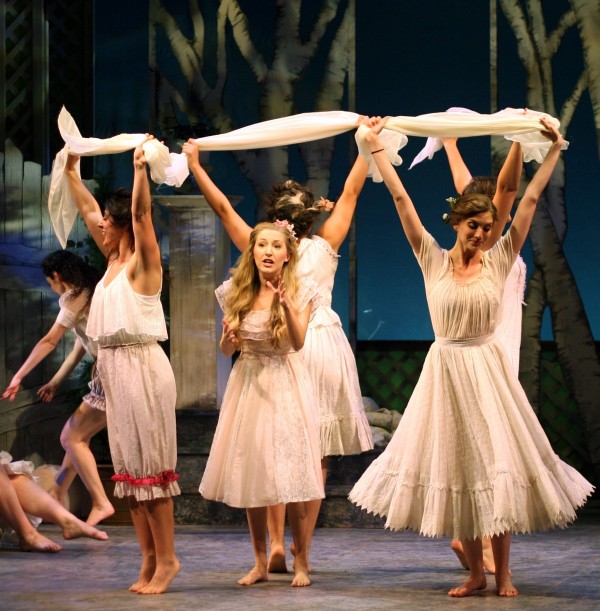
(photo by Ben Moody)

The fully restored Yiddish theater favorite DI GOLDENE KALE kicks off the National Yiddish Theatre Folksbiene’s 101st season in a big, delightful way (photo by Ben Moody)

Performed in Yiddish with English and Russian supertitles, The Golden Bride is a complete and utter joy from start to finish. The music, by little-known Lithuanian composer Joseph Rumshinsky, who actually wrote nearly one hundred Yiddish operettas, is light and bouncy, while the lyrics, by Ukrainian-born Louis Gilrod, are endearing and playful. The libretto, written by Polish native Frieda Freiman but originally published under her husband’s name, is sweet and witty. “Listen to me, friends,” Misha says when defending his love of Goldele to her other suitors. “I have a cure for your loving hearts. Each of you take a large piece of wood and knock the foolishness out of your heads.” While there is no evidence that Fiddler on the Roof lyricist Sheldon Harnick and book writer Joseph Stein ever saw or read The Golden Bride or that Rumshinsky, Freiman, and Gilrod (who all moved to America from Eastern Europe between the ages of twelve and twenty-two) were influenced by the Sholom Aleichem stories that formed the basis of Fiddler, many intriguing similarities and coincidences abound between the two works, from dialogue (Jerome seriously asks Khanele, “Do you love me?” recalling what Tevye asks his wife, named, er, Golde) to subplots (matchmaker Kalmen goes through his little black book, trying to find husbands for several young women, including one named, er, Yente: “I have for you a bridegroom, a ‘waiter’ who washes ‘dishes,’ / He’s also a ‘salesman’ at Yonah Schimmel’s Knishes”) to the general depiction of shtetl life. However, Anatevka has a very different fate in store for its residents, as Fiddler is far more political and heartbreakingly realistic than Bride, although the latter did come out right before the Immigration Act of 1924 (aka the National Origins Act), which set a restrictive quota on immigration to the U.S. from Eastern Europe and Asia. The actors, most of whom don’t know Yiddish and so perform their parts phonetically, are excellent, led by Policar, who has major operatic chops, her voice echoing beautifully throughout the theater, and Johnson, with strong turns by Rebold, Fishman, Adam B. Shapiro offering comic relief as Kalmen and the women’s chorus/ensemble of Amy Laviolette, Tatiana Wechsler, Jessica Kennedy, Liza Miller, Isabel Nesti, and Alexis Semevolos. National Yiddish Theatre Folksbiene artistic director Zalmen Mlotek conducts the fourteen-piece orchestra, situated behind the stage, while choreographer Merete Muenter makes clever use of the crowded set, which features a whimsical, homey design by John Dinning. To answer Jerome’s question, “Do you love me?” we say, yes, yes, we do love you!

(The National Yiddish Theatre Folksbiene and the Museum of Jewish Heritage have teamed up to provide free shuttle bus service to and from Columbus Circle for each performance. NYTF is also offering a free fifteen-minute Yiddish lesson and history of Yiddish theater forty-five minutes before each show. And on December 26 at 8:00, the museum will host “Dreaming in Yiddish: The Fourth Annual Adrienne Cooper Memorial Concert,” with Frank London, Sarah Gordon, Michael Winograd, and Joshua Dolgin presenting an evening of music from the 1999 album In Love and in Struggle: The Musical Legacy of the Jewish Labor Bund.)
GOLDBERG: IGOR LEVIT & MARINA ABRAMOVIĆ

(photo by James Ewing)

Marina Abramović, Urs Schönebaum, and Igor Levit collaborate on a whole new way to experience live music (photo by James Ewing)

Park Ave. Armory, Wade Thompson Drill Hall
643 Park Ave. between 66th & 67th Sts.
December 7-19, $65
212-933-5812
armoryonpark.org

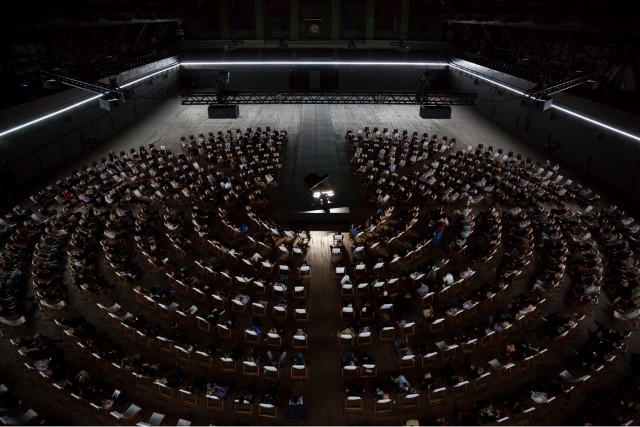
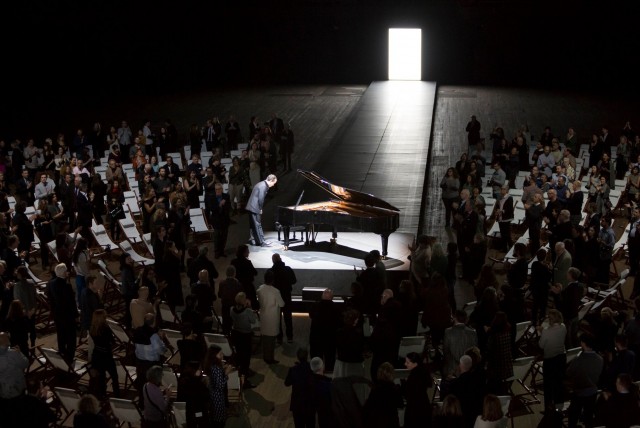
In many ways, Marina Abramović’s latest work, “Goldberg,” is a combination and the culmination of the ideas explored in her past half-decade of shows, this time focusing on the creation of a bold new way to experience live music. In 2010, the Serbian-born, New York–based performance artist spent 736½ hours in MoMA’s Donald B. and Catherine C. Marron Atrium sitting in a chair and locking eyes with individual museumgoers for extended periods of time as the highlight of her widely hailed participatory career retrospective “The Artist Is Present.” In December 2013, she examined her life and death in Robert Wilson’s visual spectacle The Life and Death of Marina Abramović at the Park Avenue Armory. And in last fall’s “Generator,” Abramović had visitors wear blindfolds and noise-canceling headphones as they moved across an empty space at Sean Kelly Gallery, occasionally making contact with others as well as the artist, who was often present, taking part in the show. For “Goldberg,” ticket holders arrive at the Park Avenue Armory and are asked to place all electronic devices (and coats and bags) in a locker, then are given a pair of noise-canceling headphones as they enter the fifty-five-thousand-square-foot Wade Thompson Drill Hall. At the center of the vast space are circular rows of white-cloth lounge chairs; people can sit anywhere, as it is general admission seating. The chairs are purposely set up a small distance away from one another to allow each person an individual, private experience. You are not meant to move your chairs together and chatter away (as the trio in front of me did) but instead relax, take in the atmosphere, and begin to focus on the performance at hand. Four screens have been set up on the four sides of the hall, blasting blazing white light, as if a visual white noise that is changing your perspective. Urs Schönebaum’s lighting design also includes a narrow band of light running around all four walls. At the far west end, pianist Igor Levit, who made his North American recital debut in March 2014 in the armory’s Board of Officers Room, sits at a Steinway grand piano. Soon a gong sounds, signaling everyone to put on their headphones. Over the course of the next fifteen minutes or so (exact time is not of the essence here), Levit and the piano slowly move to the center of the arrangement of chairs. Another gong sounds, the screens go blank, headphones are removed, and the Nizhny Novgorod–born pianist starts playing J. S. Bach’s Goldberg Variations as the piano makes one intensely slow revolution and he performs the gorgeous 1742 aria with thirty variations.

Igor Levit gives a performance for the ages at the Park Avenue Armory (photo by James Ewing)

Igor Levit gives a performance for the ages at the Park Avenue Armory (photo by James Ewing)

In a 2010 interview with the Wall Street Journal, Abramović said, “We always project into the future or reflect in the past, but we are so little in the present.” With “Goldberg,” she and Levit are practically forcing the audience to be present, to be in the moment. Removing nearly all distractions — without cell phones, watches, cameras, bags, or even a program (which are distributed on the way out) — Abramović and Schönebaum are making this experience all about the music, and what music it is, an absolutely dazzling performance by Levit, a rising star in the classical world. The twenty-eight-year-old plays the Goldberg Variations without sheet music, his hands making love to the keys, crossing each other and descending from above as he lifts his elbows with lovely flourishes. As he plays, his body sways in all directions, giving a physical quality to the music even as the three collaborators have conceived of this piece as a kind of celebration of immateriality. It’s also as if the concert is being performed just for you; when fully reclined in the chair, you cannot easily shift your body to look at the people next to you or, of course, behind you; instead, your head is positioned to face Levit only, and there is really no reason to look anywhere else. Aside from an occasional snore — the seats are rather cozy, and what would a classical concert be without at least some snoozing — the only thing to be heard is the glorious music, which has a palpable energy all its own. “To play this work, to love it and to listen to it is an experience second to none,” Levit says in the program. “Every aspect of human nature can be relived. At the end words cannot describe it. We shouldn’t discuss this work. We should and indeed can experience it. What a pleasure!” We can’t explain it any better than that. On opening night, Abramović was hanging out in the halls of the armory before the show, greeting friends and expressing her nervousness. At the end of the performance, Levit ran into the audience and gave Abramović a great big hug, filled with what appeared to be both relief and release. Thus, the artist was indeed present, and so was the audience. Now, if we can only apply Abramović’s method to film and theater…. (On December 13 at 5:00, Levit and Abramović will take part in a discussion moderated by outgoing armory artistic director Alex Poots. And you can listen to Levit’s performance of the Goldberg Variations at home on his latest album, Bach, Beethoven, Rzewski [Sony Classical, October 2015, $24.99], which also includes Beethoven’s Diabelli Variations and Frederic Rzewski’s “The People United Will Never Be Defeated!”)

A NIGHT OF KYOGEN WITH MANSAKU NOMURA AND MANSAKU-NO-KAI KYOGEN COMPANY

Japan Society
333 East 47th St. at First Ave.
December 10-12, $55-$85, 7:30
212-715-1258
www.japansociety.org
www.mansaku.co.jp

A Living National Treasure of Japan, Mansaku Nomura brings the troupe founded by his father in 1957, the Mansaku-no-Kai Kyogen Company, to Japan Society for three nights of performances of the six-hundred-year-old art form known as kyogen, a uniquely Japanese take on satirically comedic theater that was a kind of alternative to the much more serious noh discipline. (UNESCO has declared both to be Masterpieces of Oral and Intangible Heritage of Humanity.) Mansaku Nomura will be joined by his son, Mansai Nomura, and Yukio Ishida, each of whom has been designated a Holder of Important Intangible Cultural Property: Nohgaku, in three short plays each evening. In the solo piece Nasu no Yoichi, based on a chapter from The Tale of the Heike, Mansaku Nomura, who has been acting since he was three years old, trained in kyogen by his father and grandfather, portrays the title samurai who fought bravely in the Genpei War, in addition to three other characters. Mansai Nomura, who is most well known for playing Abe no Seimei in the two Onmyoji films and is also the artistic director of Setagaya Public Theatre, stars in Akutaro (Akutaro Reforms) as a young rebel seeking repentance. (Mansai Nomura was previously seen in New York City in March 2013 in Sanbaso, Divine Dance, a collaboration with Hiroshi Sugimoto that was copresented by Japan Society at the Guggenheim.) And in Bonsan (The Dwarf Tree Thief), a not-very-successful robber is intent on stealing a dwarf tree even as he’s taunted by the master of the house. At the center of kyogen is a focus on human imperfection, approached from a comic angle. Each performance will be preceded by a 6:30 lecture by Dr. Carolyn Morley, professor of Japanese literature and theater at Wellesley College. The celebration of kyogen, which means “mad words” or “wild speech,” also includes a Kyogen Movement Workshop for Kids on December 12 at 10:30 am ($20) and the adult program Kyogen Workshop: Movement + Voice on December 12 at 2:00 ($55), led by Mansai Nomura.

HIMALAYAN STYLE: HOW TO REBUILD NEPAL

(photo by Thomas Kelly)

Thomas L. Kelly and Claire Burkert explore ways to rebuild post-earthquake Nepal in discussion at Rubin Museum (photo by Thomas L. Kelly)

Who: Claire Burkert and Thomas L. Kelly
What: Himalayan Style: How to Rebuild Nepal
Where: Rubin Museum of Art, 150 West 17th St. at Seventh Ave., 212-620-5000
When: Wednesday, December 9, $20, 7:00
Why: Earlier this week, we returned from a seventeen-day visit to Kathmandu, where we saw firsthand the destruction wrought by the April and May 2015 earthquakes as well as the intoxicating resiliency of the Nepalese people, who are also currently in the midst of a significant fuel blockade imposed by India, with far-reaching effects. Among the most impressive things we witnessed during our travels was a stop in Bungamati, where an international group of architecture students are working hand-in-hand with local residents to help the community get itself back on its feet. On one wall in an old temple, Bungamati residents can indicate whether they will “clean up,” “reuse materials,” “rebuild,” “repair,” or “do nothing.” On December 9, a similar conversation will take place at the Rubin Museum of Art, when Janakpur Women’s Development Center founder Claire Burkert and photo-activist Thomas L. Kelly will discuss “Himalayan Style: How to Rebuild Nepal,” inspired by their book Himalayan Style (Roli, March 2015, $49.95), which came out shortly before the earthquake hit. Burkert, a crafts expert with Nepal’s Poverty Alleviation Fund, and Kelly, who runs Wild Earth Journeys with his wife, Carroll Dunham, will sign copies of the book after their illustrated lecture, which will include photographs Kelly has taken following the earthquakes, many of which you can see here. You can contact twi-ny directly if you are interested in seeing some of the photos we took in Nepal as well.

MATTHEW BARNEY AND JONATHAN BEPLER: RIVER OF FUNDAMENT

(photo by Hugo Glendinning)

Matthew Barney’s five-and-a-half-hour epic makes its Manhattan debut this weekend (photo by Hugo Glendinning)

RIVER OF FUNDAMENT (Matthew Barney & Jonathan Bepler, 2014)
IFC Center
323 Sixth Ave. at West Third St.
December 4-10, $14 per act, $40 series pass
212-924-7771
www.ifccenter.com

In February 2014, I experienced the entirety of Matthew Barney and Jonathan Bepler’s fecal epic, River of Fundament, in one marathon evening at the BAM Harvey, coming away impressed, confused, exhausted, and in need of a long, hot shower. And now you can feel the same as the bizarrely mesmerizing and surreal five-and-a-half-hour adventure flows into the IFC Center for a one-week engagement. Fortunately, you have the choice of seeing the cinematic journey in three acts on different days, or you can just check them out back-to-back-to-back, depending on your general level of comfort for these kinds of things. To help you make sense of it, Barney will be at the IFC Center for a Q&A following the 7:20 screening of act three on December 6; of course, that also has the potential to, er, clog your mind even further.

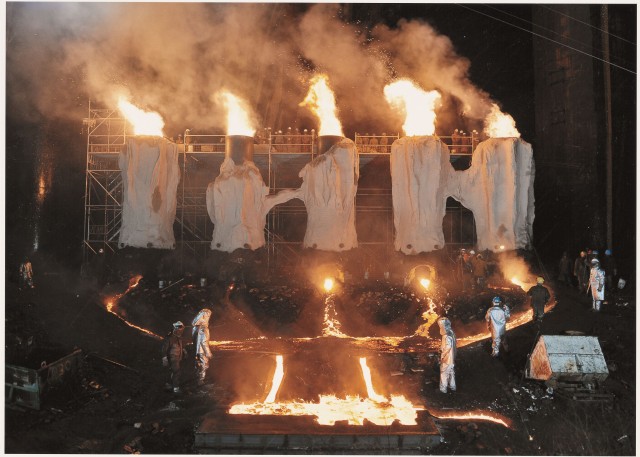
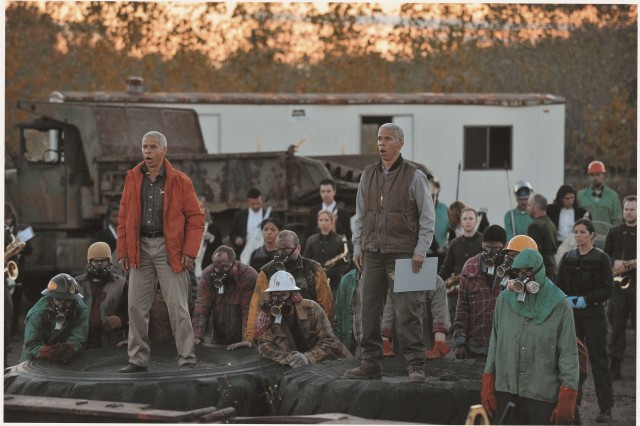
RIVER OF FUNDAMENT is built around episodes in Los Angeles, Brooklyn, and Detroit (photo by Ivano Grasso)

RIVER OF FUNDAMENT is built around episodes in Los Angeles, Brooklyn, and Detroit (photo by Ivano Grasso)

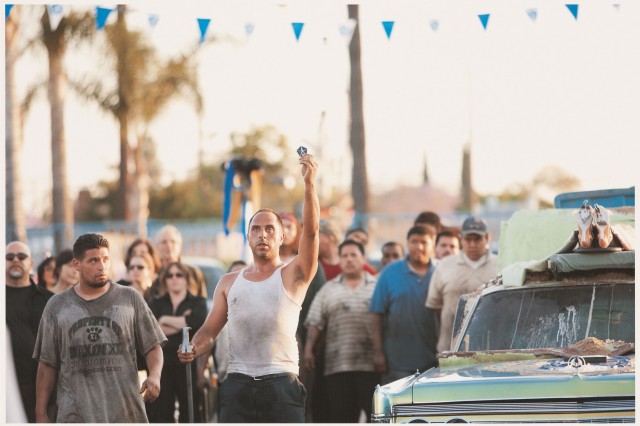
“Crude thoughts and fierce forces are my state. I do not know who I am. Nor what I was. I cannot hear a sound. Pain is near that will be like no pain felt before,” Norman Mailer writes at the beginning of his 1983 novel, Ancient Evenings. “Is this the fear that holds the universe? Is pain the fundament? All the rivers veins of pain? The oceans my mind awash? I have a thirst like the heat of earth on fire. Mountains writhe. I see waves of flame. Washes, flashes, flashes, waves of flame.” New York-based visual artist Barney and Berlin-based composer and musician Bepler have transformed Mailer’s seven-hundred-page epic about death and rebirth in Egypt into quite the cinematic spectacle. In his five-part, seven-hour Cremaster Cycle, Barney explored the ascension and descension of the cremaster muscle, which determines sexual differentiation, with a cast that included Mailer as Harry Houdini and Barney as Gary Gilmore in a section inspired by Mailer’s book The Executioner’s Song while focusing on cars and petroleum jelly in others. River of Fundament begins with Mailer’s wake at an intricate reconstruction of his Brooklyn Heights home, with Mailer’s son John Buffalo Mailer playing his father’s spirit. The second act follows the reincarnation of Mailer (Milford Graves) as he is born in the River of Feces and meets medium Hathfertiti (Maggie Gyllenhaal) and a gold 1979 Pontiac Firebird Trans Am. The third act returns to Brooklyn, with Mailer’s next reincarnation played by a 2001 Ford Crown Victoria Police Interceptor and Ellen Burstyn taking over as Hathfertiti. The primary cast also features Paul Giamatti, Cremaster star Aimee Mullins, Elaine Stritch, Lila Downs, Chief Dave Beautiful Bald Eagle, Joan La Barbara, and Madyn G. Coakley, with a multitude of cameos by Dick Cavett, Luc Sante, Larry Holmes, Salman Rushdie, Lawrence Weiner, Fran Lebowitz, Marti Domination, James Toback, David Amram, and dozens of others as the myth of Isis, Osiris, Nephthys, Set, and Horus plays out as well.

Cars once again are featured prominently in epic new Matthew Barney film (photo by Ivano Grasso)

Cars once again are featured prominently in epic new Matthew Barney film (photo by Ivano Grasso)

The action, much of which consists of filmed performance art presentations that were held in public spaces, moves from New York City to Los Angeles to Detroit as Egyptian mythology and ritual play out in unusual ways. Barney, whose multidisciplinary Cremaster exhibition at the Guggenheim in 2002-3 was one of the best of the decade, gave New Yorkers an advance sneak peek at the making of River of Fundament via the ”DJED” show at the Gladstone Gallery in the fall of 2011 and the wide-ranging “Subliming Vessel” at the Morgan Library in 2013. Not that they gave any real indication of what to expect, because with Barney, the only thing to expect is the unexpected. And even then, don’t expect to understand what is unfurling before you. Just know that once you take it all in, you will never be able to flush it out of your mind, where it will simmer and stew most likely for the rest of your natural life.