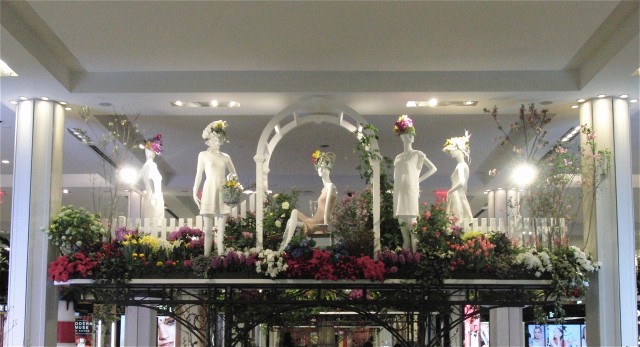
Spring has sprung, albeit with a little dusting of snow, so it’s time for Macy’s annual Flower Show, continuing in Herald Square through April 3. This year’s theme is “America the Beautiful,” as Macy’s celebrates the country geographically, with installations dedicated to the Shining Northeast Shores, the Pacific Northwest Wonderland, the Midwest Fruited Plains, the Enchanting Southeast, the Vast Southwest, and the Majestic Rocky Mountains.
Mannequins wear floral hats at Macy’s Flower Show (photo by twi-ny/mdr)
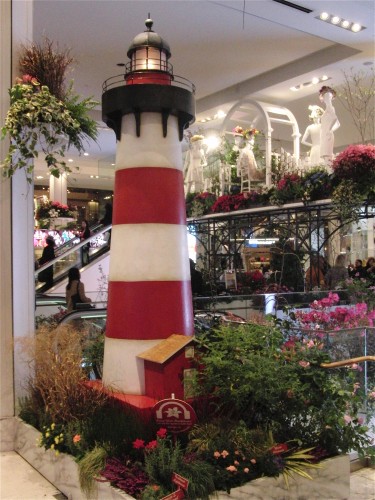
There’s a covered bridge, a lighthouse, white mannequins in floral hats, and window displays showing off Redwood trees, a cute house, blooms in the city and the desert, and blossoming in our nation’s capital. At the main entrance, Lady Liberty holds aloft her mighty flame. Among the special events are a daily bouquet by Kenji Takenaka, Jessy Wolvek, James François-Pijuan, Olivier Giugni, Yena Jung, and Jes Gordon, “Discover Your Scent” with Frank Voelki, Elizabeth Musmanno, and Ann Gottlieb on March 24 at 5:00, a Southwest Terrarium Seminar with Mike Stone on March 24 at 6:00, a Garden Cocktail Dress Party with live music also on March 24 at 6:00, and a Great Plains Wreath Making Seminar with American School of Flower Design director Michael Gaffney on March 26 at 1:00.
Lighthouse serves as a kind of homey beacon at Macy’s (photo by twi-ny/mdr)
In addition, there are flower seminars at 1:00 on the ninth floor on March 28 with Nic Faitos, March 30 with Tara Simone, and April 1 with Dimitri and Sara Gatanas. And on March 26 & 27, you can have Breakfast with the Easter Bunny at 9:00 or 10:30 ($40-$45) at Stella 34 Trattoria on the sixth floor. (The restaurant will be featuring specially selected flavors from around the country every day.) This year you can also follow along with Macy’s free Flower Show app, a guided audio tour through the various gardens, helping you to identify the desert rose, rhododendron, Asiatic lilies, sunflowers, beach plum, Spanish moss, agapanthus, azaleas, salvia, orchids, magnolias, and more. There are also unique gardens on the seventh and eighth floors, including one dedicated to Krazy Glue, of all things.
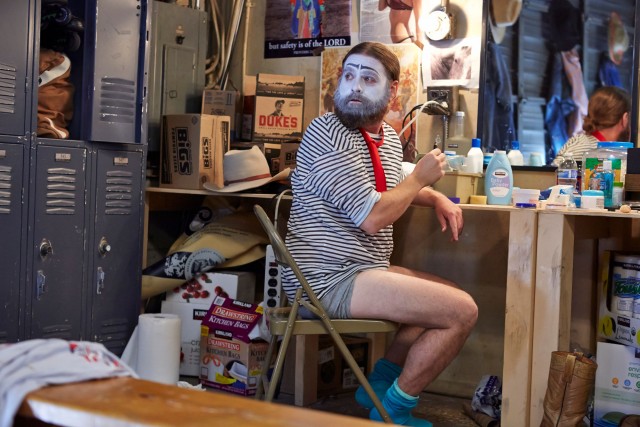
Nothing can stop Chip Baskets (Zach Galifianakis) from becoming the clown he is meant to be (photo by Ben Cohen/FX)
Who:Louie Anderson and Martha Kelly What: Viewing party for season finale of Baskets on FX Where:Carolines on Broadway, 1626 Broadway between 49th & 50th Sts., 212-757-4100 When: Thursday, March 24, $35 (plus two-beverage minimum), 10:00 Why: If you’re like us, you keep watching Baskets on FX because you never know what Zach Galifianakis, who stars as wannabe clown Chip Baskets, is going to do next, and in addition, the show continues to get better every week, if not less bizarre. The first season comes to a close on Thursday, March 24, at 10:00, and you can watch it at Carolines on Broadway with costars comedian Louise Anderson, who plays Christine, Chip’s mother, and Martha Kelly, who is Chip’s insurance claims adjustor/assistant, Martha. Headliner Anderson and opener Kelly are performing at Carolines March 24-26. On Thursday night, Anderson and Kelly will host the viewing party immediately following their 7:30 show, and they will be live tweeting as well at #BasketsFXFinale. The show, which follows Chip’s destiny to become a world famous clown, was cocreated by Galifianakis with Louis C.K. and Jonathan Krisel and has been renewed for a second season.
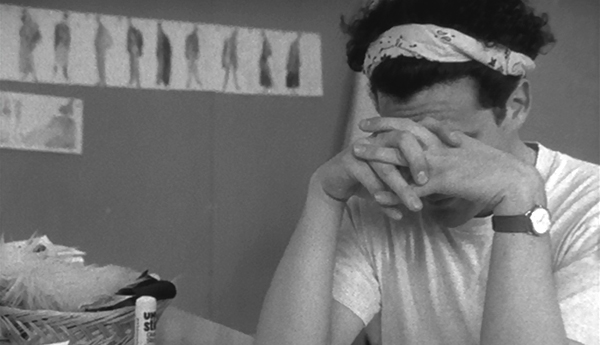
Isaac Mizrahi contemplates his future in fab documentary, UNZIPPED
UNZIPPED (Douglas Keeve, 1995)
Film Forum
209 West Houston St.
Tuesday, March 22, 8:15 (Q&A with Isaac Mizrahi)
Saturday, March 26, 5:30 (Q&A with Douglas Keeve and executive producer Nina Santisi)
Sunday, April 10, 8:00 (Q&A with Isaac Mizrahi)
212-727-8110 filmforum.org www.miramax.com
About halfway through Unzipped, Douglas Keeve’s thrilling 1995 documentary, which follows fashion designer extraordinaire Isaac Mizrahi as he puts together his fall 1994 collection following a critical disaster, Mizrahi says, “Everything’s frustrating; every single thing is frustrating. Except designing clothes. That’s not frustrating. That’s really liberating and beautiful. I don’t know, being overweight and not being able to lose weight, you know, that’s a problem. Anything you’re really working hard at and that’s not working, that’s a problem. But frankly, designing clothes is never a problem.” Of course, the statement doesn’t exactly ring true as Mizrahi, usually with his trademark bandanna wound around his wild, curly hair, encounters his fair share of difficulties as he meets with Candy Pratts and André Leon Talley from Vogue and Polly Mellen from Allure, expresses his hopes and fears with Mark Morris, Sandra Bernhard, Eartha Kitt, and his mother, and works with such supermodels as Kate Moss, Naomi Campbell, Cindy Crawford, Shalom Harlow, Linda Evangelista, Carla Bruni, Christy Turlington, and Amber Valletta. Along the way he makes endless pop-culture references, singing the theme song from The Mary Tyler Moore Show, citing scenes from The Red Shoes,Marnie,Valley of the Dolls, and Whatever Happened to Baby Jane? and using Nanook of the North and The Call of the Wild as creative inspiration.
Mizrahi is a ball of neuroses throughout as he consults Ouija boards and Tarot cards to peek into his future and plays classical piano (Bach’s “The Well-Tempered Clavier,” Debussy’s “Clair de Lune”) to calm himself down. “I’m not that stressed out,” he says. “I hate when people tell me I’m stressed out.” In his first film, director Keeve (Seamless, Hotel Gramercy Park), who was dating Mizrahi at the time, and Oscar-winning cinematographer Ellen Kuras (Eternal Sunshine of the Spotless Mind, The Betrayal) switch from grainy black-and-white to color to sharp b&w as Mizrahi’s big show approaches, in which the major point of conflict is the designer’s desperate desire to use a scrim that will allow the high-powered audience to see the backlit silhouettes of the models as they change backstage, something not all the women, or his colleagues at Mizrahi & Co., are in favor of. The film opens with Mizrahi devastated by the reviews of his previous show and closes with him quietly examining the reviews for his fall collection; in between is a delightful look inside the crazy world of fashion. And then Mizrahi will have to do it all over again for the next season. Winner of the Audience Award at the 1995 Sundance Film Festival, Unzipped is screening at Film Forum on March 22 at 8:15 and April 10 at 8:00 with Mizrahi present for Q&As and on March 26 at 5:30 with Keeve and executive producer Nina Santisi, in celebration of “Isaac Mizrahi: An Unruly History,” the first museum exhibition on Mizrahi and his career, which just opened at the Jewish Museum and continues through August 7.
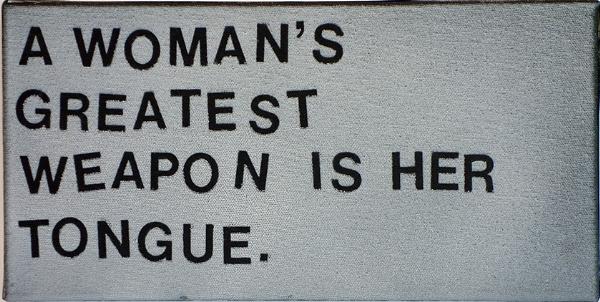
Betty Tompkins, “A Woman’s Greatest Weapon Is Her Tongue,” acrylic on canvas, 2015
Who: American artist Betty Tompkins What: Performance piece in conjunction with Women’s History Month and the exhibition “WOMEN Words, Phrases, and Stories: 1,000 Paintings by Betty Tompkins” Where:The FLAG Art Foundation, 545 West 25th St. between Tenth & Eleventh Aves., tenth floor, 212-206-0220 When: Wednesday, March 23, free with RSVP, 6:00 Why: Washington, DC, native Betty Tompkins is best known for her controversial, large-scale photorealistic paintings, drawings, photographs, and video of intimate sexual acts. On March 23 at 6:00, she will be at the FLAG Art Foundation in Chelsea for the performance “Words on WOMEN,” held in conjunction with her exhibition there, which continues through May 14. The exhibition consists of one thousand small-scale, hand-painted acrylic on canvas works that feature words and phrases used to describe women, including “Total Babe,” “Epic Bitch,” “Girly Girl,” “Arm Candy,” “Put a Bag over Her Head,” and “Will She Ever Shut Up?” (In her request for words and phrases from others, Tompkins explained, “They can be affectionate [honey], pejorative [bitch], slang, descriptive, etc.”) On March 23, Tompkins will be at the Chelsea gallery with fifty friends and colleagues, each of whom will select twenty words from the paintings to “speak, yell, sing, and perform however they wish.” The performance, which should be empowering as well as scary and funny, will begin at 6:45. Tompkins will be back at FLAG on April 6 for an artist talk with curator and writer Alison Gingeras.
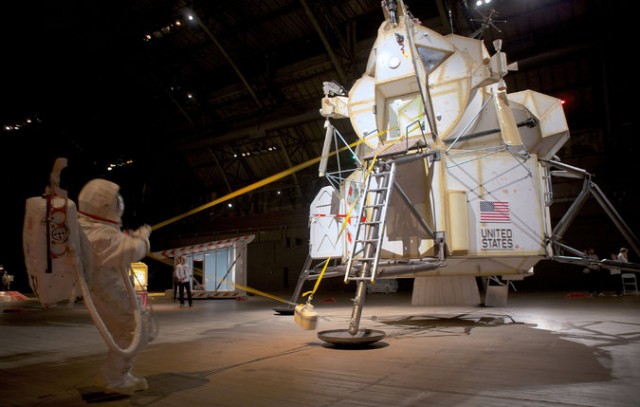
Lt. Sam Ratanarat is one of two astronauts going to Mars in A SPACE PROGRAM (photo by Josh White)
A SPACE PROGRAM (Van Neistat, 2015)
Metrograph
7 Ludlow St. between Canal & Hester Sts.
Opens Friday, March 18
212-660-0312 metrograph.com zeitgeistfilms.com
In the late spring of 2012, I wandered through the vast Wade Thompson Drill Hall at the Park Avenue Armory, accumulating experiences so I could become officially indoctrinated into artist Tom Sachs’s massive DIY installation, “Space Program Mars.” I was unable to attend the actual lift-off and exploration of the Red Planet that concluded the month-long show, but Sachs and his longtime collaborator, Van Neistat, have captured that special event in the new film A Space Program. With his crack team of artisans, New York City native Sachs, whose inaugural “Space Program” in 2007 at the Gagosian Gallery in Los Angeles went to the moon, has built nearly all the functional (if not precisely space-worthy) elements needed to send two women to Mars. But Sachs’s method is as much about process than anything else, insisting that the labor reveals itself, that his decidedly low-tech practice be evident everywhere. “Our space program is handmade, guided by the philosophy of bricolage,” deadpan narrator Pat Manocchia explains early on. Sachs’s method relies on bricolage, which he defines as “repair or creation with available resources.” The first part of A Space Program reveals how it all was built, using found materials, items bought in a regular hardware store, metal, and lots and lots of plywood. Then the team — consisting of Echo Mike (Evan Murphy), Charlie Bravo (Chris Beeston), Poppa Mike (Pat McCarthy), November Delta (Nick Doyle), Kilo Hotel (Dr. Kevin Hand), Juliet Lima (Jeff Lurie), Juliet Victor (Jared Vandeusen), Gulf Mike (Gordon Milsaps), Bravo Poppa (Bill Powers), and Sierra Victor (Sarah Vasil), each of whom has a very specific job to do — comes together to send Lt. Sam Ratanarat and Cmdr. Mary Eannarino into space in the life-size Lunar Excursion Module. The attention to detail borders on the obsessive as well as the whimsical, but Sachs has made sure to include every possible element, from a working toilet to a shelf of booze. In his first feature film, Neistat, who has made many shorts with his brother, Casey, and Sachs — Sachs also appeared on several episodes of the brothers’ wildly inventive HBO show, The Neistat Brothers, including those involving the cult-favorite miniature boat races — follows all the action centered around Sachs’s fully operational (yet forever grounded) Mission Control setup, where multiple monitors track the women’s progress, and emotions heat up when problems arise.
It all plays out like a real mission with real consequences, and that’s exactly how Sachs and Neistat see it, and want you to see it. But as much as it’s about the space program — as you watch the film, you’ll find it hard not to think about how much the government has cut funding for NASA, even though that’s not the point Sachs is trying to make — it’s also about the creation of art, about the handicraft of making things. Sachs previously worked as a welder and an assistant to Frank Gehry, so he demands that his art be functional as well as artistic. In the past, his work has concentrated on branding, merging high-tech and low-tech ideals and culture in such pieces as “Chanel Guillotine,” “Prada Toilet,” and “Hermés Value Meal” (okay, those might not have been fully functional) as well as his “Bronze Collection” series, consisting of large-scale bronze sculptures of Hello Kitty, My Melody, and Miffy, painted white to look as if they’re made purely of lightweight foamcore. With A Space Program, Sachs, who cowrote the film with Neistat, who serves as director, cinematographer, and coeditor (with Ian Holden), took all of those methods and put them to fascinating use, immersing the viewer firmly into NASA’s world of space exploration, with all the same fears and hopes as if you’re observing an actual mission, complete with the requisite potential danger. On the film’s official site, there’s a twelve-point list titled “How to Watch This Film.” Number 1 says, “This movie proves that you don’t need an education to understand — or to make — art,” number 3 explains, “This movie is NOT A DOCUMENTARY. It’s an INDUSTRIAL film like the safety videos they make you watch in high school shop class so you don’t cut your fingers off. Some say it’s a comedy,” and number 10 points out, “This movie is a love letter to the analog era.” It’s also a love letter to the power of the imagination and just what you can accomplish when you put your mind — and your bare hands — to it. A Space Program launches March 18 at the brand-new Metrograph movie theater on Ludlow St., where Sachs and Neistat will be on hand for opening-night screenings at 7:00, 9:00, and 11:00. Starting next week, you can catch Sachs’s “Tea Ceremony,” which developed out of “Space Program,” March 23 through July 24 at the Noguchi Museum, the first solo show there by an artist other than Isamu Noguchi, while “Tom Sachs: Boombox Retrospective, 1999-2016” comes to the Brooklyn Museum from April 21 through August 14.
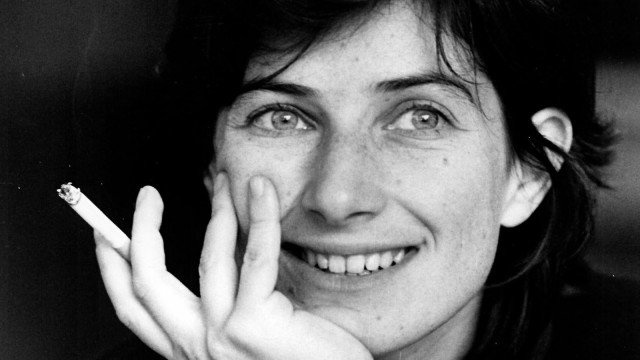
Chantal Akerman’s life and career will be celebrated at free event at Lincoln Center
Who: Jonas Mekas, Babette Mangolte, Andrew Bujalski, more to be announced What: Tribute to Chantal Akerman Where:Film Society of Lincoln Center,Walter Reade Theater, 165 West 65th St. between Eighth Ave. & Broadway When: Saturday, March 19, free, 10:00 am Why: The Film Society of Lincoln Center and City College of New York are teaming up for a memorial tribute on March 19 for Belgian-born, Paris-based pioneer, writer, director, teacher, and artist Chantal Akerman, who died on October 5 of last year at the age of sixty-five, apparently by suicide. For “Chantal Akerman: New York Remembers,” friends and colleagues will gather at the Walter Reade Theater for a free tribute to the longtime New Yorker; admission is first come, first served. The scheduled guests so far include Anthology Film Archives cofounder Jonas Mekas, longtime Akerman cinematographer Babette Mangolte, and mumblecore master Andrew Bujalski, with more to be announced. Whether making short films, a Hollywood movie, documentaries, or cutting-edge experimental works, Akerman always did things her way; among her major triumphs were I, You, He, She; News from Home; and the one and only Jeanne Dielman, 23 quai du Commerce, 1080 Bruxelles. The presentation will feature film clips, personal memories, music, and more, followed by a reception in the Furman Gallery. In 2013, Bujalski (Funny Ha Ha, Mutual Appreciation), in an interview with Vulture’s Jennifer Vineyard, cited Akerman as one of his influences: “I studied film as an undergrad at Harvard, and she was my thesis adviser. She gave me two pieces of advice, which I haven’t taken yet. She told me girls wouldn’t like me until I stopped dressing like a fourteen-year-old, and that I should stop being pretentious and just make comedies. I think of Computer Chess as a comedy, but it probably behooves me to go out and make a real one sometime.” More guests are expected to be announced for this two-and-a-half-hour special event. (In addition, BAMcinématek will be hosting a career retrospective of Akerman’s work in the series “Chantal Akerman: Images between the Images,” running April 1 through May 1, while Film Forum will be presenting Marianne Lambert’s I Don’t Belong Anywhere: The Cinema of Chantal Akerman for free March 30 through April 1, followed by Jeanne Dielman April 1-7 for $14.)
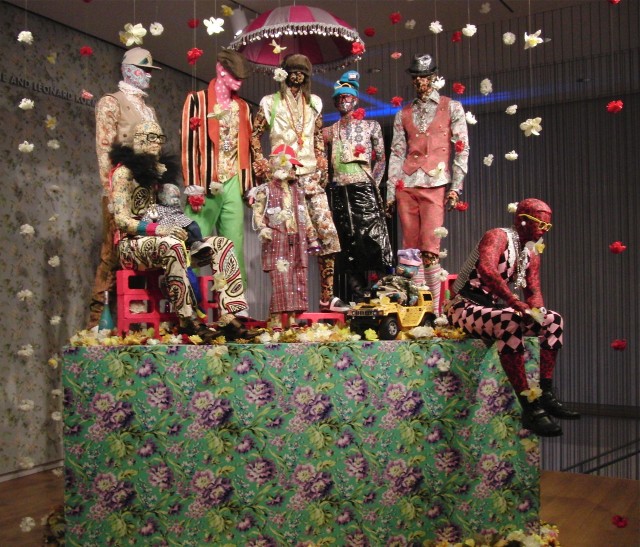
Ebony G. Patterson’s “Dead Treez” examines dancehall and bling culture and the changing ideals of masculinity and gender in Jamaica (photo by twi-ny/mdr)
Museum of Arts & Design
2 Columbus Circle at 58th St. & Eighth Ave.
Socially Constructed: Thursday, March 17, free with pay-what-you-wish admission, 6:30 Dancehall Queen: Friday, March 18, $10, 7:00
Shine: Thursday, March 24, free with pay-what-you-wish admission, 7:00
Exhibit continues through April 3
212-299-7777 madmuseum.org dead treez slideshow
Upon first seeing the Ebony G. Patterson’s “Dead Treez” at the Museum of Arts & Design, you get sucked in by the artist’s use of distinct colors, shiny accouterments, and sense of humor. But look deeper and you’ll find a lot more to consider in her first solo New York museum show. Patterson, who lives and works in Kingston, Jamaica, and Lexington, Kentucky, explores shifts in male gender identity and power that have become prevalent in dancehall culture, which has embraced a kind of metrosexuality that includes skin bleaching. Utilizing methods generally associated with women, Patterson has created five floor tapestries, wallpaper, and a tableau of male mannequins that could have been pulled from a window on Fifth Ave. Heavily adorned with floral patterns and bling, the tapestries actually depict murder victims, while the mannequins are surrounded by toys, bricks, liquor bottles, and other objects that send mixed messages. Meanwhile, in the Tiffany Jewelry Gallery, Patterson’s “. . . buried again to carry on growing . . .” comprises large glass cases filled with dazzling flowers that are all actually poisonous, while hidden in the vitrines are dead bodies and pieces of jewelry that evoke violence, combining beauty and turmoil in intriguing ways.
On March 17 at 6:30, MAD is hosting a special hands-on workshop concentrating on the social aspects of making tapestries and textile works, long considered women’s work, while also evolving into a way to share important stories; the event takes place in a sixth-floor classroom and is free with pay-what-you-wish admission. On March 18 at 7:00 ($10), MAD will screen Rick Elgood and Don Letts’s Jamaican classic Dancehall Queen in conjunction with the exhibit. And on March 24 at 7:00 (free with pay-what-you-wish admission), Northwestern University art history professor Krista Thompson will discuss her 2015 book, Shine: The Visual Economy of Light in African Diasporic Aesthetic Practice, putting it in context with Patterson’s exhibition, which continues through April 3. “Krista Thompson’s work was very important to me; she was researching the use of light in diasporic cultures, and as I began to think about my work more critically, I started to see glitter for what it is: It is light, it is illumination,” Patterson explains.

 About halfway through Unzipped, Douglas Keeve’s thrilling 1995 documentary, which follows fashion designer extraordinaire Isaac Mizrahi as he puts together his fall 1994 collection following a critical disaster, Mizrahi says, “Everything’s frustrating; every single thing is frustrating. Except designing clothes. That’s not frustrating. That’s really liberating and beautiful. I don’t know, being overweight and not being able to lose weight, you know, that’s a problem. Anything you’re really working hard at and that’s not working, that’s a problem. But frankly, designing clothes is never a problem.” Of course, the statement doesn’t exactly ring true as Mizrahi, usually with his trademark bandanna wound around his wild, curly hair, encounters his fair share of difficulties as he meets with Candy Pratts and André Leon Talley from Vogue and Polly Mellen from Allure, expresses his hopes and fears with Mark Morris, Sandra Bernhard, Eartha Kitt, and his mother, and works with such supermodels as Kate Moss, Naomi Campbell, Cindy Crawford, Shalom Harlow, Linda Evangelista, Carla Bruni, Christy Turlington, and Amber Valletta. Along the way he makes endless pop-culture references, singing the theme song from The Mary Tyler Moore Show, citing scenes from The Red Shoes, Marnie, Valley of the Dolls, and Whatever Happened to Baby Jane? and using Nanook of the North and The Call of the Wild as creative inspiration.