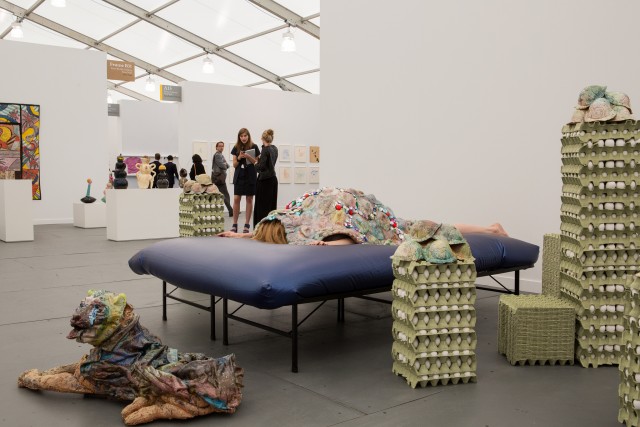
Frieze will feature free tours and conversations on collecting, among other programs
FRIEZE ART FAIR
Randall’s Island Park
May 5-8, $29-$49 per day
friezenewyork.com
There are a ton of art fairs from March through May here in New York City, but the only one we make sure to go to every year is Frieze. Held on Randall’s Island, Frieze has a terrific mix of art, performance, discussion, outdoor sculpture, and food, and it tends not to get too horrifically crowded even at prime times. This year’s fair, taking place May 5-8, features more than five dozen galleries from around the world, divided into four sections: Main, Focus, Frame, and Spotlight. Other works are part of the special programs Frieze Talks, Frieze Sounds (Giorgio Andreotta Calo & MADRIEMA, Liz Magic Laser, GCC), Frieze Education, and Frieze Projects (Alex Da Corte, Anthea Hamilton, David Horvitz, Eduardo Navarro, Heather Phillipson, Maurizio Cattelan). Every day there is a free guided tour with advance RSVP. Beginning on Thursday, the Reading Room will host seven hours of daily talks, live performance, and book signings, including “Prints, Polaroids, and Picassos” at 1:30 on Thurday with Melanie Gerlis, Lisa Schiff, and Nicholas Campbell, Bill Powers in conversation with Nathaniel Mary Quinn at 4:30, and the Brooklyn Museum talk “Ai Weiwei and Bicycles” at 5:30 with Sharon Matt-Atkins and a limited-edition bicycle made by Ai. Also on Thursday, Eileen Myles will deliver the keynote address, “What a Poet Might Be Doing Here,” at 4:00 in the Frieze auditorium. On Friday, the Reading Room schedule includes a book signing by Hans Ulrich Obrist (Conversations in Colombia: ANAÑAM-YOU-REYA) at 11:30, the ArtMag talk “The Stars Were Aligned for a Century of New Beginnings” with Basim Magdy and Omar Kholeif at 2:00, and the Art in America discussion “Comics in America” with Julia Wolkoff in conversation with Dan Nadel and Alexi Worth at 3:30. Also on Friday, Dan Fox and Mark Leckey will team up for the Frieze Talk “Haunted by What” in the auditorium at noon, while Omar Kholeif, Zach Blas, Andrea Crespo, and Jacolby Satterwhite gather at 4:00 for “The Technological Body and Its Discontents.”
Saturday’s Reading Room programming kicks off at 11:30 with “The Captioning Séance,” live aura readings by Wayne Koestenbaum in conjunction with his new book, Notes on Glaze, followed by talks with Evan Moffitt and Carlos Motta at 1:30, W magazine at 2:30 (“Art Heist”), Petra Cortright and Lindsay Howard at 3:30 (“Net Speak”), and Negar Azimi and Ketuta Alexi-Meskhishvili at 4:30 (“Hollow Body”). At 12 noon in the auditorium, Hal Foster and Ben Lerner will delve into the topic “On Hating On . . . ,” while the 4:00 Frieze Talk, “Version Control,” brings together Joanne McNeil, Thomas Demand, Oliver Laric, and Stephanie Syjuco. In the Reading Room on Sunday, Harry Thorne, Harry Burke, and Laura McLean Ferris will discuss “The Fast and the Slow — Writing and Reading On- and Offline” at 1:30, followed by Jason Farago in conversation with Agnieszka Kurant at 2:30, “On Ecstasy” with Rachel Rose and Ryan McNamara at 3:30, and Eli Diner in conversation with Martine Syms at 4:30. The last day’s Frieze Talks consist of Lawrence Abu Hamdan and Holly Herndon discussing sound and surveillance at noon and Jens Hoffmann, Julia Bryan-Wilson, Michelle Grabner, Emiliano Valdés, and Beatrice von Bismarck answering the question “Curator: Autodidact Polymath or Academic Expert?” at 4:00. Below are events at other fairs taking place during Frieze Week.
NADA
Basketball City
299 South St.
May 5-8, $20 per day, $40 run of show
newartdealers.org
Thursday, May 5
Artist DJs: Michael Mahalchick + Melissa Brown, 2:00 –5:00
Performance and ritual blessing by Angie Jennings, 5:30
“Fan Boys,” a performance by Brian Belott and Billy Grant, and “Cold Steel,” by Tyson Reeder, 6:00
“The New Neurotic,” a performance by the Shandaken Project, featuring Childress, 6:30
Friday, May 6
“Extensions,” a performance by Naama Tsabar, 1:00
“The Art of the (Cough) Deal: Why Artist-Gallerists Do It Better,” with Sarah Braman, Max Warsh, Ridley Howard, Margaret Lee, and Elyse Derosia, moderated by Andrew M. Goldstein, 2:00
Artist DJs: Annie Pearlman 2:00 – 4:00
“Go Pro: The Hyper-Professionalization of the Emerging Artist,” with Daniel S. Palmer, Jamian Juliano-Villani, Diane Simpson, and Jayne Johnson, moderated by M. H. Miller, 3:00
“The Event Economy: The Role of Performance in Gallery Programming,” with Emma Hazen, Claire Mirocha, Vanessa Thill, Mike Pepi, Rin Johnson, and Harry Burke, moderated by Nicole Reber, 4:00
Artist DJs: Ben Vida 4:00 – 6:00
“Art Fair,” new video work by Talk Hole (Steven Phillips-Horst & Eric Schwartau), followed by a discussion, 6:00
Saturday, May 7
The NADA Hoops Know Wave 3-on-3 Tournament, court designed by Michael Genovese (pick-up games available Thursday and Friday)
“Daata Editions meets Moran Bondaroff,” with David Gryn, Jessica Witkin, and Rory Padeken, 1:00
“NSK State: Imagined Territories,” with Charles Lewis and David K. Thompson, 2:00
“Models of Practice: New Territories and Frameworks for Public Art,” with Diya Vij, Maayan Strauss, and Brooke Singer, moderated by Mariel Villeré, 3:00
“Alternative Narratives: An exploration of hybrid creative practices,” with Angel Otero, Larry Ossei-Mensah, and Erik Hougen, 4:00
“TURBOFILM and the Uncertain Future of Moving Images” by Alterazioni Video, with live music performance and the U.S. premiere Rosa Perfetto, 5:00
“The Soft Side of Hardcore starring Old Put the Clown,” with performance by Bailey Scieszka, 6:00
Artist DJs: Michael Bauer 2:00 – 4:00
Artist DJs: Andrew Kuo 4:00 – 6:00
Sunday, May 8
Wearable Art Workshop with the Children’s Museum of the Arts, 1:00
Artist DJs: Denise Kupferschmidt 2:00 – 4:00
“Suits You,” sculptural performance by Poncili Creación (Zuleyka Alejandro, Jimena Lloreda, and Pablo & Efrain del Hierro), 3:30
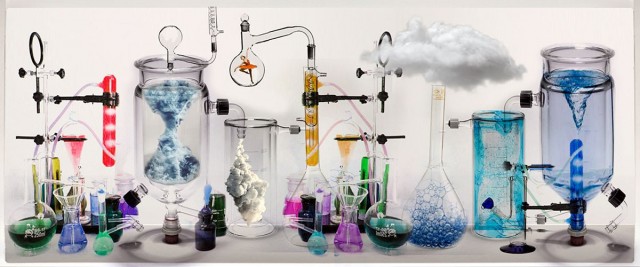
Michelangiolo Bastiani, “Tentativo Impossibile,” 2016 (courtesy of Liquid Art System | Capri3)
CONTEXT New York
Pier 94, 55th St. & West Side Highway
May 4-8, $25 per day, $55 run of show
www.contextnyfair.com
Friday, May 6
Artist Spotlight: Why Are Artists Willing to Starve in New York for Their Art?, with Bruce Helander, 2:00
Trends of the Art World from an Investment Perspective, with Annelien Bruins, Terence Doran, and Madelaine D’Angelo, 3:00
The Habits of Successful Collectors, with Nica Gutman Rieppi and Jessica Davidson, 4:15
Saturday, May 7
Artist Spotlight: Guardians — The Art of Healing and Hope with Kim Sun Tei, 1:00
Artist Spotlight: The Inside Secrets of Art Patronage — Case Study on Yuroz, with Pandora Pang and Bruce Helander, 2:00
The Evolution of Art and Finance Services in Wealth Management, with Phillip Klein and Donald Poster, 3:00
Book signing: The Art of John Keane by Mark Lawson, 4:00
Balance of Power — Who are Today’s Market Makers?, with Heidi Lee-Komaromi, Peter Priede, Amelie Chabannes, and Lenise Logan, 4:15
Sunday, May 8
Artist Spotlight: Pushing the 2-D Boundaries of an Art Collection, with Jennifer Kostuik, 2:00
New Tools of the Trade, with Lucy Redoglia, Connor Williams, and Jenny Park Adam, 3:00
Digits to Digital — Trends in Merging the Handmade with Digital Technologies, with Regine Basha, Kristin Lucas, and Birgit Rathsmann, 4:15
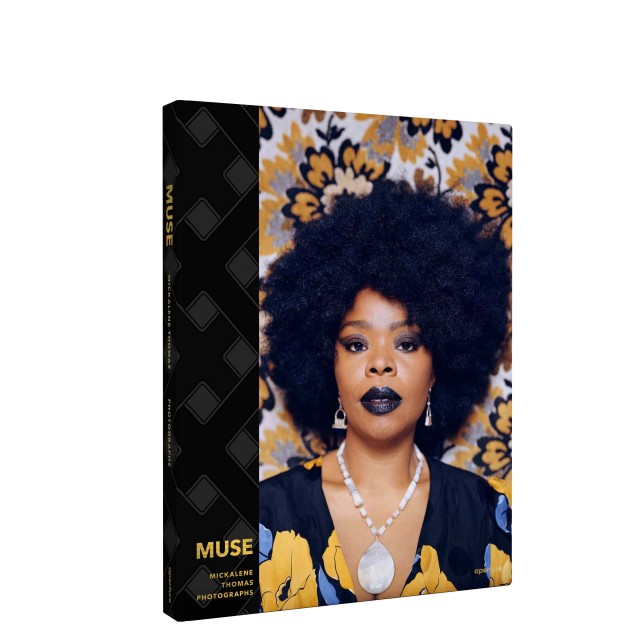
Mickalene Thomas will be at 1:54 to discuss and sign her new book
1:54 Contemporary African Art Fair
Pioneer Works, Red Hook
May 6-8, $10-$20
1-54.com/new-york
Friday, May 6
Welcome & Opening Remarks by Touria El Glaoui and Koyo Kouoh, 1:00
Beyond Cultural Polarities: Africa’s Creative “Repats,”
With Andrew Dosunmu, Nina Keïta, and Elinyisia Mosha, moderated by Claude Grunitzky, 1:30
Media Platforms for the Promotion of the Arts, Visual Cultures, and Social Experiences of and about Africa and the Diaspora, with Claude Grunitzky and Abiola Oke, moderated by Ugochukwu-Smooth C. Nzewi, 3:00
The Politics and Privilege of Play: Dexter Wimberly in conversation with ruby onyinyechi amanze, 4:30
Friday, May 6
and
Saturday, May 7
1:54 PERFORMS, “This ship would set sail, even anchored as it was,” site-specific interactive performance project by Dave McKenzie
Saturday, May 7
Book presentation and signing with Mickalene Thomas in conversation with Lesley A. Martin, Muse: Mickalene Thomas Photographs, 12 noon
Emerging Social Entrepreneurs and Cultural Brokers, with Ifeanyi Awachie, Shimite Obialo, Sharon Obuobi, and Amy Sall, moderated by Ugochukwu-Smooth C. Nzewi, 2:00
Museums and Contemporary African Art, with Karen Milbourne, Kevin Dumouchelle, and Yesomi Umolu, moderated by Ugochukwu-Smooth C. Nzewi, 3:30
Materiality, Storytelling, and Grand Narratives in Contemporary African Art: Dexter Wimberly (independent curator) in conversation with Billie Zangewa, 5:00
Adrienne Edwards in conversation with Dave McKenzie, 6:30
Sunday, May 8
Second Sundays: live performances by Osei Korankye and the Mandingo Ambassadors
Book presentation and signing with Sue Williamson in conversation with Chika Okeke-Agulu, Sue Williamson: Life and Work, 4:00
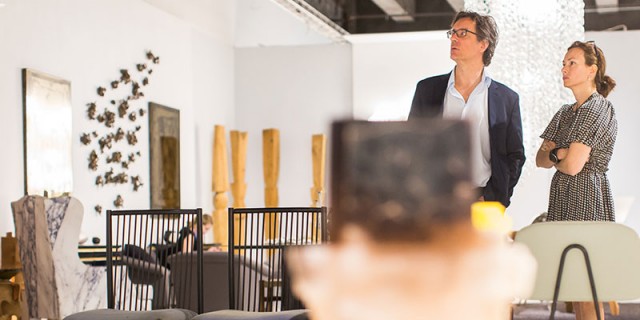
Collective Design fair showcases innovative design thinking
COLLECTIVE DESIGN
Skylight Clarkson Sq.
550 Washington St.
May 4-8, $16.82 – $36.24
collectivedesignfair.com
Thursday, May 5
Frank de Biasi, 12 noon
Robert Couturier, 3:00
Stteven Gambrel, 5:00
Friday, May 6
Kelly Behun, 12 noon
Brad Ford, 3:00
James Huniford, 5:00
Saturday, May 7
Sandra Nunnerley, 12 noon
Suchi Reddy, 3:00
Sunday, May 8
Christopher Coleman, 12 noon
Robert Stilin, 3:00
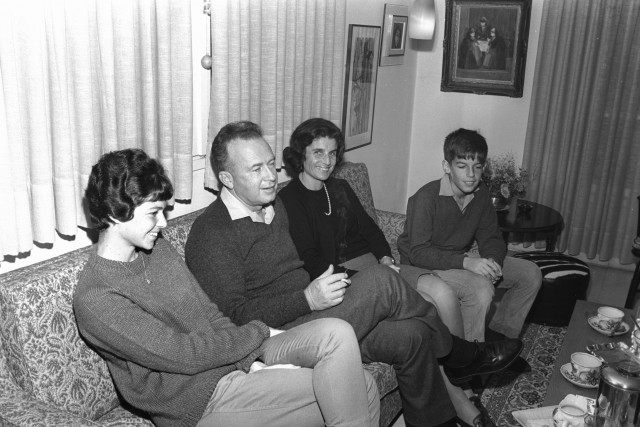
 “I did my job, especially in terms of striving for peace and ensuring Israel’s security in the best way possible,” Yitzhak Rabin says at the beginning of Erez Laufer’s poignant documentary, Rabin in His Own Words. “I think the State of Israel may have lost the prime minister with a better chance than any other of advancing peace and preventing war.” Rabin was referring to the first time he was prime minister, when he was forced to resign in 1977 because of a financial scandal. But he could have been speaking from the grave following his assassination in 1995 during his second term, shortly after winning the Nobel Peace Prize with Yasser Arafat and Shimon Peres. In fact, Rabin in His Own Words is like a message from beyond, as a dark cloud hovers over the film, which consists of archival footage, press conferences, home movies, broadcast interviews, family photographs, and letters that trace the personal and professional side of Rabin, from how he was raised as a child to his desire to be a farmer, from his rise in the military to his serving twice as prime minister, from his dedication to his beloved wife, Leah, to becoming a grandfather.