Documentary sheds new light on many frightening aspects of U.S. drone program
NATIONAL BIRD (Sonia Kennebeck, 2016)
Saturday, April 16, Bow Tie Cinemas Chelsea 4, 6:15
Sunday, April 17, Regal Cinemas Battery Park 11-6, 3:15
Thursday, April 21, Regal Cinemas Battery Park 11-9, 7:30
Friday, April 22, Bow Tie Cinemas Chelsea 8, 5:30
itvs.org/films/national-bird
tribecafilm.com
 On May 23, 2013, President Barack Obama gave a speech at the National Defense University at Fort McNair in which he discussed America’s controversial drone program, saying, “Before any strike is taken, there must be near-certainty that no civilians will be killed or injured — the highest standard we can set.” Sonia Kennebeck’s shattering documentary, National Bird, strongly disputes that claim and adds more accusations as three former military personnel talk about what was really going on behind the scenes. “It’s a secret program, and what that means is that I just can’t go shouting off the hilltops, telling the public what it is,” says Lisa, a former technical sergeant on the drone surveillance system. (The documentary does not use the three main subjects’ last names.) “What I can tell you is that to me, one person who worked within this massive thing, it’s frightening.” Heather, a former drone imagery analyst, has become a massage therapist to deal with the effects of PTSD and anxiety and sleep disorders. “In learning to heal other people, maybe I could heal myself as well,” she says as she tries to come to terms with the many Afghani men women, and children, both military targets and innocent civilians, who died from bombs she dropped from drones. “I can say the drone program is wrong because I don’t know how many people I’ve killed,” she adds. And Daniel, a former signals intelligence analyst and currently a private contractor, carefully explains, “There’s no doubt in my mind that if I said the wrong thing or gave away the wrong kind of information about what I was doing that I wouldn’t be safe from prosecution of any kind.” Kennebeck also speaks with General Stanley McChrystal, who apologized for a 2010 drone attack that killed twenty-three civilians; some of the survivors of that fatal attack; and lawyer Jesselyn Radack, the founder of the Whistleblower and Source Protection Program (WHISPeR) at ExposeFacts, who has represented Edward Snowden and other whistleblowers in addition to Heather, Daniel, and Lisa.

A former technical sergeant on the drone surveillance system heads to Afghanistan to meet victims of drone attacks in NATIONAL BIRD
In her first feature documentary, Kennebeck compares the drone program to video games, as Heather, Daniel, and Lisa, through re-creations and actual documents, reveal how they performed their jobs, resulting in untold deaths, without ever seeing action; Heather, in particular, opens up about how difficult it was to sit at a desk in the United States while dropping bombs in Afghanistan, never knowing whether the victims were the intended targets or how much collateral damage was inflicted. She doesn’t know where to turn because the program is top secret and classified, so she can’t even seek out psychiatric help; meanwhile, she points out that several former colleagues have committed suicide. Lisa is so distraught that she goes to Afghanistan to visit with victims of drone attacks. And Daniel grows more and more paranoid that the more he talks, the more his freedom will be in jeopardy. Kennebeck (Sex — Made in Germany) also includes dramatic overhead drone shots of American communities, showing the terrifying prospect that drone attacks in the United States might not be far off as unmanned warfare spreads around the world. “Like previous advancements in military technology, combat drones have transformed warfare, outpacing the ability of legal and moral frameworks to adapt and address these developments,” Kennebeck explains in her director’s statement. “A broad, immersive, and thoroughly public discourse is critical to understanding the social cost of drone warfare.” Executive produced by Wim Wenders and Errol Morris, National Bird sheds new light on this controversial topic; it’s a chilling look at the next step in the continuing dehumanization of war, seen from multiple angles. “I thought I was going to be on the right side of history, and today I don’t believe I was,” Lisa says. National Bird is screening April 16, 17, 21, and 22 at the Tribeca Film Festival, with Kennebeck and Lisa participating in Q&As after all four shows, along with Radack on April 16 & 17.
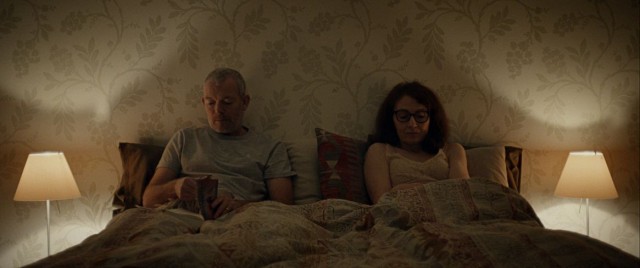
 Danish actor, writer, playwright, and director Christian Tafdrup takes the relationship between mother, father, and child to a whole new extreme in the dark, bittersweet Parents. When their son, Esben (Anton Honik), moves out to seek his own path in life, Kjeld (played by Søren Malling and Elliott Crossett Hove) and Vibeke (Bodil Jørgensen and Miri-Ann Beuschel) immediately start suffering from empty nest syndrome, especially as Esben seems to need them only to do his laundry. Kjeld returns to the apartment he shared with Vibeke when they were young lovers, hoping to rekindle the flame. But when a Twilight Zone-like twist upends the family dynamic, Esben, Kjeld, and Vibeke must redefine who they are and what they want out of life. Tafdrup, who appears as the realtor in the film, balances the real and the surreal with mixed results, as there are gaping plot holes that can be extremely frustrating, but it all comes together by the conclusion. Malling (A War, A Royal Affair) and Jørgensen (Badehotellet, The Idiots) are terrific as a husband and wife taking stock of who they are, both individually and as a couple, as Tafdrup (An Infatuation) and editors Anne Østerud and Tanya Fallenius maintain a slow but steady pace and cinematographer Maria von Hausswolff beautifully captures Jette Lehmann’s sensational production design, consisting of a wide range of interiors that mimic the characters’ evolving psyches as they deal with an impossible situation. Parents is screening in the International Narrative Competition at the Tribeca Film Festival on April 17, 20, and 21, with Tafdrup, Østerud, producer Thomas Heinesen, and actors Beuschel and Honik participating in what should be some very interesting Q&A sessions.

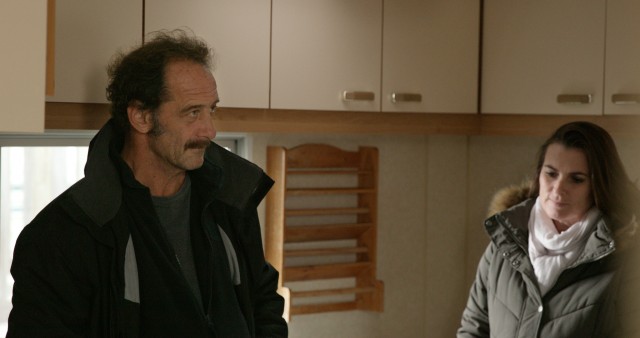
 “The ultimate measure of a man is not where he stands in moments of comfort and convenience, but where he stands at times of challenge and controversy,” the Rev. Dr. Martin Luther King Jr. famously said. In Stéphane Brizé’s The Measure of a Man, Vincent Lindon excels as a husband and father who is trying his best to survive in a changing world, fraught with challenge and controversy, that has seemingly turned its back on him. In an extraordinary performance embodying the calm before a storm that never comes, Lindon plays Thierry Taugourdeau, a working-class man who has been out of a job since the factory where he toiled for more than twenty years closed twenty months ago. He meets with job counselors, takes classes, interviews over Skype, and joins his fellow laid-off colleagues to figure out what to do next, but it is hard for him to have to start over in his fifties while trying to support his wife (Karine De Mirbeck) and take care of a teenage son who has cerebral palsy, played by Matthieu Schaller, who does have the neurological disorder. When Thierry finally does find employment, it’s not exactly a dream job, but he attempts to soldier on even when he is asked to do things that are against his moral and ethical fiber. “We all get to choose,” he says when his fellow former factory workers talk about taking action against the company that laid them off. “In my case, if only for my mental health, I prefer to draw a line and move on. Does that make me a coward?”