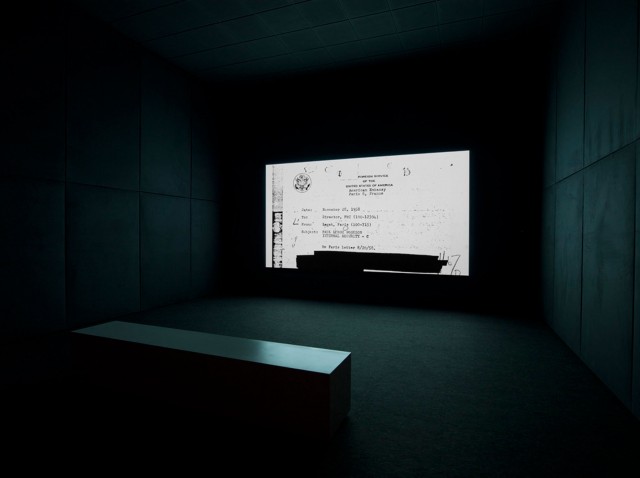
Steve McQueen, “End Credits,” sequence of digitally scanned files, sound, continuous projection, 2012 (courtesy of the artist; Thomas Dane Gallery, London; and Marian Goodman Gallery)
Who: Steve McQueen and Donna De Salvo, Harry Belafonte and Dr. Cornel West
What: Two public programs in conjunction with the exhibition “Open Plan: Steve McQueen”
Where: Whitney Museum of American Art, 99 Gansevoort St., 212-570-3600
When: Friday, April 29, Steve McQueen in Conversation with Donna De Salvo, $15, 6:30; Sunday, May 1, Harry Belafonte and Dr. Cornel West Discuss Paul Robeson, $20, 5:00
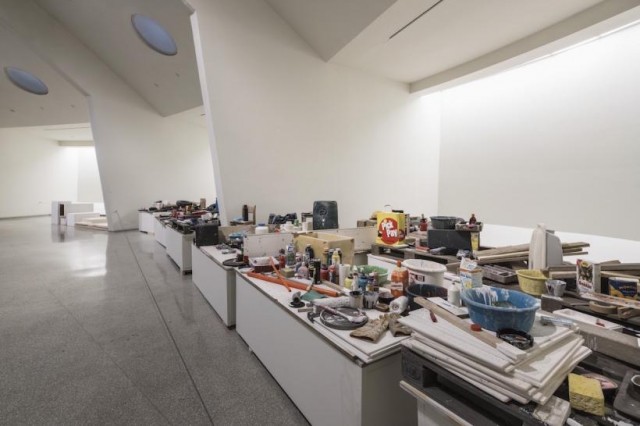
Why: The Whitney’s five-part “Open Plan” series, which previously featured installations by Andrea Fraser, Lucy Dodd, Michael Heizer, and Cecil Taylor, concludes with a project by visual artist Steve McQueen that expands on his 2012 work, “End Credits,” an exploration of the FBI’s investigation into the political activities of actor, singer, athlete, lawyer, and civil rights activist Paul Robeson. McQueen, who began his career as an experimental short filmmaker (his 2004 exhibition at the Davis Museum at Wellesley College was an eye opener), wrote and directed Hunger and Shame before directing 2013’s 12 Years a Slave, which won the Best Picture Oscar. In conjunction with the multimedia show, the Whitney will be hosting two talks. On April 29, McQueen will discuss his career with senior curator Donna De Salvo, who organized the show with curatorial assistant Christie Mitchell. And on May 1 — not coincidentally May Day — actor, singer, songwriter, and activist Harry Belafonte and philosopher, professor, author, activist, and self-described “prominent and provocative democratic intellectual” Dr. Cornel West will team up to explore Robeson’s life and legacy. End Credits will be on view in the expansive Neil Bluhm Family Galleries through May 14; in addition, the Whitney is presenting the U.S. debut of McQueen’s “Moonlit” sculpture in the adjacent Kaufman Gallery.

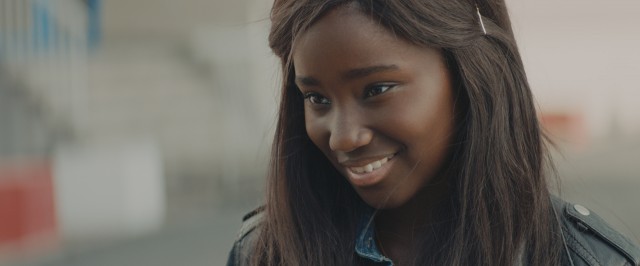
 FIAF’s two-month CinéSalon series “EDM Anthems: French Touch on Film” comes to a poignant conclusion April 26 with Céline Sciamma’s sensitive, gripping, award-winning Girlhood. In her outstanding film debut, Karidja Touré earned a César nomination as Most Promising Actress for playing Marieme, a sixteen-year-old girl who is trying to find a workable path to a worthwhile adulthood but is continually thwarted by socioeconomic and cultural issues. Marieme wants to go to college, but a guidance counselor tells her that her grades aren’t good enough and that she should instead choose a vocational school. She’s clearly bright, but she has to spend much of her time taking care of her younger sisters while her mother works as a cleaning lady and her lazy older brother, Djibril (Cyril Mendy), plays video games and keeps a tight watch on the women in the family. Distressed by her options as a young black woman in France, Marieme starts hanging out with a gang of tough girls led by Lady (Assa Sylla), who christens Marieme “Vic” for victory. Vic, Lady, Adiatou (Lindsay Karamoh), and Fily (Mariétou Touré) battle other small gangs, head to the city to steal fancy clothing, and flirt with the local boys in the Parisian suburbs of Bagnolet and Bobigny. Vic is attracted to Ismaël (Idrissa Diabaté), a friend of Djibril’s who is hesitant to get involved with her, but the two soon start a kind of relationship. Amid gang fights, drug dealing, neighborhood gossip, and romantic entanglements, Vic desperately searches for her identity and refuses to give up on her dreams.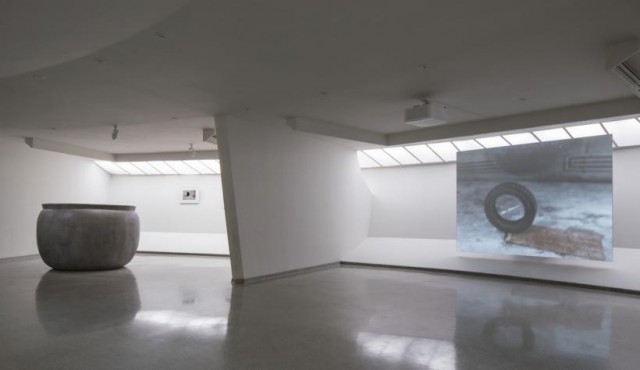
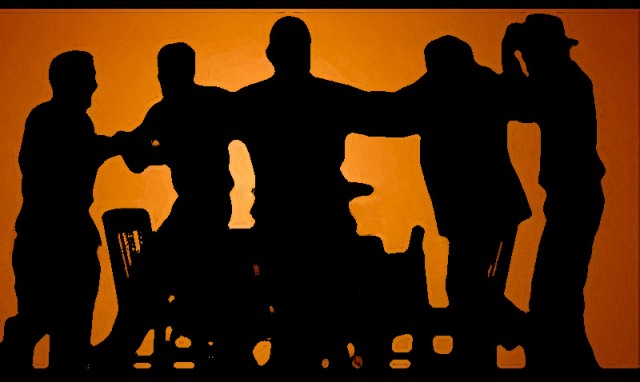
 Being gay and an Orthodox Jew just doesn’t mix. Sandi Simcha DuBowski’s award-winning documentary, Trembling Before G-d, takes a close look at gay Orthodox and Hasidic Jews in Brooklyn, Miami, Jerusalem, and London who are either rejected by their religious community or remain hidden in the closet, unable to express in public who they are. Many of the subjects use fake names and are shot in silhouette or by a handheld camera that never shows their full faces, in order to protect their identity; these powerful images get right to the heart and soul of the matter. The naysayers point out that the Bible clearly states that homosexuality is wrong, and they still believe that gays can be “cured” through therapy and atonement ceremonies for sexual sins or by eating figs. The film is having a special fifteenth-anniversary screening at the IFC Center as part of the Stranger than Fiction series and will be followed by what should be a lively and fascinating Q&A with DuBowski and subjects Rabbi Steve Greenberg, Michelle, Naomi, and Mark that should explore whether anything has changed in the last decade and a half. The series continues through May 31 with such other documentaries as Lynn True’s In Transit, Holly Morris’s The Babushkas of Chernobyl, and Ido Haar’s Presenting Princess Shaw, with Princess Shaw present for a Q&A.