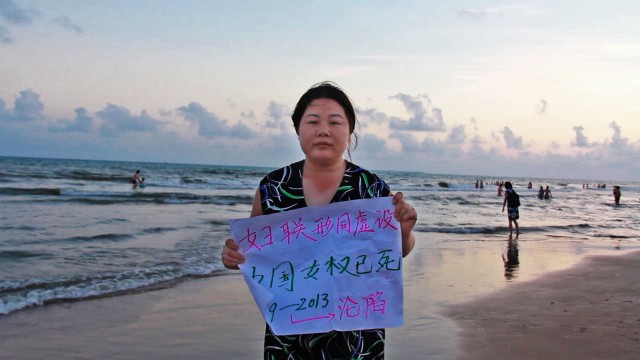
Hooligan Sparrow risks her freedom and her life for protesting for women’s rights in China
HOOLIGAN SPARROW (Nanfu Wang, 2016)
Film Society of Lincoln Center, Walter Reade Theater
165 West 65th St. between Eighth Ave. & Broadway
Friday, June 10, 6:30
Series runs June 10-19
212-875-5050
ff.hrw.org/new-york
hooligansparrow.com
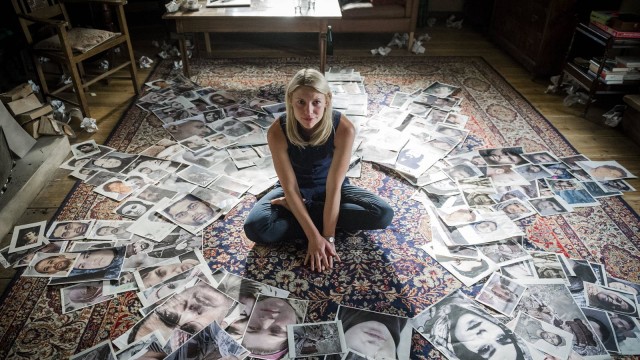
 The 2016 Human Rights Watch Film Festival kicks off at Lincoln Center’s Walter Reade Theater on June 10 with Nanfu Wang’s alarming debut feature documentary, Hooligan Sparrow. Wang won the annual Nestor Almendros Award for courage in filmmaking with this brave, disquieting look at Chinese activist Ye Haiyan, better known as Hooligan Sparrow, an advocate for sex workers’ rights, as she leads protests against a school principal who sexually abused six elementary school girls. “If you film us, we’ll smash your camera,” a man tells Wang at the beginning. Later she’s told she will be beaten if she doesn’t hand over her equipment. But she’s determined to keep telling the story any way she can. Sparrow, who gained notoriety for a project in which she offered free sex to migrant workers, is joined by Shan Lihua, Tang Jitian, Jia Lingmin, Wang Yu, and lawyer Wang Jianfen as she battles law enforcement, the government, and brothel owners, her safety and freedom in constant jeopardy. “If I believe something is right and I’m obliged to do it, they can’t stop me by arresting me or even killing me,” she defiantly says. She and her daughter, Lan Yaxin, keep getting evicted from their homes and banned from numerous provinces, but that doesn’t prevent her from protesting with such signs as “All China’s Women’s Federation Is a Farce. China’s Women’s Rights Are Dead” and “You Can Kill Me, But You Can’t Kill the Truth.” Born and raised in a remote Chinese farming village and currently based in New York City, Wang, who directed, produced, photographed, and edited Hooligan Sparrow, never backs down even as she meets with Chinese officials and is followed everywhere she goes, forced to become suspicious of nearly everyone she encounters. “Just because you’re paranoid doesn’t mean they aren’t after you,” Joseph Heller wrote in Catch-22. Wang clearly has reason to be paranoid.
The film is executive produced by Andy Cohen and Alison Klayman, who collaborated on the award-winning documentary Ai Weiwei: Never Sorry; the Chinese artist and activist, who has been under long-term house arrest, took up Hooligan’s cause, and he included her belongings in an installation in his 2014 Brooklyn Museum retrospective, “According to What?” Wang, who has three master’s degrees, cowrote the film with Mark Monroe, who wrote the Oscar-nominated documentary The Cove and numerous Sundance winners. Hooligan Sparrow also features a subtly ominous score by Nathan Halpern and Chris Ruggiero that helps keep you on the edge of your seat as Hooligan and her group continue to fight the power, despite each of them being detained and imprisoned at one point or another — and some still are. Hooligan Sparrow is the opening-night selection of the 2016 Human Rights Watch Film Festival, screening June 10 at 6:30 at the Walter Reade Theater; it will be followed by a discussion with Wang, HRW Women’s Rights division director Liesl Gerntholtz, and HRW China director Sophie Richardson, moderated by HRW Global Initiatives director Minky Worden.
 In his 2014 documentary,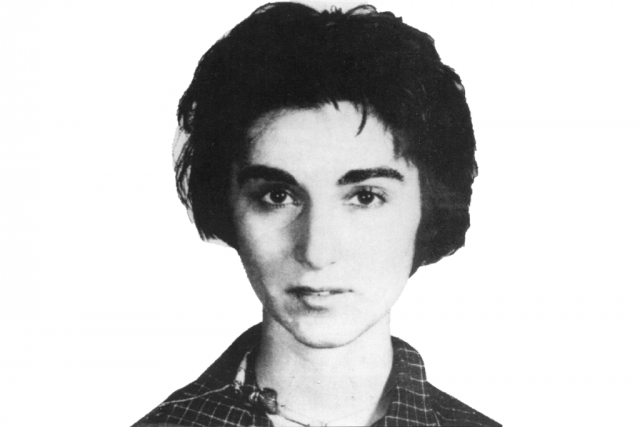
 The main image used to promote James Solomon’s debut documentary, The Witness, is a 1961 black-and-white photograph of Kitty Genovese. In the portrait, she stares back at the viewer almost accusingly; in light of her famous death three years later, it is as if she is calling us all out for the events that happened during and after her murder. In 1964, Genovese was killed by an assailant on a Kew Gardens street while, as the New York Times reported, thirty-eight neighbors heard the screams, looked out their windows, and did nothing. Forty years later, the paper reexamined the case and their coverage and found numerous holes in their original story. That set Kitty’s brother, Bill Genovese, who was sixteen when his sister was killed, on an obsessive mission to find out the truth about what really went down on March 13, 1964, and afterward, when New York City was publicly decried across the world as an awful oasis of urban apathy. Genovese hooked up with screenwriter Solomon (The Conspirator, The Bronx Is Burning) and spent eleven years reinvestigating the case — the two men had actually met in 1999, when Solomon was collaborating on a never-realized fictionalization of the story with Joe Berlinger and Alfred Uhry for HBO. The Witness plays out like a police procedural as Genovese follows every crumb he possibly can, meeting with witnesses, detectives, his sisters’ friends, and such journalists as Gabe Pressman, Mike Wallace, and Abe Rosenthal, the Times editor who wrote the book Thirty-Eight Witnesses: The Kitty Genovese Case, which helped turn the sordid tale into legend. “The story doesn’t make any sense to me,” Pressman admitted he thought back in 1964, although no one would question the Newspaper of Record. But Genovese does just that, and what he discovers is nothing short of shocking.