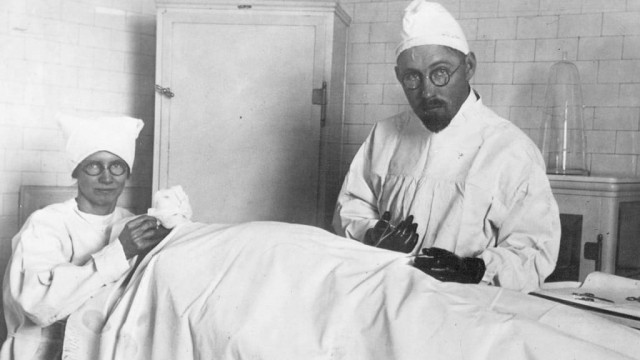
The bizarre story of John Romulus Brinkley is recounted in unique ways in “NUTS!”
“NUTS!” (Penny Lane, 2016)
Film Forum
209 West Houston St.
Opens Wednesday, June 22
212-727-8110
www.nutsthefilm.com
filmforum.org
 Penny Lane’s wonderfully titled, inventively told “Nuts!” tells the wacky true tale of Dr. John R. Brinkley, a pivotal twentieth-century figure who was part P. T. Barnum, part Donald Trump, a controversial doctor or a quack, a radio pioneer or a snake-oil charlatan, depending on one’s opinion. He became rich and famous by surgically implanting goat glands into men’s testicles, claiming it increased virility, but his story is about much more than that. “This is a film about John Romulus Brinkley, a doctor, amongst other things, a man who succeeded against terrible odds and powerful opposition, a man who changed the world,” narrator Gene Tognacci explains early on. Lane, who previously profiled another intriguing individual in her debut feature-length documentary, 2013’s Our Nixon, this time follows the often outrageous exploits of Brinkley, using text from Clement Wood’s 1934 book, The Life of a Man: A Biography of John R. Brinkley, home movies and photographs, newspaper and magazine articles, and actual radio broadcasts. She also has seven different animators re-create scenes from Brinkley’s life and career, and each artist or team (Drew Christie & Dane Herforth, Julia Veldman C, Michael Pisano, Krystal Downs, Ace & Son Moving Picture Co., Rose Stark, and Hazel Lee Santino & Downs) employs a unique style while maintaining the film’s overall potent sense of humor. Producer-director Lane, who cleverly edited the film with writer Thom Stylinski, initially casts Brinkley as a sympathetic character just trying to get his own piece of the American dream for him and his family in the tiny town of Milford, Kansas, but as Dr. Morris Fishbein, editor of the Journal of the American Medical Association, gets ever closer in his obsessive quest to discredit Brinkley, everything the goat-gland doctor has built threatens to unravel. But Lane’s genius is yet to come, as she begins to unravel our assumptions and the very process of biography and history itself as the film proceeds to its inevitable conclusion.
It’s hard to believe that “Nuts!” is true, but that’s all part of the fun. Lane just lays it out there for us to see, and you’ll be rooting for Brinkley as he grows his empire, just as you’ll be booing Fishbein for desperately trying to bring him down. Brinkley was a kind of mad genius, understanding how to get ahead in business by giving the people what they want via early infomercials, realizing the vast power of radio, and flouting the rules whenever he could — and then attempting to change them. Lane limits the talking heads to very occasional comments from historian and former Kansas councilman James Reardon, social and cultural historian Dr. Megan Seaholm, Border Radio: Quacks, Yodelers, Pitchmen, Psychics, and Other Amazing Broadcasters of the American Airwaves coauthor Gene Fowler, and Charlatan: America’s Most Dangerous Huckster, the Man Who Pursued Him, and the Age of Flimflam author Pope Brock. “Nuts!” is all the more comic for its reality, and Lane has succeeded wildly in transferring that notion to the way she has made the film, literally revealing the hands of the artist as the pages of Wood’s sycophantic book are turned; by the end, viewers will be questioning the documentary form itself just as they’re questioning Brinkley’s validity. In fact, Lane is readying a public online database “for audiences to consider the epistemological and ethical issues at the heart of the nonfiction storytelling process.” “Nuts!” opens at Film Forum on June 22, with Lane participating in Q&As following the 8:00 shows on opening night and June 24 and after the 6:10 show on June 25.




 First it took a long time for French-Vietnamese writer-director Tran Anh Hung (The Scent of Green Papaya) to convince Japanese novelist Haruki Murakami to let him adapt his 1987 novel, Norwegian Wood — Tran had been interested in turning the book into a movie ever since he first read it in 1994, but Murakami notoriously does not allow his novels to become films — and then, once the film was made and played at prestigious festivals in Venice, Toronto, and Dubai, still took more than a year to find a U.S. distributor. Norwegian Wood is a moving, faithful adaptation of Murakami’s elegiac novel about unrequited love, romantic communication, and death. After his best friend, Kizuki (Kengo Kora), commits suicide, Watanabe (Death Note’s Ken’ichi Matsuyama) and Kizuki’s girlfriend, Naoko (Babel’s Rinko Kikuchi), who previously were part of an inseparable trio with Kizuki, go their separate ways. After a short time, they meet up accidentally in Tokyo, where Watanabe is attending university and Naoko is trying to get over her loss. But an event on her twentieth birthday causes Naoko to take off again, this time seeking professional help at a sanitarium. Watanabe can’t stop thinking about Naoko, jeopardizing a possible relationship with the aggressive, sexually open Midori (Kiko Mizuhara), who already has a boyfriend but is extremely interested in Watanabe. Meanwhile, Watanabe disapproves of how his friend Nagasawa (Tetsuji Tamayama) continually cheats on his girlfriend, Hatsumi (Eriko Hatsune), who is devoted to him. With the student riots of the late 1960s swirling around them, Watanabe, Naoko, Midori, Nagasawa, Hatsumi, and Naoko’s roommate, Reiko (Reika Kirishima), take long, hard looks at what they want out of life and love, and they don’t always like what they find. Beautifully shot by Mark Lee Ping-Bing and featuring a subtle score by Radiohead’s Jonny Greenwood (There Will Be Blood), Norwegian Wood is a slow-paced, psychologically intense drama. Watanabe and Naoko are often shown walking amid vast natural landscapes of green forests and snow-covered mountains, but they are tied up tight within themselves, trapped in their own memories. The carefully composed sex scenes give depth and intelligence to the main characters without overplaying their emotions. The story itself might be relatively slight — it lacks the range of Murakami’s later books — but Tran has done a fine job bringing it to the screen. Norwegian Wood is screening at MoMA on June 17 and 29 at 7:30 in the series “Luminosity: The Art of Cinematographer Mark Lee Ping-Bing,” which runs June 16-30 and includes such other Lee-lensed treasures as Yang Chao’s Crosscurrent, Wang Tung’s Strawman, Tran’s The Vertical Ray of the Sun, and Hou Hsiao-hsien’s Flowers of Shanghai, Dust in the Wind, The Assassin, and The Puppetmaster. In addition, Lee will sit down with Department of Film associate curator La Frances Hui for