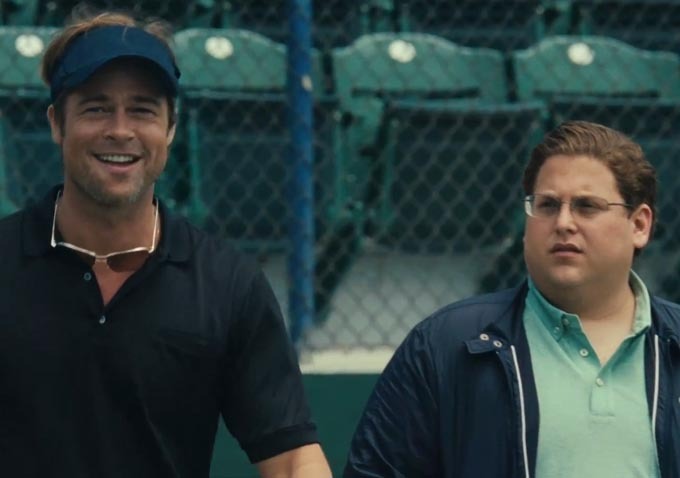
Oscar nominees Brad Pitt and Jonah Hill take a different approach with the Oakland A’s in MONEYBALL
MONEYBALL (Bennett Miller, 2011)
Metrograph
7 Ludlow St. between Canal & Hester Sts.
Saturday, July 9, 6:30
212-660-0312
metrograph.com
www.moneyball-movie.com
 After winning 102 games during the 2001 season but then falling to the New York Yankees in the American League Division Series in five tough games, the cash-poor Oakland A’s also lost three of their most prominent players, Jason Giambi, Johnny Damon, and Jason Isringhausen, to free agency. To rebuild the team with limited funds, general manager Billy Beane (Brad Pitt) turns to an unexpected source: Peter Brand (Jonah Hill), a young stat geek who believes that on-base percentage is the key to the game. The A’s scouts find it hard to believe that Beane is looking at has-been catcher Scott Hatteberg (Chris Pratt), aging outfielder David Justice (Stephen Bishop), and underperforming submariner Chad Bradford (Casey Bond) to get the A’s to the World Series, as does manager Art Howe (Philip Seymour Hoffman), who refuses to use the new players the way Beane insists. But when the A’s indeed start winning after a few more questionable deals pulled off by Beane and Brand, the entire sport world starts taking a much closer look at what is soon known as “moneyball.” Based on the 2003 bestseller Moneyball: The Art of Winning an Unfair Game by Michael Lewis, Moneyball is an exciting film even though the vast majority of it occurs off the field. Pitt is wonderfully understated as Beane, a former five-tool prospect for the Mets and divorced father of a twelve-year-old girl (Kerris Dorsey).
Pitt earned an Oscar nod for Best Actor for his portrayal of the real-life Beane, a confident but nervous man who may or may not have a big chip on his shoulder. Hill was nominated for Best Supporting Actor for his role as wiz-kid Brand, a fictional character inspired by Paul DePodesta, who refused to let his name and likeness be used in the film; Brand instead is an amalgamation of several of the people who work for Beane. Director Bennett Miller (Foxcatcher, Capote) takes the viewer into a number of fascinating back-room dealings, including a revealing scene in which Beane tries to acquire Ricardo Rincon from the Cleveland Indians, furiously working the phones to pull off the deal. Also nominated for Best Picture, Best Editing, Best Sound Mixing, and Best Adapted Screenplay, Moneyball firmly belongs in the playoff pantheon of great baseball movies, with the added bonus that you don’t have to be a fan or know a lot about the game to get sucked into its intoxicating tale. The film is screening July 9 at 6:30 at Metrograph and will be followed by a Q&A with writer, director, and actor James Toback, who wrote The Gambler and Bugsy and wrote and directed such other pictures as Fingers, Love and Money, and Seduced and Abandoned as well as the 1999 drama Black and White, which stars Mike Tyson, Robert Downey Jr., Brooke Shields, Claudia Schiffer, Raekwon, Ben Stiller, and Gaby Hoffmann and is being shown at Metrograph right after Moneyball and will also be followed by a Q&A with Toback.




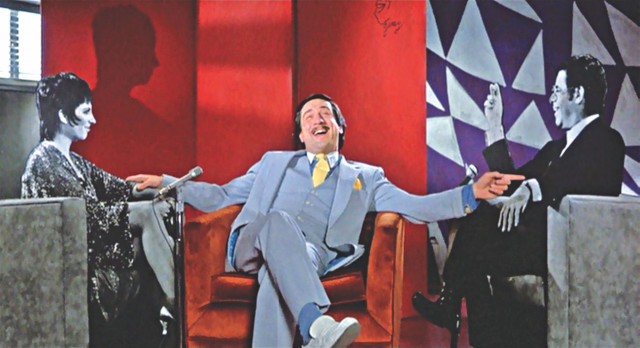
 Jerry Lewis is back in the news right now with the surprise online appearance of clips from his notorious unreleased 1972 film