Who: Bob Rosenthal, Ada Calhoun What: Celebration for the paperback publication of Cleaning Up New York: The ’70s Cult Classic (the Little Bookroom, March 2016, $12.95) Where:Rizzoli Bookstore, 1133 Broadway at 26th St., 212-759-2424 When: Wednesday, May 18, free, 6:00 Why: “$60. I needed $60 in three weeks’ time. I was out of a job so the idea of doing temporary work just popped into my head. I called a friend who had once done cleaning jobs and he told me to call up Everything for Living Space.” So begins Bob Rosenthal’s 1970s cult classic, Cleaning Up New York, which features the rather lengthy explanation on the front: “In which our hero coffees up with a pill, fortifies himself with some (pocketed) weed, and mops and waxes his way through weird vibes, domestic dramas . . . and seduction.” Rosenthal, who documented his time as Allen Ginsberg’s secretary for the Local East Village blog a few years ago, will be at the Rizzoli Bookstore on May 18 to talk about Cleaning Up New York with Ada Calhoun, the author of St. Marks Is Dead: The Many Lives of America’s Hippest Street (Norton, November 2015, $27.95).
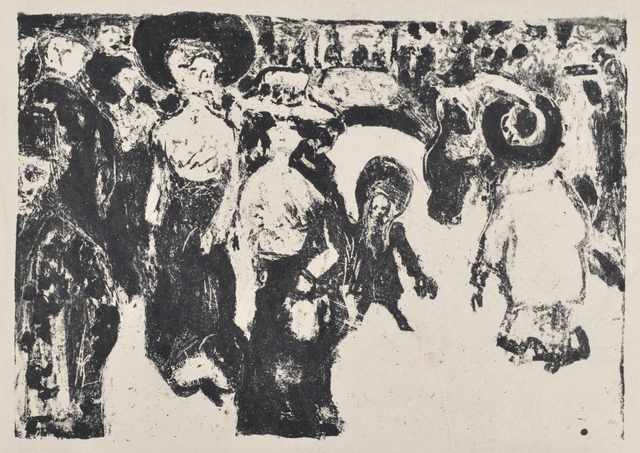
Ernst Ludwig Kirchner, “Street Life in Dresden,” lithograph on heavy cream Japan paper, 1908
Who:Eric Fischl and Jane Kallir What: Discussion about the work of Ernst Ludwig Kirchner and the evolution of drawing over the last century Where:Galerie St. Etienne, 24 West 57th St. between Fifth & Sixth Aves., 212-245-6734 When: Wednesday, May 18, free, 6:30 Why: “Ecstatic drawing is the foundation of the new art,” German Expressionist painter and Die Brücke cofounder Ernst Ludwig Kirchner said in 1919. On May 18, New York City native and painter and sculptor Eric Fischl will be at Galerie St. Etienne in Midtown to discuss “The Art of Drawing” with gallery owner Jane Kallir, held in conjunction with the exhibition “Ernst Ludwig Kirchner: Featuring Watercolors and Drawings from the Robert Lehman Collection,” which continues through July 1. The exhibition comprises more than fifty pen-and-ink drawings, woodcuts, watercolors, etchings, and lithographs by Kirchner, who committed suicide in 1938 at the age of fifty-eight, shortly after the Nazis detained or destroyed more than six hundred of his works. “Just as he preferred moving models, Kirchner himself moved as he drew, changing position or walking through town with a sketchbook in hand. He drew every day and nearly everywhere he went, filling at least 180 sketchbooks, over 12,000 sheets,” Kallir writes in her extensive exhibition essay. “Drawing is the key to Kirchner’s art, and his sketches are the key to his drawings. But the sketches should not be viewed as studies per se. Rather, the sketches birthed new forms, conceived in the throes of ‘ecstatic’ experience, that ‘crystallized and hardened’ in subsequent pictures.” Fischl, whose work includes such series as “Art Fair,” “Corrida in Ronda,” “The Travel of Romance,” “Ten Breaths,” and “The Bed, the Chair . . .” in addition to the MTA mosaic “The Garden of Circus Delights” in Penn Station, will lend insight into his own creative process as well. Free advance reservations are not required but recommended and can be made here.
Michel Gondry details a series of animated conversations with Noam Chomsky in brilliant documentary
CinéSalon: IS THE MAN WHO IS TALL HAPPY? AN ANIMATED CONVERSATION WITH NOAM CHOMSKY (Michel Gondry, 2013)
French Institute Alliance Française, Florence Gould Hall
55 East 59th St. between Madison & Park Aves.
Tuesday, May 17, $14, 4:00 & 7:30
Series continues Tuesdays through May 31
212-355-6100 www.fiaf.org
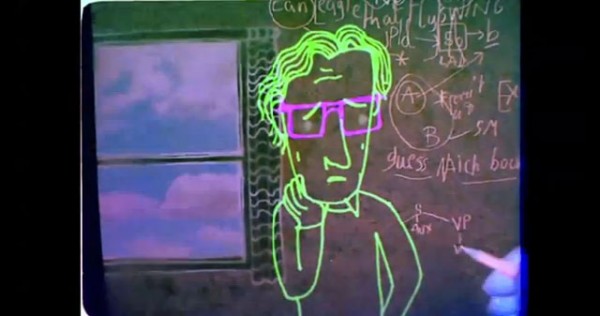
As it turns out, Michel Gondry’s exciting documentary, Is the Man Who Is Tall Happy? An Animated Conversation with Noam Chomsky, is animated in more ways than one. The fifty-year-old French director initially set out to go toe-to-toe with the controversial octogenarian linguist and philosopher, but he realized early on that the battle was lost. So when editing the series of interviews he had with Chomsky over the course of several months in 2010, he decided to illustrate the film with animated cartoon drawings, only occasionally showing the live-action Chomsky, often in a small box or circle within a colorfully rendered scene. After an attempt to impress Chomsky — the author of such books as Syntactic Structures; Cartesian Linguistics: A Chapter in the History of Rationalist Thought; Studies on Semantics in Generative Grammar; and The Logical Structure of Linguistic Theory — with his own views on image and representation, Gondry becomes embarrassed. “As you can see,” he says while the handwritten words appear on the screen, “I felt a bit stupid here. Let me explain: I think I couldn’t get my point through to Noam. Misuse of words and heavy accent aggravated my attempt.” Chomsky and Gondry go on to explore such concepts as generative grammar, language acquisition, and psychic continuity as Gondry, the director of such offbeat films as Eternal Sunshine of the Spotless Mind, The Science of Sleep, Human Nature, and Be Kind, Rewind, makes his endearing, often childlike drawings, a genius counterpoint to Chomsky’s cool and calm super-intellectualism.
Michel Gondry comes up with a unique way to depict Noam Chomsky in IS THE MAN WHO IS TALL HAPPY?
Gondry does get Chomsky to open up a little about his personal life, especially his relationship with his late wife, and they wisely avoid politics. The film eventually takes a hysterical turn when Gondry realizes that he better finish it soon, since it’s been three years since he conducted the talks with Chomsky and he wants to make sure he finishes it before Chomsky dies. In the end, Gondry manages to level the playing field as the two men diagram the title question. Is the Man Who Is Tall Happy? is an absolute treat, a fun and fascinating examination of human intelligence, the creative process, the manipulative relationship between director and viewer, and the essence of film and storytelling itself. Is the Man Who Is Tall Happy? is screening May 17 at 4:00 and 7:30 in FIAF’s “Creative Encounters” CinéSalon series, with the later show introduced by film journalist and professor Anne-Katrin Titze. The festival continues every Tuesday in May with Claire Denis’s Jacques Rivette, the Night Watchman and Chantal Akerman’s One Day Pina Asked…
Film Forum will celebrate the collaboration between Billy Wilder and Charles Brackett at two-day academy tribute
SPOTLIGHT ON SCREENWRITING
Film Forum
209 West Houston St.
Sunday, May 15, 5:20 & 7:40, and Monday, May 16, 8:20
212-727-8110 filmforum.org www.oscars.org
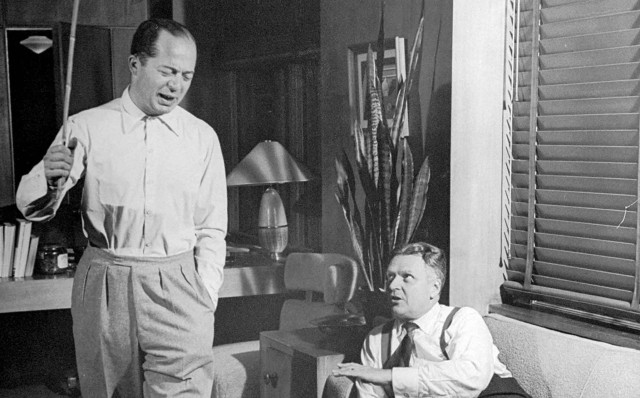
“Profile writers and Hollywood historians — the legitimate few, and a multitude of the mongrels of the species — have, without benefit of [Charles Brackett’s] diaries, created a gray-hued collage of Charlie carelessly pinned and pasted on an indistinct canvas, forever framed by the Billy Wilder legend,” Jim Moore, the grandson and biographer of screenwriter extraordinaire Charlie Brackett, writes in the foreword to Anthony Slide’s “It’s the Pictures That Got Small”: Charles Brackett on Billy Wilder and Hollywood’s Golden Age. Calling Brackett and Wilder’s collaboration an “odd-couple partnership,” Moore adds, “Two more different men you would be hard-pressed to find; two more talented ones, almost impossible to replicate; two more mercurial ones, in one place in time, have not been seen since. . . . Neither man served at the will of the other — Brackett was not Wilder’s secretary, Wilder was not the sole source of their success.” Film Forum is paying tribute to that success on May 15 and 16 with “Hollywood’s Happiest Couple,” showing three inestimable classics written by Brackett and Wilder and directed by Wilder, 1945’s The Lost Weekend and 1950’s Sunset Blvd., both of which won Oscars for screenwriting, and 1939’s Ninotchka, which was nominated for the award but lost out to Gone with the Wind. Moore will give an illustrated talk before all three screenings, which are part of the Academy of Motion Pictures Arts and Sciences series “Spotlight on Screenwriting”; in addition, he will present an academy compilation reel of Wilder and Brackett’s films following The Lost Weekend on Sunday night and Sunset Blvd. on Monday night. The dynamic duo also wrote Bluebeard’s Eighth Wife, Ball of Fire, Five Graves to Cairo, Midnight, What a Life, Hold Back the Dawn, The Major and the Minor, A Foreign Affair, The Emperor Waltz, and Arise My Love. “Worked with Billy Wilder, who paces constantly, has over-extravagant ideas, but is stimulating. He has a kind of humor that sparks with mine,” Brackett wrote in a 1936 diary entry. Together they created quite a stimulating legacy as evidenced by this brief homage.
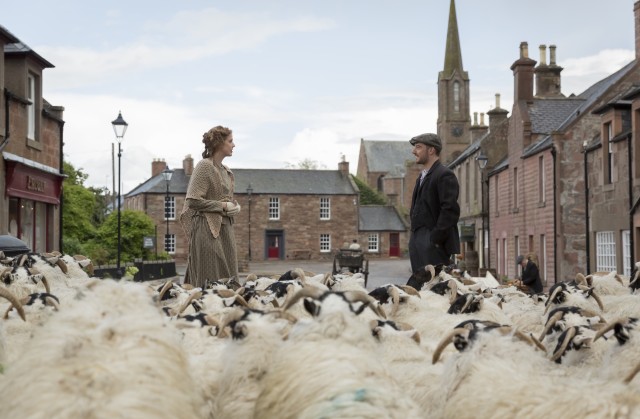
A golden glow hovers over Sunset Song, Terence Davies’s lush adaptation of Scottish writer Lewis Grassic Gibbon’s seminal 1932 novel about family, land, war, and one young woman’s coming-of-age. Although it has the epic feel of a sweeping historical tale, the film takes place over just a few years in the second decade of the twentieth century, seen through the eyes of Chris Guthrie (Agyness Deyn). Her father, John (Peter Mullan), is a brutish farmer who runs his household with an iron fist. He lashes out, literally and figuratively, at his strapping son, Will (Jack Greenlees), who stands and takes it, choosing not to fight back, and treats his wife, Jean (Daniela Nardini), like a housekeeper and baby-making machine. In one of the most wrenching scenes of the film, John drags Jean, who doesn’t want to have any more children, upstairs to rape her in order to increase the size of their family; Jean’s terrifying screams from the bedroom evolve into shrill cries as she gives birth to twins. Following a horrific tragedy, Chris is forced to give up her education — she was studying to become a teacher — and work on the family farm. Upon meeting fellow farmer Ewan Tavendale (Kevin Guthrie), friendship turns into something more as Scotland gets involved in World War I.
Sunset Song is a slow-paced melodrama with moments of poetic beauty alternating with clichéd scenes and disjointed plot twists that come out of nowhere. It’s as if Davies, who has previously adapted John Kennedy Toole’s The Neon Bible, Terence Ratigan’s The Deep Blue Sea, and Edith Wharton’s The House of Mirth in addition to making the award-winning Distant Voices, Still Lives, sliced and diced too much out of Gibbon’s story, the first book in the A Scots Quair trilogy. Supermodel Deyn (Clash of the Titans, Pusher) is gentle and touching as Chris, and she has a sweet chemistry with Guthrie (Sunshine on Leith, Restless) until things go awry. Cinematographer Michael McDonough evokes Nestor Almendros’s Oscar-winning work on Terrence Malick’s Days of Heaven but never quite reaches the breathtaking level the film aspires to, much like Davies’s screenplay leaves us somewhat confused and wanting. But there’s still much to admire in this intimate feminist tale in which the land is a character unto itself, even if it’s not one of Davies’s finest, most magical hours. Sunset Song opens May 13 at Lincoln Plaza and Film Forum; Davies will be at Film Forum for a Q&A following the 6:45 show on opening night.
Who: Charles Bock, Ani DiFranco, Amber Tamblyn, Belinda McKeon, Kate Neckel, Lady Parts Justice, Amanda Stern What:Happy Ending Music & Reading Series Where:Symphony Space, Peter Jay Sharp Theatre, 2537 Broadway at 95th St., 212-864-5400 When: Wednesday, May 18, $15-$30, 7:30 Why: Symphony Space’s Happy Ending Music & Reading Series presents artists performing risky feats while musicians collaborate on a sing-along of cover tunes. Past participants have included Lena Dunham, John Cameron Mitchell, Zadie Smith, Vampire Weekend, Jennifer Egan, and Moby. On May 18, host and curator Amanda Stern, who founded the series in 2003, brings together author Charles Bock (Alice & Oliver, Beautiful Children), musician, activist, and Righteous Babe Ani DiFranco (Up Up Up Up Up Up, Allergic to Water), author Belinda McKeon (Tender, Solace), artist and designer Kate Neckel (Start Now! The Creativity Journal), author, actress, and director Amber Tamblyn (Dark Sparkler, Joan of Arcadia), and special guests Lady Parts Justice for another unpredictable evening of art, music, literature, and mayhem.
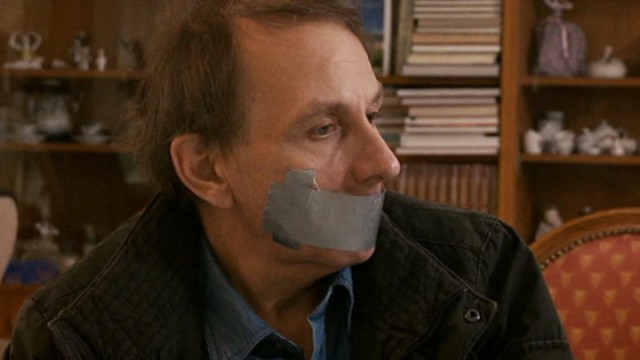
Michel Houellebecq plays a version of himself in Guillaume Nicloux’s satirical black comedy
CinéSalon: THE KIDNAPPING OF MICHEL HOUELLEBECQ (L’ENLÈVEMENT DE MICHEL HOUELLEBECQ) (Guillaume Nicloux, 2014)
French Institute Alliance Française, Florence Gould Hall
55 East 59th St. between Madison & Park Aves.
Tuesday, May 10, $14, 4:00 & 7:30
Series continues Tuesdays through May 31
212-355-6100 www.fiaf.org
In 2010, French writer, actor, poet, and filmmaker Michel Houellebecq won the prestigious Prix Goncourt for his novel The Map and the Territory. The controversial Houellebecq — who has been accused of plagiarism, misogyny, and inciting racial hatred — then went missing in 2011, failing to show up for a book tour in Belgium and the Netherlands. As it turns out, the novelist merely forgot about the readings and claims he was unreachable at the time, by either phone or e-mail. But writer-director Guillaume Nicloux tells a far more entertaining story in the absurdist black comedy The Kidnapping of Michel Houellebecq, which imagines that he really was taken hostage and held for a never-specified ransom. Even better, Nicloux got Houellebecq to play himself in the film, spoofing his image as an intellectual recluse. The fictionalized Houellebecq is taken captive by Mathieu (Mathieu Nicourt), Max (Maxime Lefrançois), and Luc (Luc Schwarz), who eventually bring him to a country house owned by elderly couple Ginette (Ginette Suchotzky) and Dede (Andre Suchotzky), where Houellebecq is almost always handcuffed and chained to his bed at night. His kidnappers engage him in literary discussions, talk about bodybuilding, bring him books to read, drink wine and smoke cigarettes with him, and even procure female accompaniment (Marie Bourjala) when he asks for it. The real Houellebecq (Platform; H. P. Lovecraft: Against the World, Against Life) plays his fictionalized self with a deadpan comic turn worthy of Buster Keaton, never letting on whether anything that is happening is even the slightest bit true to who Houellebecq actually is. Nicloux (The Nun, Valley of Love) keeps the audience guessing all the way about the characters and their motives, but don’t expect any simple answers or trite resolutions. The Kidnapping of Michel Houellebecq is screening May 10 at 4:00 and 7:30 in FIAF’s “Creative Encounters” CinéSalon series, with the later show introduced by Albertine Books deputy director Tom Roberge, who has admitted to his “slavish devotion to Michel Houellebecq.” The festival continues every Tuesday in May with Michel Gondry’s Is the Man Who Is Tall Happy?, Claire Denis’s Jacques Rivette, the Night Watchman, and Chantal Akerman’s One Day Pina Asked…

 As it turns out,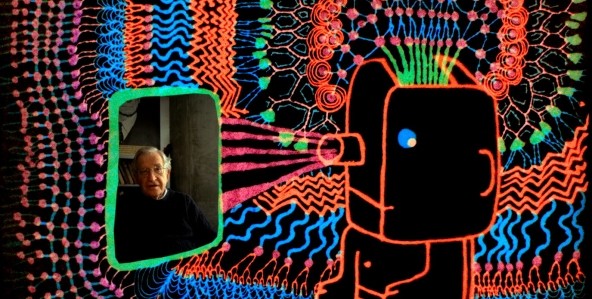
 A golden glow hovers over Sunset Song, Terence Davies’s lush adaptation of Scottish writer Lewis Grassic Gibbon’s seminal 1932 novel about family, land, war, and one young woman’s coming-of-age. Although it has the epic feel of a sweeping historical tale, the film takes place over just a few years in the second decade of the twentieth century, seen through the eyes of Chris Guthrie (Agyness Deyn). Her father, John (Peter Mullan), is a brutish farmer who runs his household with an iron fist. He lashes out, literally and figuratively, at his strapping son, Will (Jack Greenlees), who stands and takes it, choosing not to fight back, and treats his wife, Jean (Daniela Nardini), like a housekeeper and baby-making machine. In one of the most wrenching scenes of the film, John drags Jean, who doesn’t want to have any more children, upstairs to rape her in order to increase the size of their family; Jean’s terrifying screams from the bedroom evolve into shrill cries as she gives birth to twins. Following a horrific tragedy, Chris is forced to give up her education — she was studying to become a teacher — and work on the family farm. Upon meeting fellow farmer Ewan Tavendale (Kevin Guthrie), friendship turns into something more as Scotland gets involved in World War I.
 In 2010, French writer, actor, poet, and filmmaker Michel Houellebecq won the prestigious Prix Goncourt for his novel The Map and the Territory. The controversial Houellebecq — who has been accused of plagiarism, misogyny, and inciting racial hatred — then went missing in 2011, failing to show up for a book tour in Belgium and the Netherlands. As it turns out, the novelist merely forgot about the readings and claims he was unreachable at the time, by either phone or e-mail. But writer-director Guillaume Nicloux tells a far more entertaining story in the absurdist black comedy The Kidnapping of Michel Houellebecq, which imagines that he really was taken hostage and held for a never-specified ransom. Even better, Nicloux got Houellebecq to play himself in the film, spoofing his image as an intellectual recluse. The fictionalized Houellebecq is taken captive by Mathieu (Mathieu Nicourt), Max (Maxime Lefrançois), and Luc (Luc Schwarz), who eventually bring him to a country house owned by elderly couple Ginette (Ginette Suchotzky) and Dede (Andre Suchotzky), where Houellebecq is almost always handcuffed and chained to his bed at night. His kidnappers engage him in literary discussions, talk about bodybuilding, bring him books to read, drink wine and smoke cigarettes with him, and even procure female accompaniment (Marie Bourjala) when he asks for it. The real Houellebecq (Platform; H. P. Lovecraft: Against the World, Against Life) plays his fictionalized self with a deadpan comic turn worthy of Buster Keaton, never letting on whether anything that is happening is even the slightest bit true to who Houellebecq actually is. Nicloux (The Nun, Valley of Love) keeps the audience guessing all the way about the characters and their motives, but don’t expect any simple answers or trite resolutions. The Kidnapping of Michel Houellebecq is screening May 10 at 4:00 and 7:30 in FIAF’s “Creative Encounters” CinéSalon series, with the later show introduced by Albertine Books deputy director Tom Roberge, who has admitted to his