this week in lectures, signings, panel discussions, workshops, and Q&As

JAMES TOBACK PRESENTS MONEYBALL

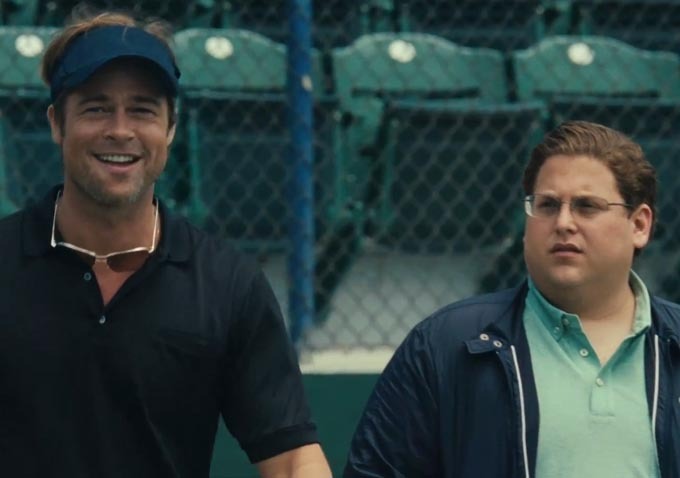
Oscar nominees Brad Pitt and Jonah Hill take a different approach with the Oakland A’s in MONEYBALL

MONEYBALL (Bennett Miller, 2011)
Metrograph
7 Ludlow St. between Canal & Hester Sts.
Saturday, July 9, 6:30
212-660-0312
metrograph.com
www.moneyball-movie.com

After winning 102 games during the 2001 season but then falling to the New York Yankees in the American League Division Series in five tough games, the cash-poor Oakland A’s also lost three of their most prominent players, Jason Giambi, Johnny Damon, and Jason Isringhausen, to free agency. To rebuild the team with limited funds, general manager Billy Beane (Brad Pitt) turns to an unexpected source: Peter Brand (Jonah Hill), a young stat geek who believes that on-base percentage is the key to the game. The A’s scouts find it hard to believe that Beane is looking at has-been catcher Scott Hatteberg (Chris Pratt), aging outfielder David Justice (Stephen Bishop), and underperforming submariner Chad Bradford (Casey Bond) to get the A’s to the World Series, as does manager Art Howe (Philip Seymour Hoffman), who refuses to use the new players the way Beane insists. But when the A’s indeed start winning after a few more questionable deals pulled off by Beane and Brand, the entire sport world starts taking a much closer look at what is soon known as “moneyball.” Based on the 2003 bestseller Moneyball: The Art of Winning an Unfair Game by Michael Lewis, Moneyball is an exciting film even though the vast majority of it occurs off the field. Pitt is wonderfully understated as Beane, a former five-tool prospect for the Mets and divorced father of a twelve-year-old girl (Kerris Dorsey).

Pitt earned an Oscar nod for Best Actor for his portrayal of the real-life Beane, a confident but nervous man who may or may not have a big chip on his shoulder. Hill was nominated for Best Supporting Actor for his role as wiz-kid Brand, a fictional character inspired by Paul DePodesta, who refused to let his name and likeness be used in the film; Brand instead is an amalgamation of several of the people who work for Beane. Director Bennett Miller (Foxcatcher, Capote) takes the viewer into a number of fascinating back-room dealings, including a revealing scene in which Beane tries to acquire Ricardo Rincon from the Cleveland Indians, furiously working the phones to pull off the deal. Also nominated for Best Picture, Best Editing, Best Sound Mixing, and Best Adapted Screenplay, Moneyball firmly belongs in the playoff pantheon of great baseball movies, with the added bonus that you don’t have to be a fan or know a lot about the game to get sucked into its intoxicating tale. The film is screening July 9 at 6:30 at Metrograph and will be followed by a Q&A with writer, director, and actor James Toback, who wrote The Gambler and Bugsy and wrote and directed such other pictures as Fingers, Love and Money, and Seduced and Abandoned as well as the 1999 drama Black and White, which stars Mike Tyson, Robert Downey Jr., Brooke Shields, Claudia Schiffer, Raekwon, Ben Stiller, and Gaby Hoffmann and is being shown at Metrograph right after Moneyball and will also be followed by a Q&A with Toback.

BURNING BRIGHT — NEW FRENCH FILMMAKERS: THE LAST HAMMER BLOW

THE LAST HAMMER BLOW

Thirteen-year-old Vicgtor (Romain Paul) has to pull off quite a balancing act in Alix Delaporte’s poignant THE LAST HAMMER BLOW

CINÉSALON: THE LAST HAMMER BLOW (LE DERNIER COUP DE MARTEAU) (Alix Delaporte, 2014)
French Institute Alliance Française, Florence Gould Hall
55 East 59th St. between Madison & Park Aves.
Tuesday, July 5, $14, 4:00 & 7:30 (later screening introduced by Mathieu Fourne)
212-355-6100
fiaf.org
www.palacefilms.com

For their work in Alix Delaporte’s 2010 drama, Angèle et Tony, Clotilde Hesme, as Angèle, won the César for Most Promising Actress and Grégory Gadebois, as Tony, was named Most Promising Actor. For his film debut in Delaporte’s 2014 follow-up, the gentle, tender-hearted The Last Hammer Blow, playing at FIAF on July 5, teenager Romain Paul, portraying Victor, the illegitimate son of characters played by Hesme and Gadebois, won the Marcello Mastroianni Award for Best New Young Actor at the Venice International Film Festival. (Hesme and Gadebois also both starred in the French television series The Returned.) Victor is a sullen thirteen-year-old soccer phenom living with his mother, Nadia (Hesme), in a lonely trailer park. They have run out of money as Nadia battles cancer and considers selling their home and moving in with her estranged parents. When Victor’s father, famous conductor Samuel Rovinski (Gadebois), arrives to lead a performance of Mahler’s Sixth Symphony at the local opera house, Victor confronts him, but Rovinski at first denies that he has a son. But Victor persists in visiting the maestro, all the while not telling his mother that he is being considered for a spot in a prestigious soccer program. In addition, his hormones start raging as he begins noticing that one of his neighbors, Luna (Mireia Vilapuig), is blossoming into quite a beautiful young girl. The various parts of his life converge suddenly, putting him in a precarious position as he is forced to make some difficult decisions.

The Last Hammer Blow is a touching, sensitively told coming-of-age tale, anchored by a breakout performance by Paul, who imbues Victor with a mixture of compassion and ennui, keeping him at an even keel no matter what he faces. Hesme (Love Songs, Mysteries of Lisbon) is heartbreaking as a mother running out of options, and Gadebois (One of a Kind, Une femme dans la Révolution) excels as a bold, strong man who can’t just wave his conductor’s baton and make the past go away. Delaporte’s second film is a character-driven study filled with a poignant humanity that avoids melodrama and cliché in favor of honesty and genuine surprise. Claire Mathon (Angèle et Tony, Mon roi, Two Friends) earned her first of three Lumières Award nominations for her evocative cinematography, and Evgueni and Sacha Galperine’s soundtrack is bittersweet and subtle, especially in the shadow of the grand Mahler symphony. The Last Hammer Blow is screening at 4:00 and 7:30 on July 5 in FIAF’s CinéSalon series “Burning Bright: New French Filmmakers”; the later screening will be introduced by Mathieu Fournet of the French Embassy. The series continues Tuesday nights in July with Arnaud Viard’s Paris, Love, Cut, Thomas Salvador’s Vincent, and Jean-Charles Hue’s Eat Your Bones.

TOM SACHS: TRAINING

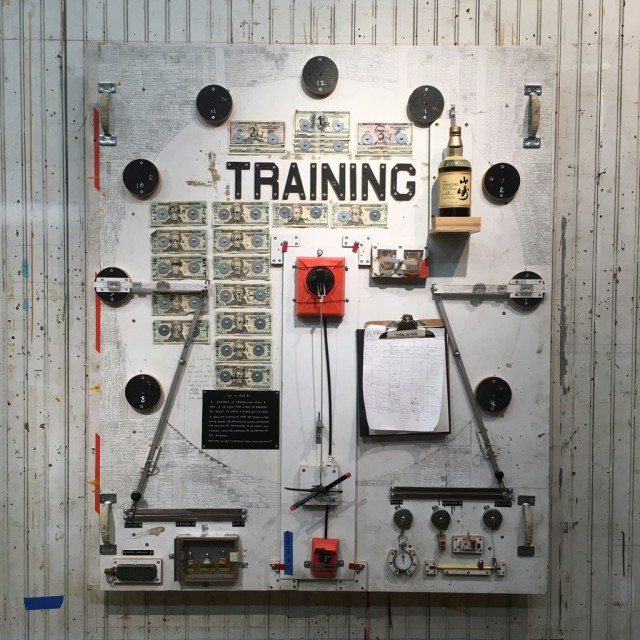
Tom Sachs, “Training,” synthetic polymer paint on plywood, 2016 (photo courtesy FLAG Art Foundation)

Tom Sachs, “Training,” synthetic polymer paint on plywood, 2016 (image courtesy the artist)

The FLAG Art Foundation
545 West 25th St. between Tenth & Eleventh Aves., ninth floor
Wednesday, July 6, free with advance RSVP, 6:30
212-206-0220
flagartfoundation.org
www.tomsachs.org

In his operation manual for his 2006 installation “The Island,” New York City native Tom Sachs quotes Yoda: “Do, or do not. There is no try.” Sachs does. And he has a lot of fun doing it. The Bennington College graduate takes a DIY approach to his art, displaying a wry sense of humor in such works as “Chanel Guillotine,” “Prada Toilet,” “Nutsy’s McDonald’s,” “Barbie Slave Ship,” and “Hello Kitty Nativity.” In 2008, he went up against the Neistat brothers in a hilarious power boat race. In 2012, he staged an intricately planned trip to the red planet in his massive interactive Park Avenue Armorny exhibition “Space Program: Mars,” which was later turned into a 2016 film. Currently, “Tom Sachs: Boombox Retrospective, 1996 – 2016” welcomes visitors to the Brooklyn Museum, while “Tom Sachs: Tea Ceremony” offers an immersive experience at the Noguchi Museum. On July 6, Sachs will be at the FLAG Art Foundation in Chelsea, activating “Training,” his contribution to the group show “Summer School,” which consists of playful works by such artists as John Baldessari, Dan Colen, Tara Donovan, Mark Grotjahn, Tony Matelli, Marilyn Minter, Vik Muniz, and Ugo Rondinone. “Training” is a helicopter rescue game / wall sculpture that involves riddles and such game pieces as a bag of McDonald’s fries and an Apollo command module. Sachs and his studio team will participate in a live tournament that will put the finishing touches on the work. Admission is free, but advance RSVP is recommended; as a bonus, whiskey and wine will be served. The tournament starts at 7:00, but be sure to get there at 6:30 to check out “Summer School” as well as the tenth-floor exhibit, Patricia Cronin’s “Shrine for Girls, New York.”

STET

(photo © Ben Strothmann)

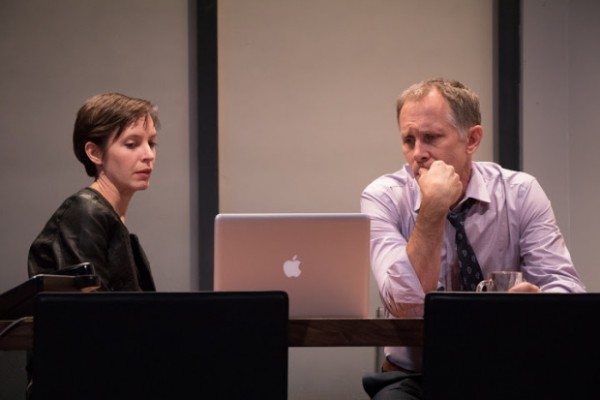
Erika (Jocelyn Kuritsky) and Phil (Bruce McKenzie) tackle a complex story about campus rape culture in STET (photo © Ben Strothmann)

June Havoc Theatre, Abingdon Theatre Company
Abingdon Theatre Arts Complex
312 West 36th St. between Eighth & Ninth Aves.
Tuesday – Sunday through July 10, $51-$76 (pay what you can $5-$20 July 8)
212-868-2055
abingdontheatre.org

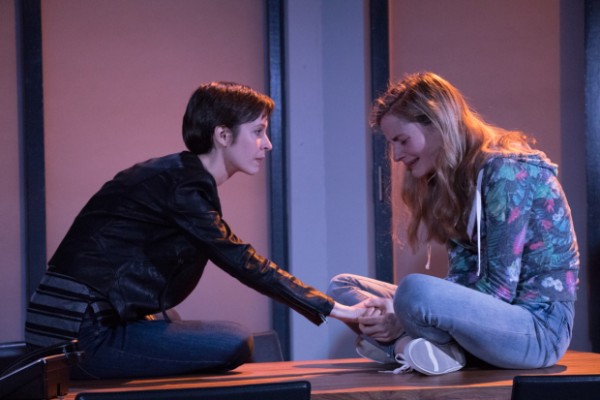
You might expect Kim Davies’s STET, a play about campus rape and how it’s reported in the media, to be a didactic, pedagogic, and preachy piece of well-meaning, issue-driven propaganda. It was developed by Davies, new Abingdon Theatre artistic director Tony Speciale, and star Jocelyn Kuritsky, founder of the Muse Project, which calls for “a paradigm shift for female actors.” It has partnered with Take Back the Night, a nonprofit organization that “seeks to end sexual assault, domestic violence, dating violence, sexual abuse, and all other forms of sexual violence.” Several of the performances are being followed by discussions with journalists and survivors of sexual assault. And one of the characters in the play is spreading the word of One in Four, the all-male sexual assault peer education group at colleges and universities around the country that takes its name from various studies that show that approximately twenty-five percent of female undergraduates are victims of sexual assault. But it turns out that STET is a compelling, thought-provoking work that pulls no punches as it explores complex situations with intelligence and finesse. STET was inspired by the controversial Rolling Stone article “A Rape on Campus,” which led to a retraction that shook the world of journalism. Kuritsky stars as Erika, a reporter at a national magazine looking to get her first cover story. Her editor, Phil (Bruce McKenzie), suggests that she take a new angle on the topic, focusing on what it’s like for survivors long after the assault, whether they are able to get back to a more normal life in the aftermath, but Erika says, “I’m just — you know, I’m just kind of raped out? That’s all.” But she ultimately accepts the assignment and tracks down a college student named Ashley Young (Lexi Lapp), who describes in detail how she was raped at a fraternity party by seven pledges. However, she is terrified of using any real names or giving away any specifics that could lead to retaliation, so she is unsure if she wants to be part of the story. Erika also meets with Christina Torres (Déa Julien), a graduate of Ashley’s school who now works as project coordinator for the university’s sexual misconduct response and prevention initiative. “I’m here for people who are in pain, who are suffering, who need someone to help them be okay,” Christina says, “because literally everything else is about the perpetrator of the assault and that is just not my job.” Christina refers Erika to Connor (Jack Fellows), a current student who is cofounder of the school’s One in Four chapter and the vice president of the fraternity where Ashley was allegedly attacked. As Erika investigates further, she gets a better picture of the culture that has grown around campus rape. “I think Ashley has a very . . . um . . . it’s a very clear story for a reader to follow,” she tells Christina, who replies, “Yeah, it’s very easy to understand as rape.” Erika: “Yeah.” Christina: “But a lot of stories aren’t. But that doesn’t mean, you know, that they’re not, um, rape.” Despite telling Phil that she’s “not a sympathetic person,” Erika starts getting more personally involved in the story while trying to maintain her journalistic ethics.

(photo © Ben Strothmann)

Erika (Jocelyn Kuritsky) tries to comfort Ashley Young (Lexi Lapp) while investigating a difficult story (photo © Ben Strothmann)

STET, named for the term used to tell a typesetter to ignore a suggested change, takes place in Jo Winiarski’s conference-room set, surrounded by opaque walls through which shadows can occasionally be seen. The walls also serve as a backdrop for Katherine Freer’s projections, which include Skyping, text messages, a television interview, and a shower of words as the story takes off. Davies (Smoke) handles the tense subject with great care, avoiding platitudes for the most part while still making her point. “I just don’t see women as victims waiting to happen,” Connor says. Erika responds, “I don’t see women as victims. But don’t you think — isn’t it possible that someone could, you know, get pressured into doing something she doesn’t want to do?” to which Connor replies, “But she’s still choosing to do it, right?” It’s not an easy play to watch, and it does have its occasional lapses, but it’s very effective in its specific exploration of rape culture examined from multiple angles. Don’t be surprised if it has you reevaluating your thoughts on rape and the media long after the play is over. STET has been extended through July 10; the June 30 performance will be followed by a discussion with writers Amanda Duarte and Eliza Bent and activist Kathy Moran.

FIRST SATURDAY: VISUALIZE INDEPENDENCE

Dread Scott (American, born 1965). Performance still from On the Impossibility of Freedom in a Country Founded on Slavery and Genocide, 2014. Pigment print, 22 × 30 in. (55.9 × 76.2 cm). Project produced by More Art. Collection of the artist, Brooklyn. © Dread Scott. (Photo: Mark Von Holden Photography. © Dread Scott

Dread Scott, performance still from “On the Impossibility of Freedom in a Country Founded on Slavery and Genocide,” pigment print, 2014 (Project produced by More Art. Collection of the artist, Brooklyn. © Dread Scott. Photo: Mark Von Holden Photography. © Dread Scott)

Brooklyn Museum
200 Eastern Parkway at Washington St.
Saturday, July 2, free, 5:00 – 11:00
212-864-5400
www.brooklynmuseum.org

The Brooklyn Museum honors America’s 240th birthday with an evening of free programs dedicated to free speech and social change on July 2. The monthly First Saturday events will feature live performances by Pablo Helguera’s project El Club de Protesta (the Protest Club), Bread and Puppet Theater (Underneath the Above Show #1), Dennis Redmoon Darkeem (smudging ritual, interactive Good Trade), and DJ Chela; a screening of Judd Ehrlich’s Keepers of the Game (followed by a talkback with cast members Louise and Tsieboo Herne); highlights from the “LGBTQ New Americans” oral history project (followed by a talkback); storytelling with percussionist Sanga of the Valley; a pop-up gallery talk for “Agitprop!”; a curator tour of the American art collection with Connie Choi; a hands-on workshop in which participants can make their own personal flag using cloth collages; and interactive “Legislative Theatre” with Theatre of the Oppressed NYC. In addition, you can check out such exhibitions as “Disguise: Masks and Global African Art,” “Tom Sachs: Boombox Retrospective, 1999–2016,” and “Stephen Powers: Coney Island Is Still Dreamland (to a Seagull).”

THE KING OF COMEDY

THE KING OF COMEDY

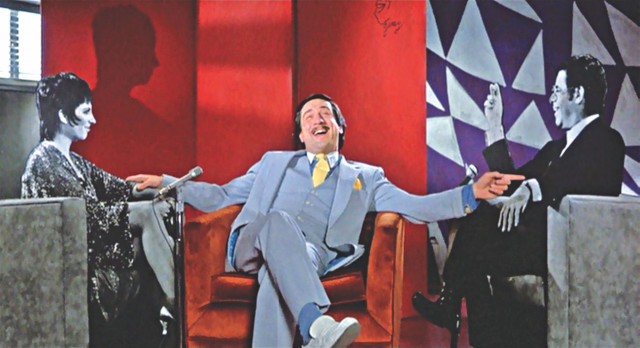
The inimitable Rupert Pupkin (Robert De Niro) imagines quite a career for himself in THE KING OF COMEDY

THE KING OF COMEDY (Martin Scorsese, 1982)
Film Forum
209 West Houston St.
June 24-30
212-727-8110
filmforum.org

Jerry Lewis is back in the news right now with the surprise online appearance of clips from his notorious unreleased 1972 film The Day the Clown Cried, a Holocaust picture believed to be so disastrous that he has vowed it will never see the light of day. But from June 24 to 30 at Film Forum, you can revisit one of the former MDA telethon host’s best performances, in Martin Scorsese’s vastly underrated and underappreciated 1982 masterpiece, The King of Comedy. Lewis stars as Jerry Langford, the host of a massively popular late-night television show. (The part was initially offered to Johnny Carson, who turned it down.) Lewis is one cool, calm customer as the smooth, elegant Langford, a far cry from his familiar caricatures in such films as The Bellboy, The Patsy, and The Nutty Professor. The most fascinating role in the film, however, is his stalker, wannabe-comedian Rupert Pupkin (Robert De Niro), who is desperate to get on Jerry’s show and become part of his inner circle, as well as Masha (Sandra Bernhard), who is in love with Jerry and thinks they are destined to be together. When not hanging around Jerry’s office, harassing Langford’s right-hand associate, Cathy Long (Shelley Hack), and the receptionist (Margo Winkler), Pupkin is in the basement of his home, pretending to be a guest on the show, yakking it up with cardboard cutouts of Langford and Liza Minnelli while his mother (voiced by Scorsese’s real mom, Catherine) yells at him to do something with his life. Pupkin is also trying to impress a former high school classmate, Rita (Diahnne Abbott, who was married to De Niro at the time), a bartender who barely remembers him. When things don’t go quite as planned, Rupert and Masha try to pull off a crazy scheme to get what they feel is their destiny.
THE KING OF COMEDY

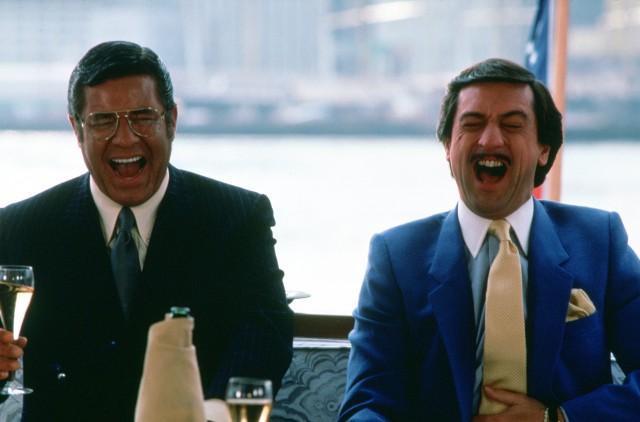
Jerry Lewis gives his most mature performance ever opposite Robert De Niro in Martin Scorsese’s THE KING OF COMEDY

Written by film critic, activist, and author Paul D. Zimmerman, The King of Comedy has held up remarkably well over the years, displaying a thrilling prescience about the state of celebrity obsession and the need to be on television well before the internet and reality shows changed the dynamic between star and fan. De Niro fully embodies the creepy, awkward, splendidly dressed Pupkin, who is essentially the illegitimate love child of Travis Bickle and Jake LaMotta as seen through the lens of Paddy Chayefsky’s Network. And Bernhard, in her first major film role, is a revelation as Masha, exhibiting an expert physicality worthy of the best cinematic comedians, with just the right amount of dark madness. Just as Pupkin goes back and forth between fantasy and reality, Scorsese keeps viewers on edge, not always differentiating between fiction and nonfiction; he has numerous familiar faces play versions of themselves, including radio and television announcer Ed Herlihy and bandleader Les Brown, Tony Randall as a guest host, longtime Carson producer Fred de Cordova as Bert Thomas, producer of The Jerry Langford Show, Dr. Joyce Brothers as one of Randall’s guests, and Emmy-winning producer Edgar Scherick as a network executive. Cinematographer Fred Schuler beautifully captures the hustle of early 1980s New York City, echoing what’s going on inside Pupkin’s deranged mind, while music adviser Robbie Robertson, a friend of Scorsese’s who was in the great Band documentary The Last Waltz, puts together a fab soundtrack that ranges from Ray Charles’s “Come Rain or Come Shine” and the Pretenders’ “Back on the Chain Gang” to Robertson’s own “Between Trains” and Van Morrison’s gorgeous closing credits song, “Wonderful Remark.” Scorsese fills the film with plenty of little treats and sweet touches. Look for the Clash’s Mick Jones, Joe Strummer, and Paul Simonon as the street punks, along with Ellen Foley, Don Letts, Kosmo Vinyl, and Pearl Harbour. In the scene in which Pupkin takes Rita to dinner, a man in the back of the restaurant is curiously mimicking Pupkin’s gesticulations. And Scorsese makes an inside-joke cameo when Randall, preparing to host The Jerry Langford Show, questions something, shrugs, and says to Scorsese, “You’re the director.” The 2013 digital restoration of The King of Comedy is playing at Film Forum June 24-30; the 7:30 show on June 24 will be introduced by Gilbert Gottfried and Frank Santopadre, on June 25 by Aparna Nancherla, and on June 29 by Mario Cantone.

SONG OF MYSELF: THE WORDS OF WALT WHITMAN

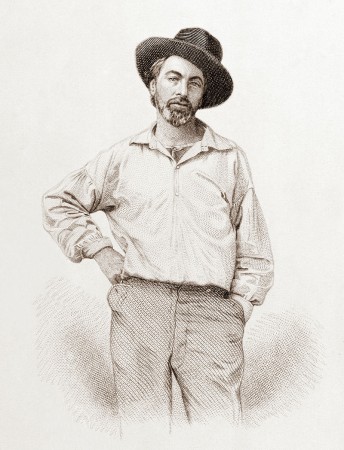
One-man show honors the legacy of Walt Whitman

One-man show honors the legacy of Walt Whitman

Who: Matthew Aughenbaugh, Michael Ruby, Graham Fawcett
What: Immersive theater piece
Where: The Old Stone House, Washington Park & JJ Byrne Playground, between Fourth & Fifth Aves. and Third & Fourth Sts., Park Slope, 718-768-3195
When: Friday, June 24, $15-$20, 8:00
Why: On June 24, Matthew Aughenbaugh will perform his one-man show, Song of Myself: The Words of Walt Whitman, at the Old Stone House in Park Slope, in the borough where the mighty poet was raised. “Crowds of men and women attired in the usual costumes, how curious you are to me! / On the ferry-boats the hundreds and hundreds that cross, returning home, are more curious to me than you suppose, / And you that shall cross from shore to shore years hence are more to me, and more in my meditations, than you might suppose,” Whitman wrote in 1856’s “Crossing Brooklyn Ferry.” Aughenbaugh, a Shakespearean actor who has also done musical theater, noted in a statement, “I was inspired to create a theater piece using only original text as a way to share my passion for our greatest American poet.” The immersive show, presented by London’s Upper Wimpole Street Literary Salon, will be followed by a Q&A with Aughenbaugh and Brooklyn poet Michael Ruby, moderated by British broadcaster, teacher, and translator Graham Fawcett. Tickets are $15 in advance and $20 at the door and come with wine and refreshments.