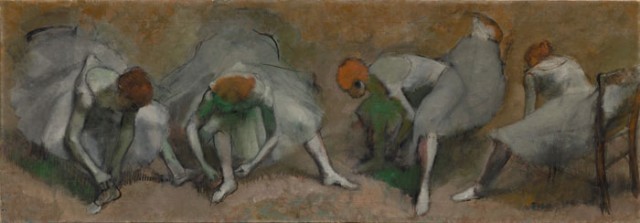
Edgar Degas, “Frieze of Dancers,” oil on canvas, ca. 1895, (the Cleveland Museum of Art, gift of the Hanna Fund)
Museum of Modern Art
Floor 6, Special Exhibitions Gallery North
11 West 53rd St. between Fifth & Sixth Aves.
Daily through Sunday, July 24, $25
212-708-9400
www.moma.org
The splendidly curated MoMA exhibit “Edgar Degas: A Strange New Beauty” reveals the French artist’s dazzling, experimental work with monotypes, manipulating their tools and processes as if he were using a predigital, hands-on version of Photoshop. Born in Paris in 1834, Hilaire-Germain-Edgar Degas discovered the monotype technique in the mid-1870s, allowing him to expand his creativity and do things that no one else had done before. He “is no longer a friend, a man, an artist! He’s a zinc or copper plate blackened with printer’s ink, and plate and man are flattened together by his printing press whose mechanism has swallowed him completely!” etcher Marcellin Desboutin wrote in an 1876 letter, recounted in curator Jodi Hauptman’s introduction in the exhibition catalog. “The man’s crazes are out of this world. He now is in the metallurgic phase of reproducing his drawings with a roller and is running all over Paris, in the heat wave — trying to find the legion of specialists who will realize his obsession. He is a real poem! He talks only of metallurgists, lead casters, lithographers, planishers!” Degas indeed got his hands dirty, smudging ink, scratching plates, and painting over prints in a whirlwind of artistic fervor. Degas covered many of the same topics he had in his oil paintings and drawings, but employing etching, drypoint, and aquatint gave him a virtual freedom that he took full advantage of. In “Actresses in Their Dressing Rooms,” state 1 of 5 is gray and shady, the characters and interior harder to define than in the fifth state. One of two printings of “An Admirer in the Corridor” is like a ghostly version of the other. The monotype-on-paper “Ironing Women” is cleverly paired with the larger oil on canvas “A Woman Ironing,” capturing Degas’s differing takes on a domestic scene. But it’s not only the multiples that highlight Degas’s process. More abstract works such as “The River” and “Factory Smoke” are filled with a lovely mystery. Other subjects that Degas investigates include women in baths and brothels, putting on stockings, and reclining in bed.
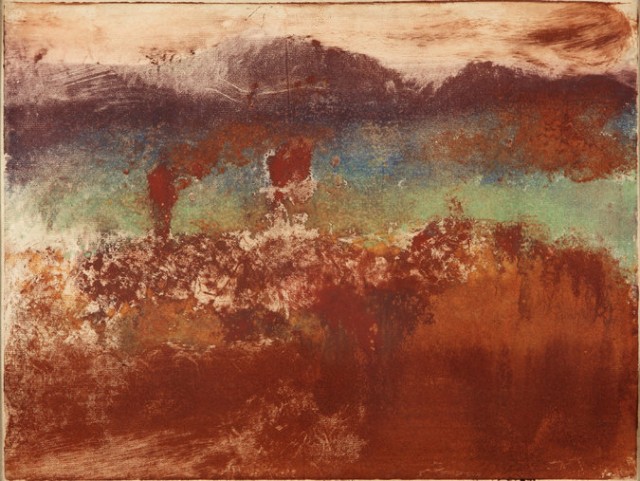
Edgar Degas, “Autumn Landscape,” monotype oil on paper, 1890 (private collection)
Perhaps the biggest surprise is the series of landscapes from the 1890s, stunning monotypes of roads, mountains, and the moonrise that range from figurative to abstract. Of course, it is Degas’s love of performance, particularly of singers and dancers, that stands out. The same trio of dancers is the focus of “Ballet Scene” and “Three Ballet Dancers,” but in the latter Degas has drawn in pastel over the monotype, adding sparkling pinks. The black-and-white “Café Singer” is almost like a negative image of the colorful “Singers on the Stage”; in the pair, one can also see Degas’s passion for light as gas lamps became electric bulbs. Be sure to grab one of the available magnifying glasses to marvel in every little detail. Degas’s obsession with multiple images also found its way into his oil paintings and pastels, as seen in “Frieze of Dancers” and two versions of “Dancer Adjusting Her Slipper.” It’s all a tour de force that delights in this lesser-known aspect of Degas’s oeuvre. “He who is such an anarchist! In art, of course, and without knowing it!” Camille Pissarro wrote in an 1891 letter to his son referenced in Richard Kendall’s catalog essay, “An Anarchist in Art: Degas and the Monotype.” Anarchy may never have looked so good. The exhibition, named after a quote about Degas’s work from poet Stéphane Mallarmé, is supplemented with several of Degas’s sketchbooks in addition to etchings by his friend and fellow artist Ludovic Napoléon Lepic; the show continues through July 24, with the participatory program “Endless Repetition” led by Elisabeth Bardt-Pellerin on July 19 and 21 at 11:30.

 Unpredictable Japanese writer-director Sion Sono defies expectations once again with Love & Peace, a wacky tokusatsu tale that has been gestating for more than two decades but has finally hit the big screen, with all its crazy madness. One of six films Sono (


 “I like mixing fiction and reality,” writer, director, and star Arnaud Viard says in his second film, Paris, Love, Cut, the French title of which is Arnaud fait son 2ème film, or “Arnaud Makes His Second Film.” As the movie opens, Viard, sitting on the toilet, says directly into the camera, “Sometimes, in life, nothing works. You struggle . . . Nothing. Then, one day, it all flows. Just like that. Fluid. Magnificent. As if you were constipated, then suddenly . . . not at all. Last time things flowed was when I made my first film.” A longtime television actor who made his biggest impact as Jean-François in the French series Que du bonheur, Viard released his debut feature, Clara et moi, in 2004, then experienced difficulties raising money for his follow-up. In Paris, Love, Cut, Viard plays a version of himself, a longtime television actor who made his biggest impact as Jean-François in the French series Happy Times and who released his debut feature in 2004, then experienced difficulties raising money for his follow-up. Viard is trying to have a baby with his girlfriend, Chloé (Irène Jacob), but she is having trouble getting pregnant, echoing his inability to give birth to his second film, which he decides will be about a man unable to get an erection. He takes a job teaching an acting class, where he falls for twenty-one-year-old student Gabrielle (Louise Coldefy), whose goal is to become a famous actress. As he meets with his producer (Christophe Rossignon), other directors, his ailing mother (Nadine Alari), a sex coach (Chris Esquerre), a psychoanalyst (Pierre Aussedat), a tax agent (Marie-Christine Laurent), his sisters, and various dates, he has a generally positive take on life; he is soft-spoken and gentle, with a fun sense of humor whether being audited or going to a party thrown by his students, one of whom (Hamza Meziani) gets to the heart of the matter when he delivers a monologue from Alfred de Musset’s Don’t Fool with Love: “All men are liars, false, fickle, hypocritical, cowardly, contemptible, sensual. All women are faithless, deceitful, vain, curious, and depraved. The world is a bottomless sewer where shapeless beasts writhe on mountains of filth. But one thing is holy and sublime, the union of two beings, so imperfect and horrible.”